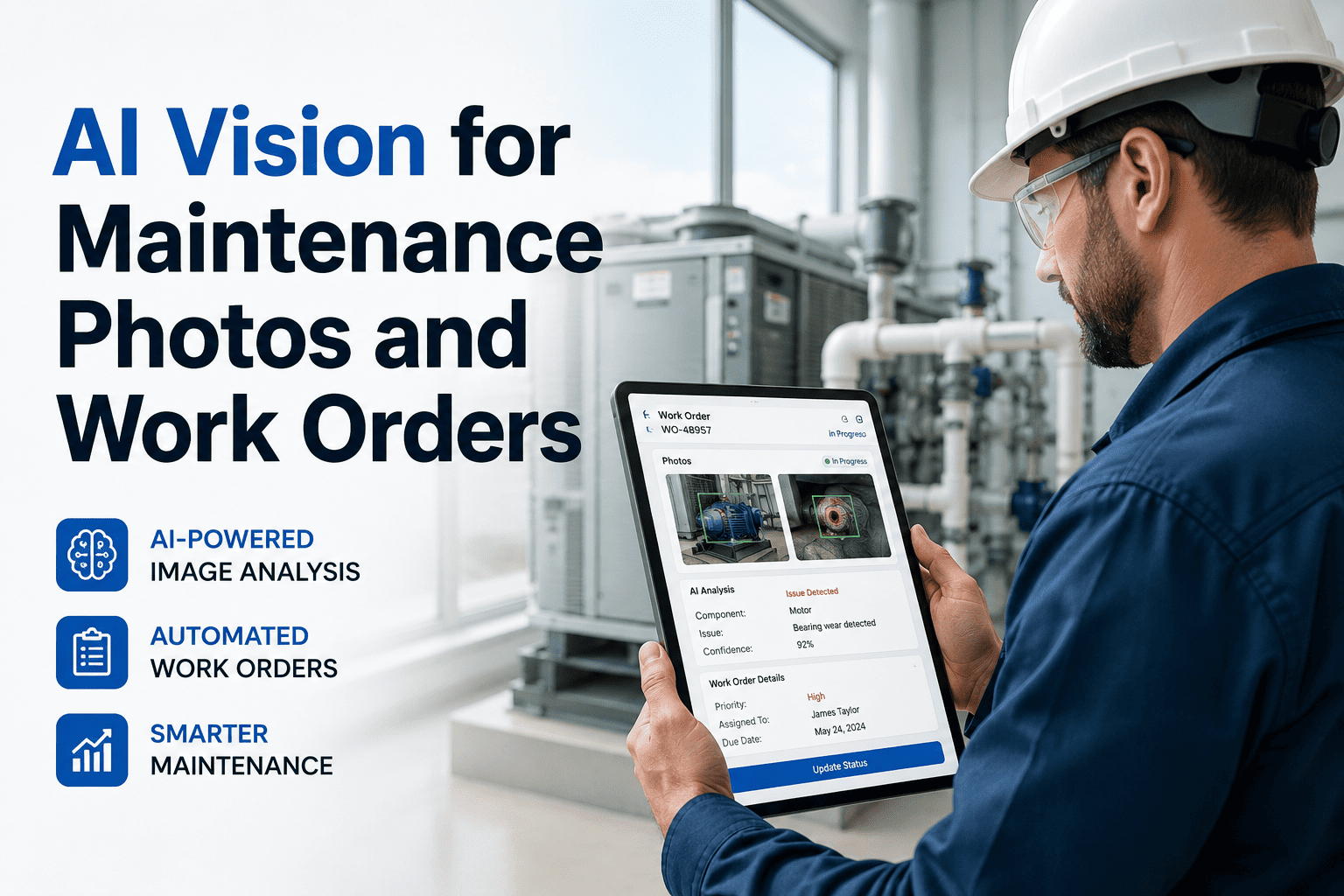
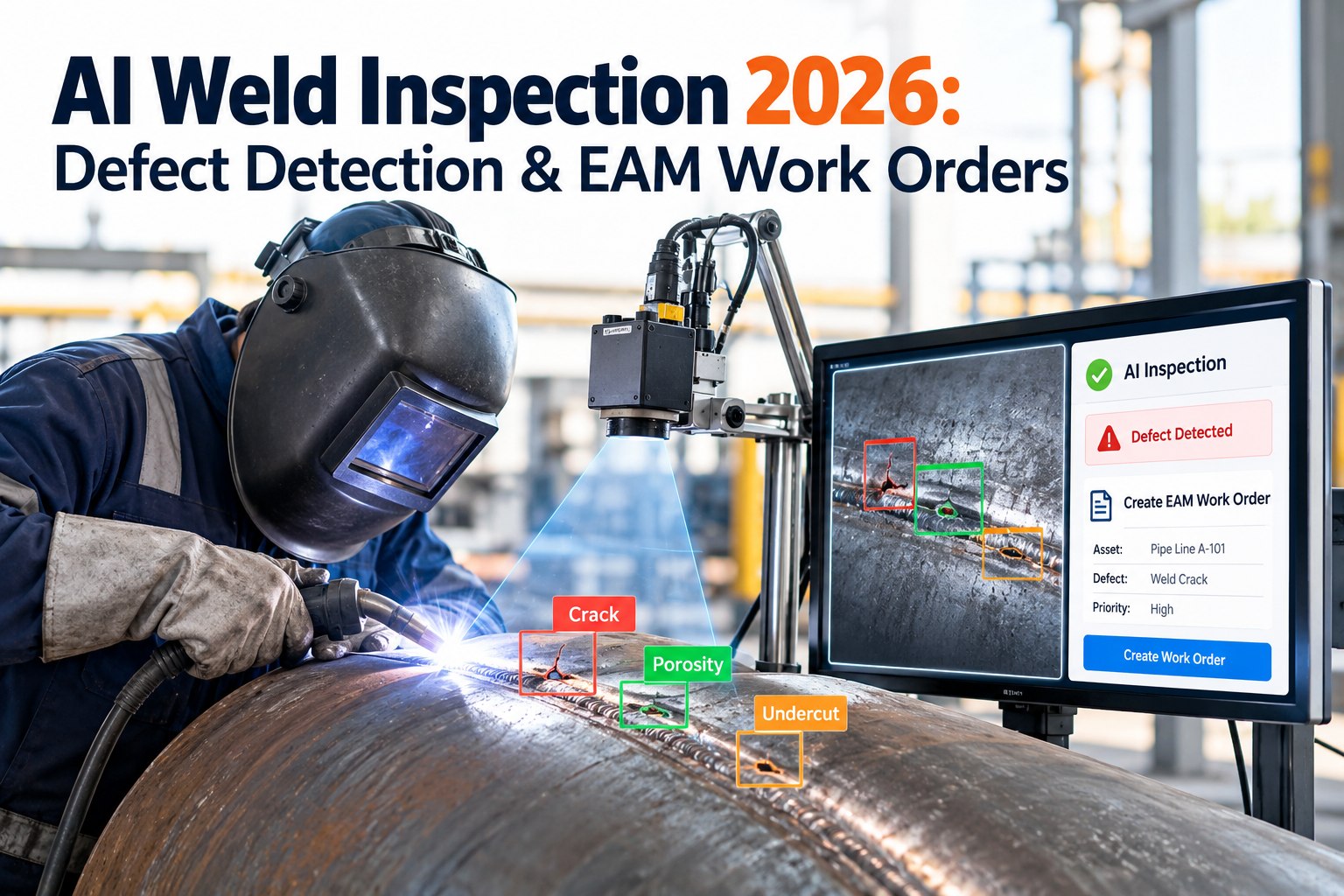
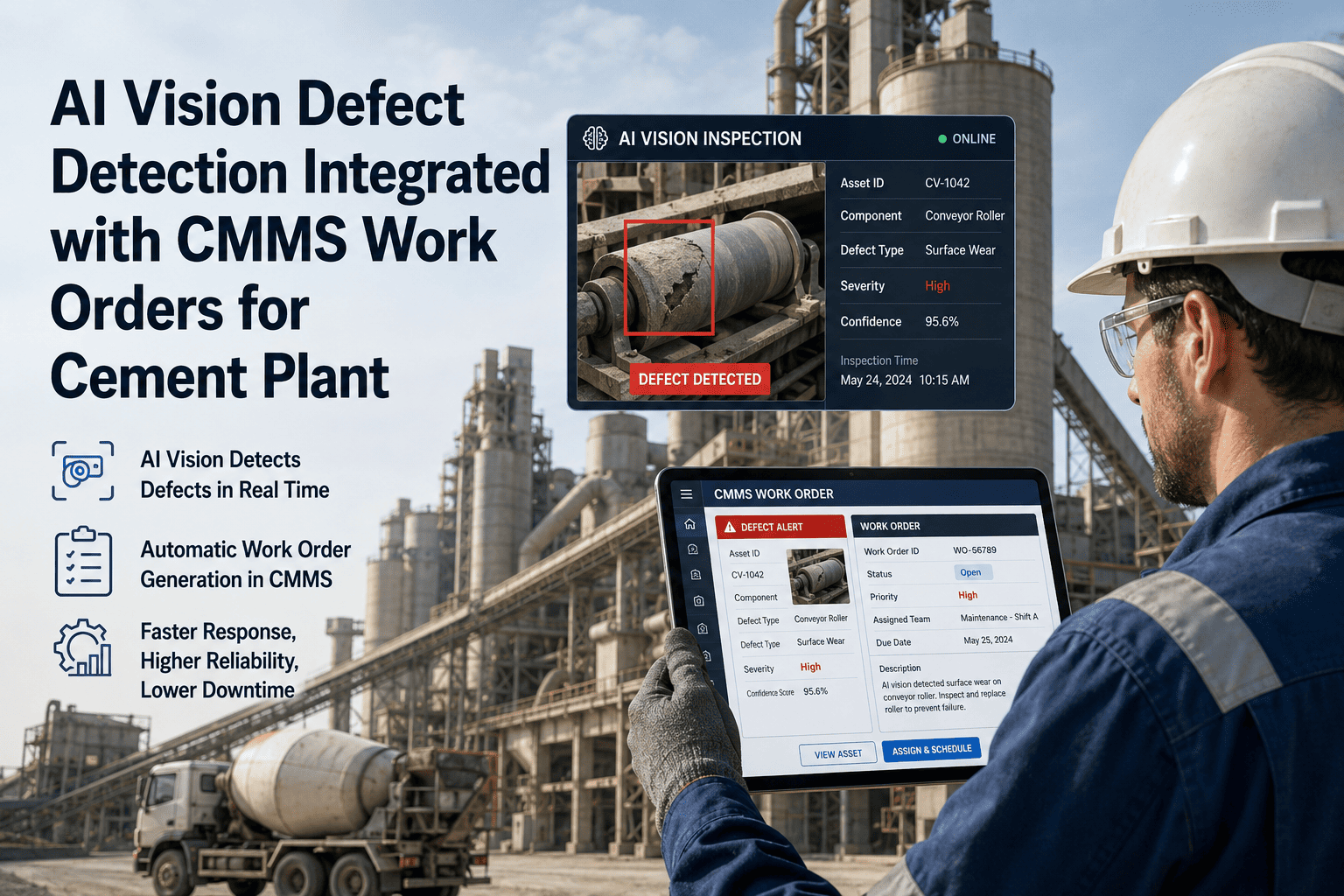
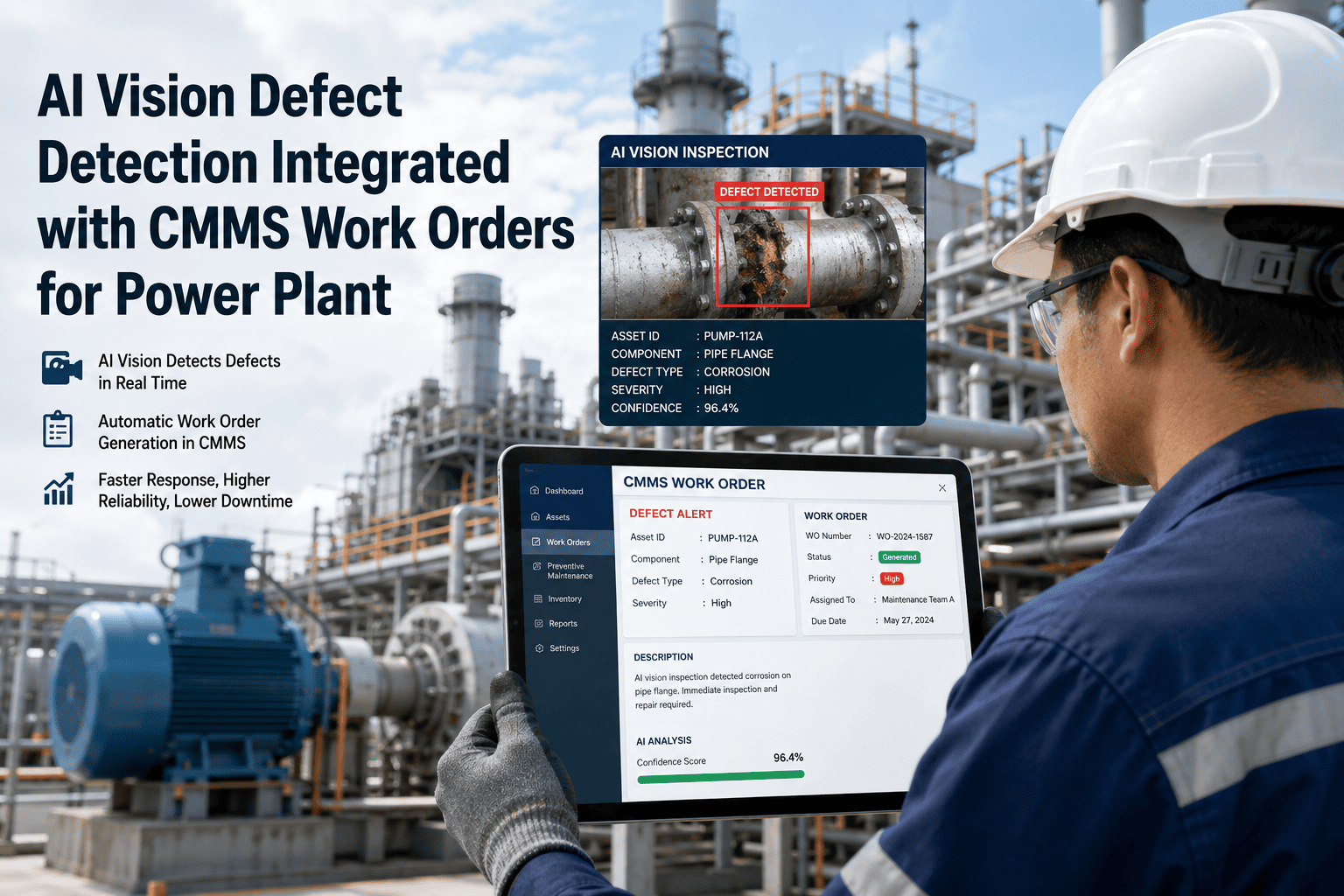
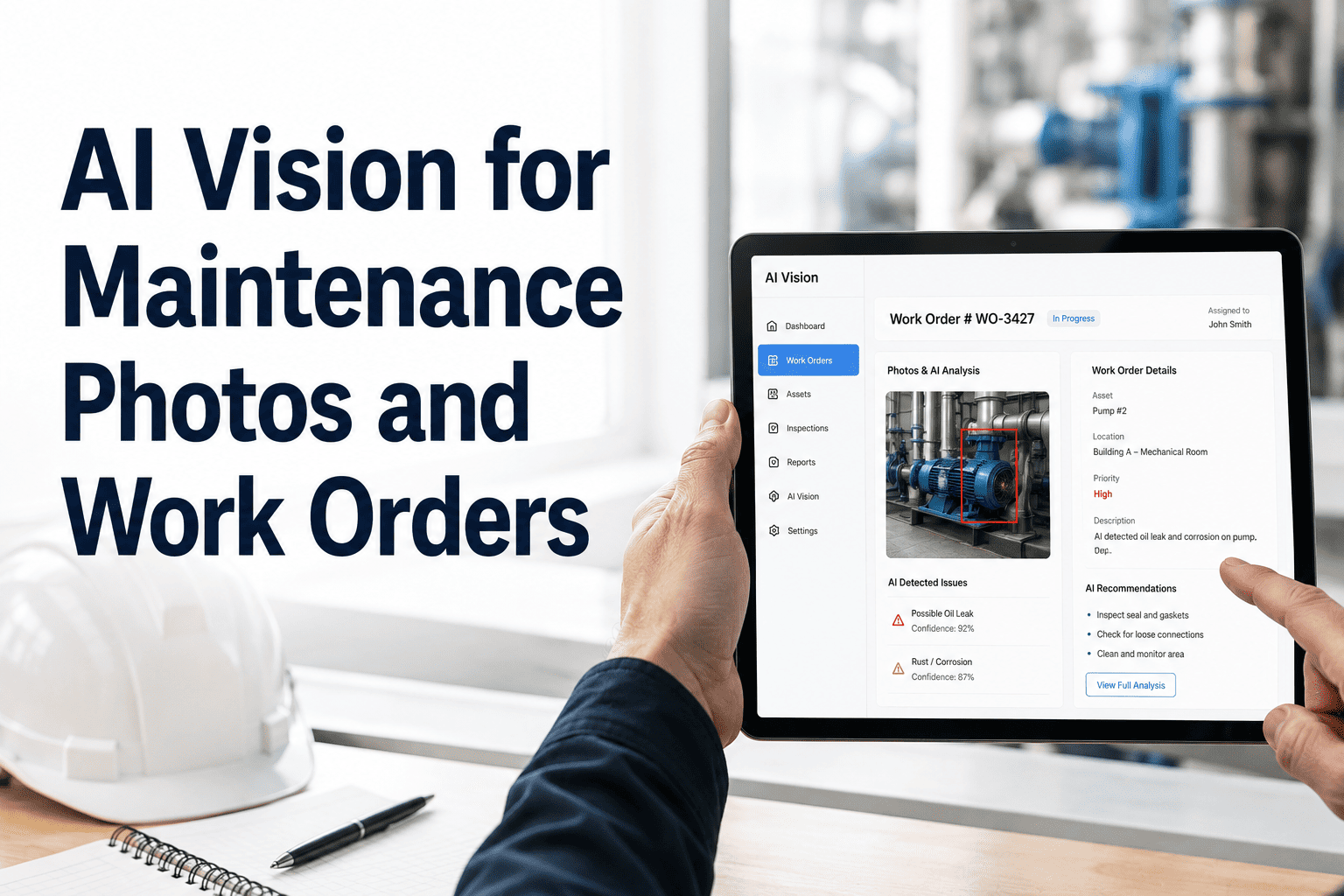
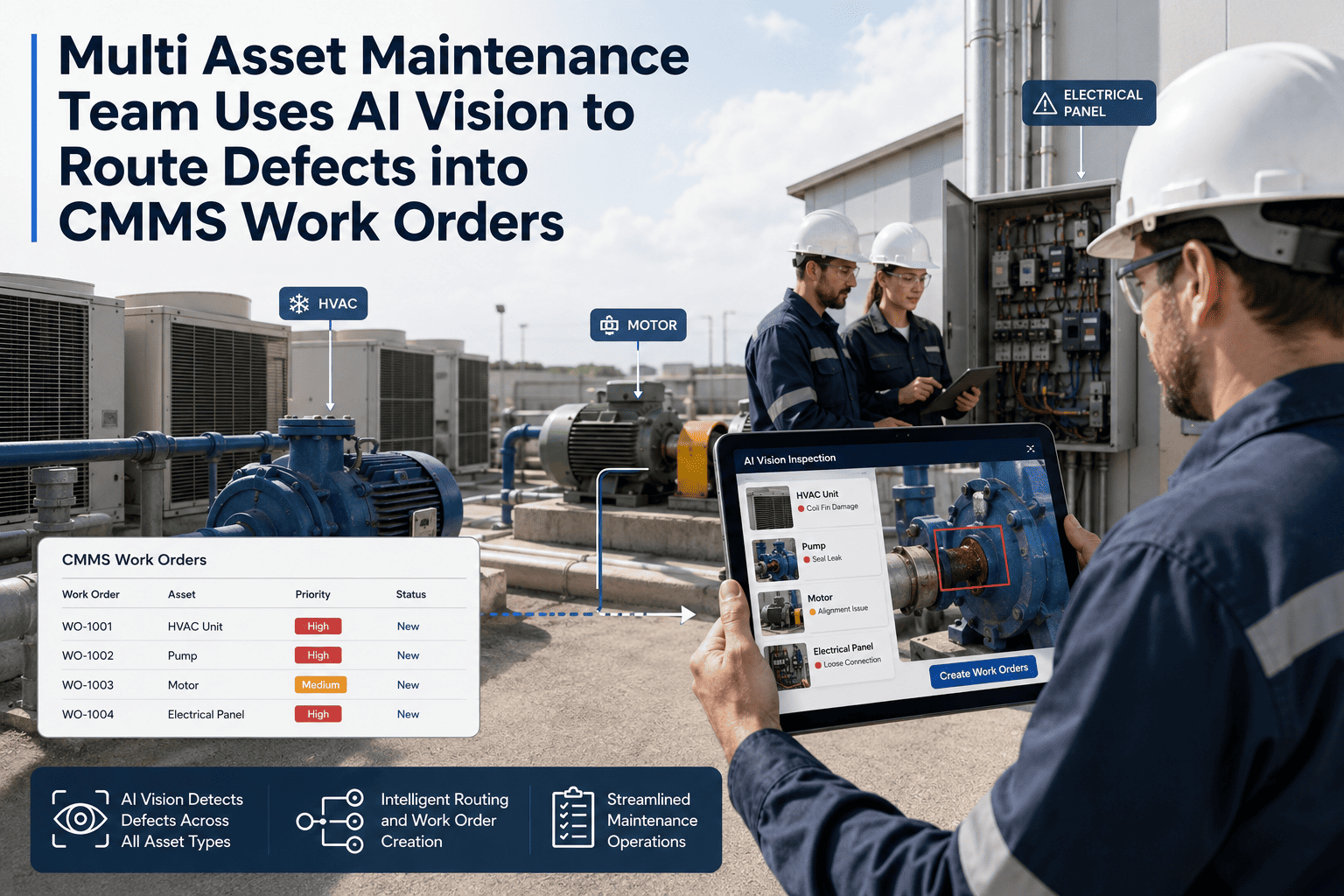
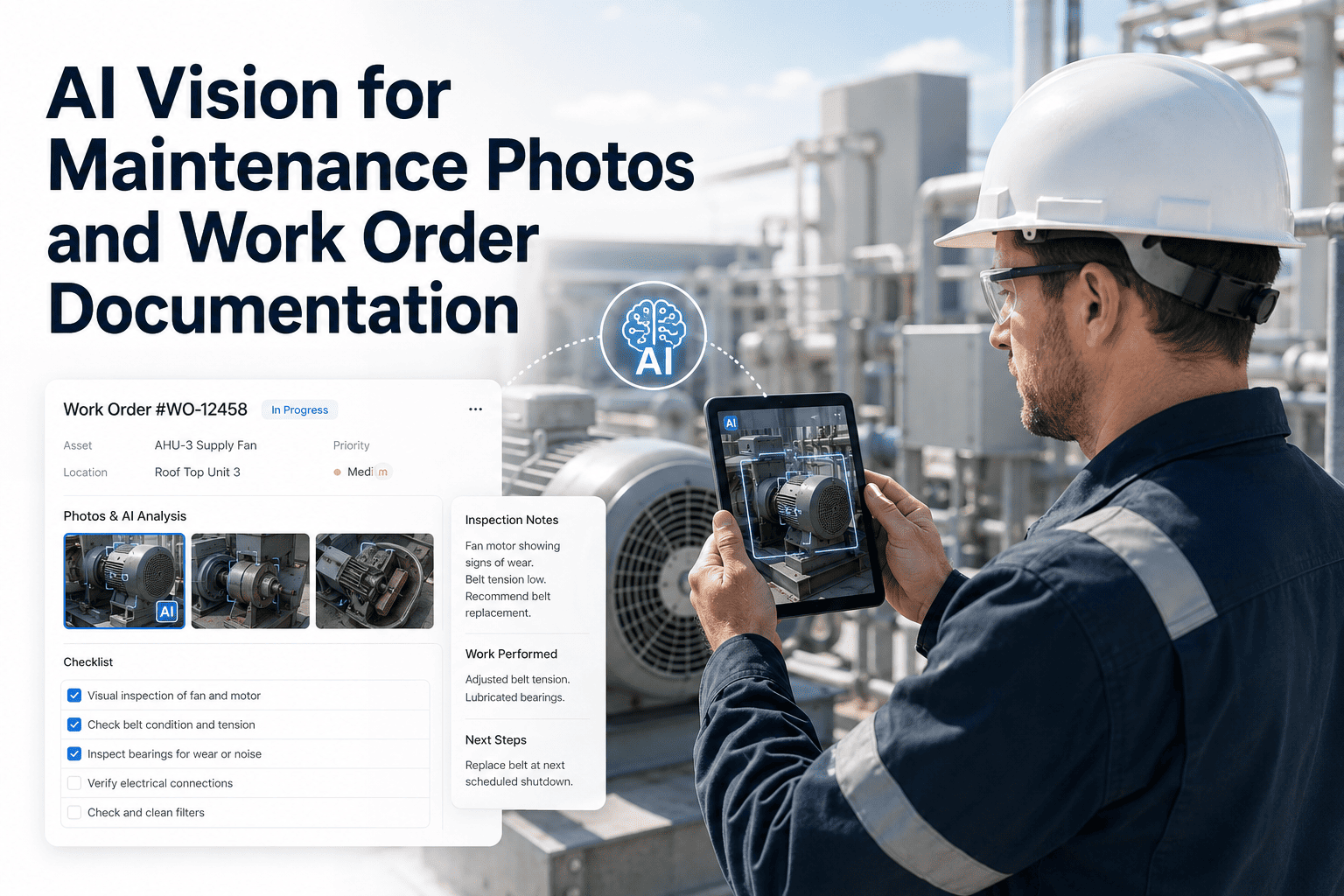
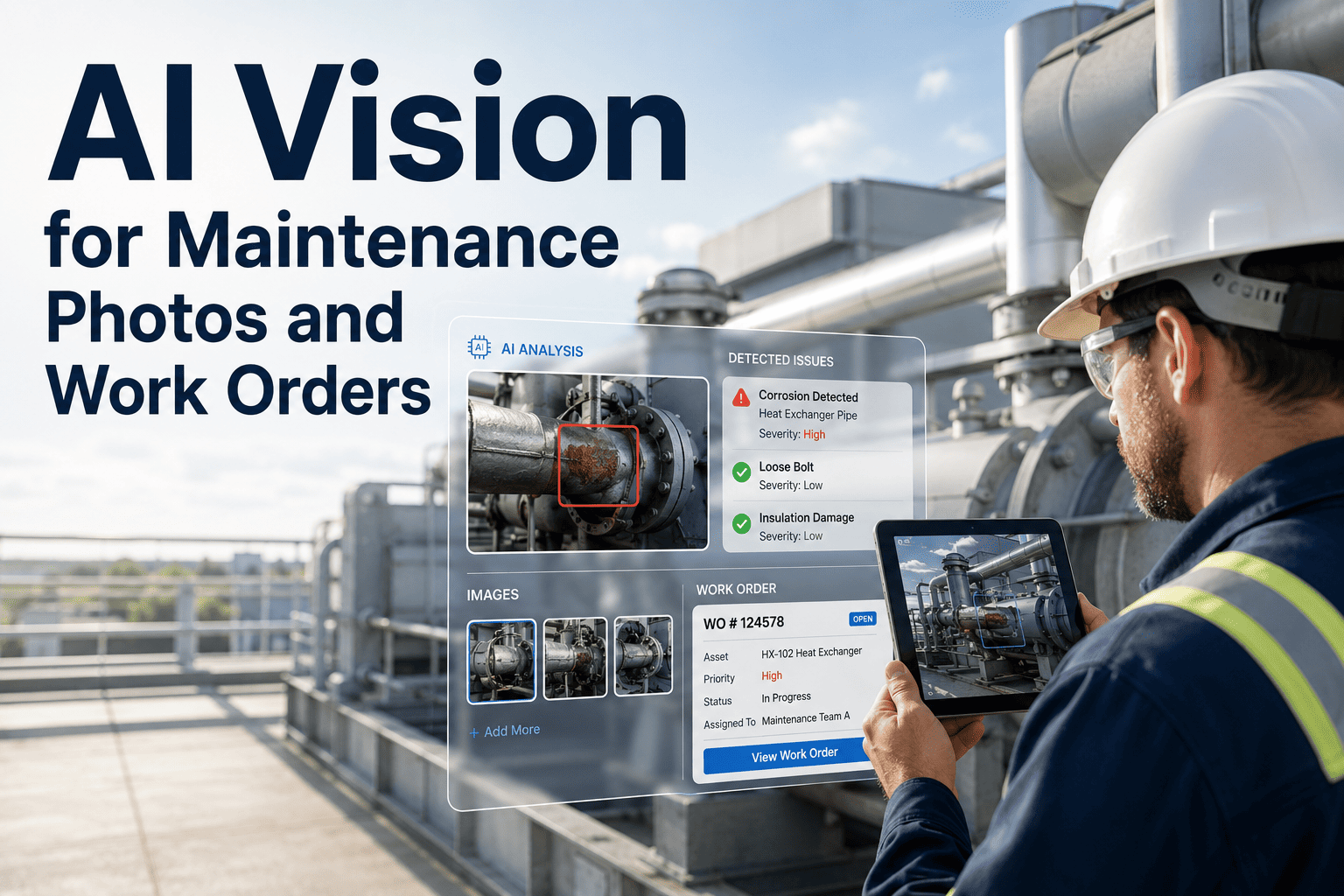
A maintenance technician photographing a corroded pipe flange during a routine round is generating evidence. Without AI vision, that photograph is filed in a work order note field where it sits as an unstructured image — visible but not analysed, attached but not actioned. With AI vision, the same photograph is analysed in under 2 seconds: the corrosion is identified, classified by type and severity, scored on a 1–5 scale, and a prioritised work order is automatically generated with the annotated image, defect classification, asset ID, location, and recommended corrective action — before the technician finishes the round. Gartner 2025 puts defect-detection accuracy above 98%; Manufacturing Technology Insights 2024 documents a 60% reduction in inspection time and 23% reduction in rework; IDC 2025 reports a 75% decrease in unplanned downtime at plants combining predictive AI with automated work order generation. The value is not in the photograph. It is in the structured insight extracted from the photograph in real time. Book a demo to see OxMaint AI Vision Camera in action — or start free today.
AI Guide · AI Vision Camera · Equipment Photos · Work Order Automation
AI Vision for Maintenance: From Equipment Photos to Actionable Work
How OxMaint AI Vision analyses equipment photographs during routine inspections to detect defects, classify severity, and auto-generate prioritised work orders — without any additional hardware beyond the smartphone already in your technician's pocket.
98%
Defect-detection accuracy — AI vision (Gartner 2025)
60%
Reduction in inspection time vs manual visual methods
2 sec
Processing time — photo capture to defect classification
75%
Downtime reduction with predictive AI + automated WO generation (IDC 2025)
Before AI Vision vs After — The Same Inspection, Transformed
Without AI Vision
1
Technician photographs corroded flange during round
2
Photo attached to a handwritten or typed note: "corrosion observed on pipe flange near pump P-07"
3
Note submitted — sits in a backlog of inspection notes with no severity rating, no priority, and no work order
4
Supervisor reviews notes at end of day — manually decides whether to raise a work order and what priority to assign
5
Work order raised next morning — 18–36 hours after defect was observed, with priority based on subjective text description
Average time to WO creation: 18–36 hours after observation
→
With OxMaint AI Vision
1
Technician photographs corroded flange during round — same action, same smartphone
2
AI analyses photo in under 2 seconds: corrosion detected, classified as surface oxidation — moderate, severity score 3/5
3
Annotated image generated — bounding box around affected area with classification, confidence %, and recommended action
4
Work order auto-created: asset ID, location, defect type, severity, annotated image, and corrective action — all pre-populated
5
WO in priority queue before technician leaves the asset — supervisor notified for Severity 4–5 findings immediately
Average time to WO creation: under 2 minutes after observation
Defect Types AI Vision Detects from Equipment Photographs
Corrosion and oxidation
Surface rust, electrolytic corrosion, galvanic attack, and general oxidation on metal surfaces. AI classifies by corrosion type (surface vs pitting vs crevice) and coverage area. Early-stage corrosion is detectable in photographs before it is visible to casual inspection.
Carbon steel pipe flanges · Structural steel connections · Electrical enclosures · Tank exteriors
Cracks and fractures
Hairline cracks in concrete, metal fatigue cracks at welds and joints, stress fractures in structural components. AI vision can detect cracks below 1mm width that human visual inspection reliably misses, particularly in high-contrast surfaces under consistent lighting.
Concrete structures · Weld inspections · Structural steel · Foundation elements
Leak and fluid evidence
Staining patterns, residue trails, and moisture accumulation consistent with active or historical leaks. AI distinguishes between active drip patterns (continuous staining gradient) and historical leaks (dry crystalline deposit), enabling severity and urgency differentiation.
Pipe flanges and fittings · Valve packing · Pump shaft seals · Heat exchanger connections
Surface wear and abrasion
Coating wear-through, surface abrasion, spalling, delamination, and progressive material loss. AI identifies wear patterns that indicate mechanical contact, flow-induced erosion, or cavitation — each suggesting a different root cause and corrective approach.
Conveyor wear surfaces · Impeller inspection · Bearing housing exteriors · Coated surfaces
Missing components and fastener loss
Absent bolts, missing guards, removed covers, and disconnected fittings. AI counts expected fasteners at documented flange connections and flags missing items — catching safety-relevant component loss that is easily overlooked during walk-rounds focused on mechanical condition.
Flange bolt patterns · Safety guards · Access panel fasteners · Junction box covers
Thermal and discolouration anomalies
Heat discolouration on electrical terminals, scorching at connection points, and thermal cycling damage on painted surfaces. When combined with thermal camera imagery, AI vision classification accuracy for electrical hotspot detection reaches 96%+ (Voxel AI 2024).
Electrical panels · Motor terminal boxes · Overloaded conductors · Heat exchanger surfaces
Your Technicians Are Already Taking Photographs. AI Vision Makes Every Photo Actionable.
OxMaint AI Vision Camera works on the smartphone your technicians already carry. Photo taken during a round → defect classified in 2 seconds → severity scored 1–5 → work order auto-created and in the priority queue before the technician moves to the next asset.
Expert Review
"The gap between what maintenance technicians observe during inspections and what gets actioned as work orders is one of the most persistent inefficiencies in facility and industrial maintenance. In every organisation I have worked with, technicians notice more than they report — partly because reporting is effortful, partly because they do not always have a clear severity framework to distinguish 'worth logging' from 'not worth logging,' and partly because the work order system they are supposed to use takes 5 minutes to complete a finding that should take 30 seconds. AI vision changes the effort equation fundamentally. Taking a photograph takes zero additional effort — technicians already photograph equipment with their phones as visual notes. What AI vision adds is the structured classification, severity scoring, and work order creation that converts a photograph from an informal note into a compliant, prioritised maintenance record. The 60% reduction in inspection time documented by Manufacturing Technology Insights is real, but the larger value is in the findings that now get captured that were previously not worth the effort to document manually — the early-stage corrosion that gets caught at Severity 2 rather than Severity 4, the missing fastener that gets a work order rather than a mental note, the discolouration that gets classified as a thermal anomaly rather than filed under 'looked a bit different.'"
Dr. Sandra Osei-Mensah, PhD, CCPE, CFIOSH
Certified Professional Ergonomist · Chartered Fellow, Institution of Occupational Safety and Health · 18 years industrial maintenance and safety inspection programme design · Specialist in AI-powered inspection workflow implementation and defect detection system deployment
Frequently Asked Questions
Does OxMaint AI Vision require a special camera or hardware?
No — OxMaint AI Vision runs on the smartphone camera already in your technician's pocket. Modern smartphone cameras (any flagship device from 2020 onwards) exceed the resolution requirements for industrial defect detection. The AI model runs at the edge — analysis happens in under 2 seconds without uploading to the cloud. No dedicated industrial camera, lighting rig, or inspection tool is required. For facilities that want to extend AI vision to fixed-position monitoring (conveyor lines, outdoor assets, automated inspection stations), OxMaint supports integration with standard IP cameras via the existing camera infrastructure — no replacement required. The only setup required is linking the AI Vision module to your OxMaint account and configuring the defect severity thresholds for work order auto-generation.
Book a demo to see the OxMaint AI Vision Camera setup process.
How does the AI decide what severity to assign to a detected defect?
OxMaint AI Vision uses a 1–5 severity scale calibrated to visual indicators of defect progression: Severity 1 (monitor — no immediate action); Severity 2 (plan repair — schedule in next maintenance cycle); Severity 3 (moderate — address within 30 days); Severity 4 (high — address within 7 days); Severity 5 (critical — immediate escalation). Each severity level is determined by the AI model's assessment of defect area coverage, depth indicators, pattern characteristics, and proximity to failure-critical zones. For corrosion, for example, surface staining scores 1–2; pitting with measurable depth scores 3–4; through-wall corrosion or structural engagement scores 5. Severity thresholds for work order auto-generation are configurable per asset type in OxMaint — facilities may set different auto-generation thresholds for critical vs non-critical asset classes.
Can AI vision replace manual visual inspection entirely?
AI vision augments and accelerates manual visual inspection — it does not replace the physical presence of a trained technician. The AI model analyses what is visible in a photograph, which means it requires the technician to direct the camera at the relevant surfaces. Defects obscured by insulation, internal component faults, and subsurface degradation remain outside photographic analysis without additional sensor inputs (thermal camera, ultrasound). What AI vision replaces is the manual classification, severity assessment, and work order creation that occurs after the photograph is taken — eliminating the human effort and delay between observation and action. The technician still walks the round, still directs the inspection, and still applies contextual judgement. The AI removes the reporting friction that causes findings to be underreported and the processing lag that causes urgent defects to wait 18–36 hours for a work order.
Start free to configure OxMaint AI Vision for your inspection rounds.
How does OxMaint AI Vision handle low-quality or poorly-lit photographs?
OxMaint AI Vision includes image quality validation at capture — if the image is too blurry, too dark, or has insufficient resolution for reliable analysis, the technician is prompted to retake the photograph before the AI attempts classification. This prevents low-quality images from generating incorrect severity scores or missed defect findings. For routine maintenance environments (indoor plant, warehouses, utilities rooms), standard smartphone camera performance is sufficient. For challenging lighting environments — bright outdoor glare, dark confined spaces, or reflective surfaces — OxMaint recommends enabling HDR mode on the device camera and using a supplemental torch for confined space inspections. The AI model's 98% detection accuracy (Gartner 2025) is measured under controlled conditions; facilities should calibrate against their specific asset types and lighting conditions during the onboarding period.
AI VISION CAMERA · WORK ORDER AUTOMATION · OXMAINT
A Photo Taken. A Defect Classified. A Work Order Created. In 2 Seconds.
OxMaint AI Vision Camera turns routine inspection photographs into structured defect records, severity scores, annotated images, and prioritised work orders — automatically, in real time, using the smartphone your technicians already carry. 98% detection accuracy. 60% inspection time reduction. Every finding actioned before the technician moves to the next asset.