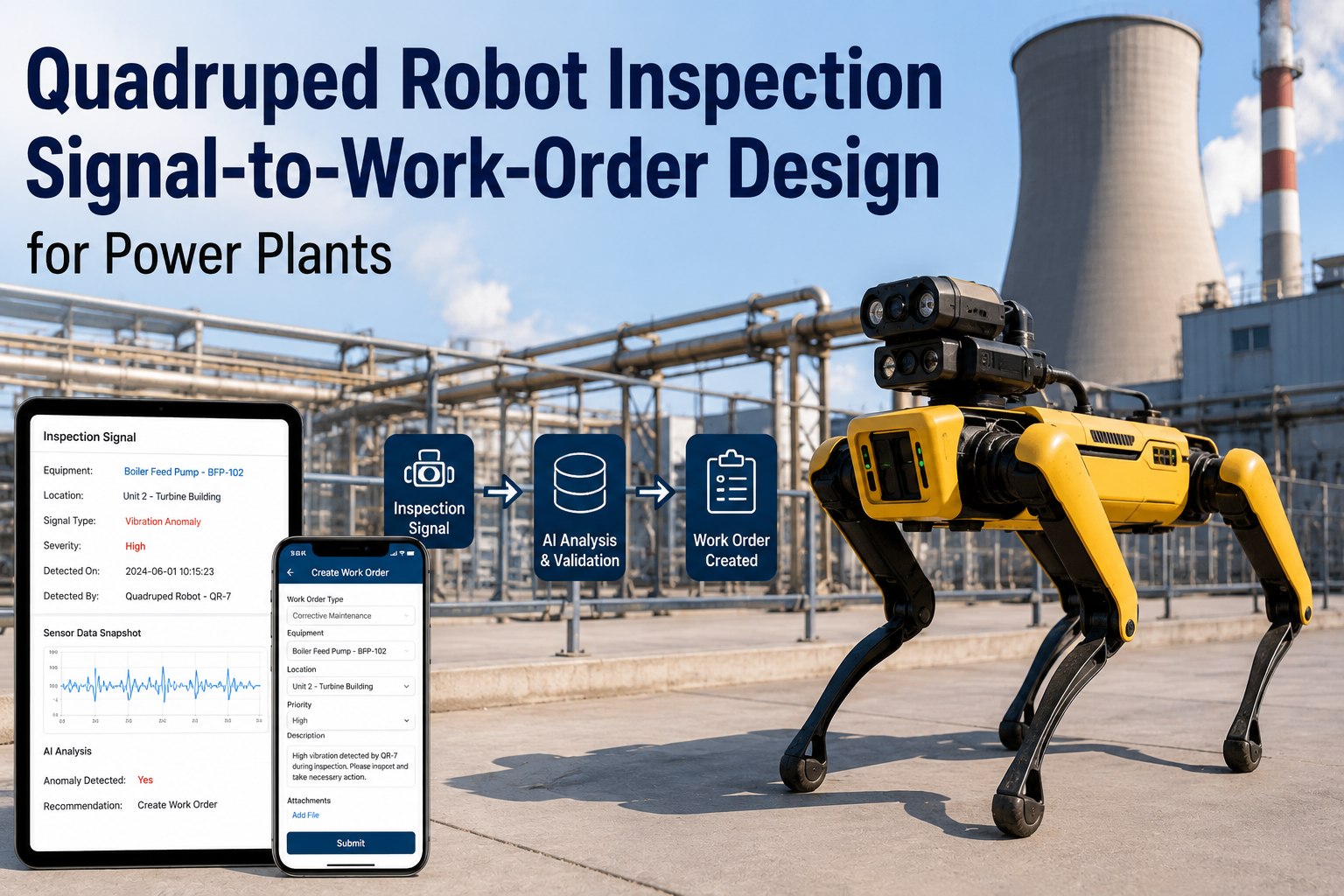
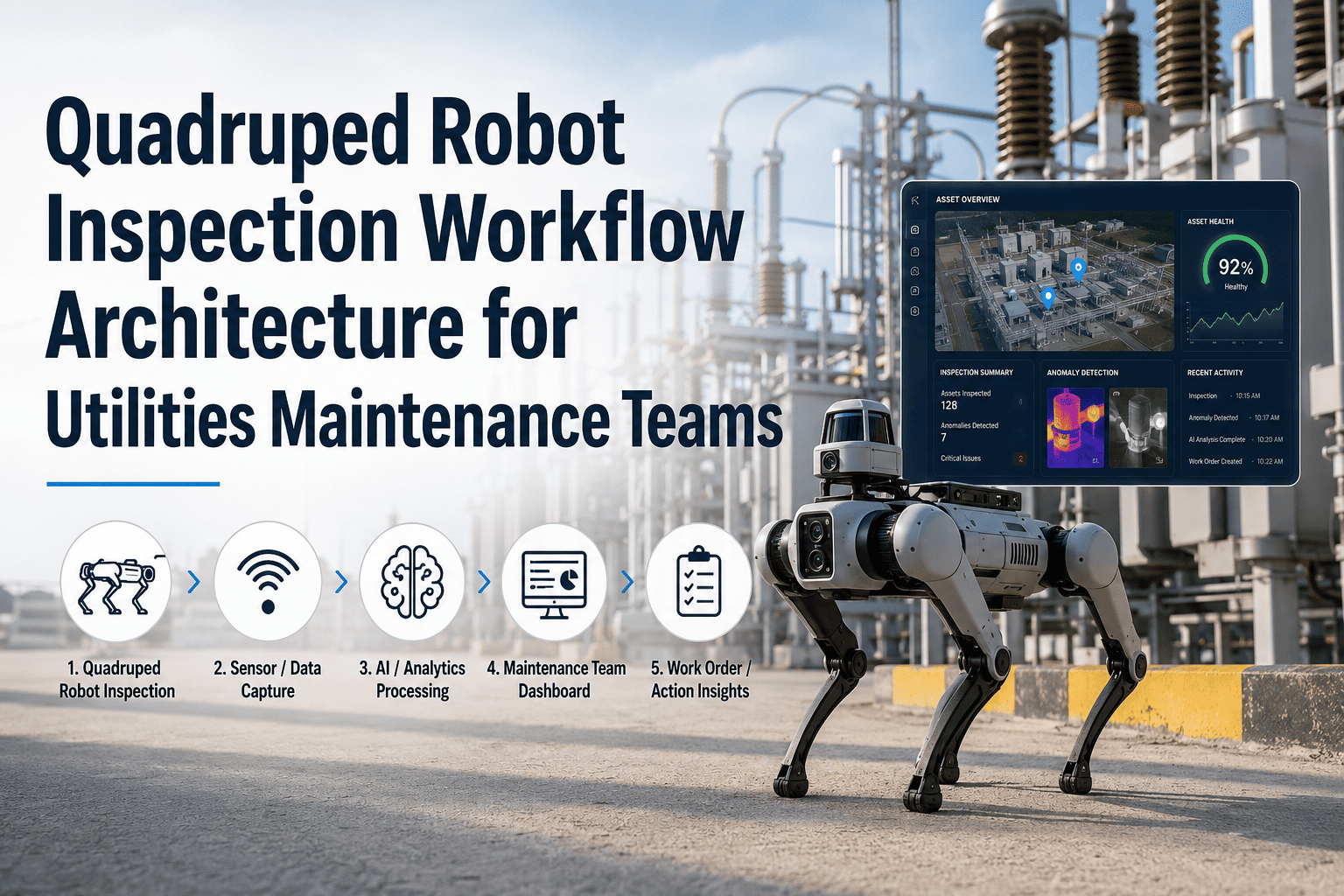
Power plants cannot stop — and neither can their inspection routines. Quadruped robots are now deployed across turbine halls, boiler decks, and transmission substations to conduct autonomous inspections in environments too hazardous or continuous for human walkthroughs. But robot-generated inspection data is only useful when it triggers the right maintenance response. OxMaint's CMMS converts quadruped robot inspection signals directly into prioritized work orders, with AI-validated visual evidence, technician routing, and real-time asset health dashboards — turning autonomous inspection into autonomous action for power generation and transmission operations.
QUADRUPED ROBOT INSPECTION · POWER PLANT MAINTENANCE · CMMS AUTOMATION
Robot inspections generate data. OxMaint generates work orders — automatically.
Quadruped robots cover ground human inspectors cannot. The bottleneck is never the robot — it is the gap between robot-detected anomalies and the maintenance team that needs to act on them. OxMaint closes that gap in under 10 minutes.
SIGNAL-TO-WORK-ORDER DESIGN
How the inspection signal becomes a closed work order
DETECT
Robot identifies anomaly
Quadruped robot captures thermal, acoustic, and visual data. Onboard AI flags deviations — oil leaks, bearing temperature rise, loose terminal connections, structural cracks.
VALIDATE
OxMaint AI confirms signal
Incoming robot data is cross-referenced against OxMaint's asset history. False positives are filtered. Confirmed anomalies are ranked by severity using asset criticality scoring.
ASSIGN
Work order auto-generated
A work order is created with robot-captured evidence attached, asset location mapped, and the right technician or contractor assigned based on skill qualification profiles.
CLOSE
Technician proof captured
Field technicians complete the work order on mobile — confirming the finding, logging repair actions, and uploading post-repair photo evidence. Audit trail complete.
BY THE NUMBERS
Why power plants are adopting robot-to-CMMS inspection pipelines
72%
of power plant inspection findings are missed between scheduled human walkdowns (EPRI, 2022)
4×
faster anomaly-to-work-order time with automated robot signal routing vs. manual inspection review
$4.8M
average cost of a single unplanned forced outage in a combined-cycle plant (EIA estimate)
91%
of robot-detected anomalies left unresolved within 48 hours without automated work order integration
INSPECTION ZONES COVERED
Where quadruped robots and OxMaint work together in power plants
| Inspection Zone |
Robot Detection Capability |
OxMaint Work Order Type |
Typical Criticality |
| Turbine Hall |
Vibration anomaly, oil mist, bearing temperature |
Predictive maintenance WO, urgent routing |
Critical |
| Boiler Deck |
Flue gas leak, surface temperature exceedance, tube crack detection |
Safety inspection WO, shutdown recommendation |
High |
| Electrical Substation |
Loose terminal, hotspot thermal imaging, corona discharge detection |
Electrical PM WO, EHS notification |
High |
| Cooling Tower |
Fill degradation, fan vibration, basin sediment |
Scheduled maintenance WO |
Medium |
| Fuel Storage Area |
Leak detection, pressure vessel visual inspection |
Safety WO, regulatory notification |
Critical |
| Cable Corridors |
Insulation damage, heat signature, rodent intrusion |
Corrective maintenance WO |
Medium |
EVIDENCE CHAIN
From robot frame to compliance record — the OxMaint proof chain
1
Robot captures annotated frame
Thermal or visual image with AI-drawn bounding box and confidence score — stored against asset ID and GPS/zone coordinates.
2
OxMaint attaches evidence to WO
Robot-captured frames are embedded in the work order — accessible to the assigned technician on mobile at point of repair.
3
Technician adds post-repair proof
After repair, technician uploads before/after photos and logs resolution notes. OxMaint timestamps and attributes every upload.
4
Full audit trail exported
The complete signal-to-closure chain — robot frame, WO creation timestamp, technician actions, resolution — is exportable for CERC, CEA, or ISO audits.
EXPERT REVIEW
What power plant reliability engineers say
Deploying quadruped robots without a connected CMMS is like installing smoke detectors without wiring them to an alarm panel. The detection capability is there — but the response system is missing. OxMaint provides that response layer for power generation operations.
Arvind Varma
Senior Reliability Engineer, Thermal Power Sector, India
The regulatory landscape for power plant inspections is moving toward mandatory digital evidence trails. Robot-to-CMMS integration with documented proof chains positions plants for compliance with emerging CEA and IEC inspection documentation standards.
Pradeep Sundaram
Power Plant O&M Consultant, Southeast Asia
CONNECT YOUR ROBOTS TO ACTION
Your robots are already inspecting. OxMaint makes every finding actionable.
Power generation teams running Boston Dynamics Spot, ANYbotics ANYmal, and custom quadruped platforms have configured OxMaint signal intake in under 2 weeks. No inspection data goes unactioned. No anomaly sits in a report folder.
COMMON QUESTIONS
Quadruped robot inspection integration — what power plant teams ask
Which quadruped robot platforms does OxMaint integrate with?
OxMaint accepts inspection data from any robot platform that outputs structured JSON or REST API payloads — including Boston Dynamics Spot, ANYbotics ANYmal, and Unitree platforms. Custom robot data adapters are configured during onboarding.
Book a demo to confirm compatibility with your specific robot platform and see a live demo of signal intake configuration. Integration is typically completed within 5–10 business days for standard platforms.
How does OxMaint handle false positives from robot sensors in high-interference environments like turbine halls?
OxMaint applies a secondary AI validation layer that cross-references incoming robot signals against the asset's baseline historian data and past work order history. Signals that do not meet confidence thresholds are queued for human review rather than auto-escalated.
Start a free trial to configure confidence thresholds for each asset zone. Teams typically fine-tune false positive rates down to under 6% within the first 30 days of calibration on site-specific data.
Can OxMaint support multiple robot inspection routes with different asset priorities?
Yes. OxMaint allows maintenance managers to define zone-based criticality profiles that map directly to robot patrol routes. Critical zone signals — turbine hall, fuel storage — generate immediate work orders with P1 priority. Non-critical zone findings queue as scheduled maintenance items.
Book a demo to see zone-based priority routing configured for a power plant layout similar to your site. The configuration takes under 2 hours to set up.
Is the robot inspection evidence chain sufficient for CERC or ISO 55001 audit requirements?
OxMaint's evidence chain includes the original robot-captured frame with timestamp and asset location, the AI confidence score at detection, the work order creation record, technician completion log with photo uploads, and a digital signature at closure. This full chain is exportable as a PDF or structured data file. The format meets documentation requirements referenced in ISO 55001 asset management evidence standards and aligns with CERC inspection record guidelines for power generation facilities.
READY TO BUILD THE PIPELINE
Connect robot inspection to real maintenance action — starting today.
Power plants running quadruped inspections with OxMaint integration have documented 35–60% reductions in missed anomaly-to-action time. Every robot finding becomes a verified work order. Every work order becomes a compliance record. Every record makes the next audit effortless.