Reliability-Centered Maintenance (RCM) for air compressors in manufacturing is the practice of matching each compressor failure mode to the cheapest effective maintenance task — and it routinely cuts unplanned compressed-air downtime 30–50% while trimming energy waste that can reach 30% of a plant's electricity bill. Compressed air is often called the "fourth utility," yet it remains one of the most neglected assets on the factory floor: a single failed 100-hp rotary screw compressor can idle an entire production line at $10,000–$50,000 per hour of lost output. This guide breaks down the dominant air compressor failure modes in manufacturing, the monitoring techniques that catch them earliest, and a proven RCM maintenance strategy you can deploy this quarter. If you want to move from reactive firefighting to a controlled, data-driven compressor reliability program, Start Free Trial with OxMaint and put these workflows into practice on every asset, technician, and shift.
RCM Strategy for Manufacturing Air Compressors
What if your next compressor failure announced itself 3 weeks early?
Plants running RCM-based air compressor maintenance detect bearing wear, oil degradation, and valve leakage weeks before breakdown — converting $25,000 emergency repairs into $2,000 planned interventions. Here is the framework, the failure-mode map, and the PM schedule that makes it repeatable.
Failure Modes
The 6 air compressor failure modes behind 85% of manufacturing downtime
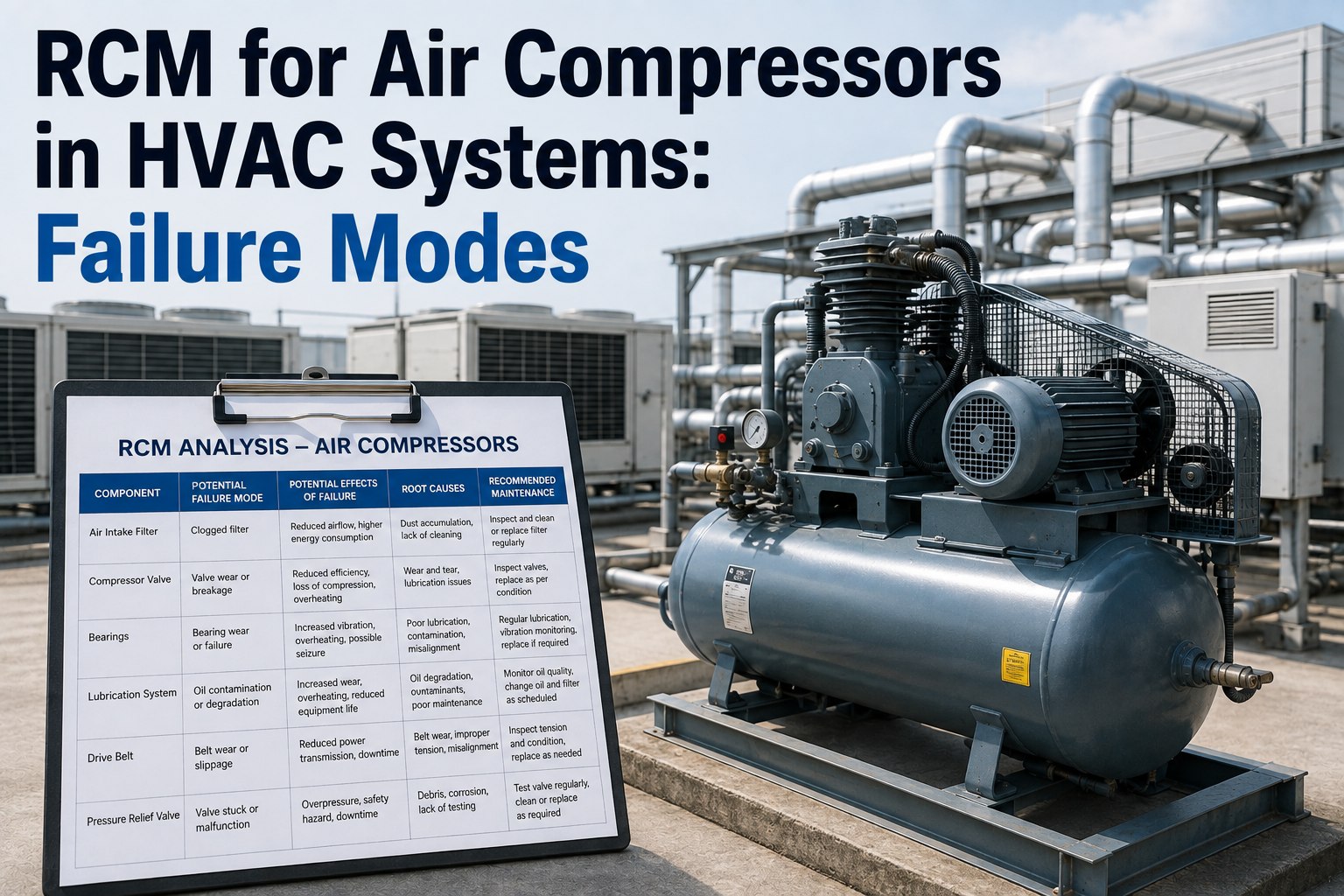
An RCM approach starts with a Failure Modes and Effects Analysis (FMEA): for each compressor function, you list how it fails, what causes it, and what the consequence is. Across thousands of manufacturing air compressors, six failure modes account for the overwhelming majority of unplanned stops — and each one demands a different maintenance tactic.
Bearing wear & shaft misalignment
The #1 mechanical killer of rotary screw and reciprocating units. Vibration velocity above 4.5 mm/s RMS (ISO 10816 zone C) signals developing wear; left alone, a $400 bearing becomes a $12,000 airend rebuild. RCM tactic: monthly vibration routes + precision alignment after every coupling service.
Lubricant degradation & contamination
Oxidized or water-contaminated oil accelerates wear 3–5x. Oil analysis every 2,000 run-hours (viscosity, TAN, particle count, water ppm) catches degradation long before a 4,000–8,000 hour change interval would. RCM tactic: condition-based oil changes instead of calendar-based ones.
Air/oil separator & filter fouling
A clogged separator raises differential pressure; every 2 psi of excess dP costs roughly 1% of compressor energy. On a 100-hp unit running 6,000 hrs/yr, that is $600–$900 per year per clogged element. RCM tactic: dP trending with automatic work orders at threshold.
Valve & unloader failures (recips)
Suction/discharge valve leakage shows up as elevated discharge temperature and reduced FAD. Ultrasound and temperature trending flag leaking valves 2–4 weeks before capacity loss forces a shutdown. RCM tactic: quarterly ultrasound + temperature baseline comparison.
Cooling system fouling & overheating
Every 10°F rise above design inlet temperature cuts compressor capacity ~2% and shortens oil life. Dirty aftercoolers and blocked radiators drive thermal shutdowns in summer peaks. RCM tactic: seasonal cooler cleaning + continuous discharge temperature monitoring.
Control & sensor drift
Drifting pressure transducers cause short-cycling and loaded/unloaded hunting — silent energy killers that inflate kWh per cfm by 10–15%. RCM tactic: annual calibration plus analytics that flag abnormal cycle counts automatically.
Decision Logic
How to choose the right RCM maintenance task for each failure mode
Classic RCM decision logic (per SAE JA1011) asks seven questions per asset, then assigns one of four task types. The goal is simple: never do time-based work where condition-based work is cheaper, and never accept run-to-failure where downtime consequence is high. Here is how the logic maps to manufacturing air compressors.
| Failure mode | Consequence if unmanaged | Best RCM task type | Monitoring technique | Typical interval |
|---|---|---|---|---|
| Bearing wear / misalignment | Airend seizure, $12K+ rebuild, days of downtime | Condition-based (predictive) | Vibration analysis (ISO 10816) | Monthly routes |
| Oil degradation | 3–5x accelerated wear, varnish, rotor scoring | Condition-based | Oil analysis (TAN, viscosity, ISO 4406) | Every 2,000 run-hrs |
| Separator/filter fouling | 1% energy loss per 2 psi dP, oil carryover | Condition-based | Differential pressure trending | Continuous / weekly checks |
| Valve leakage (recips) | Capacity loss, overheating, unplanned stop | Condition-based | Ultrasound + discharge temp | Quarterly |
| Cooler fouling | Thermal shutdowns, shortened oil life | Time-based (scheduled) | Visual inspection + temp log | Seasonal (2x/yr) |
| Sensor/control drift | Short-cycling, 10–15% energy waste | Time-based + analytics | Calibration + cycle-count analytics | Annual |
| Non-critical drain valves | Minor condensate carryover | Run-to-failure (accepted) | Operator rounds | On failure |
Rule of thumb: if a failure mode gives a detectable warning (P-F interval) of 2+ weeks, condition-based monitoring almost always wins on cost. Reserve run-to-failure for cheap, non-critical components — never for airends, motors, or controls feeding a production-critical line.
PM Schedule
A copy-ready air compressor PM schedule for manufacturing plants
Below is a tiered preventive maintenance schedule that blends OEM requirements with RCM condition triggers. Plants that digitize this schedule in a CMMS report 95%+ PM compliance versus 60–70% on paper systems — and PM compliance is the single strongest predictor of compressor reliability.
- Log discharge pressure, temperature, and loaded hours
- Check oil level and look for leaks or unusual noise
- Drain condensate from receiver and filters
- Verify dryer dew point is within spec
- Vibration readings on motor and airend bearings
- Record separator and filter differential pressures
- Inspect belts, couplings, and guard condition
- Test safety valves and high-temp shutdown
- Oil sample for full lab analysis (TAN, water, metals)
- Ultrasound scan of valves, traps, and air leaks
- Thermographic scan of electrical panel and motor
- Replace intake filter if dP exceeds threshold
- Full oil and separator change (or per oil analysis)
- Motor insulation test and alignment verification
- Calibrate pressure transducers and controls
- Compressed-air leak audit across the distribution network
See It On Your Assets
Book a 30-minute demo — we will map this RCM schedule onto your compressor fleet
Bring your asset list. We will show you live PM automation, condition alerts, and downtime analytics configured for manufacturing air compressors.
Worked Example
What RCM is worth: a 12-compressor plant's first-year numbers
Consider a mid-size automotive components plant running 12 rotary screw compressors (two 150-hp primaries, ten smaller units) with a history of 9 unplanned compressor events per year. Here is the before-and-after of switching from calendar PMs to an RCM program managed in a CMMS.
"The vibration route flagged a bearing defect on our primary 150-hp unit 19 days before it would have seized. That one catch paid for the entire year of the program — the repair happened on a planned weekend instead of mid-production."
Maintenance & Reliability Manager, automotive components plant — 5/5 program rating
How OxMaint Helps
How OxMaint operationalizes your air compressor RCM strategy
RCM fails in spreadsheets because condition triggers, run-hour intervals, and failure history live in different places. OxMaint's AI-powered CMMS + EAM platform puts the whole loop — detect, dispatch, fix, learn — in one system built for maintenance and reliability teams.
Condition-triggered work orders
Connect vibration, dP, and temperature readings to automatic thresholds. When a reading crosses your RCM limit, OxMaint generates and assigns the work order instantly — no clipboard, no delay. Plants cut response time from days to hours and catch 70%+ of failures in the early P-F window.
Meter- and calendar-based PM automation
Schedule compressor PMs by run-hours, calendar, or both — OxMaint tracks loaded hours and fires the 2,000-hr oil analysis or 8,000-hr major service exactly when due. Teams routinely lift PM compliance from ~65% on paper to 95%+ within two quarters.
Asset hierarchy & failure history
Model every compressor down to airend, motor, separator, and dryer. Every work order attaches failure codes, so your FMEA stays live — you can see which failure modes are actually consuming budget and refine task intervals with real data, not guesses.
Spare parts & downtime analytics
Critical spares (bearings, separators, valves) are linked to assets with min/max levels, so a planned repair never stalls waiting on a part. Dashboards quantify MTBF, MTTR, and downtime cost per compressor — the exact numbers you need to justify RCM to plant leadership.
Rollout Plan
A 90-day RCM rollout for manufacturing air compressors
You do not need a year-long consulting engagement to start. Most plants can stand up a working RCM program on their compressor room in one quarter — here is the sequence that works.
Days 1–30: Baseline and criticality
Build the asset register, rank compressors by production criticality, and pull 12 months of failure history. Establish baselines: vibration signatures, discharge temps, dP values, and kWh per cfm. Digitize your existing PMs into the CMMS so nothing is lost in the transition.
Days 31–60: FMEA and task selection
Run the failure-mode workshop with your senior technicians — they know where the bodies are buried. Map each mode to a task type using the RCM decision logic, set condition thresholds, and load the new PM schedule with meter-based triggers.
Days 61–90: Monitor, measure, refine
Start monthly vibration routes and the first oil-analysis cycle. Track PM compliance, alert-to-work-order response time, and any early catches. Review the first month's data as a team and tighten thresholds — RCM is a living program, and month three is where the compounding starts.
FAQ
Air compressor RCM in manufacturing: common questions
What is RCM for air compressors in manufacturing?
Reliability-Centered Maintenance is a structured method (standardized in SAE JA1011) that analyzes each compressor's functions and failure modes, then assigns the most cost-effective task — condition-based, time-based, or run-to-failure — to each one. For manufacturing air compressors, it typically shifts 60–70% of maintenance effort from calendar tasks to condition monitoring, cutting both cost and unplanned downtime.
What are the most common air compressor failure modes in manufacturing?
Six modes cause roughly 85% of unplanned downtime: bearing wear and misalignment, lubricant degradation, separator/filter fouling, valve leakage (reciprocating units), cooling-system fouling, and control/sensor drift. Each has a distinct early-warning signature — vibration, oil chemistry, differential pressure, temperature, or cycle-count anomalies — which is exactly what makes them manageable under RCM.
Which condition-monitoring techniques work best for air compressors?
Vibration analysis is the highest-value technique — it catches bearing and misalignment faults weeks in advance and follows ISO 10816 severity zones. Pair it with oil analysis every 2,000 run-hours, quarterly ultrasound for valve leaks and air-system leaks, and continuous differential-pressure and temperature trending. A CMMS like OxMaint turns these readings into automatic work orders — Book a Demo to see the threshold-trigger workflow live.
How often should a manufacturing air compressor be serviced?
Daily operator checks, monthly vibration and dP readings, oil analysis every 2,000 run-hours, and a major service at 8,000 hours or annually is a defensible baseline. Under RCM, fixed intervals are replaced by condition triggers wherever a reliable early-warning signal exists — so a well-monitored compressor may safely run past calendar intervals, while a degrading one gets serviced early.
What is the ROI of an RCM program for air compressors?
Documented programs typically deliver 30–50% reductions in unplanned downtime, 25–30% lower maintenance costs, and 8–15% compressed-air energy savings, with payback in 4–9 months. The biggest single driver is converting emergency repairs (which cost roughly 8x planned work) into scheduled interventions. You can model your own fleet's numbers during a Start Free Trial using OxMaint's downtime analytics.
From Firefighting to Reliability
Put your air compressor RCM program on autopilot with OxMaint
Asset hierarchies, condition-triggered work orders, meter-based PMs, spare-parts control, and downtime analytics — everything in this guide, running in one AI-powered CMMS. See it configured for your compressor room.
Free 14-day trial · No credit card · Set up your first compressor PM schedule in under an hour