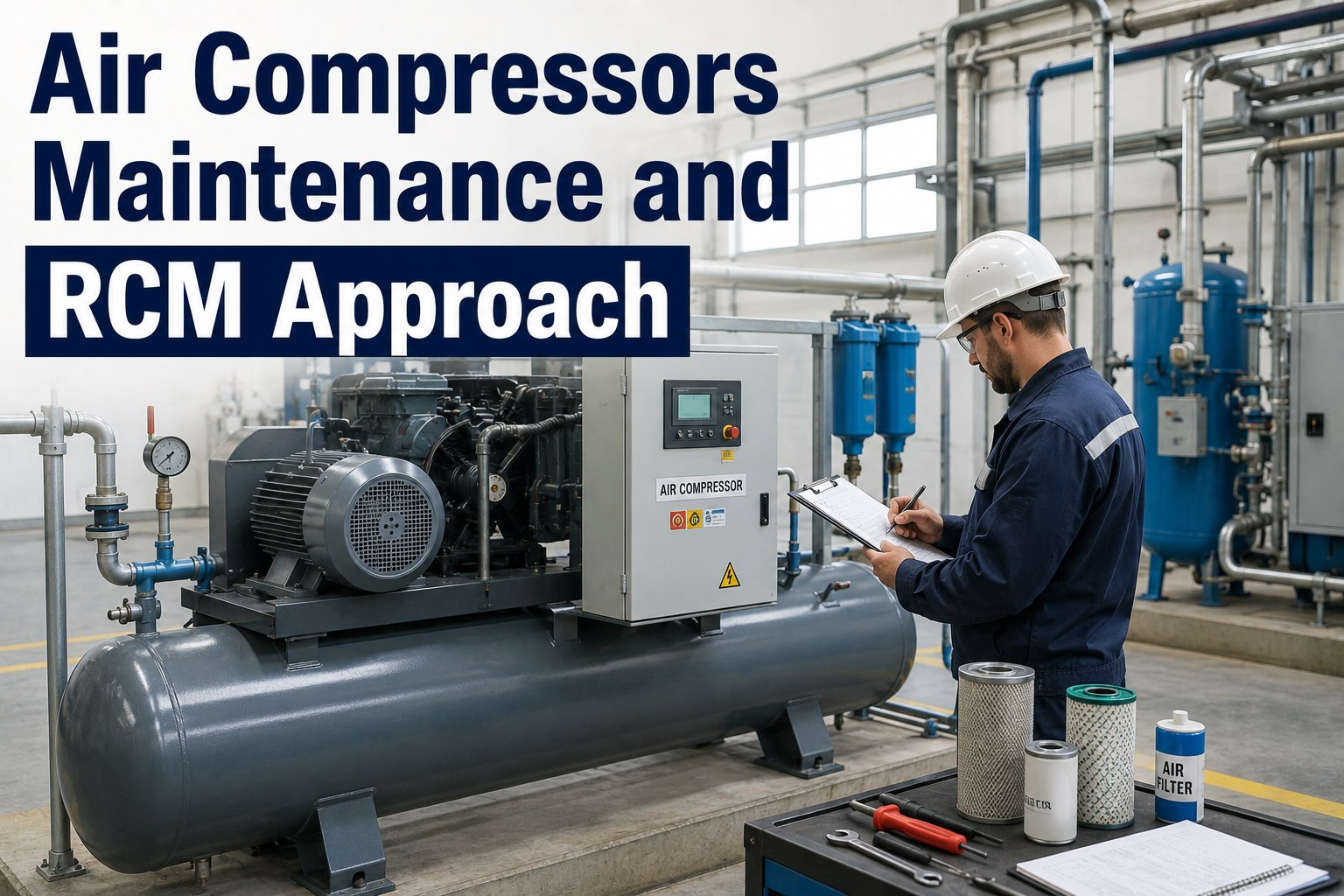
Reliability-Centered Maintenance (RCM) for air compressors in data centers is the systematic process of identifying specific failure modes—such as valve wear, intercooler fouling, and lubrication degradation—and applying targeted condition monitoring and preventive strategies to prevent catastrophic downtime. Data center facility teams rely heavily on compressed air for cooling system actuation, backup pneumatic controls, and equipment cleaning, making compressor availability critical to uptime SLAs. A well-executed RCM strategy shifts maintenance from reactive firefighting to predictive precision, ensuring continuous operations while controlling maintenance spend. To implement this framework across your facility assets without the burden of manual spreadsheets, you can Start Free Trial of OxMaint and automate your preventive maintenance workflows today.
What does a single failed air compressor cost your data center?
In a high-density data hall, pneumatic valve failure from lost compressed air can cascade into thermal shutdowns in under 10 minutes. Applying RCM to air compressors eliminates 40–60% of unplanned downtime events and protects your uptime SLAs.
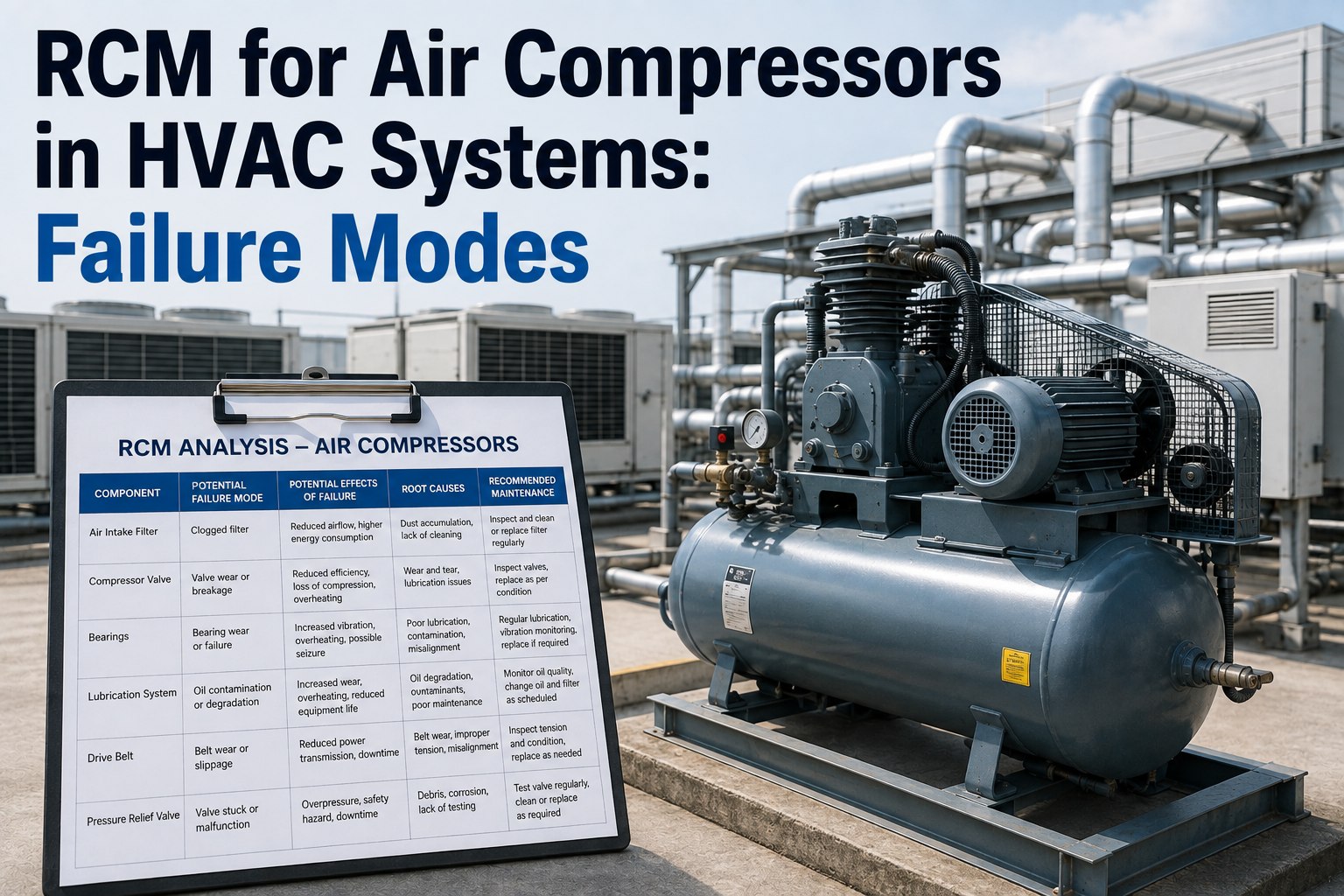
Common Air Compressors Failure Modes in Data Centers
Data centers operate rotary screw and centrifugal compressors continuously at high loads, making them vulnerable to seven primary failure modes that account for over 80% of unplanned breakdowns.
Reciprocating compressors experience valve fatigue from continuous cyclic loading. Symptoms include reduced discharge pressure and increased cycle frequency. Without vibration trend analysis, valve failure typically triggers sudden pressure loss within 72 hours of initial symptom onset.
Heat exchangers accumulate mineral scale and biological fouling in humid data center environments. A 2mm scale layer reduces heat transfer by 30%, driving discharge temperatures above 105°C and accelerating oil degradation by up to 4x.
Synthetic lubricants break down via oxidation and particulate contamination. At sustained operating temps above 90°C, oil life drops from 8,000 hours to under 2,500 hours. Degrading oil loses viscosity, causing rapid bearing wear and rotor contact in screw compressors.
Separator elements capture oil from the compressed air stream. As particulate load increases, differential pressure rises. Operating above the 1.0 bar drop threshold wastes 8–12% in energy consumption and risks element rupture, injecting oil into downstream pneumatic cooling valves.
Rotor and motor bearings fail due to misalignment, improper lubrication, and current passage. Bearing defects propagate from inner race spalling to catastrophic seizure in 15–30 million revolutions. High-frequency ultrasonic monitoring detects early-stage defects 3–6 months before failure.
Failed automatic condensate drains flood the air receiver and distribution lines, washing lubricant from downstream pneumatics and causing rust in pneumatic actuator cylinders. This leads to stuck cooling dampers and bypass valve failures during peak thermal loads.
Air Compressors Monitoring Best Practices for Data Centers
Effective condition monitoring for air compressors in data centers combines IoT sensor data with threshold-based alerting to detect degradation weeks before functional failure occurs.
| Monitoring Technique | Failure Mode Detected | Frequency | P-F Interval | Estimated Cost Avoidance / Yr |
|---|---|---|---|---|
| Vibration Analysis (Accelerometer) | Bearing wear, rotor imbalance | Continuous / 30-day trend | 3–6 months | $18,000–$32,000 |
| Oil Degradation Analysis | Lubricant breakdown, contamination | Quarterly lab sample | 2–4 months | $12,000–$24,000 |
| Thermography (IR Camera) | Intercooler fouling, motor overheating | Monthly scan | 4–8 weeks | $8,000–$15,000 |
| Differential Pressure Tracking | Separator clogging, filter blockage | Continuous via SCADA/CMMS | 2–4 weeks | $5,000–$9,000 |
| Ultrasonic Acoustic Monitoring | Valve leakage, early bearing friction | Weekly spot check / continuous | 1–3 months | $10,000–$20,000 |
The P-F interval represents the time between detecting a potential failure (P) and it becoming a functional failure (F). A robust RCM strategy ensures maintenance interventions occur well within this window.
Air Compressors PM Schedule & RCM Checklist for Data Centers
Building a preventive maintenance schedule for data center air compressors requires aligning OEM recommendations with actual operating loads. Use this RCM checklist to standardize inspections across all facility shifts.
Stop reacting to compressor failures. Start preventing them.
See how OxMaint automates your RCM checklists, tracks condition-monitoring data, and predicts air compressor failures before they disrupt your data center SLAs.
How OxMaint Enables Air Compressors Reliability in Data Centers
OxMaint's AI-powered CMMS transforms theoretical RCM frameworks into daily operational reality, eliminating spreadsheet tracking and ensuring every inspection, sensor alert, and work order is executed and audited.
Map every RCM checklist item to automated PM triggers based on runtime hours, calendar dates, or condition thresholds. OxMaint generates and routes work orders without manual intervention.
Ingest vibration, temperature, and pressure data directly into asset records. OxMaint's AI models analyze trends and auto-generate predictive work orders when P-F intervals are breached.
Eliminate paper checklists. Technicians receive mobile work orders with RCM procedures, safety lockout/tagout (LOTO) steps, and historical asset data directly on the floor.
Track MTBF, MTTR, OEE, and PM compliance in real-time dashboards. Tie maintenance outcomes directly to data center uptime SLAs and regulatory compliance metrics.
A 50MW colocation data center operating 12 rotary screw air compressors was experiencing 3–4 unexpected compressor shutdowns per quarter, risking pneumatic cooling valve actuation failures. By implementing OxMaint to automate RCM-driven PM schedules and integrating ultrasonic bearing monitoring, the facility team flagged early-stage bearing degradation on Compressor #7. The bearing was replaced during a planned off-peak window, avoiding an estimated $85,000 in potential downtime costs and emergency repair premiums. The facility achieved zero unplanned compressor outages over the following 12 months.
Data Centers Air Compressors Failure Prevention & RCM FAQs
RCM (Reliability-Centered Maintenance) for air compressors in data centers is a structured methodology to identify critical failure modes—like bearing wear, intercooler fouling, and separator clogging—and apply the right maintenance strategy (predictive, preventive, or run-to-failure) based on risk and operational impact. Implementing this via a CMMS like OxMaint ensures every inspection and sensor alert translates into an automated, auditable work order. Start Free Trial to map your compressor RCM strategy today.
Data center air compressors require daily visual inspections for pressure, temperature, and leaks, monthly differential pressure and thermal checks, and quarterly vibration or oil analysis. Continuous condition monitoring via IoT sensors is recommended for critical assets feeding pneumatic cooling systems to catch degradation within the P-F interval.
The most common failure modes include valve plate wear, intercooler fouling, lubricant degradation, air/oil separator clogging, bearing failure, and condensate control malfunction. These account for over 80% of unplanned compressor downtime and are best detected early using vibration analysis, oil sampling, and differential pressure tracking.
A CMMS like OxMaint improves reliability by automating PM schedules, centralizing asset history, and integrating condition-monitoring data to trigger predictive work orders. This eliminates manual spreadsheet tracking, ensures 100% PM compliance, and reduces mean time to repair (MTTR) by providing technicians with exact procedures and historical context on mobile devices.
Unplanned air compressor downtime in a data center can cost upwards of $9,000 per minute if it leads to pneumatic cooling failure and thermal server shutdown. For a mid-sized facility, implementing an RCM strategy supported by a CMMS typically saves $50,000–$120,000 annually by preventing catastrophic failures and reducing emergency repair costs. Book a Demo to calculate your specific ROI.
Implement RCM for your air compressors with OxMaint
Join data center facility teams using OxMaint to automate preventive maintenance, predict compressor failures, and guarantee uptime SLAs across all critical infrastructure.
Free 14-day trial · No credit card