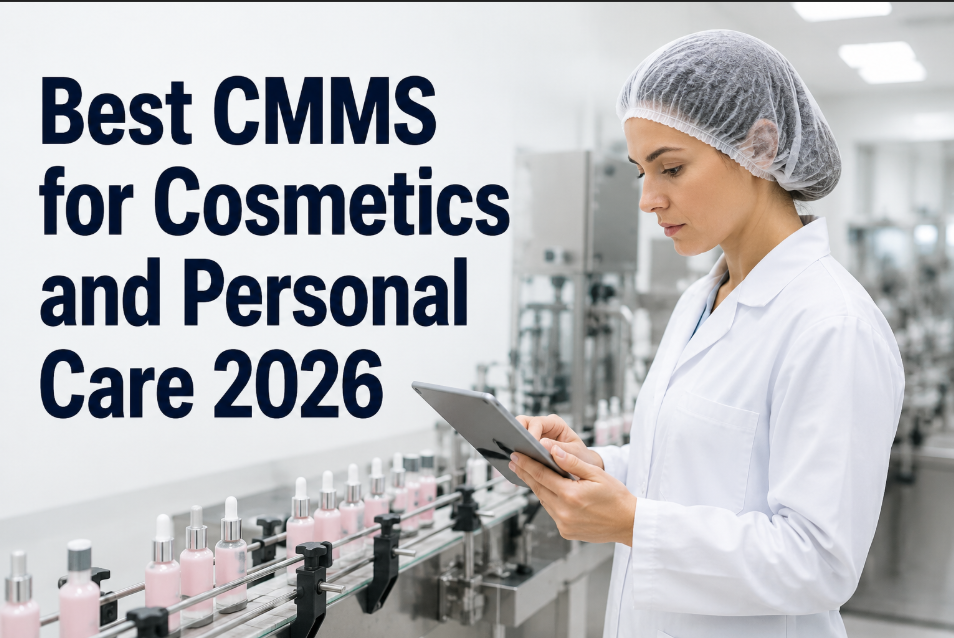
Cosmetics and personal care manufacturing sits at a unique intersection of consumer expectation, regulatory scrutiny, and production complexity. A single batch contamination event in a personal care facility can trigger an FDA 483 observation, a voluntary recall affecting millions of units, and reputational damage that takes years to rebuild. Yet 58% of cosmetics manufacturers still manage batch cleaning validation, filling line maintenance, and packaging equipment PMs through a combination of paper logs, spreadsheets, and tribal knowledge held by senior technicians approaching retirement. The production environment in a cosmetics plant is demanding in ways that generic CMMS platforms are not designed for: CIP cycles that must be documented per batch, filling heads that require sanitization after every product changeover, emulsification kettles with agitator seal inspections tied to viscosity product requirements, and hot-fill lines where temperature uniformity maintenance is directly linked to product stability. Regulatory compliance in this environment is not a documentation exercise — it is a batch-by-batch operational discipline that a CMMS must support automatically. Platforms like Oxmaint provide cosmetics manufacturing configurations with GMP-aligned PM templates, FDA 21 CFR Part 211 compliance documentation, batch-linked work orders, and filling line maintenance scheduling that integrates with production changeover sequences. See how it works for your facility — start a free trial or book a demo with our manufacturing team today.
Best CMMS for Cosmetics and Personal Care Manufacturing 2026
Filling lines, batch reactors, CIP systems, packaging — the CMMS platforms built for FDA-compliant personal care production and the GMP documentation that auditors demand.
Why Cosmetics Manufacturing Demands Specialized CMMS
The FDA regulates cosmetics under 21 CFR Part 111 (dietary supplements) and follows GMP expectations aligned with 21 CFR Part 211 for drug-cosmetic hybrid products — over-the-counter sunscreens, anti-dandruff shampoos, and fluoride toothpastes all face pharmaceutical-grade documentation requirements. Even purely cosmetic products must demonstrate that manufacturing equipment is maintained in a state that prevents contamination, cross-contamination, and product quality deviations. A reactive maintenance culture — where filling head O-rings are replaced when they fail rather than on a documented PM schedule — is not just operationally expensive. It is a compliance vulnerability that exposes the facility to regulatory findings.
Beyond regulatory requirements, cosmetics production complexity makes generic CMMS platforms insufficient. Batch reactors producing 10 different product formulas require product-specific cleaning validation after each changeover. Filling lines running 300–2,400 units per minute accumulate filling head wear at rates determined by product viscosity, not calendar days. Packaging equipment running tubes, jars, pumps, and sachets simultaneously requires component-level maintenance tracking that generic work order systems cannot provide. Oxmaint's cosmetics configuration handles all of these scenarios — explore it with a free trial or book a demo to walk through your production areas.
CMMS Requirements by Cosmetics Production Area
Each production area in a personal care facility has distinct maintenance and compliance requirements. The right CMMS addresses all of them with area-specific templates and GMP-aligned documentation.
Batch kettles running emulsions, creams, and lotions require agitator seal inspections tied to batch count and product viscosity range. Jacket seal integrity, temperature control calibration, and homogenizer maintenance are compliance-critical — a seal failure mid-batch contaminating a 10,000 kg lot carries full product loss and potential recall costs.
Filling lines running 300–2,400 units per minute accumulate O-ring wear, nozzle tip erosion, and piston seal degradation at rates tied to fill volume processed — not calendar days. Hot-fill systems require temperature probe calibration before every production run. A single out-of-tolerance fill temperature on a hot-fill shampoo line creates a product stability failure invisible until consumer complaint.
CIP systems cleaning batch vessels, transfer lines, and filling equipment must document cycle parameters — temperature, concentration, contact time, flow rate — per batch and per product family. A failed CIP cycle that passes product carryover from a fragranced lotion into an unscented baby product is an immediate stop-and-hold event. CMMS must link CIP maintenance records to batch production records automatically.
Cosmetics packaging lines run 15–30 product changeovers per week. Each changeover requires tooling swaps, format adjustments, and cleaning verification before production restart. Tube sealing jaw temperature calibration, capper chuck torque verification, and labeler registration accuracy are PMs that prevent consumer-visible defects — improper seals, under-torqued caps, and misaligned labels that generate returns and social media complaints.
The 8 CMMS Capabilities Every Cosmetics Manufacturer Needs
Pre-built PM procedures aligned to FDA 21 CFR Part 211 and 111 GMP requirements — with mandatory fields for technician ID, date, equipment status, and deviation notation.
Work orders linked to production batch records — CIP validation, filling head maintenance, and cleaning logs traceable to specific batches for regulatory traceability.
CIP cycle parameters captured per run — temperature, concentration, contact time, flow rate — with automated deviation alerts and digital sign-off by QA and maintenance.
O-ring, nozzle, and piston seal PMs triggered by fill volume throughput — not calendar days. Viscosity-range classification adjusts PM frequency for thick vs thin formulas automatically.
Digital changeover checklists for each product-to-product transition — tooling change verification, cleaning confirmation, and pre-start calibration checks captured with timestamp and technician signature.
Temperature probes, weight scales, torque testers, and pH meters tracked with calibration due dates, certificate storage, and out-of-tolerance escalation before next production use.
All maintenance records digitally signed by completing technician and reviewing supervisor — tamper-proof, timestamped, and audit-exportable without manual document assembly.
FDA audit preparation reduced from weeks to hours — maintenance records exportable by equipment, date range, product line, and compliance category with all signatures and attachments included.
Paper Logs vs Oxmaint: The FDA Audit Reality
This is what an FDA inspector sees when they audit a paper-based cosmetics manufacturer versus one using Oxmaint's GMP-aligned CMMS.
What Personal Care Manufacturers Achieve With Oxmaint
Frequently Asked Questions
Does Oxmaint support both OTC drug-cosmetic hybrids and purely cosmetic products?
How does Oxmaint handle the cleaning validation documentation requirement between products?
Can Oxmaint track calibration for temperature-sensitive filling equipment?
How does Oxmaint handle multi-product facilities with fragrance allergen cross-contamination risk?
FDA Audits Should Not Require 4 Weeks of Document Hunting.
Every CIP cycle, filling head PM, calibration record, and changeover verification your team performs is compliance evidence — but only if it is captured digitally, signed, and traceable to the batch it supports. Oxmaint gives your personal care facility GMP-aligned maintenance documentation that is audit-ready every day, not just when the inspector calls.




.png)