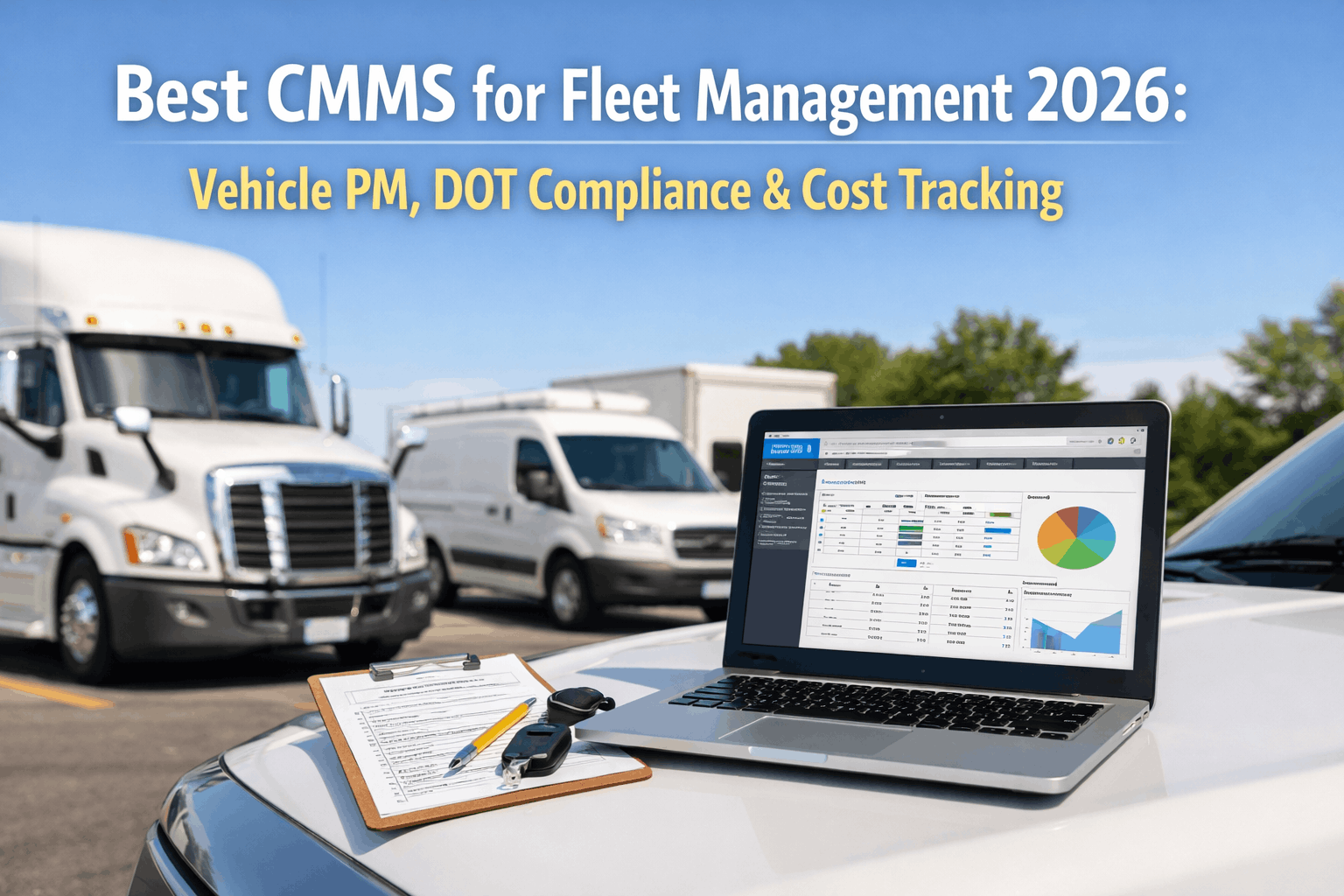
Fleet directors managing 20, 200, or 2,000 vehicles share the same core problem: vehicles generate revenue when they move and cost money when they stop. A truck sitting in a bay waiting for a part that should have been ordered three days ago is not a maintenance problem — it is a revenue problem. The average commercial fleet loses $448 to $760 per vehicle per day of unplanned downtime, and organizations running reactive maintenance on their fleets experience 3.2x more unplanned breakdowns than those with structured preventive maintenance programs. The difference between the two is almost always the system behind the maintenance operation. In 2026, the best CMMS platforms for fleet management go far beyond work order tracking — they deliver vehicle-specific PM templates tied to mileage, engine hours, and calendar intervals, DOT inspection readiness built into every workflow, and real-time visibility into every vehicle's status across every depot and yard. If your fleet is still running on spreadsheets, whiteboards, or a CMMS that was not built for vehicles, the cost compounds every single day. Want to see what a fleet-first CMMS looks like in practice, start a free trial with OxMaint and build your first vehicle PM schedule — or book a demo to walk through fleet-specific features with our team.
Fleet CMMS · DOT Compliance · Preventive Maintenance · Vehicle Uptime
Best CMMS for Fleet Management Operations 2026
Fleets lose $448–$760 per vehicle per day of unplanned downtime. The right CMMS delivers vehicle-specific PM templates, DOT compliance tracking, real-time vehicle status, and multi-depot visibility — turning reactive breakdown cycles into planned, predictable maintenance.
$760
per vehicle per day cost of unplanned fleet downtime
3.2x
more breakdowns in reactive vs planned fleet operations
23%
average fleet maintenance cost reduction with CMMS
91%
of DOT violations are preventable with scheduled inspections
Why Fleet CMMS Is Different
Fleet Maintenance Is Not Facility Maintenance — Your CMMS Needs to Know the Difference
A CMMS built for buildings manages static assets in fixed locations. A CMMS built for fleets manages assets that move, accumulate mileage and engine hours, cross jurisdictions, carry regulatory compliance requirements, and have utilization patterns that change daily. The PM triggers are different. The inspection requirements are different. The compliance documentation is different. And the consequences of failure are different — a broken HVAC unit inconveniences occupants, a broken truck misses a delivery window, triggers a service penalty, and may leave a driver stranded 400 miles from the depot.
Fleet-capable CMMS platforms understand that a preventive maintenance schedule for a Class 8 truck cannot be calendar-only — it must respond to odometer readings, engine hours from telematics, load cycles, and seasonal factors. They understand that a pre-trip inspection completed at 5 AM needs to be in the system before the driver leaves the yard, with pass/fail status visible to dispatch in real time. And they understand that DOT inspection records, brake certifications, and driver vehicle inspection reports are not optional paperwork — they are legal compliance documents that must be retrievable on demand. If your current system treats a truck the same as a water heater, it is time to book a demo and see how OxMaint handles fleet-specific maintenance logic.
Critical Fleet CMMS Features
8 Fleet CMMS Capabilities That Separate Top Platforms from General Tools
When evaluating CMMS platforms for fleet operations, these eight capabilities determine whether the system actually fits fleet workflows — or creates more manual work than it eliminates.
01
Multi-Trigger PM Scheduling
PM schedules that trigger on mileage, engine hours, calendar intervals, or whichever comes first. An oil change at 10,000 miles or 6 months — automatically generated based on telematics data, not manual tracking. Eliminates the most common cause of missed PMs in fleet operations.
02
DOT Compliance Documentation
Digital storage and retrieval of all DOT-required records: driver vehicle inspection reports (DVIRs), annual inspection certificates, brake adjustment records, and HOS logs. Every document timestamped, signed, and retrievable in seconds during a roadside inspection or audit.
03
Vehicle-Specific Asset Registry
Complete vehicle profiles including VIN, make, model, year, GVW rating, license plate, registration expiration, insurance policy, odometer baseline, and component-level history — tires, brakes, engine, transmission. Every vehicle's complete maintenance story in one record.
04
Telematics Integration
Direct integration with GPS and telematics platforms to pull real-time odometer readings, engine hours, fault codes, and location data into CMMS. PM schedules update automatically when mileage thresholds are reached. DTC codes trigger corrective work orders without human intervention.
05
Mobile Driver Inspection Forms
Digital pre-trip and post-trip inspection forms completed by drivers on mobile devices. Defects flagged immediately trigger work orders in CMMS — visible to the shop before the driver returns to the yard. Eliminates paper DVIRs and the 24-48 hour delay between defect discovery and shop awareness.
06
Multi-Depot Visibility
Real-time status of every vehicle across every yard, depot, and service location. Fleet managers at headquarters see what is in the shop at the regional depot. Dispatch knows which vehicles are available before assigning loads. Cross-depot parts sharing reduces emergency procurement delays.
07
Total Cost of Ownership Tracking
Per-vehicle cost accumulation across every work order, parts purchase, and contractor invoice. When a vehicle's annual maintenance cost exceeds 40-50% of its replacement value, the data surfaces automatically — making replacement decisions with numbers, not intuition.
08
Warranty and Recall Tracking
Vehicle warranty expiration dates, powertrain warranty coverage, and active recall notices tracked per VIN. CMMS flags when a repair should be covered under warranty before the shop orders parts. Active recalls surface automatically — preventing regulatory violations for uninspected vehicles.
Every Day Your Fleet Runs Without Structured PM Is a Day You Pay 3.2x More for Breakdowns
OxMaint delivers vehicle-specific PM templates, DOT compliance documentation, telematics integration, and multi-depot dashboards — built for fleet directors managing real vehicles under real operational pressure. See it in action in a 30-minute demo.
Fleet Pain Points
Why Fleet Maintenance Programs Break Down — And What Each Gap Costs
Every fleet director has lived through at least one of these. The question is whether these are recurring patterns or solved problems in your operation.
Missed PM
Mileage-Based PMs Missed Because Nobody Tracked Odometers
The shop supervisor planned the oil change schedule based on when vehicles came in for other work — not when they actually hit mileage thresholds. Vehicle #47 ran 4,200 miles past its oil change interval. The engine burned oil for six weeks before anyone noticed. Repair cost: $8,400. Without telematics-integrated CMMS, this scenario repeats across every high-mileage vehicle in the fleet every year.
Missed mileage-based PMs cause 34% of preventable fleet engine failures
DOT Violation
Annual Inspection Expired During Active Route Operation
Vehicle #12 had its annual DOT inspection expire on a Tuesday. Nobody noticed because expiration tracking lived in a spreadsheet that the fleet manager updated manually — when he had time. The vehicle ran for 11 days on an expired certificate before a roadside inspection triggered a $10,200 fine and a 34-day out-of-service order that cost more than the fine itself.
91% of DOT violations are preventable with automated inspection scheduling
Parts Delay
Vehicle Sits for 4 Days Waiting for a Part That Was in Stock 80 Miles Away
Truck #23 needed a specific air brake component. The local parts supplier was out of stock. The shop ordered from a national distributor — 3-4 day lead time. Three days later, someone called the regional depot and discovered they had four of the exact part sitting on the shelf. No cross-depot inventory visibility. No shared parts lookup. $2,800 in downtime costs for a part that was available the same day.
Cross-depot parts visibility reduces vehicle downtime from parts delays by 58%
Compliance Gap
Driver Defect Reports Sitting in a Paper Folder Nobody Reads
Drivers completed paper DVIRs and dropped them in a folder at the dispatch desk. The shop supervisor collected them every few days — sometimes every week. A driver flagged a brake noise on vehicle #8 on a Monday. The work order was not created until Thursday. The vehicle ran three routes in between. When the brake inspection was finally done, one caliper was seized. Total repair: $3,100 plus liability exposure for routes run with a known defect.
Digital DVIR-to-work-order automation reduces defect-to-repair time from days to hours
How OxMaint Solves It
Fleet Maintenance Workflows OxMaint Automates — Step by Step
OxMaint is not a generic CMMS adapted for fleet use. It is built to handle vehicle-specific workflows from the ground up, with the logic, triggers, and documentation requirements that fleet operations actually need.
1
Vehicle Onboarding and Profile Creation
Every vehicle enters OxMaint with a complete profile: VIN, make, model, year, GVW, license plate, registration expiration, insurance policy number, warranty terms, current odometer, and engine hours. Component-level records — engine serial, transmission serial, axle ratings — attach to the vehicle record. From day one, the vehicle's complete technical identity is in the system.
2
PM Template Assignment by Vehicle Type
Pre-built PM templates for Class 3-8 trucks, trailers, vans, and specialty vehicles assign automatically based on vehicle type. Each template includes manufacturer-specified service intervals, DOT-required inspection tasks, and fluid specifications. Templates deploy in minutes — not weeks of manual schedule building. Fleet managers override intervals for specific vehicles based on duty cycle or operational conditions.
3
Telematics-Driven PM Triggering
OxMaint connects to telematics platforms via API to receive daily odometer and engine hour updates. When a vehicle hits a PM mileage threshold — within a configurable buffer of 500-1,000 miles — the system generates a work order automatically and notifies the shop. No manual odometer checking. No spreadsheet updates. The PM schedule runs itself based on actual vehicle usage.
4
Digital Pre-Trip and Post-Trip Inspections
Drivers open the OxMaint mobile app, select their assigned vehicle, and complete the digital inspection form before departure. Each checklist item maps to a specific vehicle system — brakes, tires, lights, fluid levels, coupling devices. Any item marked as defective automatically generates a work order with the defect category, severity, and driver notes attached. Dispatch and the shop see the defect the moment the driver submits — not three days later.
5
DOT Compliance Calendar and Alerts
Every vehicle's compliance calendar lives in OxMaint — annual DOT inspection due date, registration renewal, insurance expiration, brake certification, and FMCSA operating authority renewal. Alerts fire 90 days, 30 days, and 7 days before each expiration. The fleet manager sees a single compliance dashboard showing every vehicle's upcoming compliance events — no spreadsheet, no calendar app, no missed renewals.
6
Total Cost of Ownership Reporting
Every work order, parts purchase, and contractor invoice accumulates against the vehicle's lifetime cost record in OxMaint. Annual cost reports per vehicle show labor, parts, outsourced repairs, and downtime costs in one view. When a vehicle's annual cost-to-value ratio exceeds the replacement threshold, OxMaint surfaces it in the fleet replacement dashboard — turning gut-feel replacement decisions into data-backed capital planning.
The cumulative effect of these six automated workflows is a fleet maintenance operation that runs on data instead of memory, on schedules instead of crises, and on compliance records instead of paper folders. If you want to see all six working together, start a free trial and configure your first vehicle fleet in OxMaint or book a demo and we will walk through your specific fleet type.
Reactive vs Planned
Reactive Fleet Maintenance vs Planned Fleet Maintenance: The Real Numbers
| Dimension |
Reactive Fleet Maintenance |
Planned Fleet Maintenance (OxMaint) |
| Average repair cost per event |
$1,200–$4,800 (emergency rate) |
$280–$950 (scheduled rate) |
| Unplanned downtime per vehicle/year |
14–22 days |
3–6 days |
| DOT violation rate |
High — inspections missed or late |
Near zero — automated compliance tracking |
| PM completion rate |
Below 60% — calendar-only scheduling |
Above 92% — mileage + calendar triggers |
| Defect-to-repair time |
2–5 days — paper DVIR process |
Same day — digital DVIR auto-generates WO |
| Parts availability |
Reactive ordering — high emergency freight |
Proactive stocking based on PM schedule |
| Fleet replacement decisions |
Intuition — or when breakdown costs spike |
TCO data per vehicle — threshold alerts |
| Annual maintenance cost per vehicle |
Baseline — unpredictable |
23% lower — consistent and forecastable |
Fleet Type Coverage
Fleet Types OxMaint Is Built to Support
Fleet maintenance requirements vary dramatically by vehicle type, duty cycle, regulatory environment, and operational model. OxMaint supports all of them with configurable PM templates, compliance tracking, and vehicle-specific asset structures.
Class 7-8 Trucking
Long-haul and regional trucking fleets with full DOT compliance tracking, FMCSA record requirements, ELD integration, driver qualification file management, and mileage-based PM scheduling for engines, transmissions, differentials, and braking systems.
DOT · FMCSA · CSA Score impact
Last-Mile Delivery Vans
High-cycle urban delivery fleets with stop-and-go duty cycles that accelerate brake and suspension wear. Multi-stop daily inspection workflows, high-frequency oil change intervals, and real-time vehicle availability status for dispatch integration.
DOT · State vehicle safety inspection
Municipal and Government Fleets
Public works vehicles, emergency response apparatus, transit buses, and utility service trucks with specialized compliance requirements, public records obligations, and procurement workflows tied to municipal ERP and financial systems.
State fleet compliance · FMCSA · ADA
Construction Equipment Fleets
Excavators, dozers, cranes, and support vehicles with engine-hour-based PM scheduling, OSHA inspection requirements, site-to-site tracking, and load cycle maintenance triggers. Equipment-specific PM templates per OEM specification.
OSHA · State licensing · OEM warranties
Refrigerated Transport Fleets
Reefer unit maintenance tracking alongside vehicle PMs, temperature monitoring log integration, FMCSA compliance, and food safety regulatory documentation. Reefer unit service intervals managed separately from the tractor — both visible in one vehicle record.
FMCSA · FDA FSMA · Cold chain compliance
School and Transit Bus Fleets
High-cycle passenger transport with daily pre-trip inspection requirements, state school bus inspection certification, wheelchair lift maintenance, and route-based scheduling coordination. Student safety compliance documentation fully digital and audit-ready.
State DOT · NHTSA · ADA · School safety
Measurable Results
What Fleet Operations Achieve After Deploying OxMaint
23%
lower annual fleet maintenance cost
Planned maintenance versus reactive breakdown cycle across commercial fleet portfolios
92%
PM completion rate
Mileage plus calendar dual-trigger scheduling vs calendar-only manual tracking
58%
reduction in parts-related downtime
Cross-depot inventory visibility and proactive parts stocking based on PM forecasts
Near zero
DOT compliance violations
Automated compliance calendar with 90/30/7 day expiration alerts per vehicle
DOT Compliance Detail
DOT Compliance Records OxMaint Manages Automatically
Federal Motor Carrier Safety Administration compliance is not optional — and the documentation burden on fleet operations is significant. OxMaint manages every compliance record in one place, with automated alerts and on-demand retrieval for roadside inspections and audits.
Annual Vehicle Inspection
Certificate tracking per vehicle with 90-day advance alert. Inspection results stored digitally with inspector credentials and signature. Out-of-date status flags vehicles in the dispatch dashboard before they leave the yard.
Driver Vehicle Inspection Reports (DVIR)
Digital pre-trip and post-trip DVIRs completed on mobile devices by drivers. Defects generate immediate work orders. Completed and certified records stored per 49 CFR Part 396.11 requirements — retrievable in seconds during roadside inspection.
Brake Inspection Records
Brake adjustment data, lining thickness measurements, and brake inspection certifications stored per vehicle. Trending data shows brake wear rates — enabling proactive replacement before brake adjustment limit violations occur.
Vehicle Registration and Licensing
Registration expiration dates, apportioned plate status, IRP credentials, and IFTA sticker status tracked per vehicle with automated renewal alerts. Ensures no vehicle operates with expired registration or interstate credentials.
Maintenance and Repair Records
Complete maintenance history per vehicle stored and retrievable per 49 CFR Part 396.3 requirements. Every work order, every parts replacement, every inspection result — organized chronologically and searchable by date range, repair type, or component category.
Out-of-Service Condition Tracking
When a vehicle receives an out-of-service order during a roadside inspection, OxMaint records the OOS condition, generates a corrective work order, and tracks the vehicle's return-to-service status. Prevents inadvertent dispatch of OOS vehicles.
FAQs
Fleet CMMS — Common Questions from Fleet Directors
Which telematics platforms does OxMaint integrate with?
OxMaint integrates with major telematics providers via REST API and webhook connections. Platforms supporting standard API output for odometer readings, engine hours, fault codes, and location data connect to OxMaint without custom development. This includes integration with major fleet telematics systems commonly used across North America, Europe, and Australia.
Book a demo to confirm compatibility with your specific telematics provider — we will test the connection in the demo session.
Can drivers complete inspection forms without a data connection?
Yes. The OxMaint mobile app supports offline inspection completion. Drivers complete pre-trip and post-trip forms in areas with no cellular coverage — the data queues locally and syncs to the platform the moment connectivity is restored. Defect work orders generate immediately upon sync. No incomplete inspections due to connectivity gaps.
How does OxMaint handle fleets spread across multiple states and depots?
OxMaint is built for multi-site fleet operations. Each depot operates independently for daily work order management and local inventory — while fleet directors at the corporate level see every vehicle across every location in one dashboard. PM compliance, vehicle availability, compliance status, and cost reports roll up across all depots automatically.
Start a free trial to configure your multi-depot fleet structure.
Does OxMaint support mixed fleets with both powered equipment and non-powered trailers?
Yes. OxMaint manages tractors, trailers, and ancillary equipment in the same system with separate asset profiles and PM templates for each. Trailers have their own inspection schedules, annual certification requirements, and maintenance histories — fully independent from the tractors that pull them, and fully visible in the same fleet dashboard.
Your Fleet Generates Revenue When It Moves — OxMaint Keeps It Moving
Vehicle-specific PM templates, DOT compliance documentation, telematics-driven scheduling, digital driver inspections, and multi-depot dashboards — all in one platform built for fleet directors managing real vehicles under real operational pressure. See it in 30 minutes.


.png)