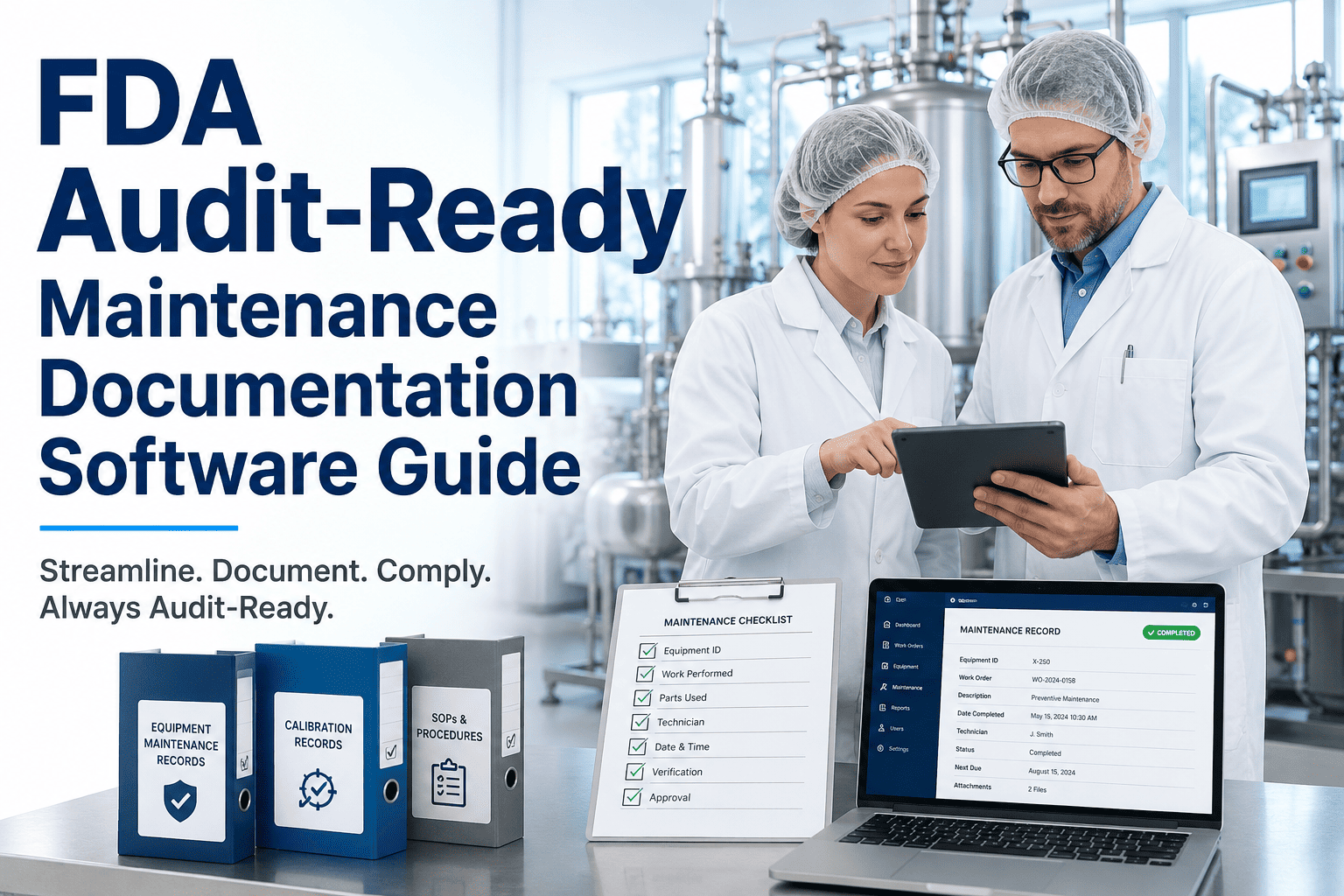
FDA investigators review maintenance records to assess whether pharmaceutical manufacturers control equipment that could affect product quality, safety, and efficacy — and documentation gaps are one of the most cited reasons for 483 observations in manufacturing facilities worldwide. Digital maintenance documentation software gives pharma quality and maintenance teams the tamper-evident records, complete work order histories, calibration audit trails, and GMP-aligned workflows that paper logbooks and spreadsheets simply cannot provide. This guide explains exactly what FDA expects to see in a maintenance documentation review, what data integrity failures look like, and how the right CMMS architecture dramatically reduces observation risk. Start free with Oxmaint and build your audit-ready maintenance record system today.
1 in 3
FDA Warning Letters cite inadequate equipment maintenance documentation as a contributing factor to GMP failures — making it one of the most preventable inspection risks in pharmaceutical manufacturing.
FDA AUDIT READINESS · CMMS
Is Your Maintenance Record System Inspection-Ready Right Now?
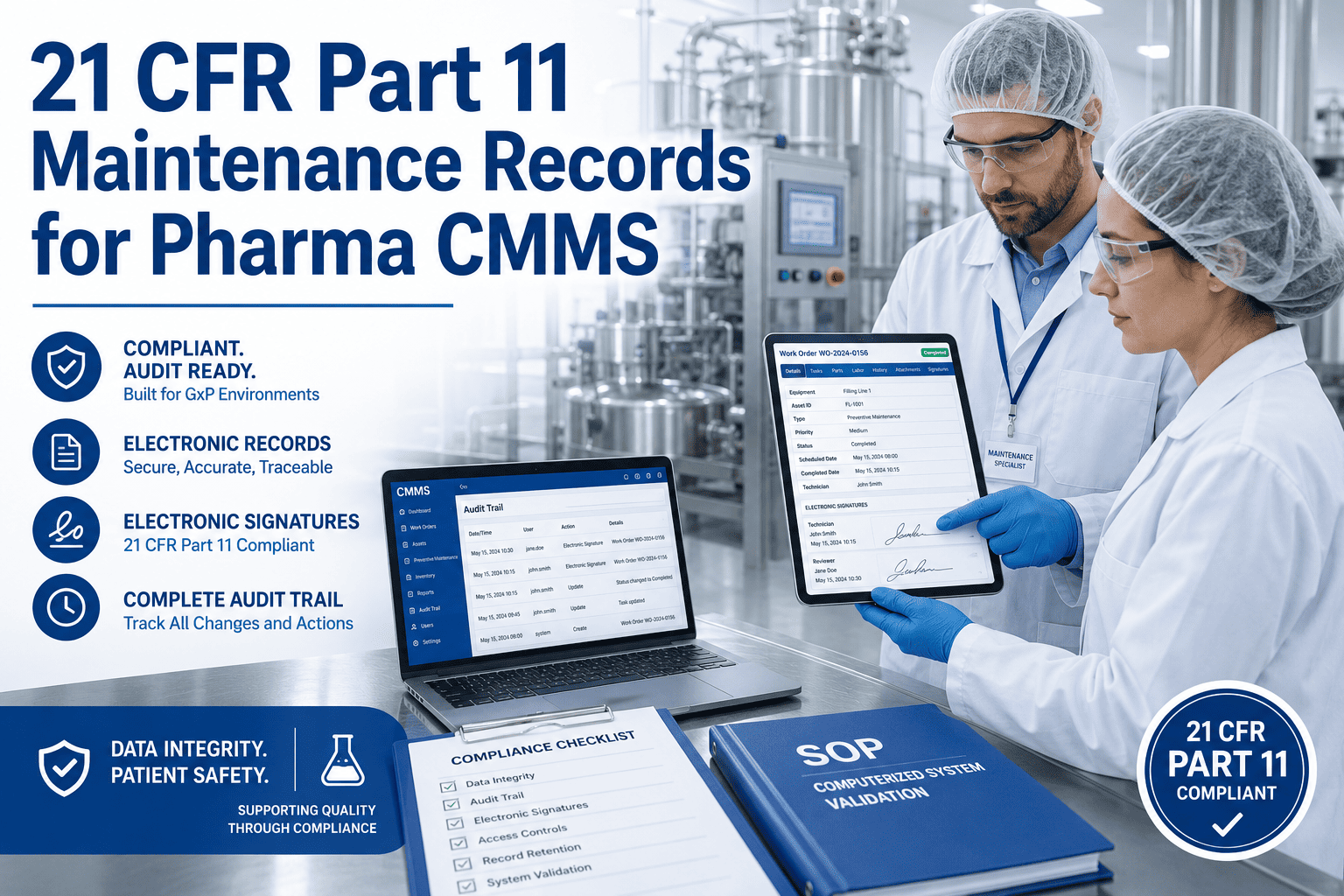
Oxmaint gives pharma teams complete 21 CFR Part 11 audit trails, electronic signatures, calibration history, and one-click compliance reports — so every FDA inspection starts from a position of strength.
What FDA Expects to See in a Maintenance Documentation Audit
Under 21 CFR 211.68 and related GMP regulations, pharmaceutical manufacturers must maintain equipment in a state of calibration, cleanliness, and repair that prevents product contamination and ensures process reliability. During inspections, investigators typically request a specific piece of critical equipment's complete maintenance history — and they expect to see it produced quickly, completely, and unaltered.
1
Complete PM History with No Gaps
Every scheduled preventive maintenance activity must be documented with date, technician, procedures performed, and pass/fail outcomes. Missed PMs must be documented with justification — unrecorded gaps are a data integrity red flag.
2
Calibration Records Linked to Equipment
Calibration as-found and as-left values, calibration standards used, technician identity, and out-of-tolerance impact assessments must be traceable to specific equipment records — not stored in disconnected spreadsheets.
3
Corrective Maintenance with Return-to-Service Authorization
Unscheduled repairs must document the problem found, actions taken, parts replaced, and a verification test confirming acceptable performance before the equipment re-enters production service. The authorization to return must be signed and timestamped.
4
Data Integrity: Tamper-Evident Records
Records must be attributable, legible, contemporaneous, original, and accurate (ALCOA+). Any post-entry changes must preserve the original value with a reason for change — this is the ALCOA standard FDA applies to all GMP records including maintenance.
5
Equipment Status Control
A clear system must exist showing which equipment is qualified for use, out-of-service, or under maintenance — with the transition between statuses controlled and documented. Production must not be able to use equipment in an unqualified or maintenance state.
Common FDA 483 Observations Linked to Maintenance Documentation
| 483 Observation Type |
Root Cause in Maintenance System |
Prevention with Digital CMMS |
| Calibration overdue, equipment in service |
No automated calibration due date alerts |
Auto-alerts 30 days before due, equipment lock-out if overdue |
| PM records not retrievable during inspection |
Paper logs, spreadsheets, file cabinets |
Instant digital search by asset, date range, or technician |
| Backdated or altered maintenance entries |
Paper or editable electronic records |
Tamper-evident timestamps, ALCOA-compliant audit trail |
| No impact assessment for out-of-tolerance calibration |
Manual process easily overlooked |
Automatic deviation trigger with mandatory impact assessment workflow |
| Equipment returned to service without documentation |
No electronic return-to-service gate |
Work order close-out requires authorization signature before status change |
| Training records not linked to maintenance work orders |
Disconnected training management system |
CMMS enforces task assignment only to qualified, trained technicians |
EXPERT REVIEW
Sarah Okonkwo, RAC
Regulatory Affairs Consultant · Ex-FDA CDER · 14 Years Pharmaceutical Compliance
The fastest way to turn a routine FDA inspection into an enforcement situation is to produce inconsistent, incomplete, or obviously altered maintenance records. I have seen investigators spend an entire afternoon on a single piece of equipment's maintenance history — comparing PM dates to batch records, checking calibration values against instrument specifications, and looking for any indication that records were created after the fact. A modern CMMS with proper 21 CFR Part 11 controls removes the human error and intentional alteration risks that paper systems carry. More importantly, it gives your quality team a real-time picture of compliance status — not a reactive scramble when the investigator arrives.
The ALCOA+ Standard for Maintenance Records
A
Attributable
Every record entry linked to a specific, identified individual with secure login credentials — not shared accounts.
L
Legible
Digital records are permanently legible — no degradation over time, no handwriting interpretation issues.
C
Contemporaneous
Records entered at the time of activity — system timestamps prevent backdating and create a verifiable timeline.
O
Original
First capture of data is preserved; any changes create an amendment trail — original values are never overwritten.
A
Accurate
Automated calculations and validated input ranges reduce transcription errors and impossible values in maintenance records.
FDA AUDIT READINESS · CMMS
Is Your Maintenance Record System Inspection-Ready Right Now?
Oxmaint gives pharma teams complete 21 CFR Part 11 audit trails, electronic signatures, calibration history, and one-click compliance reports — so every FDA inspection starts from a position of strength.
Frequently Asked Questions
How long must pharmaceutical companies retain maintenance records per FDA regulations?
Under 21 CFR 211.180, most pharmaceutical manufacturing records including equipment maintenance must be retained for at least one year after the expiration date of the batch they support, or one year after the date of distribution for the last batch produced — whichever is longer. In practice this means most equipment maintenance records are retained for 3–7 years. For equipment used in clinical trial manufacturing or products under active FDA review, retention requirements may extend further. A digital CMMS with permanent, searchable record storage eliminates the administrative burden of paper-based retention management and ensures records are instantly accessible throughout the required retention period.
What is a maintenance data integrity failure and how does it lead to Warning Letters?
Maintenance data integrity failures occur when records are incomplete, altered without documentation, backdated, or created by unauthorized personnel — any of which violates ALCOA+ principles and 21 CFR Part 11 requirements. FDA Warning Letters frequently cite data integrity failures when investigators find inconsistencies between electronic records and paper backups, records created with shared login credentials, or maintenance logs that do not match the dates on equipment calibration certificates. A single provable data integrity failure can cast doubt on the reliability of all records produced by the same system, potentially triggering a comprehensive data integrity investigation across the entire facility.
Can a spreadsheet-based maintenance system pass an FDA inspection?
Spreadsheets can technically contain accurate maintenance data, but they rarely satisfy FDA's data integrity requirements because they typically lack controlled access, tamper-evident change logs, electronic signature controls, and automatic backup. FDA investigators are specifically trained to look for spreadsheet manipulation — checking file metadata for edit dates that don't match entries, looking for formula overrides, and noting the absence of audit trail functionality. Most pharmaceutical quality experts recommend transitioning from spreadsheets to a validated, 21 CFR Part 11-compliant CMMS as a standard part of data integrity remediation.
Book a demo to see how Oxmaint replaces spreadsheets with inspection-ready digital records.
Does Oxmaint require computer system validation (CSV) for FDA-regulated use?
Yes — any computerized system used for GMP record-keeping in a pharmaceutical facility should be validated in accordance with 21 CFR Part 11 and GAMP 5 guidelines. Oxmaint provides a comprehensive validation support package including Installation Qualification (IQ) and Operational Qualification (OQ) protocols, a pre-written validation plan template, change control documentation, and a system risk assessment to streamline the CSV process. Most Oxmaint pharma customers complete their CMMS validation in 4–8 weeks with the support documentation package, significantly reducing the validation resource investment compared to fully custom validation approaches.