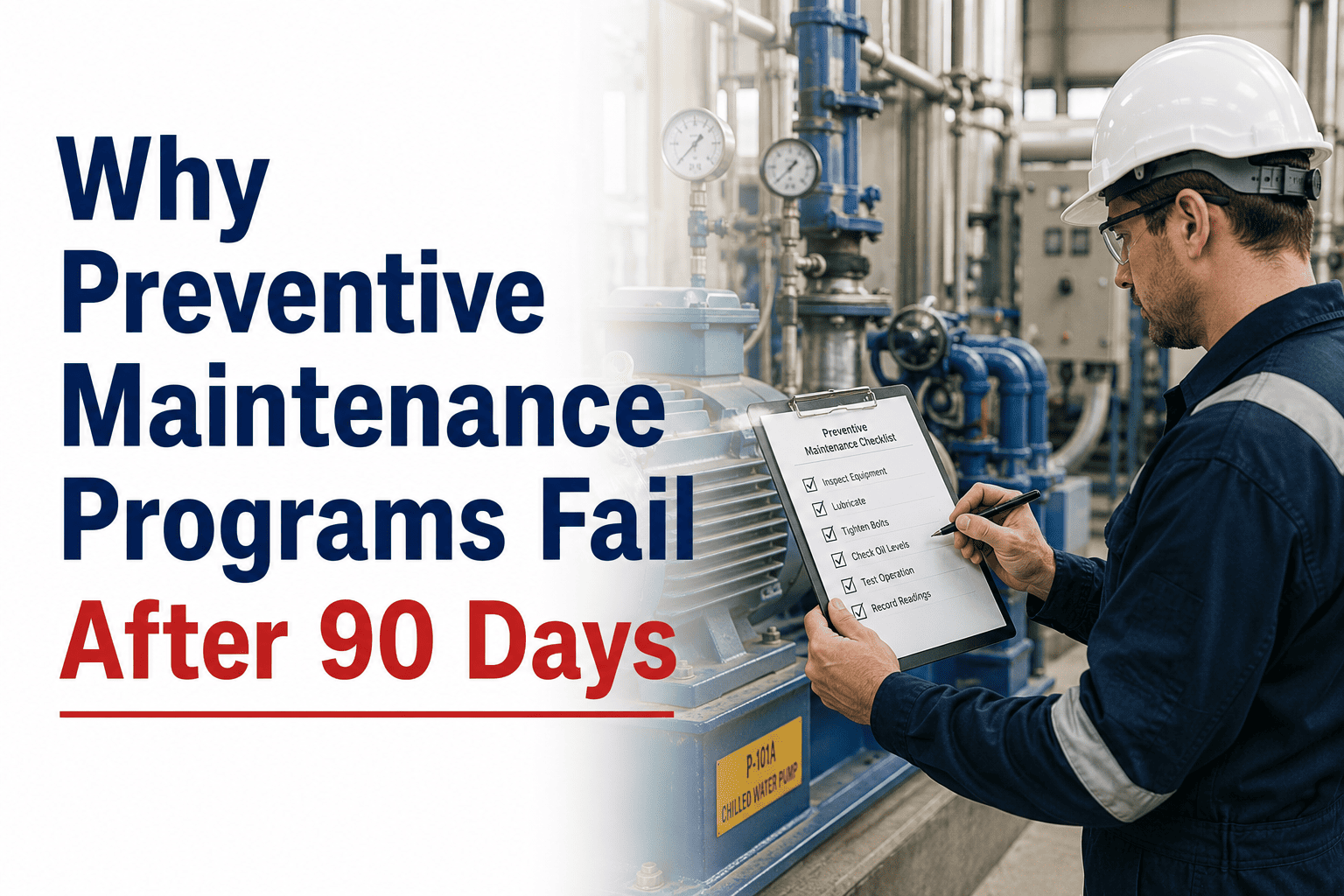
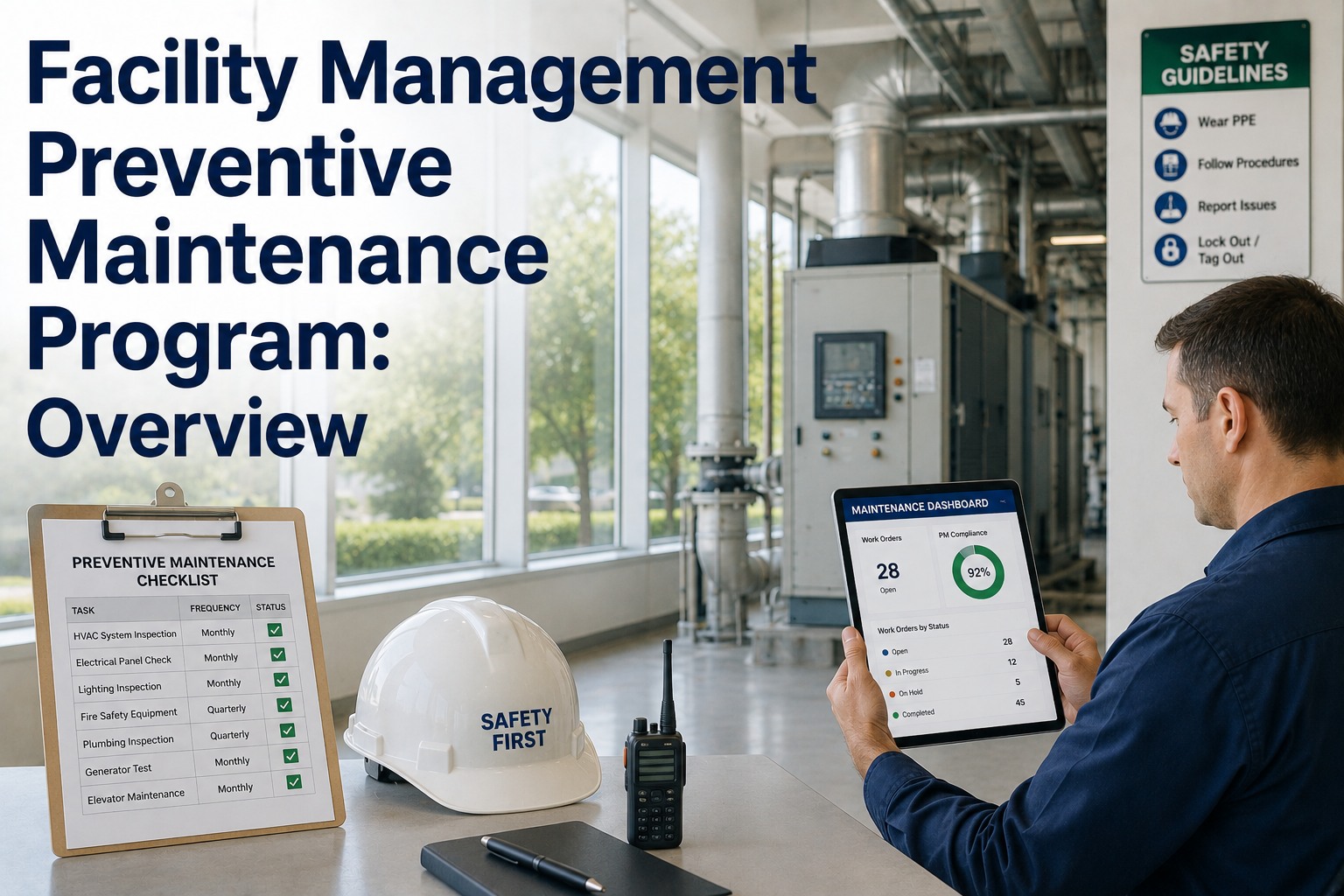
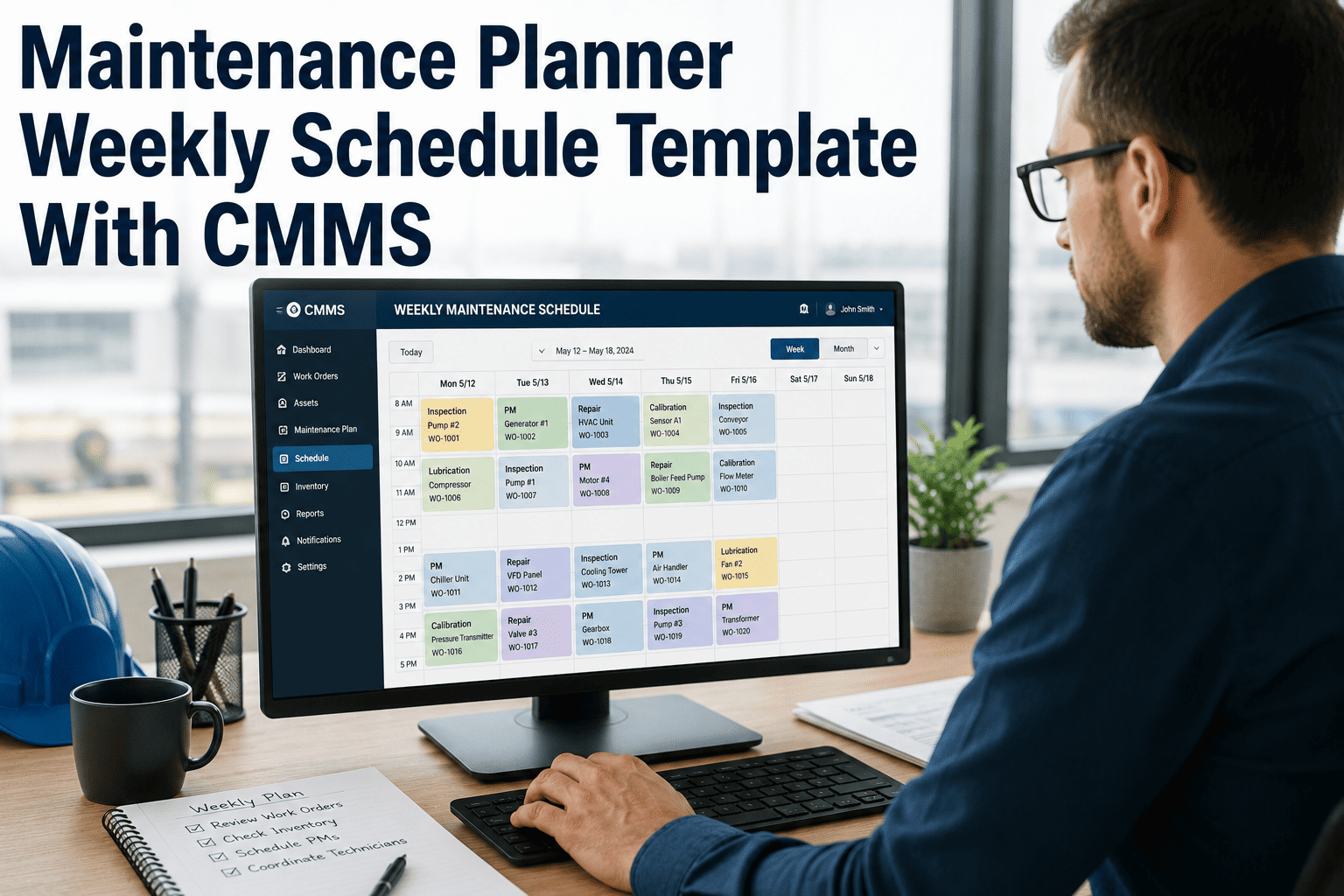
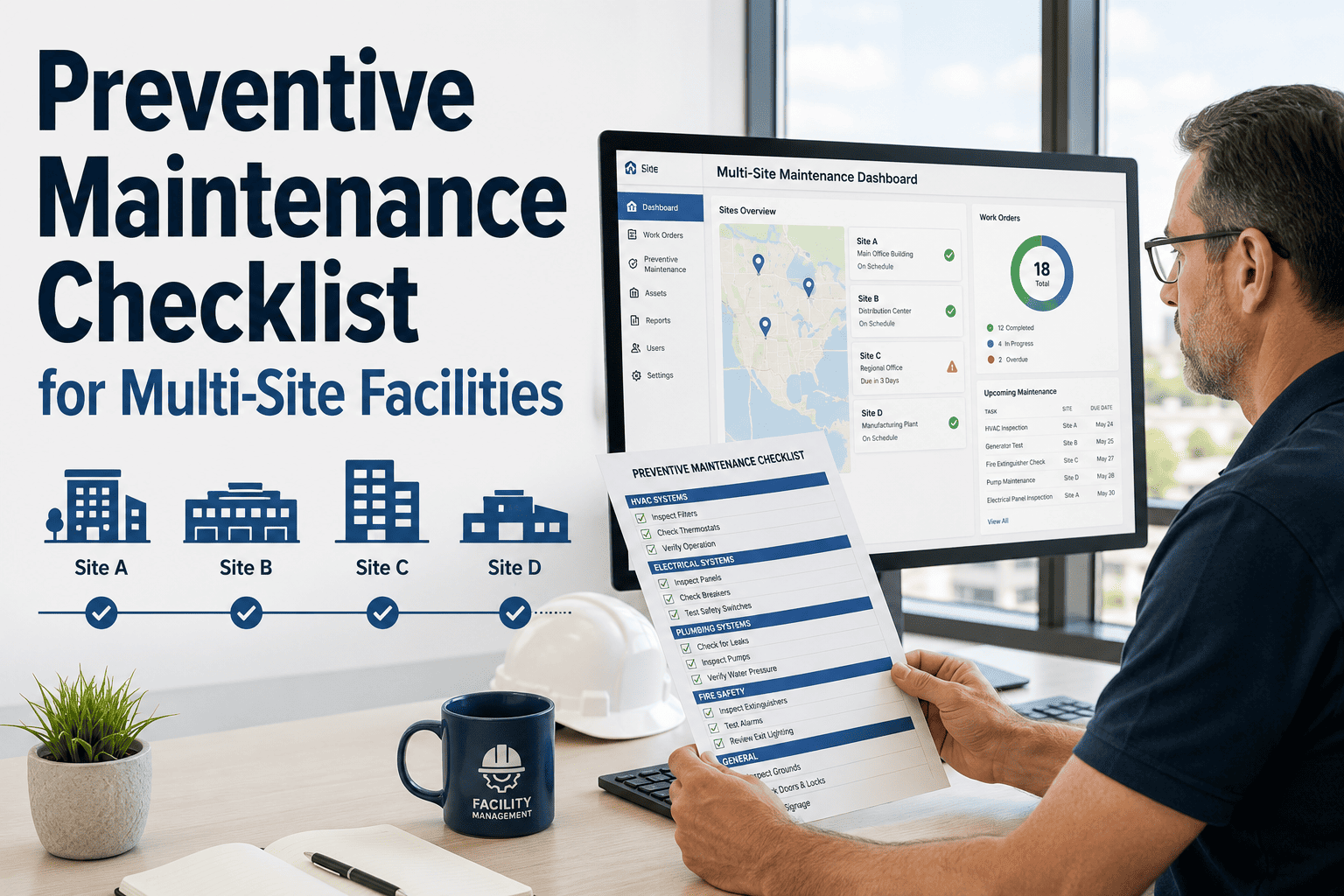
The pattern is remarkably consistent across industries: a maintenance team launches a preventive maintenance program with genuine commitment — schedules are built, checklists are designed, kickoff meetings are held. Ninety days later, PM compliance has dropped from 90% to below 50%, checklists are being rubber-stamped rather than completed, and the team has quietly returned to reactive firefighting. This is not a people problem. It is a structural problem — and this page explains why it happens and what it actually takes to build a PM program that holds. See how OxMaint keeps PM programs on track beyond the 90-day mark.
Preventive Maintenance · PM Compliance · CMMS Adoption · Maintenance Strategy
Why Preventive Maintenance Programs Fail After 90 Days
90 days is when PM programs hit their first serious stress test — reactive jobs have accumulated, initial enthusiasm has faded, and the structural weaknesses in the original design become impossible to ignore. Understanding the failure pattern is the only way to design around it.
Day 1–30
90%
Avg PM compliance
Day 31–60
72%
Compliance begins slipping
Day 61–90
54%
PM bumped by reactive work
Day 90+
38%
Program effectively dead
Root Causes of PM Failure
The 5 Structural Reasons PM Programs Die After Launch
Reason 1
The Schedule Was Built in Isolation
PM schedules designed by planners or managers without technician input consistently fail. Technicians know which tasks take 45 minutes when the PM schedule says 20 — and when reality doesn't match the plan, compliance tracking becomes a game of paper manipulation rather than real maintenance execution.
Fix: Build PM task duration estimates with the technicians who do the work. Audit actuals in the first 30 days and adjust.
Reason 2
No Consequence for Bumping PM
When a reactive job and a scheduled PM compete for the same technician, the reactive job wins by default — because reactive failures are visible and PM skips are invisible until the audit. Without a system that tracks and escalates missed PM, the skip happens silently and nobody is held accountable.
Fix: CMMS auto-escalates missed PM tasks to the supervisor within 24 hours. Accountability is automated, not manual.
Reason 3
Checklists Are Too Generic to Be Useful
A PM checklist that says "inspect motor" is not a checklist — it is a reminder. Without specific pass/fail criteria, measurement points, and tolerance ranges, technicians fill it out from memory rather than from actual inspection. After 90 days, those checks produce no useful data and earn no trust.
Fix: Write checklists to ISO maintenance task standards — specific steps, measurements, and failure criteria for every task.
Reason 4
No Visible Proof That PM Is Working
Preventive maintenance prevents failures that are invisible — the machine doesn't break because you maintained it. This creates a perception problem: the PM looks like overhead with no return. Teams that don't track and communicate avoided failures lose support from management and motivation from technicians within 90 days.
Fix: Use CMMS reports to show PM completion rate vs breakdown rate. The inverse correlation is the proof that PM works.
Reason 5
Over-Scheduled From Day One
Launching a PM program with every possible task at maximum frequency is ambitious but unsustainable. Teams that try to go from 0% to 100% PM coverage in the first month always burn out before day 90. The initial enthusiasm covers the overload, but as fatigue sets in, the program collapses under its own weight.
Fix: Start with the top 20% of critical assets. Expand coverage every 30 days as compliance proves sustainable.
PM That Lasts Beyond 90 Days
OxMaint Keeps Your PM Program Running When Motivation Fades
Automated PM work order generation, escalation alerts for missed tasks, mobile completion tracking, and compliance reporting — OxMaint makes PM accountability structural, not personal.
PM Program Design Reference
PM Program Launch Roadmap — 6 Months to Sustainable Compliance
| Month |
Focus |
Asset Coverage |
Compliance Target |
Key Action |
| Month 1 |
Foundation |
Top 20 critical assets |
85%+ |
Build detailed checklists with technicians; load into CMMS |
| Month 2 |
Stabilise |
Top 20 assets + expand 15 |
85%+ |
Review duration estimates vs actuals; adjust schedule |
| Month 3 |
Prove Value |
35 assets total |
80%+ |
Run first PM vs breakdown correlation report; present to management |
| Month 4–5 |
Expand |
50–70% of asset register |
85%+ |
Add next-tier assets; train additional technicians on CMMS |
| Month 6 |
Optimise |
Full coverage |
90%+ |
Review over-maintained assets; remove low-ROI PM tasks |
Expert Review
Maintenance Professionals on PM Program Sustainability
★★★★★
"I've launched PM programs in four different plants. The ones that survived all had one thing in common — technicians were involved in building the checklists from day one. The ones that failed were designed by engineers at desks and handed down. Ownership is not optional. It is the programme."
GW
G. Williams
Maintenance Director, Multi-site Manufacturing Group
★★★★★
"We moved our PM compliance reporting from monthly to weekly inside OxMaint. The moment supervisors could see missed tasks the same week they happened — instead of four weeks later in a spreadsheet — compliance jumped from 58% to 84% in under two months. Visibility was the only variable that changed."
HS
H. Sato
Reliability Manager, Semiconductor Fabrication Facility
Frequently Asked
PM Program Failure — Common Questions
What is a realistic PM compliance target for a maintenance team transitioning from reactive?
Teams transitioning from predominantly reactive maintenance should target 70–75% PM compliance in months 1–3, increasing to 85% by month 6 as processes stabilise. Setting a 95% target from day one is a common mistake that demoralises teams when they inevitably miss it. The trajectory matters more than the starting number — a team moving from 50% to 80% compliance over 6 months is outperforming one stuck at 85% with no improvement trend.
OxMaint tracks your compliance trend week-over-week so you can see progress and address slippage before it becomes a collapse.
How do you prevent reactive work from constantly bumping scheduled PM?
The most effective structural fix is to schedule PM work in protected time blocks — typically the first 6 hours of a shift — with a clear rule that reactive work draws from the remaining buffer capacity first. When the reactive buffer is exhausted, supervisors are alerted before any PM gets bumped, allowing a conscious decision rather than a default one. CMMS scheduling enforces this automatically. Teams that implement protected PM windows typically see reactive work rates drop within 90 days, because the PM they're now completing is preventing the reactive work from generating in the first place.
Book a demo to see how OxMaint enforces PM priority scheduling.
How specific do PM checklists need to be to be effective?
An effective PM checklist specifies the exact measurement to be taken (e.g. vibration reading at bearing housing, X-axis, mm/s RMS), the acceptable range (e.g. under 4.5 mm/s), and the action if out of range (e.g. raise corrective work order, tag asset, notify supervisor). Vague instructions like "check bearing condition" produce inconsistent results because each technician interprets "check" differently. The goal is that a new technician with no asset knowledge could complete the PM correctly on their first attempt — because the checklist tells them exactly what to do, measure, and decide. This specificity is what makes PM data useful for trending and root cause analysis over time.
Does a PM program need a CMMS, or can it be managed with spreadsheets?
Spreadsheet-based PM management is technically possible for fewer than 50 assets and a single-shift team — but it breaks down rapidly with scale, shift changes, and reactive work competing for attention. The critical failure point is that spreadsheets cannot automatically generate work orders, escalate missed tasks, or correlate PM compliance with breakdown frequency. A CMMS like
OxMaint performs all three automatically — and that automation is what keeps PM programs running past the 90-day point where manual systems consistently collapse under operational pressure.
Build a PM Program That Lasts
Most PM Programs Fail at 90 Days. Yours Doesn't Have To.
OxMaint automates PM generation, tracks compliance weekly, escalates missed tasks, and shows you the ROI of every preventive job completed. Start with your top 20 critical assets today — free for 14 days, no credit card required.