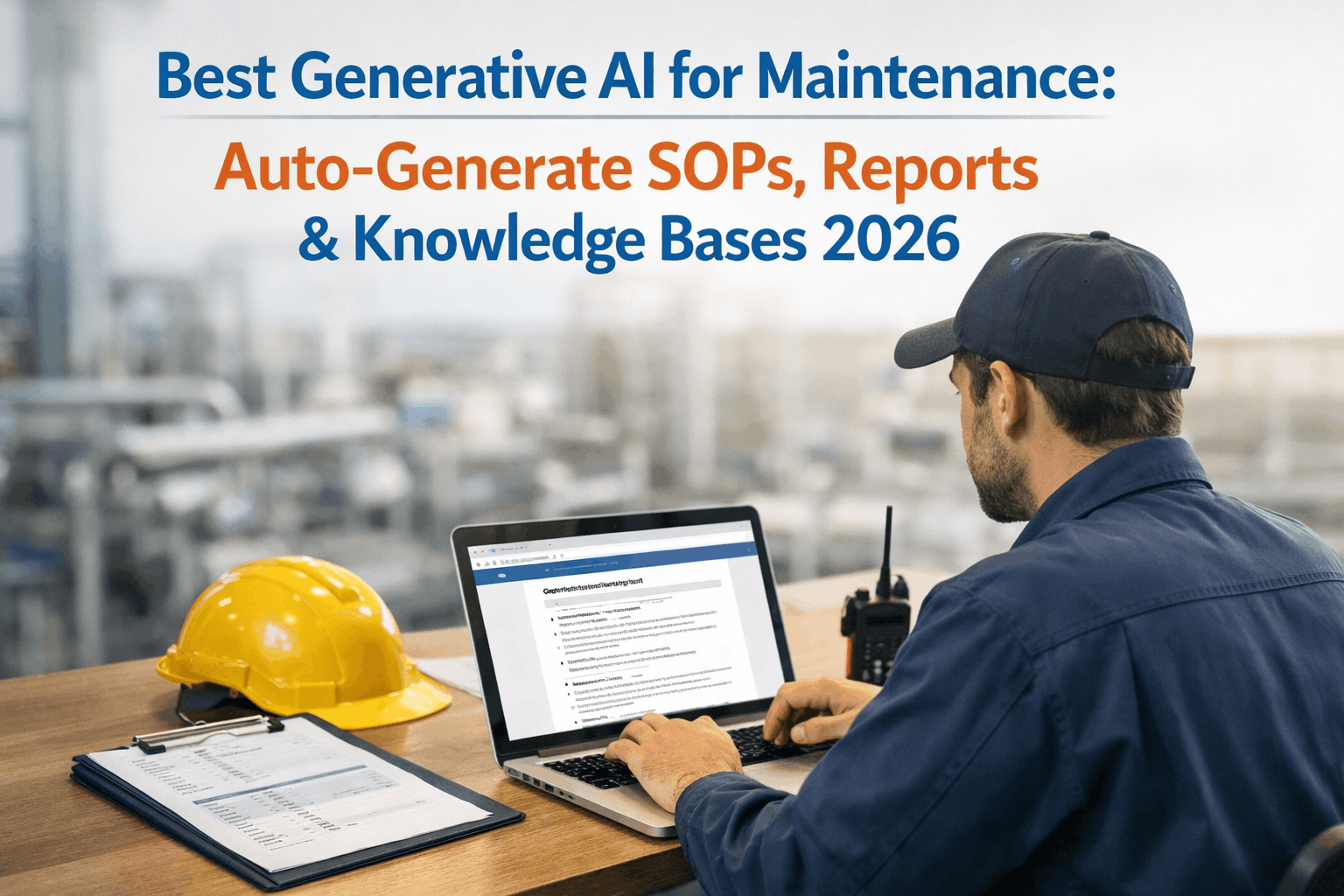
Best Generative AI for Maintenance: Auto-Generate SOPs, Reports & Knowledge Bases 2026
At 4:00 PM on a Friday, a senior technician repairs a complex hydraulic fault on a critical packaging line. When closing the work order, exhausted and rushing to clock out, he types a three-word resolution: "Fixed pressure valve." Thirty years of tribal knowledge, diagnostic steps, and safety precautions related to that specific repair vanish into a digital void. Six months later, when a junior technician faces the exact same fault, that historical record is completely useless. The line stays down for an extra four hours while the junior tech figures it out from scratch. This is the reality of maintenance documentation today: highly skilled mechanics are forced to act as data entry clerks, resulting in inconsistent Standard Operating Procedures (SOPs), vague failure reports, and unsearchable databases.
Smart facilities in 2026 are deploying an entirely different model using Generative AI (GenAI). GenAI acts as an intelligent assistant that transforms fragmented technician notes, voice memos, and historical data into comprehensive, standardized documentation. It automatically drafts highly detailed SOPs, structures root cause failure reports, and builds dynamic, conversational knowledge bases. When paired with a CMMS like Oxmaint, this technology doesn't just digitize paperwork—it automates tribal knowledge capture, ensuring every procedure is consistent, searchable, and instantly accessible. Talk to our team about building an AI-driven knowledge base that works as hard as your technicians do.
Maintenance AI 2026
Best Generative AI for Maintenance: Auto-Generate SOPs, Reports & Knowledge Bases 2026
Generate maintenance SOPs, failure reports, and training content with generative AI. Automate documentation from messy technician notes for total consistency and build a highly searchable reliability knowledge base.
Industrial operations are facing a severe demographic cliff: the most experienced technicians are retiring, and they are taking decades of undocumented troubleshooting expertise with them. At the same time, modern equipment is becoming infinitely more complex. Relying on manual data entry leads to inconsistent safety protocols, unstructured root cause analysis (RCA), and CMMS databases filled with useless, unsearchable "free text." Generative AI solves this by acting as a translation layer—taking the raw, messy reality of field maintenance and automatically converting it into pristine, structured, and highly valuable enterprise intelligence.
Common Maintenance Documentation Challenges
01
Vague Technician Notes
Short, scribbled, or incomplete work order closure notes make it impossible to track accurate repair histories or analyze failure modes.
02
Lost Tribal Knowledge
When senior staff leave, the unwritten "tricks" to keeping legacy machines running vanish, increasing future diagnostic times dramatically.
03
Inconsistent SOPs
Manual SOPs suffer from differing formats, confusing terminology, and missing safety steps depending on who drafted the document.
04
Tedious RCA Reporting
Reliability engineers waste hours formatting Root Cause Analysis reports and failure summaries instead of actually engineering solutions.
05
Unsearchable History
Data trapped in legacy CMMS free-text fields or paper binders cannot be easily queried by new technicians seeking historical context.
The Modern GenAI Maintenance Stack
A modern Generative AI documentation architecture layers capabilities: Raw Data Ingestion captures voice memos and shorthand notes; Contextual Analysis interprets the technical intent; Auto-Generation drafts the formatted SOPs and RCA reports; Semantic Integration builds the knowledge base; and CMMS Workflows attach these AI guides directly to future tasks. This stack transforms raw field inputs into an intelligent reliability asset.
GenAI Documentation Layers
From raw technician notes to an automated knowledge base pipeline
1
Raw Data Ingestion
The AI ingests unstructured inputs—voice-to-text dictations from the plant floor, shorthand work order notes, and messy historical repair logs.
Capture
2
Contextual Analysis (LLMs)
Large Language Models trained on maintenance terminology decipher abbreviations, identify the core problem, extract the root cause, and understand the applied fix.
AI Processing
3
Auto-Generation of SOPs & Reports
The system instantly drafts standardized, step-by-step SOPs, OSHA-compliant safety warnings, and comprehensive failure analysis reports with zero manual typing.
Documentation
4
Knowledge Base Indexing
Generated documents are semantically tagged, categorized by asset class, and placed into a centralized, natural-language searchable training repository.
Intelligence
5
CMMS Workflow Sync
Oxmaint automatically attaches these AI-generated guides to future predictive and reactive work orders, providing context to technicians exactly when they need it.
Actionable Output
Turn Shorthand Notes into Enterprise Knowledge
Oxmaint integrates generative AI directly into your work order closure process, auto-generating pristine failure reports and detailed SOPs from simple voice memos. Stop losing critical repair data—capture it automatically.
GenAI Documentation vs. Manual Entry: The Case for Automation
There is a stark contrast between forcing maintenance crews to manually type out procedures and using AI to do the heavy lifting. GenAI delivers speed, structure, and semantic searchability—turning a 30-second voice ramble into a flawless 3-page RCA report. Manual entry results in fatigue and fragmentation—burdening technicians with administrative work that ultimately produces inconsistent, low-quality data.
Documentation Strategy Comparison
GenAI Documentation (Automated)
Input: 30-second voice dictation
Formatting: 100% standardized layout
Search: Natural language semantic query
Output: Auto-attached to future CMMS tasks
vs
Manual Entry (Traditional)
Input: 20 minutes of tedious typing
Formatting: Highly inconsistent per user
Search: Exact keyword matching only
Output: Trapped in isolated spreadsheet logs
Expert Perspective: Preserving the Human Element
The goal of Generative AI in maintenance isn't to replace the mechanic; it's to stop treating the mechanic like a typist. A seasoned technician's value is in their diagnostic intuition and their hands-on skills, not their ability to format an ISO-compliant Standard Operating Procedure. By using GenAI to translate their raw, spoken observations into polished enterprise documentation, we capture their invaluable tribal knowledge without slowing them down. The CMMS doesn't just record that the work was done—it actively learns *how* the work was done, creating an immortal knowledge base that trains the next generation of workers.
— Director of Reliability, Global Manufacturing Group
2 Hrs
Admin time saved per technician shift
95%
Faster RCA report generation
100%
Terminology & language standardization
Implementing a Generative AI documentation pipeline is building the cognitive foundation of a resilient maintenance program. It requires shifting away from legacy text boxes and embracing AI-assisted workflows that connect tribal knowledge to actionable maintenance execution. By establishing this capability now, facilities position themselves to beat the skilled labor shortage, slash diagnostic times, and build a training repository that grows smarter every single day. Start Free Trial and begin auto-generating your maintenance intelligence.
Automate Your Maintenance Knowledge Base
Oxmaint utilizes embedded Generative AI to instantly draft SOPs, summarize failure logs, and create dynamic training content. Empower your team with a highly searchable, naturally conversational reliability repository—all from one platform.
How does Generative AI create an SOP from technician notes?
GenAI leverages Large Language Models (LLMs) to interpret the context of rough notes or voice dictations. If a technician says, "Locked out pump, removed outer casing, found sheared impeller, swapped with part #445, aligned, tested OK," the AI expands this. It automatically generates a structured SOP with proper safety warnings (LOTO procedures), sequential step-by-step instructions, required tools, and verification checks based on industry best practices and your historical CMMS data.
Can the AI handle messy jargon and maintenance shorthand?
Yes. Modern AI models used in platforms like Oxmaint are highly adept at contextual understanding. They can decipher industry-specific jargon, colloquial abbreviations (like "PM'd", "R&R", "vibes"), and minor typos. The AI acts as an intelligent editor, transforming this shorthand into clear, professional, and standardized enterprise language that any new hire or auditor can easily understand.
Does GenAI replace the need for human reliability engineers?
Absolutely not. GenAI acts as a powerful "co-pilot" that handles the tedious administrative heavy lifting. It quickly drafts the initial framework of a Root Cause Analysis (RCA) or an SOP, which the reliability engineer then reviews, edits, and formally approves. This shifts the engineer's focus from formatting documents and chasing down missing information to actually analyzing the engineering data and implementing permanent solutions.
How does a "semantic" AI knowledge base differ from regular CMMS search?
Traditional search relies on exact keyword matching; if you search for "broken bearing," it will miss records that say "failed roller." A semantic AI knowledge base understands the *meaning* and *intent* behind the query. A junior technician can ask a natural question like, "Why does conveyor line 3 keep overheating during startup?" and the AI will analyze all past work orders, SOPs, and manuals to synthesize an exact, conversational answer with referenced citations.
What is the ROI of implementing GenAI for maintenance documentation?
The ROI is driven by massive labor savings and drastically reduced Mean Time To Repair (MTTR). Technicians regain 1-2 hours per shift previously lost to data entry and report writing. More importantly, when a critical failure occurs, having instant, AI-searchable access to past solutions prevents hours of redundant diagnostic work. For an average enterprise facility, reclaiming that lost productivity and accelerating repair times yields a full ROI in a matter of months. Book a demo to see the AI workflow in action.