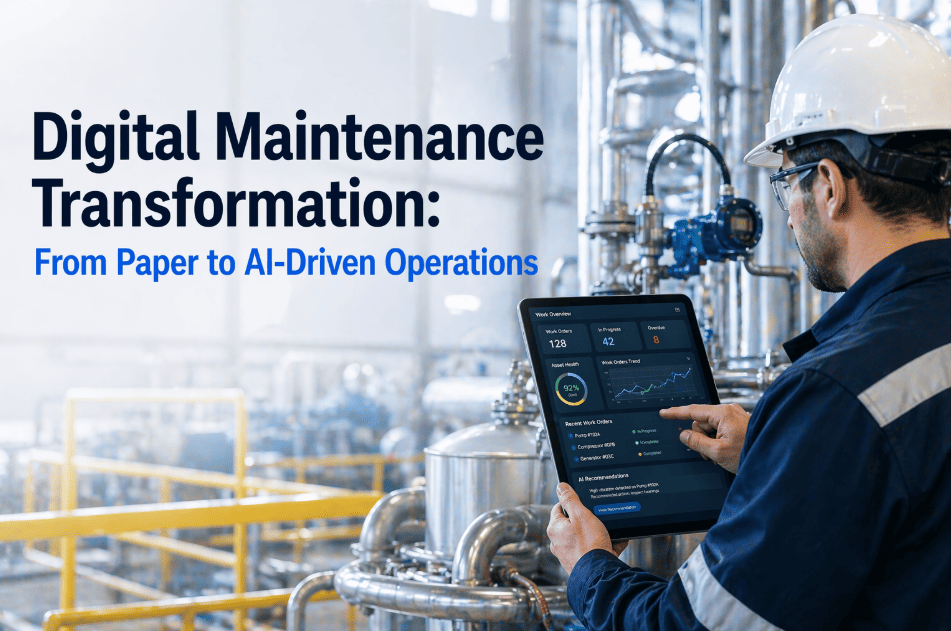
A mid-sized food processing plant in the Midwest ran maintenance out of a filing cabinet until 2023 — work orders on pink carbon-copy forms, PM schedules on a wall whiteboard, asset histories in whatever notebook the senior technician carried in his back pocket. When that technician retired, 22 years of troubleshooting knowledge retired with him. Three months later, a packaging line had 47 hours of unplanned downtime across four separate failures — every one of which the old-timer would have flagged weeks earlier from memory. The paper cost the plant $680,000 in lost production that quarter alone. Digital transformation of maintenance is not a software purchase. It is a preservation strategy for the only thing that keeps industrial operations running: institutional knowledge. If your plant still runs on paper or spreadsheets, sign up to try Oxmaint free for 30 days or book a demo.
The Digital Maintenance Reality — 2026
Maintenance Is Mid-Transformation: The Data Gap Between Paper Plants and Connected Plants Is Widening
57%
Still run to failure
Manufacturing maintenance managers operating reactively in 2025
88%
See significant savings
Facilities with fully implemented CMMS — ranging from tens of thousands to millions annually
800 hrs
Unplanned downtime per year
Average for paper-based operations — at costs up to $17,000 per incident
80%
More time on actual work
Digital maintenance techs vs paper-based peers spend on the tools, not the paperwork
The Four Stages of Maintenance Digitalization — Where Is Your Plant Today?
Maintenance operations move through four distinct eras of digitalization, each building on the one before. Most industrial sites sit between stages two and three, aware of the next step but stuck in the habits of the last one. Understanding which stage the plant is currently at is the starting point for any credible transformation roadmap.
01
Stage 1 — Paper-Based Operations
Work orders on carbon forms, PM schedules on whiteboards, asset history in notebooks
Institutional knowledge lives in individual memories and filing cabinets. When the senior technician retires, decades of troubleshooting walks out the door. Audits become week-long archaeological digs through file rooms. This is where 15–20% of mid-sized plants still operate in 2026.
02
Stage 2 — Spreadsheet and Email
Excel asset lists, Outlook work request routing, shared drives for manuals
The first digital step — and the one most plants get stuck at for far too long. Data exists but lives in 40 different spreadsheets that nobody reconciles. Version control becomes a daily argument. PMs get missed because the schedule email landed in a spam folder. Better than paper, but barely.
03
Stage 3 — Connected Digital CMMS
Cloud CMMS, mobile work orders, centralized asset registry, integrated procurement
The transformational step. One source of truth. Mobile access from the plant floor. PMs scheduled automatically, assigned with documentation, closed with digital signatures. Asset history survives personnel changes. This is where 88% of plants with fully adopted CMMS report significant operational savings.
04
Stage 4 — AI-Driven Operations
IoT sensors, predictive analytics, condition-based work orders, AI-assisted diagnostics
Work orders generated by the equipment itself. Condition-based triggers replacing calendar guesswork. AI pattern recognition catching subtle degradation signatures that no human technician would catch across thousands of data points per shift. The destination — not the starting line.
The Hidden Cost of Paper — Four Line Items That Never Appear on the Budget
Paper-based and spreadsheet-driven maintenance looks cheap because the software cost is zero. The real cost of paper shows up in four budget lines that never get labeled "paper-based operations" but that exist because of them. Book a demo to see how these costs compare in a connected CMMS environment.
01
Technician Time Spent on Paperwork, Not Wrenches
Technicians in paper-based plants spend a measurable fraction of every shift hunting work order details, asset histories, and part locations through files and phone calls. Digital maintenance operations consistently report their technicians spending 80% more time on actual maintenance work versus paperwork.
02
Institutional Knowledge Lost at Every Retirement
When a 20-year veteran retires from a paper-based plant, the playbook for every asset they specialized in retires with them. In a digital operation, that knowledge is captured in work order notes, inspection comments, and asset histories — accessible to every technician who comes after.
03
Compliance Audits Become Archaeological Digs
FDA, EPA, OSHA, and FSMA audits demand maintenance documentation on demand. In a paper-based operation, that means three staff members pulling binders for three days. In a digital operation, the full audit package is a one-click export — and more importantly, the records are actually complete.
04
Predictive Patterns Never Become Visible
Paper logs cannot surface patterns across thousands of data points. Subtle signs of bearing wear, motor degradation, or seal failure go unnoticed until catastrophic breakdown — costing 3–4x more than the planned repair would have. The data was captured. It just was never connected.
Maintenance Transformation Starts Here
From Paper Forms to AI-Driven Operations — One Platform, Four Stages, One Path Forward.
Oxmaint is the platform that most plants use to move from Stage 2 to Stage 3 to Stage 4 — because going directly from paper to AI without the structured data foundation in between is how transformation projects fail.
How Oxmaint Drives Maintenance Digital Transformation — Six Capabilities That Matter
Digital transformation is not a software selection exercise. It is an organizational change program, and the platform either accelerates or obstructs that change. Here is what Oxmaint brings to plants moving from paper or spreadsheets toward connected, predictive operations. Start a free trial to see how each of these works in practice.
01
Mobile-First Work Orders
Technicians log PMs, submit requests, attach photos of failing components, and sign off on completed work from phones — with wet gloves and in loud environments. The single biggest adoption driver in every digital transformation project.
Work order cycle time drops 40–60%
02
Complete Asset Registry With History
Every asset documented with hierarchy, condition score, warranty terms, spare parts, and complete work order history. The knowledge that used to live in someone's head now lives in the asset record — accessible to everyone.
Institutional knowledge preserved across personnel changes
03
Preventive Maintenance Scheduling
Time-based, meter-based, and condition-based PM schedules tied to the asset record. Automated work order generation. No more missed PMs because the email went to someone who left the company. No more emergency repairs for failures that were on next month's calendar.
Reactive maintenance share drops from 40% to 15% typical
04
Audit-Ready Compliance Documentation
Every work order, every PM, every inspection timestamped and digitally signed. Full audit package exports in one click for FDA 21 CFR 117, OSHA, EPA, and internal quality system reviews. Three-day audits become three-hour audits.
Audit preparation time reduced 90%+
05
IoT & SCADA Integration
Connect vibration, temperature, pressure, and condition sensors directly to the CMMS. Work orders triggered by actual asset condition rather than calendar rules. The bridge from Stage 3 connected operations to Stage 4 AI-driven maintenance.
Condition-based PMs replace calendar guesswork on critical assets
06
Analytics, OEE & CapEx Dashboards
Plant performance, asset criticality rankings, reactive-vs-planned ratios, OEE by line, CapEx forecasts — all calculated live from the underlying work order and asset data. Operational decisions driven by data, not gut feel.
Evidence-based maintenance strategy at every management level
Paper vs. Spreadsheet vs. Connected CMMS — Where the Real Cost Lives
Most operations leaders look at CMMS pricing and compare it to zero — the cost of doing maintenance the way it has always been done. The relevant comparison is to the hidden costs of paper and spreadsheets, which add up to considerably more than any subscription fee.
| Operational dimension |
Paper-based |
Spreadsheet-based |
Connected CMMS |
| Single source of truth |
No — multiple paper files |
No — versions scattered across email and drives |
Yes — cloud registry visible to all users |
| Mobile plant-floor access |
Not available |
Limited (manual Excel on phone) |
Native mobile-first workflows |
| Audit documentation speed |
Days — manual file search |
Hours — manual compilation |
Minutes — one-click export |
| PM schedule compliance |
Variable — tied to individual follow-through |
40–60% — tied to whoever owns the spreadsheet |
95%+ — automated scheduling with alerts |
| Institutional knowledge capture |
None — lives in individual memory |
Minimal — scattered notes |
Full — every work order enriches the asset record |
| Predictive pattern analysis |
Not possible |
Not possible |
Built-in — data already structured for analysis |
| Annual downtime hours |
800+ on average |
400–600 typical |
Under 200 on mature implementations |
Frequently Asked Questions
The questions operations leaders bring to digital maintenance transformation evaluations — from single-plant operators to multi-site enterprises.
Our technicians are resistant to digital tools. How do successful CMMS deployments handle this?+
User resistance is the number one cause of failed digital transformation projects. The platforms that succeed are the ones technicians actually want to use — mobile-first interfaces, minimal typing, barcode/QR scanning for asset identification, voice notes for comments. Successful rollouts also include comprehensive training (20–40 hours), peer champions on each shift, and executive sponsorship that reinforces why the change matters. Most plants achieve 85–95% adoption within 6 weeks.
Book a demo to see how the mobile workflow is built for floor reality, not office reality.
How long does a typical digital maintenance transformation take from kickoff to go-live?+
A single-site manufacturing plant with 200–800 assets typically goes live on Oxmaint in 4–8 weeks. Multi-site rollouts phase across 3–6 months, starting with one pilot site to validate the workflow before scaling. Most organizations start seeing measurable operational improvements within 60–90 days of go-live — reduced reactive work ratio, faster work order cycle times, recovered technician hours. Full ROI is typically documented within 10–20 months.
Can we migrate data from our legacy system or from spreadsheets?+
Yes. Oxmaint imports data from Excel, CSV, and major legacy CMMS/EAM platforms. For asset registers, the typical migration cleans up duplicates, fills in missing fields, and establishes a consistent hierarchy — outputs that are genuinely valuable even beyond the platform transition. For work order history, we preserve the record so the new system starts with the full operational context instead of a blank slate.
Do we need IoT sensors deployed before moving off paper?+
No — and trying to do both at once is how transformation projects fail. The right sequence is: (1) get off paper onto connected CMMS with mobile work orders and a complete asset registry, (2) achieve reliable PM compliance and work order data quality, (3) then deploy IoT sensors on the most critical assets for condition-based monitoring. Stage 3 gives you the structured data foundation that Stage 4 AI needs to work at all. Sensors without clean asset data is noise generation, not intelligence.
What ROI should we realistically expect from maintenance digital transformation?+
Research from facilities with mature implementations shows 25–40% maintenance cost reduction, 35–50% OEE improvement, and 88% reporting significant overall savings. Typical investments of $200,000–$600,000 generate $1–3 million in annual operational savings. Most plants recover the full platform cost within the first year through a combination of emergency repair reduction, technician productivity gains, extended asset lifespans, and recovered compliance/audit preparation hours.
Digital Maintenance Transformation — Oxmaint
Stop Losing Institutional Knowledge. Stop Losing Routes to Preventable Failures.
Mobile-first work orders, complete asset registry, automated PM scheduling, audit-ready compliance records, IoT sensor integration, and evidence-based analytics — the platform most plants use to move from paper to connected to AI-driven operations, at the pace that actually works.
25–40%
Maintenance cost reduction documented
88%
Of CMMS adopters report significant savings
4–8 wks
Typical single-site go-live timeline
10–20 mo
To documented full-project ROI