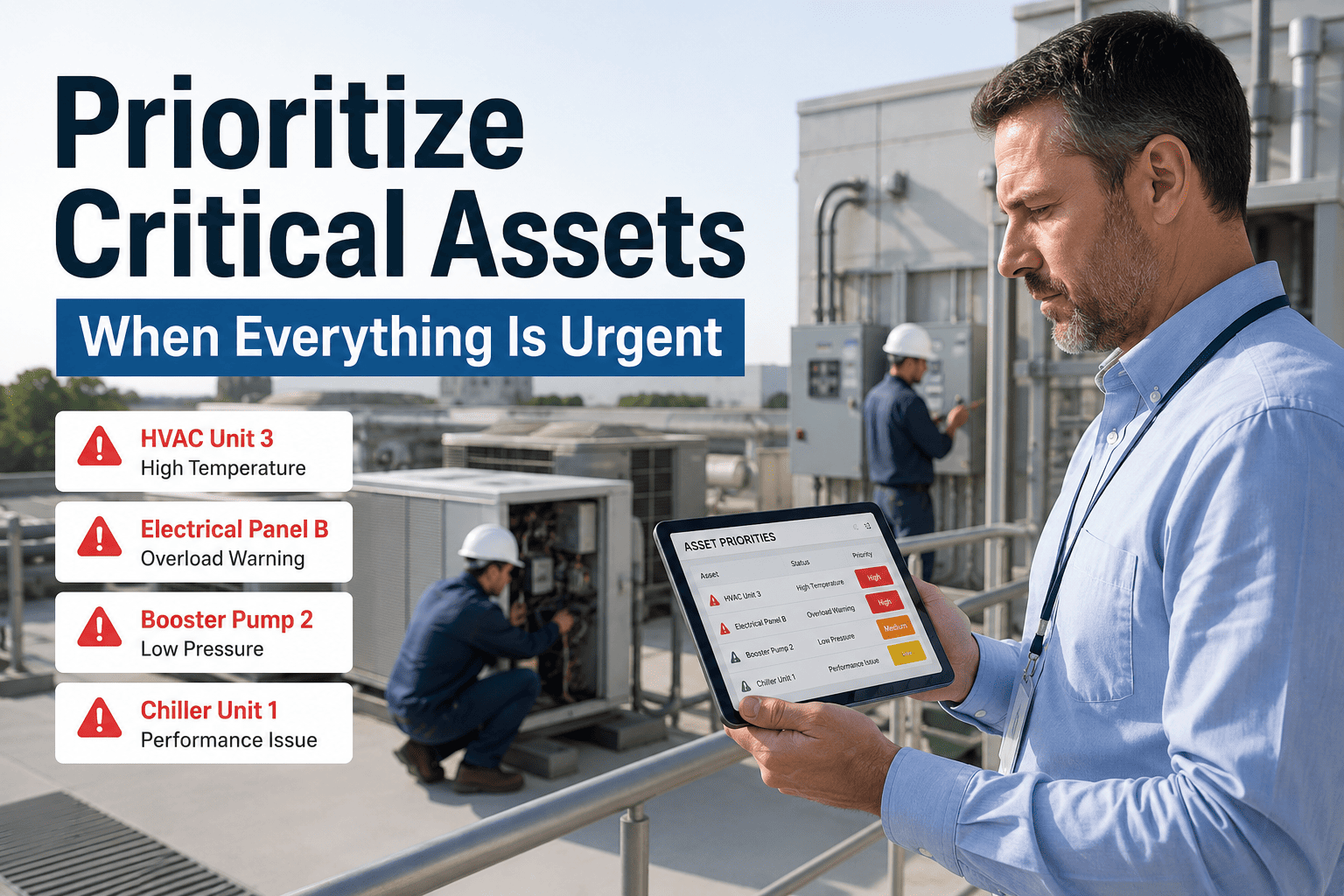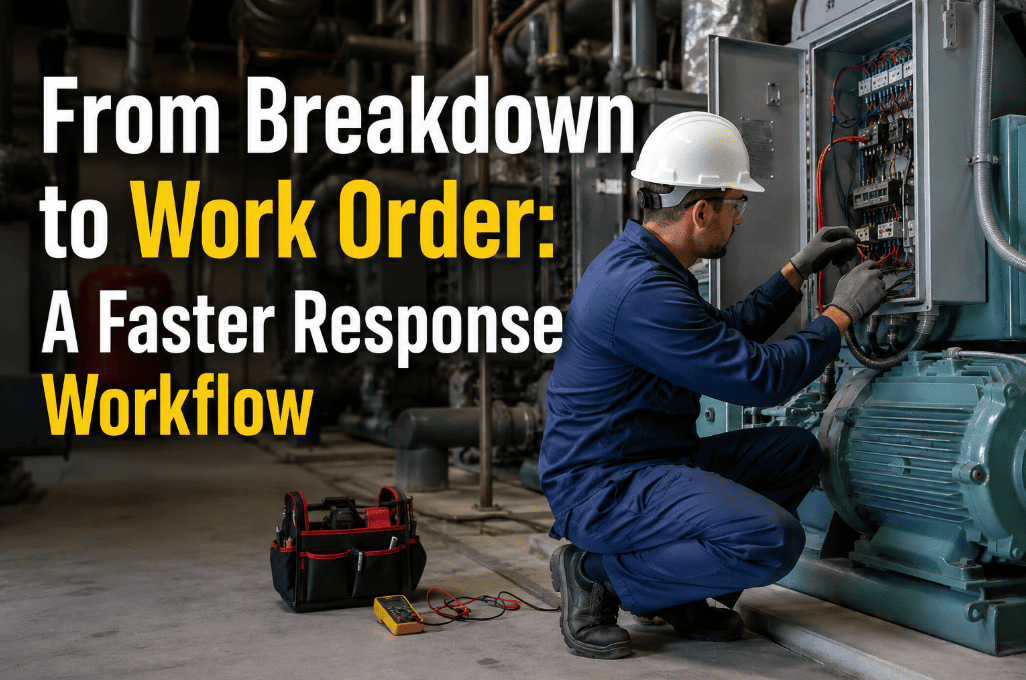
When three systems fail simultaneously on a Monday morning — a roof leak over the server room, a jammed loading dock door, and a flickering ballast in the break room — the maintenance team that triages correctly protects revenue, safety, and asset life, while the team that reacts emotionally spends 4.8x more on emergency repairs that could have been sequenced intelligently. Emergency maintenance triage is not about fixing everything fast — it is about fixing the right thing first, with the right technician, using the right parts, in the right order. According to a 2024 Plant Engineering survey, 52% of maintenance teams report that unstructured emergency response is their single largest source of wasted labor hours. The difference between a chaotic reactive team and a disciplined triage operation is not budget or headcount — it is the decision framework applied in the first 90 seconds after a failure report arrives. Oxmaint gives maintenance leaders a structured triage workflow that ranks, routes, and documents every emergency work order from first alert to final close-out, cutting average emergency response time by 41% and ensuring no critical failure gets buried under low-priority noise. If your team still triages by whoever shouts loudest, start a free trial or book a demo to see how structured triage works in practice.
Emergency Maintenance Triage: How to Decide What Gets Fixed First
Stop guessing which breakdown matters most. Build a repeatable triage framework that protects safety, production, and asset life — and document every decision for compliance and continuous improvement.
Your Team Deserves a Triage System, Not a Guessing Game
Every minute spent debating which breakdown to address first is a minute of downtime on the asset that actually matters most. Oxmaint's priority engine scores every incoming emergency against safety impact, production impact, asset criticality, and available resources — then routes the work order to the right technician with parts availability confirmed before they walk to the job. Want to see how triage scoring works on your real asset list? Start a free trial or book a demo to walk through the priority matrix with our team.
What Is Emergency Maintenance Triage?
Emergency maintenance triage is a structured decision framework that ranks simultaneous or competing urgent work requests by objective criteria — not by who reported it, not by who shouted loudest, and not by which manager has the most political weight. The word "triage" comes from battlefield medicine: when resources are limited and casualties are many, a systematic scoring method determines who gets treated first so that the most lives are saved with the resources available. In maintenance operations, the same principle applies. When a facility has 3 emergency calls and 1 available technician, triage determines which failure gets addressed first based on measurable impact — not gut feeling. Research from Reliabilityweb.com shows that organizations using formal triage criteria resolve critical emergencies 37% faster and experience 28% fewer secondary failures caused by delayed response to the wrong priority. Triage is not about speed alone — it is about sequencing decisions that protect safety, revenue, compliance, and asset life in that order, and triage done well produces documentation that improves future PM planning based on where emergencies actually cluster.
The Four Triage Priority Levels Every Team Needs
A triage system without clearly defined priority levels is just a suggestion box. These four levels — used across healthcare, aviation, military, and industrial maintenance — create a shared language that eliminates debate and accelerates dispatch. Every incoming emergency in Oxmaint is scored against these levels automatically based on asset criticality, failure type, and operational impact.
Six Factors That Determine Triage Priority in the First 90 Seconds
Priority assignment is not subjective when you score against these six factors. Each incoming emergency is evaluated against all six — the combination determines the priority level, not any single factor alone. Oxmaint's triage engine captures all six data points at work order intake and auto-assigns priority based on your facility's configured scoring weights.
Is anyone at risk right now? Active electrical hazard, gas leak, structural failure, or slip/fall conditions automatically escalate to P1. OSHA reports that 14% of workplace injuries involve equipment that was known to be malfunctioning but not yet repaired — triage prevents this by forcing safety-first sequencing on every decision.
Is revenue stopping or degrading? A failed conveyor on a line producing $12,000/hour of product outranks a failed HVAC unit in a storage area. Triage quantifies the cost of delay per hour — teams using revenue-impact scoring reduce total downtime cost by 33% compared to first-come-first-served dispatching.
Is this a Tier 1 critical asset or a Tier 4 convenience asset? Oxmaint's asset registry assigns criticality scores to every asset based on replacement cost, redundancy, and operational dependency. A failure on a non-redundant chiller serving a data center scores differently than a failure on one of four break room microwaves.
Will this failure cause secondary damage if not addressed? A small roof leak over electrical panels creates fire risk. A vibrating bearing left unattended burns out a motor shaft. 23% of catastrophic equipment failures start as minor anomalies that propagated because they were triaged too low — scoring propagation risk separately prevents cascade failures.
Can this actually be fixed right now? A P1 failure requiring a part with a 3-day lead time cannot be resolved immediately regardless of priority — triage factors in whether the repair can actually proceed. Oxmaint checks spare parts inventory at work order creation and flags resource gaps before the technician is dispatched to avoid wasted trips.
Does delaying this repair create a compliance violation? A failed emergency exit light, a broken fire door closer, or a non-functional exhaust system in a chemical storage area are all compliance events with time-limited correction windows. Regulatory exposure bumps triage priority independent of production impact because the cost of a citation or shutdown order exceeds the cost of the repair.
How Oxmaint Turns Triage from a Debate into a Workflow
Oxmaint does not just record emergencies — it triages, routes, escalates, and documents them automatically. The system eliminates the hallway arguments about what gets fixed first by applying your configured priority rules to every incoming request before a supervisor even sees it. Teams using Oxmaint's triage workflow report 41% faster emergency resolution and 67% better documentation compliance on emergency work orders. Ready to replace chaos with a system? Start a free trial or book a demo to see the triage engine in action.
Every emergency work order is scored against your configured criteria — safety, production, asset criticality, propagation risk — and assigned a priority level before it reaches the dispatcher. No manual ranking, no debates, no politics.
Oxmaint matches the emergency to the nearest available technician with the required skill set and certifications. A P1 electrical failure does not get routed to the HVAC tech — it goes to the qualified electrician closest to the asset.
Before dispatching, Oxmaint checks whether the likely repair parts are in inventory at the nearest storeroom. If parts are unavailable, the system flags the gap and suggests interim containment — preventing wasted technician trips to jobs that cannot be completed.
P1 not acknowledged in 15 minutes? Oxmaint auto-escalates to the maintenance supervisor. P2 still open after 1 hour? The operations manager gets notified. No emergency falls through the cracks because someone was on lunch break.
Technicians update work order status from their phone — en route, on site, diagnosing, parts needed, repair complete. Operations managers see real-time status on every active emergency without calling, texting, or walking the floor.
Every closed emergency work order prompts root cause classification. Was it wear-based? Operator error? PM gap? Missing inspection? This data feeds back into PM scheduling — converting today's emergency into tomorrow's prevented failure. Teams using root cause tracking reduce repeat emergencies by 34%.
Unstructured Response vs. CMMS-Managed Triage
Measured Results from Structured Triage Programs
Structured triage eliminates the 20-40 minute debate phase that unstructured teams burn before any wrench turns
Root cause tracking on every closed emergency converts reactive firefighting into preventive PM improvements
Digital work orders with mandatory fields capture what paper logs miss — timestamps, photos, parts used, root cause
Reduced wasted trips, fewer secondary failures, and shorter downtime windows add up to measurable cost reduction
Frequently Asked Questions
How do you triage when two P1 emergencies happen simultaneously?+
Can triage priority be overridden manually when needed?+
How long does it take to set up triage rules in Oxmaint?+
Does triage work for multi-site operations with different asset types?+
Stop Debating What Gets Fixed First — Let the System Decide
Every minute your team spends arguing about priority is a minute your critical asset sits broken. Oxmaint's triage workflow scores, routes, escalates, and documents every emergency automatically — no implementation project, no consultant, no six-month rollout. First automated triage work orders process in week one.