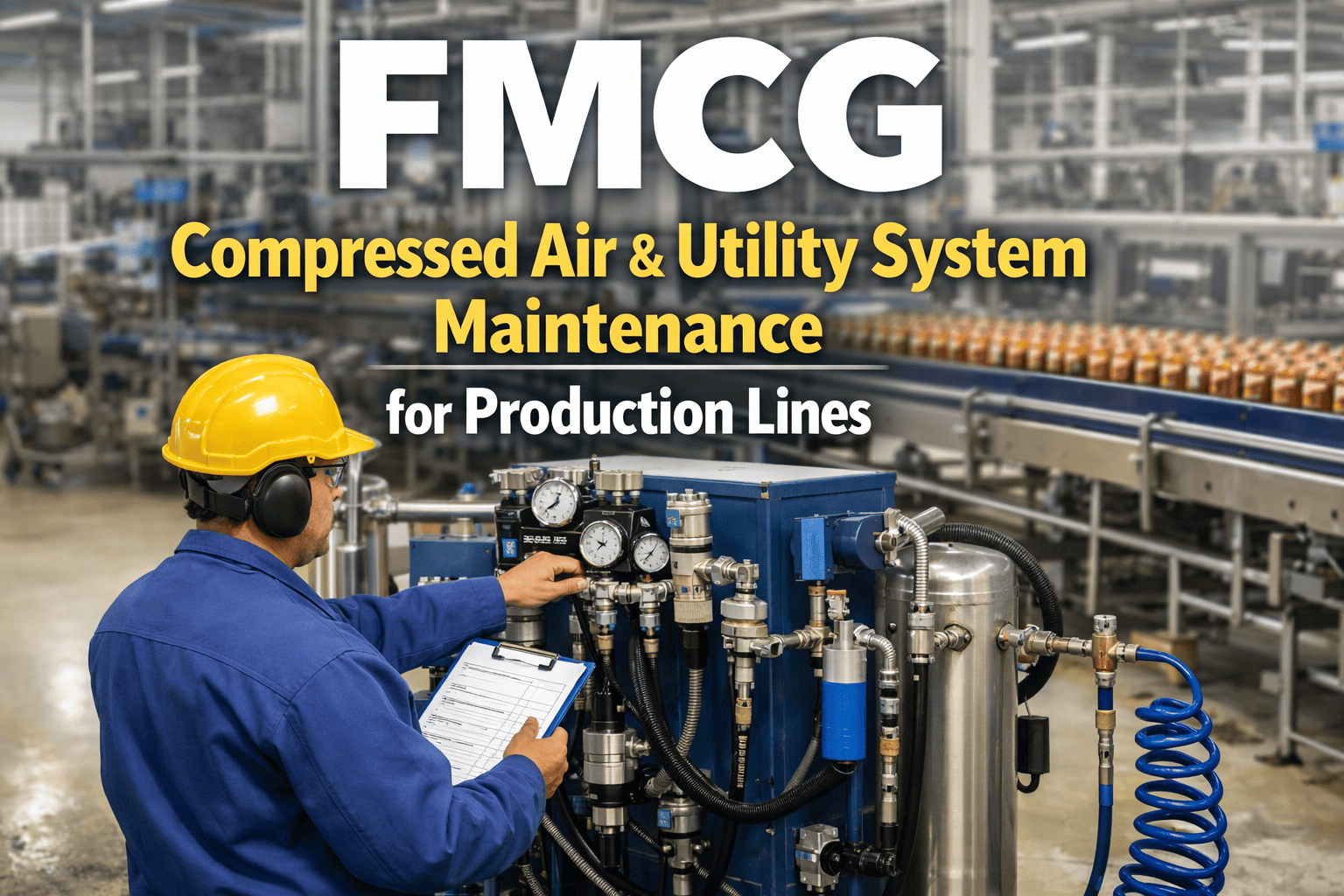
Before Oxmaint, this multi-national FMCG manufacturer was running 12 packaging lines at a portfolio average of 71% OEE. Breakdowns consumed 14% of available production time. Changeovers averaged 52 minutes per SKU switch. The maintenance team was spending 68% of its budget on reactive emergency repairs at 4.8 times the planned repair cost. The plant produced 140 SKUs across beverage filling, snack packaging, and personal care lines — a high-changeover, high-complexity operation where every minute of unplanned downtime compounded across production schedules already running at capacity. 18 months after deploying Oxmaint CMMS with full OEE tracking, autonomous maintenance digitalisation, IoT condition monitoring, and structured kaizen — 12 packaging lines reached a portfolio average OEE of 92%. Changeover time dropped to 34 minutes. Breakdown frequency fell 60%. The maintenance budget reactive share dropped from 68% to 19%. Sign up free on Oxmaint to start your OEE baseline today, or book a demo to see how OEE improvement is measured and managed across a multi-line FMCG plant.
Case Study
How an FMCG Plant Achieved 92% OEE Across 12 Packaging Lines with CMMS
9 min read
Plant Profile
Multi-national FMCG manufacturer · 12 packaging lines · 140 SKUs · beverage, snack, and personal care production
Baseline Problem
71% average OEE · 52-min changeovers · 68% reactive maintenance · 14% available time lost to breakdowns
Solution Deployed
Oxmaint CMMS · OEE Dashboard · AM mobile checklists · IoT condition monitoring · TPM Module
Primary Result
92% portfolio OEE · 60% fewer breakdowns · 35% changeover reduction · 18-month deployment
92%
Portfolio average OEE across 12 packaging lines at Month 18 versus 71% pre-deployment baseline
60%
Reduction in breakdown frequency across all 12 lines — from 14% to 5.6% of available production time lost to unplanned stops
35%
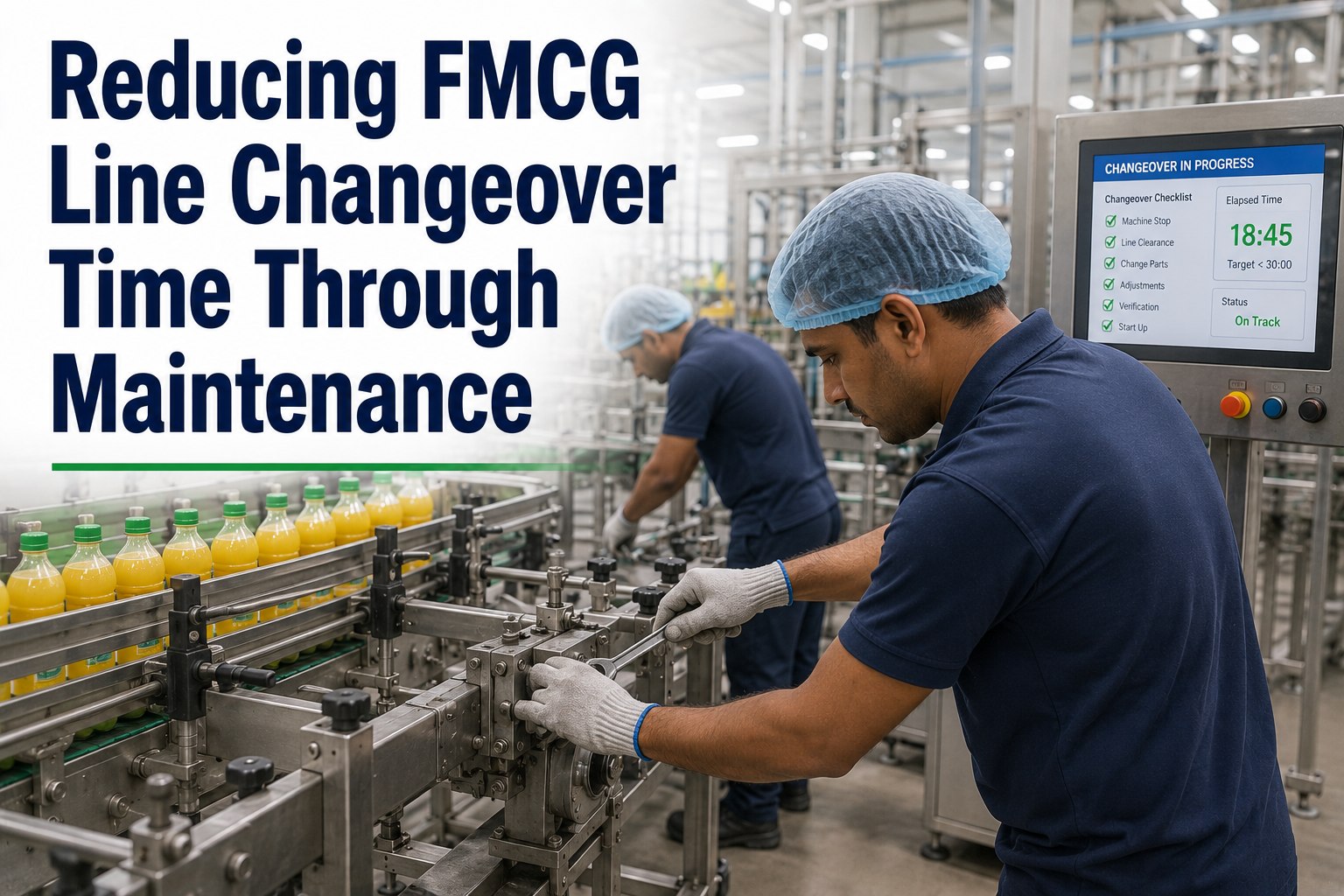
Changeover time reduction — from 52 minutes to 34 minutes per SKU switch across high-complexity packaging lines
72%
Reduction in reactive maintenance share — from 68% of maintenance budget to 19% within 18 months of Oxmaint deployment
Case Summary
Before deployment, this plant had no digital OEE tracking — breakdown events were logged manually and never categorised by the Six Big Loss framework. Changeover time was measured by operators with stopwatches and recorded on paper. PM schedules existed in spreadsheets and were regularly skipped under production pressure with no visibility to management. The maintenance team had no mobile access to work orders, no condition monitoring on critical assets, and no parts reservation system. Maintenance budget overruns were a quarterly occurrence driven by emergency repairs that could have been prevented. Oxmaint was deployed starting with a two-line pilot in Month 1. By Month 3, the pilot lines showed 11% OEE improvement with documented kaizen results. By Month 18, all 12 lines were on the Oxmaint OEE dashboard, autonomous maintenance compliance exceeded 90%, and the plant achieved 92% portfolio OEE — a result that was previously considered achievable only in Japanese automotive plants.
The Problem: A High-Complexity FMCG Plant Running Without OEE Visibility
140 SKUs across 12 lines means the plant executes multiple changeovers per line per day. In this environment, every minute of unplanned downtime, every extended changeover, and every quality reject compounds through a production schedule with no buffer. The problems below were structural — not resolvable by working harder with the existing system.
01
OEE Was an Estimate, Not a Measurement
Production reported OEE weekly using end-of-shift logs completed by operators on paper. Stoppage reasons were not categorised — every event was recorded as "breakdown" regardless of cause. The resulting OEE number was the plant's best estimate of its own performance, not a measurement. Without stoppage reason codes, no kaizen team could identify whether availability loss came from breakdowns, changeovers, or minor stoppages — so no improvement was targeted at the right loss category.
02
PM Schedules Existed But Were Not Enforced
The maintenance manager had built PM schedules in a spreadsheet covering all 12 lines. Under production pressure, PM tasks were regularly deferred — with no automated escalation, no supervisor visibility, and no system record that the deferral had occurred. PM compliance was estimated at 54% by the maintenance team. The actual rate, measured during the Oxmaint baseline assessment, was 41%. Deferred PM was the direct cause of the 14% availability loss from breakdowns — not inadequate maintenance skill.
03
Changeover Time Had No Structured Improvement Target
Changeover duration varied between 38 and 72 minutes across the same packaging line depending on which operator performed the change. No standardised changeover sequence existed, no format part condition record was maintained, and no distinction was made between internal and external activities. The 52-minute average was accepted as inherent to the product mix. SMED analysis under Focused Improvement revealed 60% of changeover activities could be externalised or eliminated without any capital investment.
04
Reactive Maintenance Consumed 68% of the Maintenance Budget
Emergency repairs at 4.8 times the planned cost were generating quarterly budget overruns that leadership attributed to "aging equipment." The equipment was not the problem — the sealing machines, filling lines, and labellers were all within their engineered service life. The root cause was the 41% PM compliance rate that left known failure modes unaddressed until they became production-stopping breakdowns. The maintenance team was experienced and skilled. The system around them prevented planned maintenance from happening.
The Deployment: What Oxmaint Activated and in What Sequence
Month 1 to 2 — Pilot Lines Setup
OEE Baseline Established on Lines 1 and 2
Two beverage filling lines selected as the pilot based on highest downtime frequency and greatest leadership visibility. Oxmaint OEE tracking activated — downtime events recorded on mobile by operators with Six Big Loss reason codes. PM schedules migrated from the spreadsheet to Oxmaint with automated work order generation. Autonomous maintenance checklists deployed on mobile for all 12 operators on the two pilot lines. Baseline OEE at Month 1: Line 1 at 69%, Line 2 at 67%. PM compliance at Month 1 actual measurement: 41%.
Month 3 to 4 — First Kaizen Results
11% OEE Improvement on Pilot Lines — Business Case Proven
Oxmaint stoppage reason code data from the first two months identified the top three breakdown causes on the pilot lines: sealing jaw wear undetected between manual inspections, lubrication interval overrun on the filler main drive, and minor stoppages from label feed sensor fouling. Three kaizen teams formed. Sealing jaw inspection added to AM checklist. Lubrication PM interval shortened and automated in Oxmaint. Label sensor cleaning added to operator daily routine. By Month 4: Line 1 OEE reached 80%, Line 2 reached 78%. PM compliance reached 87%. Results presented to plant leadership — expansion approved for all 12 lines.
Month 6 to 8 — The Pivotal Expansion
All 12 Lines on Oxmaint OEE Dashboard — Changeover Kaizen Launched
Oxmaint deployed to all 12 packaging lines. Portfolio OEE dashboard activated showing all 12 lines' Availability, Performance, and Quality in real time. IoT condition monitoring activated on critical assets across all lines — sealing jaws, filler drives, labeller motors, and thermoformer heat elements connected to Oxmaint via REST API. First predictive work order generated on Month 7: filling line drive vibration deviation detected 3 weeks before bearing failure would have caused a production stop. Planned replacement cost: $2,400. Avoided emergency replacement cost: $11,600. SMED changeover kaizen launched on all snack packaging lines — standardised changeover sheets, operator video training, and format part condition records activated in Oxmaint for every format set across all 140 SKUs.
Month 12 — Mid-Programme Review
Portfolio OEE at 86% — Changeover Time Down to 38 Minutes
12-month review: portfolio average OEE reached 86% across all 12 lines. Breakdown frequency reduced 48% from baseline. Changeover time at 38 minutes average versus 52 minutes at programme start. PM compliance at 91%. The maintenance team reported that reactive work orders had dropped from 68% to 31% of total maintenance events. The plant produced the equivalent of 14 additional production days per year from OEE improvement — without adding headcount, capital equipment, or floor space. Monthly TPM review meetings established with Oxmaint OEE dashboard as the meeting data source.
Month 18 — Programme Completion
92% OEE Portfolio Average — World-Class Performance Achieved
Month 18 final results: 12-line portfolio OEE of 92%. Breakdown frequency down 60% from baseline. Changeover time at 34 minutes versus 52 at start. Reactive maintenance share down from 68% to 19% of maintenance events. Quality reject rate reduced from 2.8% to 0.9% from Quality Maintenance pillar improvements to seal jaw and fill head calibration standards. Annual maintenance cost saving of $420,000 from reactive premium elimination. Equivalent production capacity recovered from OEE improvement: the equivalent of 31 additional production days per year across the 12-line plant.
Results: Year 1 and Month 18 Outcomes
All results measured against the pre-deployment OEE baseline established in Month 1 before any Oxmaint TPM activities began. Every result was tracked in Oxmaint's OEE Dashboard and verified against production records.
Portfolio OEE
92%
12-line average at Month 18 versus 71% baseline — world-class performance achieved on FMCG packaging lines
Breakdown Reduction
60%
Fewer breakdown events across all 12 lines — availability loss from breakdowns down from 14% to 5.6% of production time
Changeover Time
34 min
Average changeover duration down from 52 minutes — 35% reduction delivering multiple additional production runs per line per day
91%
PM compliance rate at Month 18 versus 41% actual pre-deployment — automated work order generation eliminated deferred PM entirely
19%
Reactive maintenance share at Month 18 versus 68% baseline — the 4.8x cost premium eliminated on 72% of previously reactive repair events
$420K
Annual maintenance cost saving from reactive premium elimination — calculated from emergency repair cost reduction across all 12 lines
31 days
Equivalent additional production days per year recovered from the 21-percentage-point OEE improvement — without adding equipment or headcount
Before and After: Key Metrics
Deployment Cost (CMMS + IoT)
$280,000
18-month total including software, IoT sensors, and onboarding
Annual Maintenance Saving
$420,000
Reactive premium elimination across 12 lines annually
Production Capacity Recovered
31 days/yr
Equivalent additional production days from 21-pp OEE gain
"We had experienced maintenance engineers and motivated operators. The system was the problem, not the people. We had no OEE measurement that we could trust, no PM enforcement that production could not override, and no visibility into whether changeover times were improving or not. Three months after we launched the Oxmaint pilot on lines one and two, we had more reliable production data than we had ever produced in the plant's ten-year history. By month 18, we were running at 92% OEE across all twelve lines. The thing that surprised us most was the changeover improvement — we had assumed 50-minute changeovers were inherent to our product mix. They were not. They were a process problem that SMED kaizen and Oxmaint format part tracking solved in four months."
Plant Director
12-Line FMCG Packaging Plant · 140 SKUs · Multi-National Consumer Goods Manufacturer
Frequently Asked Questions
FMCG OEE Improvement: What Plant Managers Ask About This Programme
QHow did the plant achieve 92% OEE without capital investment in new equipment?
Every improvement came from using existing equipment better — not from replacing it. PM compliance improvement prevented the breakdowns that consumed availability. AM operator engagement eliminated the minor stoppages that suppressed performance. SMED changeover kaizen reduced setup time. Quality Maintenance reduced the defect rate. The equipment was capable of 92% OEE throughout — the system around it was not.
Sign up free to establish your OEE baseline, or
book a demo to see how Oxmaint structures the improvement programme for your line types.
QHow was changeover time reduced from 52 minutes to 34 minutes without SMED capital investment?
SMED analysis revealed that 60% of changeover activities on the snack packaging lines could be externalised or eliminated. Standardised changeover sheets, operator video training with before and after times displayed on the production board, and format part condition tracking in Oxmaint delivered the reduction. No capital investment was required — only process standardisation and digital format part management. The variability between operators (38 to 72 minutes for the same line) collapsed to a 30 to 38-minute band within 8 weeks.
Book a demo to see format part and changeover tracking, or
sign up free to register your format parts as assets today.
QCan a plant with 12 or more production lines realistically achieve 90%+ OEE with Oxmaint?
Yes — but not all at once. This plant succeeded because it started with a two-line pilot, documented real results at Month 4 before requesting approval to expand, and replicated the proven process line by line. Attempting simultaneous plant-wide launch on 12 lines would have overloaded the maintenance team and produced no documented results. The pilot-and-expand model is the only approach that sustains OEE improvement to world-class levels in multi-line FMCG operations.
Sign up free to start your pilot line OEE baseline, or
book a demo to model the deployment sequence for your line count.
QWhat is the minimum OEE baseline measurement period before starting TPM activities?
A minimum of two full production weeks on the pilot line, with every stoppage event recorded against Six Big Loss reason codes. Without a documented pre-improvement baseline, OEE improvement is invisible to management — there is no "before" number to compare against. This plant measured for four weeks before any TPM activity started, which gave the data quality needed to form targeted kaizen teams rather than general improvement initiatives.
Sign up free to activate OEE baseline tracking immediately, or
book a demo to see OEE measurement setup for your equipment types.
Oxmaint CMMS + OEE Dashboard | FMCG Manufacturing | 92% OEE in 18 Months
92% OEE. 60% Fewer Breakdowns. 35% Faster Changeovers. 31 Additional Production Days Per Year. Same Equipment. Same Team. Different System.
OEE Dashboard
AM Mobile Checklists
Automated PM Scheduling
Kaizen Action Tracking
Format Parts Asset Management
IoT Condition Monitoring