Tracking total downtime hours tells you how bad the problem is. Tracking downtime by reason code tells you exactly where to fix it. OxMaint's downtime tracking module classifies every minute of lost production against a specific cause — mechanical, electrical, operational, parts delay, or vendor — so your maintenance decisions are based on root cause data, not gut feel.
Guide · Downtime Tracking
How to Track Asset Downtime by Reason Code
Classifying downtime by cause category is the single most impactful step a maintenance team can take toward reducing it. Here's the complete system — from code setup to monthly reporting.
23%
Average downtime reduction after reason code tracking is implemented
$82K
Median annual savings per production line from targeted downtime elimination
60 days
Typical time to first actionable insight after reason code rollout
The 5 Core Reason Code Categories
These five categories cover over 95% of all industrial asset downtime events. Each maps to a different responsible team, budget line, and corrective strategy — which is exactly why separating them matters.
M
Mechanical
Component wear, bearing failure, seal leaks, structural breaks. Owned by maintenance. Reducible through better PMs and condition monitoring.
38% of events
E
Electrical
Motor failures, control system faults, wiring issues, sensor failures. Often requires electrical specialist. Fast diagnosis = fast recovery.
22% of events
O
Operational
Operator error, incorrect settings, process parameter exceedances. Owned by operations. Training and SOPs are the primary fix.
18% of events
P
Parts Delay
Asset ready to repair but waiting on parts or materials. Owned by procurement/stores. Drives min-max stocking strategy decisions directly.
14% of events
V
Vendor / OEM
Waiting for specialist contractor or OEM service. Owned by procurement. Contract SLAs and approved vendor lists are the lever.
8% of events
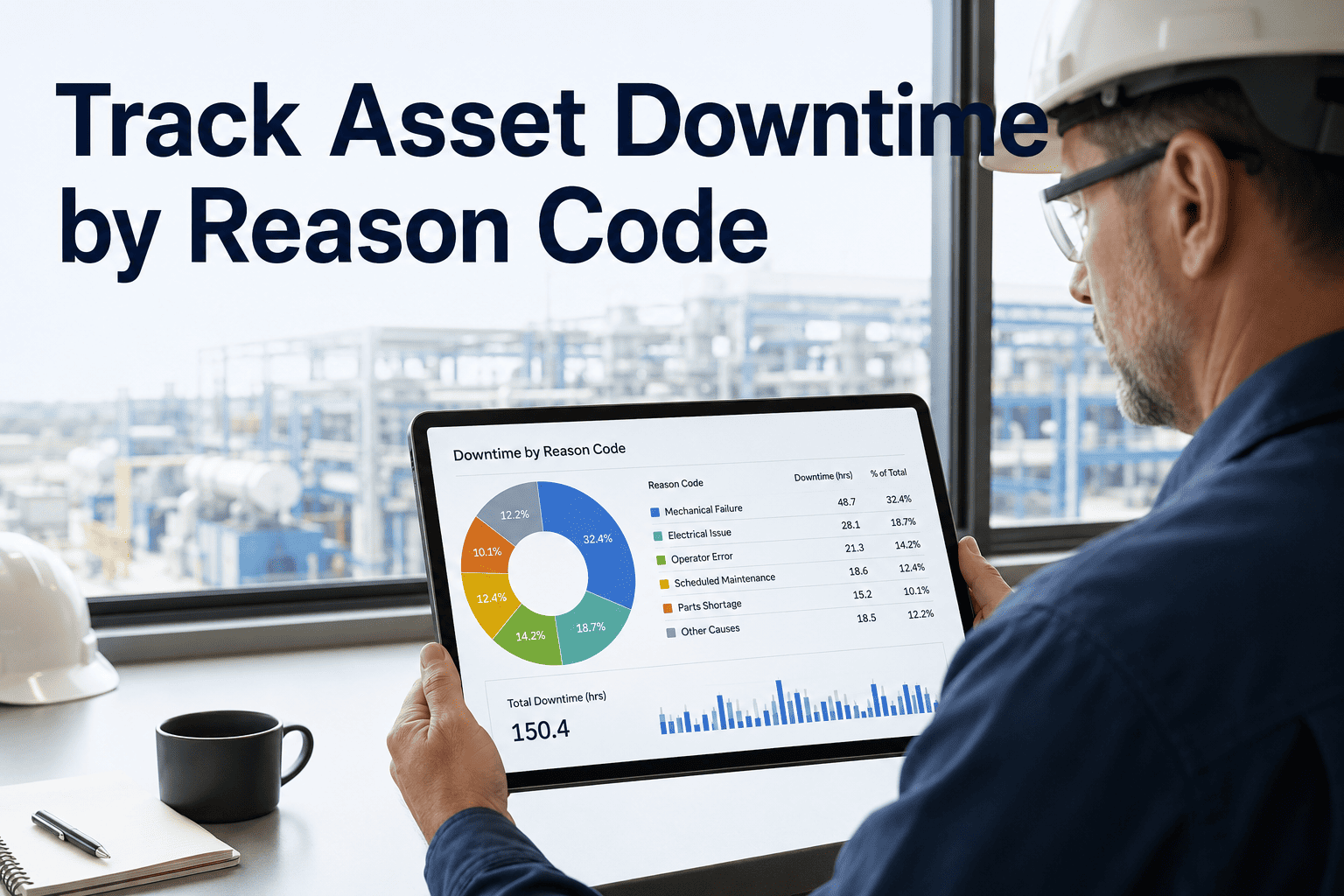
Downtime Distribution: What Most Plants Look Like
This benchmark distribution represents average data from mid-size manufacturing facilities. Your actual mix will differ — but the pattern of mechanical dominance is nearly universal.
How to Implement Reason Code Tracking in 3 Phases
Phase 1 — Setup (Week 1–2)
- Define your 5 core codes in your CMMS
- Add sub-codes for top 3 failure modes per category
- Make reason code a required field on all corrective work orders
- Brief all technicians on code definitions with real examples
Phase 2 — Data Collection (Week 3–8)
- Run every corrective WO with mandatory reason code entry
- Supervisor spot-checks code accuracy at weekly standups
- Flag any "unknown" or "other" codes for immediate reclassification
- Build 30-day baseline before drawing conclusions
Phase 3 — Analysis and Action (Month 2+)
- Run monthly downtime report sorted by reason code and asset
- Identify top 3 code-asset combinations driving most hours
- Assign owner and corrective action to each top-3 combination
- Measure month-over-month reduction per code category
OxMaint Downtime Tracking
Every Downtime Event, Coded, Tracked, and Reportable in One Click.
OxMaint's downtime module captures reason codes at work order close, calculates MTTR by code category, and generates monthly reports that show exactly which downtime causes to tackle first — with no manual data work required.
Expert Review
"Most plants track downtime hours but not downtime causes. That's like tracking your hospital admission rate without tracking why people got sick. Once you break downtime into reason codes, two things always happen: Parts delay turns out to be far more significant than anyone expected, and operational causes that were being blamed on maintenance get correctly attributed. The blame shifts, the conversations change, and budgets get redirected to what actually needs fixing. I've seen this transform maintenance planning at every site where it's been properly implemented."
— Plant Reliability Manager, 16 years in automotive and heavy industry maintenance improvement
Frequently Asked Questions
What if technicians enter incorrect reason codes?
Data quality degrades fast without supervisor oversight. Build a weekly audit into your process: review all work orders closed in the past 7 days and flag any with missing, vague, or inconsistent codes. The real problem is usually definitions — technicians aren't sure what counts as "mechanical" vs "operational." Fix this with a one-page code reference card posted in the maintenance office.
OxMaint includes required-field enforcement so no WO can close without a reason code selected.
How do we handle downtime with multiple contributing causes?
Use a primary and secondary code structure. The primary code reflects the root cause — what actually caused the failure. The secondary code reflects what extended the downtime — often a parts delay or vendor wait. Tracking both gives you a more accurate picture than forcing a single code. Most CMMS platforms support dual-code entry, and it significantly improves the accuracy of your monthly analysis without adding much data entry burden on the technician.
How long before reason code data becomes statistically meaningful?
For high-frequency assets with multiple events per month, 30 days is enough to see clear patterns. For lower-frequency failures, you'll need 60 to 90 days before drawing firm conclusions about which codes dominate. The important thing is not to delay implementing reason codes while waiting for a "large enough" dataset — start immediately, run monthly reviews, and the patterns will emerge naturally as data accumulates.
Book a demo to see how OxMaint's downtime dashboards surface trends automatically.


.png)


