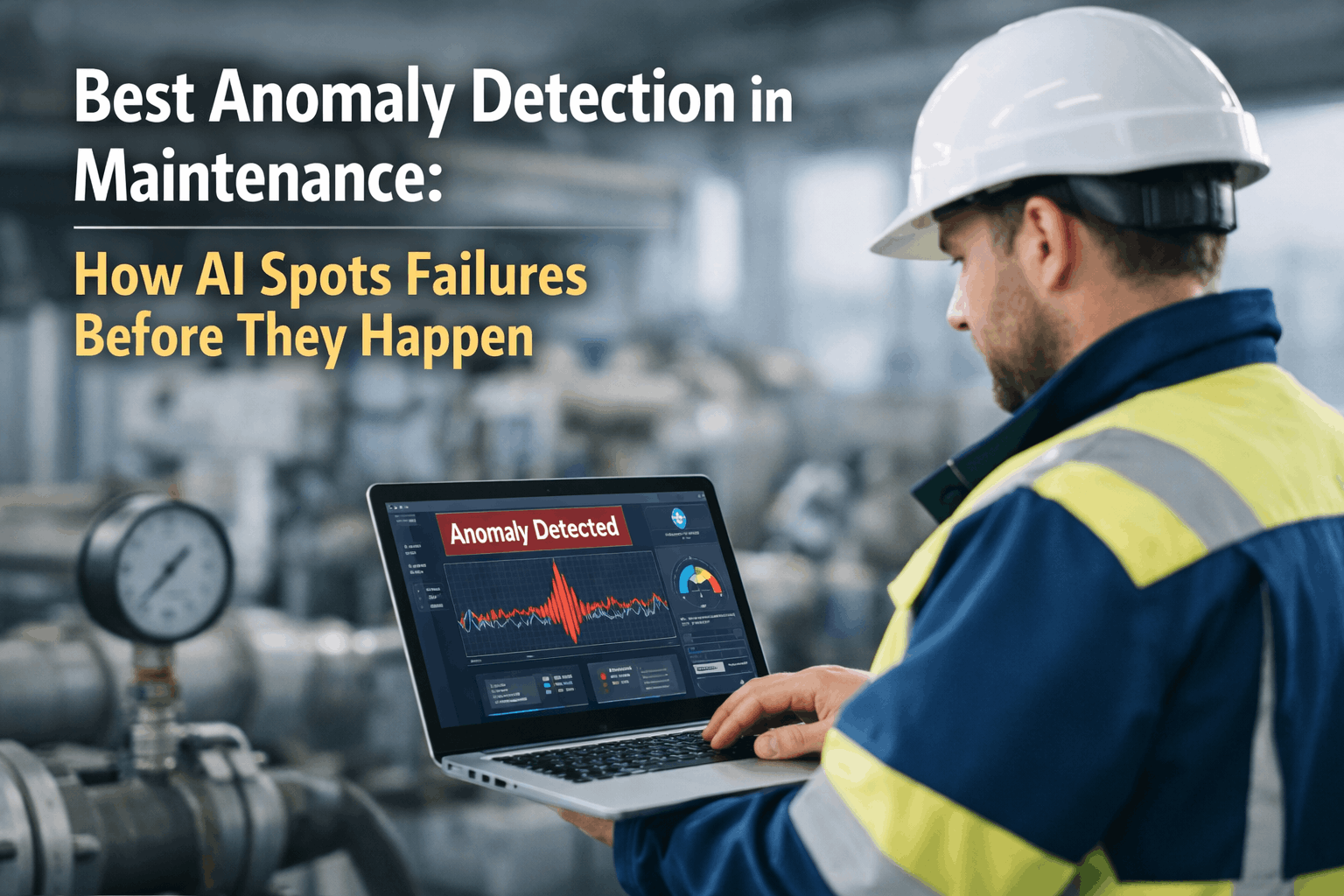
A bearing failure on a rolling mill main drive does not happen without warning. In the weeks before the seizure that stops production and triggers a 12-hour emergency repair, the bearing's vibration signature changes — subtle shifts in the frequency spectrum that a human technician performing a monthly visual inspection will never detect, but that an accelerometer mounted on the bearing housing captures continuously. The acoustic emission profile changes as microscopic surface fatigue begins. The temperature rises at a rate too slow to feel with a hand, too consistent to be ambient variation. The oil film thickness analysis from a sample taken three weeks earlier showed a change in metal particle count that was within the normal range — but trending. Each of these signals, individually, is ambiguous. Collectively, integrated by a machine learning model trained on thousands of similar bearing failure sequences, they constitute a prediction that this specific bearing will fail within the next 14–21 days at the current load profile. That prediction is available now, three weeks before the failure, with enough lead time to schedule a planned bearing replacement during the next maintenance window. The production line does not stop. The emergency repair cost is not incurred. The model learned this from the data your sensors are already generating. Sign up for Oxmaint to connect your sensor data to AI-driven failure prediction today.
What AI Actually Reads — The Six Industrial Sensor Data Streams That Feed Failure Prediction
AI equipment failure prediction is not magic. It is pattern recognition operating on sensor data streams that industrial assets generate continuously. The question is not whether the data exists — it almost always does, in assets that have been instrumented for decades. The question is whether a machine learning model is consuming that data and detecting the failure patterns it contains before they manifest as unplanned downtime. Sign up for Oxmaint to connect your sensor data to AI-driven failure prediction.
Vibration frequency spectra from accelerometers mounted on rotating equipment bearings, gearboxes, and pump impellers carry the earliest detectable signatures of component wear. Bearing defect frequencies (BPFO, BPFI, BSF, FTF) appear in the spectrum weeks before audible noise begins. AI models trained on vibration data from hundreds of similar machines can identify defect frequency emergence at amplitudes too low for human interpretation.
Temperature elevation is one of the most reliable early warning signals for mechanical and electrical failure. A bearing losing its lubrication film, a motor winding developing insulation breakdown, an electrical connection increasing in resistance — all produce heat before they produce visible failure. Thermal cameras and RTD sensors track temperature trends against baseline, and AI distinguishes process-related temperature changes from equipment degradation signals.
Acoustic emission sensors capture stress wave energy released by microscopic crack propagation, friction, and material deformation — all at frequencies far above human hearing range. These signals precede detectable vibration changes in bearing fatigue progression by days to weeks. Ultrasonic sensors are particularly valuable for compressed air and steam leak detection, where even 1mm leak orifices produce characteristic ultrasonic signatures that are invisible to any other measurement method.
The current draw of an electric motor contains a detailed signature of the mechanical load it is driving. A pump developing cavitation, a conveyor belt with increasing drag from a misaligned bearing, a compressor with a worn valve plate — all produce characteristic current modulation patterns that AI can extract from the motor's current waveform. Current monitoring requires only a current transformer on the motor supply cable — no physical contact with the rotating equipment needed.
Oil sample analysis from gearboxes, hydraulic systems, and lubricated bearings provides a direct chemical record of the wear occurring inside the sealed system. Ferrous particle count trending — the rate at which iron particles are accumulating in the oil per operating hour — is one of the highest-confidence indicators of imminent gear or bearing failure. AI trend analysis on oil sample data produces remaining useful life projections with specific confidence intervals rather than simple pass/fail results.
Process parameters — pump differential pressure at rated flow, compressor discharge temperature at rated pressure ratio, heat exchanger approach temperature — are efficiency metrics that degrade as equipment condition deteriorates. A pump producing 8% less head than its rated design point at a measured flow rate is showing evidence of impeller wear that a vibration sensor alone would not detect at this stage. AI correlates process efficiency trends with equipment condition across the full sensor array. Book a demo to see process parameter deviation monitoring in Oxmaint.
How Machine Learning Actually Identifies Failure Patterns — Four Model Types in Industrial Use
Different failure prediction problems require different machine learning approaches. A bearing defect detected from vibration frequency analysis uses different model architecture than a pump cavitation event predicted from process parameter correlation. Understanding which model type applies to which failure mode helps maintenance teams evaluate AI predictive maintenance capabilities accurately. Sign up for Oxmaint to activate AI failure pattern detection across your asset register.
The most widely deployed industrial AI model type. The algorithm learns the normal operating signature of each asset across all sensor streams — what vibration, temperature, pressure, and current patterns look like during healthy operation at different loads, speeds, and ambient conditions. When the real-time sensor reading diverges from the learned normal pattern beyond a statistically defined threshold, the model flags an anomaly regardless of whether a human has previously labelled that pattern as a failure precursor. No historical failure data required — the model trains on normal operation data only.
Best for: rotating equipment with stable operating conditionsSupervised regression models trained on historical failure sequences produce a specific remaining useful life estimate — "this bearing has approximately 18 ± 5 days before failure at current load profile" — rather than a binary anomaly flag. These models require historical training data that includes run-to-failure sequences from the same equipment type, so they produce the most accurate predictions on common equipment classes where significant failure history data exists. RUL models are particularly valuable for scheduling planned maintenance windows because they provide a specific time-to-action rather than just an alert that something is changing.
Best for: high-volume equipment types with failure history dataClassification models predict not just that a failure is approaching but which specific failure mode is developing — distinguishing between inner race defect, outer race defect, and rolling element defect from the same bearing's vibration spectrum, or identifying cavitation versus seal leakage versus impeller wear from a centrifugal pump's sensor array. This fault type specificity enables parts pre-staging before the repair begins, because the maintenance team knows in advance whether to order an inner race bearing, a complete bearing assembly, or a shaft seal. These models require labelled training data from each fault class.
Best for: complex assets where fault type determines repair actionThe most sophisticated industrial AI approach combines sensor data with physics-based equipment models. Rather than purely statistical pattern matching, the AI knows that a heat exchanger with a 5°C rising approach temperature at constant flow and inlet conditions must have a specific fouling level — and can calculate the remaining heat transfer capacity before the exchanger reaches its process limit. These physics-informed models require domain expertise to configure but produce the most interpretable and reliable predictions because their outputs can be validated against engineering calculations rather than relying solely on statistical correlation. Sign up to see physics-informed models in Oxmaint.
Best for: thermal, fluid, and process equipment where physics is well-characterisedFrom Raw Sensor Reading to Planned Work Order — The Five-Step AI Prediction Pipeline
Understanding how raw sensor data becomes a scheduled maintenance work order in Oxmaint helps maintenance teams configure AI failure prediction systems that function as operational tools rather than analytics dashboards that produce alerts nobody acts on. Book a demo to see the full pipeline configured for your equipment types.
IoT sensors (accelerometers, thermocouples, RTDs, current transformers, pressure transmitters) stream data at configured sample rates — vibration at 25.6 kHz, temperature at 1 Hz, current at 10 kHz. Edge computing devices at the asset location perform initial signal processing: FFT computation for vibration spectra, feature extraction, and data compression before transmission to the cloud platform. This edge processing reduces bandwidth requirements by 95% while preserving the diagnostic information content needed by the AI model.
Pre-processed sensor features are scored against the trained AI models in real time. The anomaly detection model produces a health score (0–100) for each asset at each scoring interval. The fault classification model assigns probability scores to each fault class when the health score drops below a configured threshold. The RUL regression model produces a time-to-failure estimate with a confidence interval. All three scores are updated continuously and stored with their generating sensor data for traceability and model performance monitoring.
When an asset health score falls below a configurable threshold (typically 70/100 for Caution, 50/100 for Alarm), Oxmaint generates an alert classified by urgency. The alert includes the asset ID, fault classification probabilities, estimated remaining useful life, recommended maintenance action, and the sensor data excerpt that triggered the alert. Alert routing follows configurable escalation rules — a Caution alert notifies the maintenance supervisor by mobile push, an Alarm alert simultaneously notifies the supervisor, the maintenance manager, and the production manager.
For Alarm-level alerts, Oxmaint auto-generates a predictive maintenance work order linked to the alert, pre-populated with the AI-recommended maintenance action (bearing replacement, seal inspection, hydraulic oil change), the fault classification evidence, and the parts requirement list from the asset's bill of materials for the predicted fault type. The work order is assigned to the responsible technician crew and placed in the maintenance schedule with a due date based on the RUL estimate. The maintenance supervisor reviews and approves — the AI recommendation becomes a scheduled maintenance event within minutes of the original alert.
When the technician completes the work order, they record what was found during the repair — confirming or disconfirming the AI's fault prediction. This outcome feedback is used to update the model's performance record and, over time, to retrain the model with plant-specific failure data that improves prediction accuracy for that specific equipment in that specific operating environment. A model that has processed 24 months of work order outcome feedback from the same plant produces significantly more accurate and specific predictions than the same model on day one of deployment. Sign up for Oxmaint to activate this feedback loop at your plant.
What Changes When AI Failure Prediction Replaces Reactive Maintenance
The operational difference between a reactive maintenance programme and an AI-driven predictive programme is not just in repair cost. It is in every aspect of how the maintenance organisation functions — from how they know about problems to how they plan their week.
AI Failure Prediction Connected to Oxmaint Work Orders — Live in Your Plant Within Weeks
Connect your existing sensor data to Oxmaint's AI failure detection engine and watch health scores, fault classifications, and auto-generated work orders replace the emergency calls that currently define your maintenance schedule.
The Four Highest-Return AI Maintenance Applications in Industrial Operations
Not all AI maintenance applications deliver equal value. Focus implementation on these high-impact areas first to build the internal evidence base that justifies broader deployment. Sign up for Oxmaint to activate predictive analytics on your highest-value assets.
Bearing wear, motor degradation, and pump cavitation detected weeks before failure. Emergency repairs eliminated. The highest-volume industrial AI application.
Equipment condition monitoring linked to quality output — catching the maintenance condition change that precedes the quality deviation, before the product is made.
Equipment operating outside optimal efficiency consumes 10–30% excess energy. AI detects efficiency degradation weeks before performance-limiting failure — enabling maintenance that recovers energy costs.
AI failure predictions 14–21 days ahead enable just-in-time parts procurement — eliminating both emergency parts ordering and the excess inventory holding that comes from stocking against unpredictable failures.
AI Predictive Maintenance — Documented Performance Outcomes
| Metric | Before AI Maintenance | After AI Maintenance | Improvement |
|---|---|---|---|
| Unplanned downtime events per month | 15+ hours/week | 2–3 hours/week | ↓ 85% |
| Average cost per corrective repair event | $18,000 emergency average | $4,200 planned average | ↓ 77% cost per event |
| Emergency parts procurement spend | $840,000/year | $180,000/year | ↓ 79% procurement premium |
| Defect detection timing | At failure — after production stops | 14–21 days before failure | Weeks of advance warning |
| Equipment lifespan (proper condition maintenance) | Standard OEM estimate | +25% average extension | ↑ 25% asset life |
| Energy consumption (poorly maintained equipment) | 10–30% above design spec | Within 3–5% of design spec | ↓ 5–8% energy cost |
Swipe to view full table
What if you could predict a $300,000 equipment failure three weeks before it happens? While struggling plants react to crises, profitable ones prevent them. The difference is not luck — it is real-time AI operating on the data your equipment generates every second of every shift. ArcelorMittal, Tata Steel, POSCO, and hundreds of industrial operations are already capturing this advantage. The question is not whether AI predictive maintenance works. The question is when you will start.
AI Equipment Failure Prediction — Common Questions
The advance warning window depends on the failure mode and the sensor type. Bearing defect detection from vibration frequency analysis typically provides 14–42 days advance warning for progressive fatigue failures in well-instrumented rotating equipment. Thermal anomaly detection from infrared imaging can identify electrical hotspots 7–21 days before a failure that would otherwise present as sudden. Process parameter efficiency degradation in pumps and compressors can be detected 30–90 days before the asset reaches a process-limiting condition. Sudden failures — fatigue fractures, foreign object damage, or acute overloads — are by definition not predictable by trend-based methods; these require redundancy or rapid response rather than prediction. Sign up for Oxmaint to configure advance warning windows for your equipment types.
Retrofit sensors are the standard deployment path for AI predictive maintenance at plants with legacy equipment. Wireless accelerometers can be adhesively mounted on bearing housings of existing motors, pumps, and gearboxes without modification. Wireless temperature sensors clip onto existing thermowells or mount on equipment surfaces. Non-contact current transformers clamp onto motor supply cables without breaking the circuit. Most legacy industrial equipment that has been operating for 10–30 years can be fully instrumented for AI predictive maintenance in a single week-long installation campaign. The OEM's non-instrumentation of the equipment at manufacture does not prevent retrofit sensor deployment. Book a demo to discuss a sensor retrofit plan for your equipment.
False positive prediction — predicting an imminent failure that does not occur — is the most significant operational credibility risk for AI predictive maintenance systems. AI models that produce too many false positives will be ignored by maintenance teams within weeks of deployment. Oxmaint addresses this through three mechanisms: a configurable alert threshold that allows maintenance teams to set the sensitivity level appropriate for each asset's criticality and failure cost; a human review step where the maintenance supervisor confirms an Alarm-level alert before a work order is auto-generated; and a continuous model performance tracking system that reports false positive rate alongside false negative rate so teams can calibrate thresholds based on actual field experience. Most well-deployed AI maintenance systems achieve false positive rates below 5% within 90 days of threshold calibration on actual production data.
Yes. Oxmaint integrates with major industrial automation platforms via OPC-UA (the universal industrial protocol supported by Siemens, ABB, Honeywell, Emerson, and Rockwell Automation systems), REST APIs for cloud-hosted historian and analytics platforms, and MQTT for IoT edge devices. For plants where the process historian already stores sensor data — Osisoft PI, Aspentech, and similar platforms — Oxmaint can read historical data from the historian and immediately begin model training and health scoring without waiting for new sensor hardware deployment. Sign up for Oxmaint to discuss your existing automation architecture and integration path.
Your Equipment Is Already Generating the Data That Would Predict Its Next Failure. Is Anyone Listening?
Every bearing in your plant is generating a vibration signature right now. Every motor is drawing a current waveform. Every pump is reporting a differential pressure. Every heat exchanger is producing an approach temperature. This data contains the earliest detectable signals of every failure that will occur in the next 30 days — if an AI model is processing it. Oxmaint connects this data to the failure prediction models, work order automation, and maintenance planning tools that turn sensor readings into prevented failures.