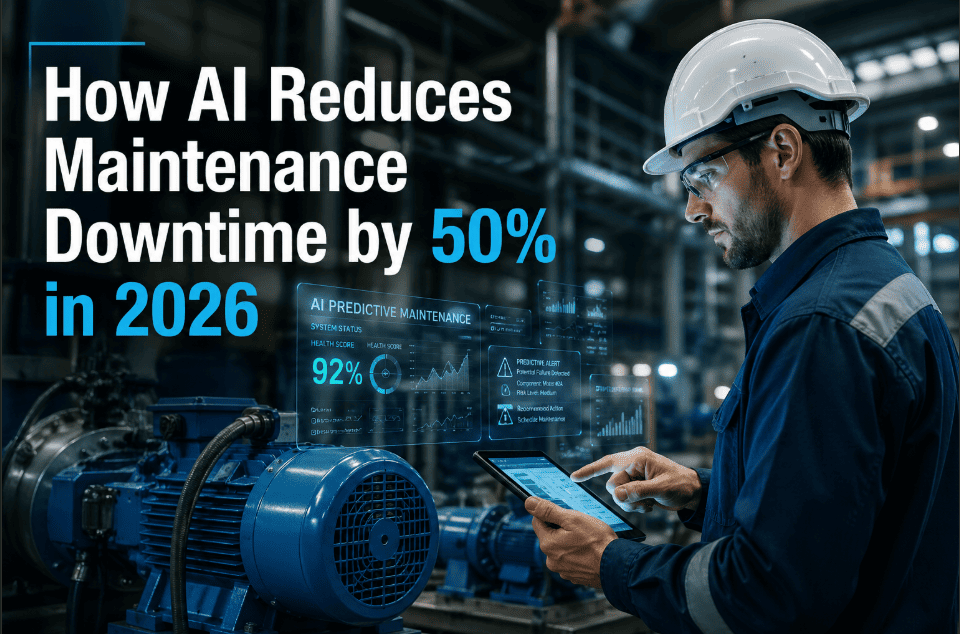
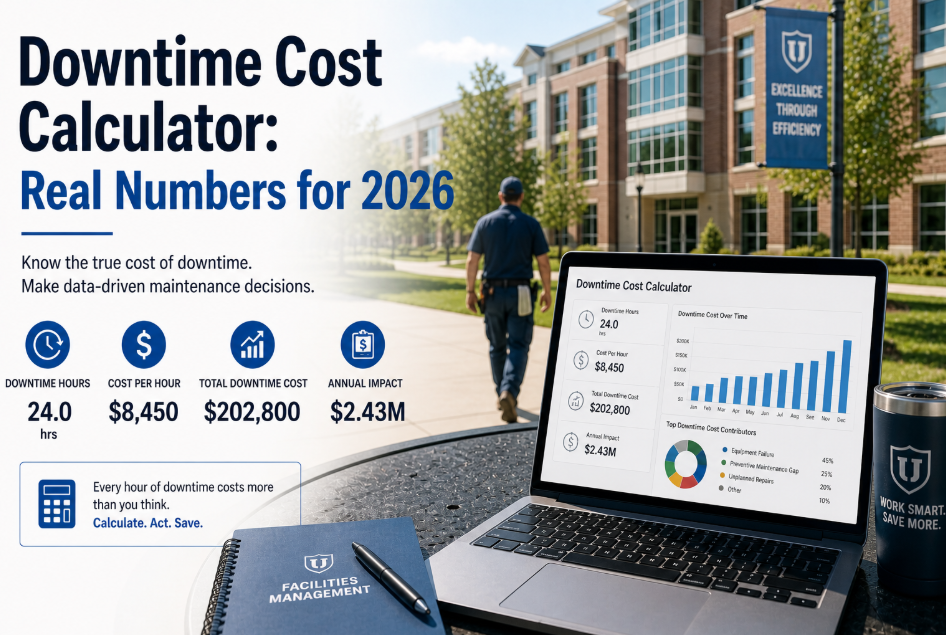
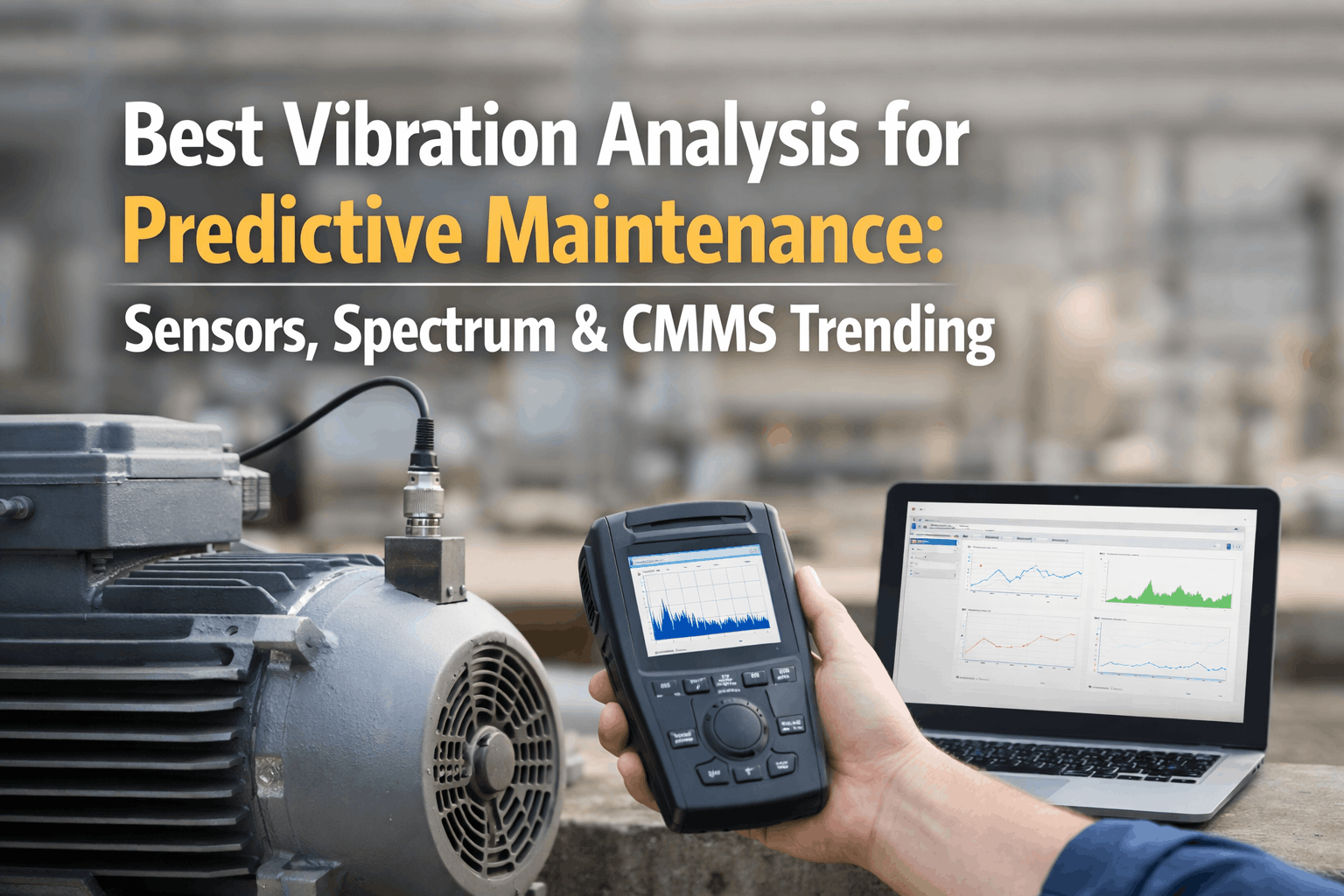
Unplanned downtime costs industrial manufacturers an estimated $50 billion annually across the United States alone. In 2026, AI-powered maintenance systems are cutting that figure in half for early adopters — using vibration analysis, anomaly detection, and predictive scheduling to catch failures before they happen. The shift from reactive firefighting to AI-driven prevention is not theoretical anymore. Plants running AI maintenance programs report 50% fewer unplanned breakdowns, 30% lower maintenance costs, and 25% longer asset lifespans. This guide breaks down exactly how AI reduces maintenance downtime, the specific technologies involved, and the measurable results operations teams are achieving right now. If your facility still loses production hours to surprise breakdowns, start a free trial with OxMaint or book a demo to see AI anomaly detection in action.
AI Maintenance Downtime Reduction
2026 Industry Benchmarks
How AI Reduces Maintenance Downtime by 50% — The Technologies, The Data, The Results
Real-time anomaly detection, vibration analysis, and predictive scheduling are replacing reactive maintenance across manufacturing, facilities, and industrial operations. Here is how the math works — and why 2026 is the tipping point.
$50B
Annual unplanned downtime cost — US manufacturing alone
50%
Average downtime reduction with AI maintenance programs
91%
Accuracy rate for AI fault prediction on monitored assets
10x
ROI documented on predictive vs reactive maintenance spend
See AI Anomaly Detection Working on Your Assets
OxMaint connects sensor data to AI models that auto-generate work orders before breakdowns happen. Free for 30 days — no implementation fees, no contracts.
What Is AI-Powered Maintenance — And Why Does It Cut Downtime by Half?
AI-powered maintenance uses machine learning algorithms to analyze real-time sensor data — vibration signatures, temperature patterns, pressure fluctuations, acoustic emissions, and electrical current draws — and identify the early-stage degradation patterns that precede equipment failure. Unlike calendar-based preventive maintenance (which services assets on schedule regardless of actual condition), AI maintenance triggers interventions based on what the equipment is actually telling you. The difference is precision: calendar PM catches about 30% of failures before they happen, while AI-driven predictive maintenance catches 85–91% of failures with enough lead time to plan the repair. That precision gap is where the 50% downtime reduction comes from. Organizations still managing assets with spreadsheets and calendar PM schedules can see what the alternative looks like — start a free trial or book a demo to compare.
The Four AI Technologies That Eliminate Unplanned Downtime
AI maintenance is not one technology — it is four interconnected systems working together. Each catches a different failure mode. Together, they cover 90%+ of industrial breakdown scenarios. Understanding which technology addresses which failure type is essential for building a program that delivers real downtime reduction rather than expensive dashboard decoration.
V
AI Vibration Analysis
Accelerometers measure vibration signatures at 10,000+ samples per second. ML models compare real-time patterns against baseline signatures to detect bearing wear, misalignment, imbalance, and looseness 4–12 weeks before failure.
Catches 43% of rotating equipment failures — the single largest failure category in manufacturing
A
Real-Time Anomaly Detection
Unsupervised ML models learn normal operating behavior across temperature, pressure, flow rate, and power draw. Any deviation from baseline triggers an alert — even for failure modes the system has never seen before.
Identifies 85% of emerging faults before any human operator notices symptoms
T
Thermal Pattern Recognition
Infrared sensors and thermal imaging analyzed by convolutional neural networks detect hotspots in electrical panels, motor windings, bearings, and process piping — identifying thermal runaway scenarios 2–6 weeks before failure.
Prevents 28% of electrical and motor failures — the second-largest industrial failure category
P
Predictive Scheduling Engine
Combines degradation forecasts from all sensor streams with production schedules, spare parts availability, and technician capacity to schedule maintenance at the optimal window — maximizing asset life while minimizing production disruption.
Reduces over-maintenance by 35% while eliminating 50% of unplanned stops
Why Reactive Maintenance Costs 4.8x More Than Planned AI Maintenance
The cost multiplier is not theoretical — it is documented across 15 years of SMRP benchmarking data and confirmed by the US Department of Energy. Emergency repairs require premium labor rates (overtime, weekend callouts), expedited parts shipping ($800+ per overnight delivery on average), production line stops that cascade across dependent processes, and quality defects from rushed restarts. AI maintenance eliminates 50%+ of these emergency events by providing 2–12 weeks of advance warning. The comparison below shows what changes when an operation moves from reactive firefighting to AI-driven prevention. Teams running reactive programs will recognize these numbers immediately — start a free trial and see where your facility sits on this spectrum, or book a demo to map the ROI to your specific operation.
60%+ reactive work orders
3–5% annual downtime (unplanned)
$17,000 average cost per downtime hour
Emergency parts expediting $800+ per event
MTBF declining year over year
Over-maintained low-risk assets
Technician time: 40% admin, 60% wrench
No failure pattern visibility
Under 10% reactive work orders
1.5% or less annual downtime
$3,500 average cost per maintenance event
Planned parts ordering — standard shipping
MTBF increasing 25%+ year over year
Condition-based PM on every asset class
Technician time: 15% admin, 85% wrench
Full failure pattern analytics dashboard
How OxMaint Delivers AI Downtime Reduction — Step by Step
OxMaint is not a standalone AI analytics tool that sits outside your maintenance workflow. It is a unified CMMS with AI anomaly detection built into the work order engine, the PM scheduler, the asset registry, and the reporting layer. When AI detects a developing fault, it does not send an email to a shared inbox — it auto-generates a prioritized work order, assigns the right technician, attaches the failure context, and schedules the intervention within the optimal production window. Here are the six capabilities that make this work.
01
IoT and SCADA Sensor Integration
Connect vibration, temperature, pressure, current, and acoustic sensors directly to the OxMaint platform. Supports Modbus, MQTT, OPC-UA, and REST API protocols. Data streams continuously — no batch uploads.
02
AI Baseline Learning
ML models learn normal operating behavior for each asset over 2–4 weeks. Baseline adapts to load variations, seasonal shifts, and production changes. No manual threshold configuration required.
03
Real-Time Anomaly Detection
Continuous monitoring compares live sensor data against learned baselines. Statistical deviations trigger severity-scored alerts. False positive rate under 4% after 30 days of training.
04
AI Auto-Generated Work Orders
When anomaly confidence exceeds threshold, OxMaint auto-generates a work order with fault description, sensor context, recommended action, and technician assignment — no manual entry needed.
05
Predictive Scheduling Optimizer
AI-generated work orders are scheduled against production calendars, technician availability, and spare parts inventory. Maintenance happens at the optimal time — not too early, not too late.
06
Failure Pattern Analytics
Every detection, intervention, and outcome feeds back into the ML model. Asset-level MTBF, failure mode distribution, and cost-per-event tracked continuously. Models improve with every cycle.
ROI of AI Maintenance — The Numbers That Convince CFOs
Operations leaders know AI maintenance works. CFOs need proof. These benchmarks — drawn from McKinsey, Deloitte, the US Department of Energy, and SMRP — represent the documented financial impact of AI-driven maintenance programs across industrial, manufacturing, and commercial operations.
50%
Unplanned Downtime Reduction
Deloitte 2024 — average across 200+ industrial AI maintenance deployments
30%
Total Maintenance Cost Reduction
McKinsey 2025 — including labor, parts, lost production, and emergency premiums
25%
Asset Lifespan Extension
US DOE benchmark — assets maintained at optimal condition vs. run-to-failure
10x
ROI on Predictive vs Reactive Spend
SMRP — every $1 invested in AI predictive returns $10 in avoided breakdown costs
Industry-Specific AI Downtime Impact — Where the Savings Hit Hardest
AI maintenance downtime reduction is not uniform across industries. The financial impact depends on the cost per hour of downtime, the failure mode distribution, and the asset criticality profile. Here is where AI delivers the most dramatic results — and the specific failure modes it catches in each vertical.
| Industry |
Downtime Cost / Hour |
Top AI-Detected Failure Mode |
Downtime Reduction |
Annual Savings (Mid-Size) |
| Automotive Manufacturing |
$22,000 |
Bearing wear on robotic arms |
55% |
$1.2M–$3.8M |
| Food and Beverage |
$18,000 |
Compressor degradation, seal failure |
48% |
$800K–$2.4M |
| Pharmaceuticals |
$45,000 |
HVAC excursion, pump cavitation |
42% |
$2.1M–$6.5M |
| Commercial Facilities |
$8,500 |
HVAC motor failure, chiller degradation |
52% |
$180K–$620K |
| Oil and Gas |
$60,000 |
Pump vibration anomaly, valve erosion |
45% |
$3.2M–$9.8M |
| Mining and Minerals |
$35,000 |
Conveyor belt wear, crusher bearing |
50% |
$1.8M–$5.2M |
Frequently Asked Questions
How quickly does AI maintenance start reducing downtime after deployment?+
AI anomaly detection models require 2–4 weeks of baseline learning on each monitored asset. First actionable alerts typically appear within 30–45 days of deployment. Measurable downtime reduction — validated against historical breakdown frequency — is documented within 90 days for most operations. OxMaint's pre-trained models for common industrial equipment (motors, pumps, compressors, HVAC systems) accelerate this timeline by starting from industry baselines rather than blank-slate learning. Want to see the timeline for your specific assets —
book a demo and bring your asset list.
Do we need expensive IoT sensors to use AI maintenance?+
Not necessarily. Modern wireless vibration and temperature sensors cost $50–$200 per monitoring point — down 80% from five years ago. For facilities with existing SCADA or BMS systems, OxMaint connects directly to those data streams without additional hardware. The 80/20 rule applies: monitoring your 20 most critical assets (which typically account for 80% of downtime impact) requires 40–100 sensor points at a total hardware investment of $4,000–$15,000. That investment pays back within 2–3 months based on avoided emergency repairs alone.
What is the false positive rate for AI anomaly detection?+
Industry benchmark for well-trained AI anomaly detection systems is 3–8% false positive rate after 30 days of baseline learning. OxMaint's models achieve under 4% false positive rate on assets with consistent operating patterns. The system continuously learns from technician feedback — when a technician marks an alert as a false positive, the model adjusts. False positive rate drops below 2% after 90 days of active use on most equipment types.
Can AI maintenance work alongside our existing PM schedules?+
Yes — and this is the recommended deployment approach. AI maintenance does not replace preventive maintenance overnight. It layers on top of existing PM programs, identifying which calendar-based PMs are unnecessary (saving labor) and which assets need attention before their next scheduled PM (preventing breakdowns). Over 6–12 months, teams progressively shift critical assets from time-based to condition-based schedules as confidence in the AI models builds.
Start a free trial to run both approaches in parallel.
AI Downtime Reduction with OxMaint
Stop Reacting to Breakdowns. Start Preventing Them.
Every hour of unplanned downtime costs your operation $8,500 to $60,000 depending on your industry. OxMaint's AI anomaly detection, auto-generated work orders, and predictive scheduling engine cut that downtime by 50% — starting within 90 days of deployment. No heavy implementation fees. No long onboarding. Free for 30 days.
50%
Downtime reduction documented
91%
AI fault prediction accuracy
90 Days
Time to measurable results
$0
Implementation and setup fees