
HVAC systems account for 35–50% of a commercial building's total energy consumption and represent the highest-frequency maintenance category in most facility operations programmes. Yet the majority of commercial HVAC fleets are still maintained on fixed calendar intervals — filter changes on the first of the month, compressor checks whenever the contractor visits — rather than on the actual condition and performance data that determines when service is genuinely needed. The result is both over-maintenance of healthy equipment and under-maintenance of equipment showing early degradation signals. HVAC maintenance software built on condition-based PM scheduling and IoT sensor monitoring changes this equation. This guide covers what HVAC CMMS capability actually looks like in practice and how Oxmaint.ai delivers it across commercial and industrial HVAC fleets.
HVAC Maintenance Software: Schedule, Track & Optimise Your Entire HVAC Fleet
For facility managers, building engineers, and maintenance supervisors managing commercial HVAC assets — structured PM scheduling, IoT-connected condition monitoring, and F-gas compliance tracking in one platform.
How Oxmaint.ai Manages HVAC Maintenance End-to-End
From scheduled PM generation through condition alert response to compliance record archiving — every step of the HVAC maintenance workflow in one connected platform.
Asset Registration & PM Schedule Configuration
Register every HVAC unit — AHUs, FCUs, chillers, rooftop units, boilers, and VRF systems — as an individual asset with its make, model, location, and service requirements. Configure PM schedules per asset type with the correct intervals for each maintenance task: monthly filter inspections, quarterly coil cleaning, six-monthly refrigerant checks, and annual full system service.
Automated Work Order Generation
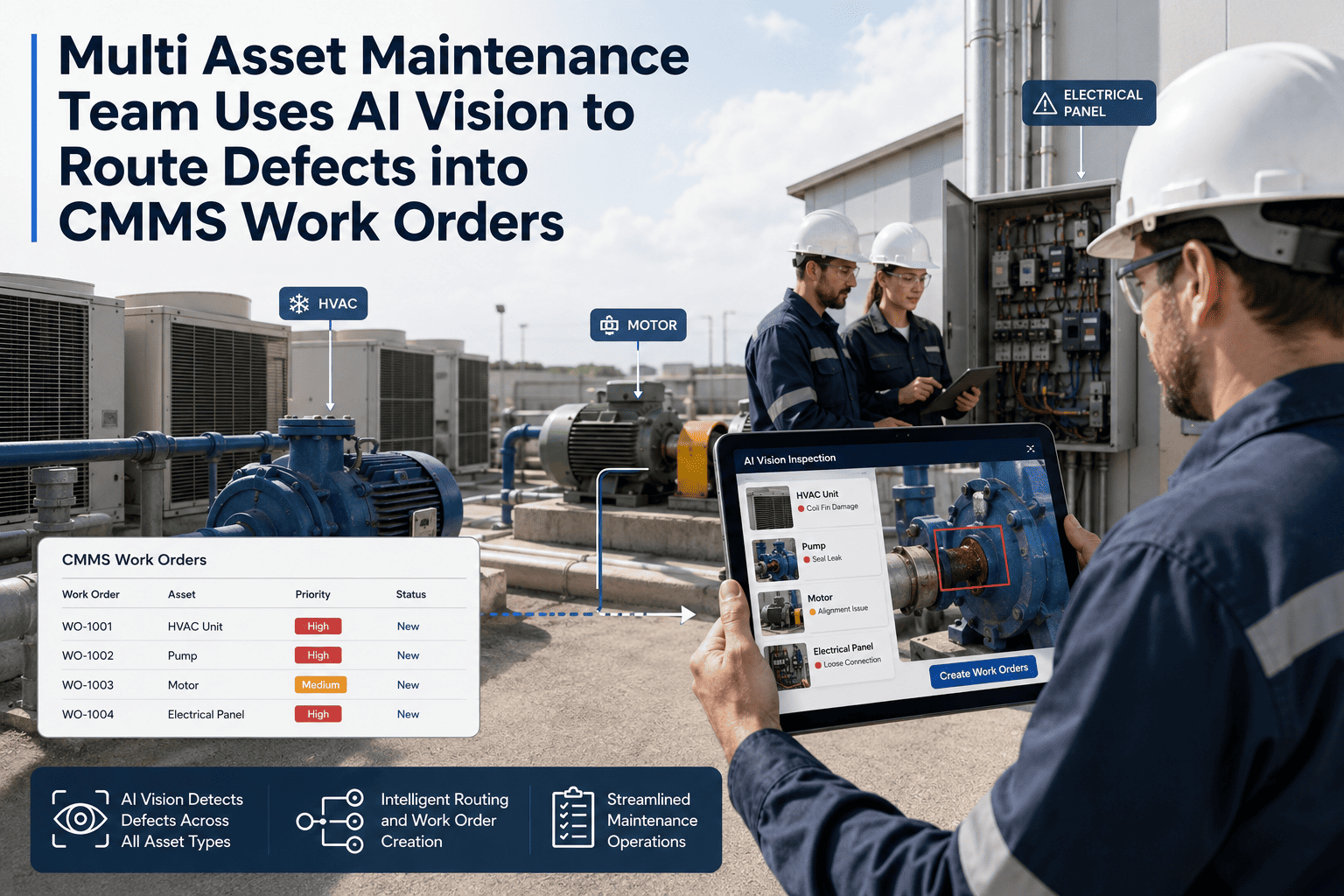
PM work orders are generated automatically when each scheduled interval arrives — assigned to the responsible technician or contractor with the task checklist, required parts, and access information pre-populated. No manual calendar management. No missed service intervals. No discovering the filter has not been changed for six months at the next tenant complaint.
IoT & Sensor Data Monitoring
Connect BMS outputs, smart HVAC controllers, and supplementary IoT sensors to Oxmaint.ai's data pipeline. Temperature differentials, airflow rates, compressor current draw, and refrigerant pressure are monitored continuously — with configurable alerts that generate reactive work orders when readings exceed the defined thresholds, before performance degradation affects building comfort or energy efficiency.
Compliance & Certificate Management
F-gas certificates, refrigerant log entries, and statutory HVAC inspection records are stored per unit with expiry date tracking and automatic renewal alerts. Every completed work order creates a timestamped maintenance record against the asset — building the service history that satisfies building warranty requirements, insurance audits, and regulatory inspection requests without manual compilation.
HVAC CMMS Capabilities in Detail
What structured HVAC maintenance software actually delivers — in the specific operational terms that matter to facility engineers and building managers.
Condition-Based PM Scheduling
Standard HVAC PM software schedules maintenance by calendar interval. Oxmaint.ai goes further — integrating actual run-hours, BMS performance data, and IoT sensor readings to adjust service intervals based on what the equipment is actually experiencing rather than what the calendar says.
An AHU running continuous 24/7 duty in a hospital environment needs service at 60% of the interval appropriate for the same unit in a standard office building. Oxmaint.ai applies runtime-adjusted scheduling that reflects actual operating conditions — reducing both premature component replacement and the performance degradation that fixed-interval systems miss in high-utilisation applications. Start a free trial to configure runtime-adjusted PM for your HVAC fleet.
IoT Sensor Monitoring & Fault Alerting
The performance indicators that predict HVAC failures are all measurable before the failure occurs: rising compressor discharge temperature indicates refrigerant undercharge or condenser fouling; falling airflow across an AHU indicates filter loading or fan bearing degradation; increasing temperature differential across a heat exchanger indicates fouling of the heating or cooling coil.
Oxmaint.ai's IoT monitoring layer connects to BMS outputs, smart HVAC controller APIs, and standalone IoT sensors to collect these parameters continuously. When any reading exceeds the configured threshold, a reactive work order is generated automatically — with the affected unit, the parameter that triggered the alert, the current reading, and the threshold value all populated without manual data entry. Teams using Oxmaint.ai's HVAC monitoring identify compressor issues an average of 18 days before they would produce a fault that takes the system offline.
F-Gas Compliance & Refrigerant Tracking
Under EU F-Gas Regulation 517/2014 and equivalent national legislation, HVAC systems containing fluorinated greenhouse gases above defined charge thresholds must have leak checks at specified intervals (annually for systems with 5 tonnes CO₂ equivalent or more) and the results recorded in equipment logs. In the UK under TF0 and the updated UK F-gas regulations, similar obligations apply. Non-compliance exposes building operators to significant fines.
Oxmaint.ai manages F-gas compliance at the individual unit level — tracking refrigerant type, system charge, CO₂ equivalent, required leak check frequency, last check date, and certificate expiry. Alerts are generated before leak check deadlines and before F-gas certificates lapse. Book a demo to see the F-gas compliance module for your HVAC fleet.
HVAC Energy Performance Tracking
Energy consumption is the most sensitive leading indicator of HVAC maintenance status. A chiller with a fouled condenser consumes 10–15% more energy for the same cooling output. An AHU with a dirty cooling coil operates at higher static pressure, increasing fan motor energy draw. An under-charged refrigerant circuit forces the compressor to run longer duty cycles to achieve setpoint temperatures.
Oxmaint.ai's energy performance module tracks consumption trends per HVAC unit and flags equipment where energy per unit output is trending upward — a condition-based maintenance trigger that identifies deteriorating equipment before it fails, and before the energy waste compounds over weeks and months. Linking energy performance data to maintenance events creates the evidence base that demonstrates the ROI of the HVAC maintenance programme to building owners and sustainability reporting frameworks.
Start Managing Your HVAC Fleet With Precision
PM schedules that run automatically. Sensor alerts that create work orders before failures occur. F-gas compliance tracked per unit. Energy performance trends that prove the ROI of your maintenance programme. All in one mobile-accessible platform.
HVAC Asset Types Managed by Oxmaint.ai
Every commercial and industrial HVAC asset category — each with its specific maintenance requirements, service intervals, and compliance obligations configured within the platform.
Manual Scheduling vs. Oxmaint.ai HVAC CMMS
The operational and financial gap between paper-based HVAC maintenance and a structured CMMS platform.
| Capability | Manual / Spreadsheet | Oxmaint.ai |
|---|---|---|
| PM Scheduling | Calendar reminders — missed when staff absent, no tracking of what was actually completed | Automatic PM work orders with completion records per asset and technician attribution |
| F-Gas Compliance | Certificate files — expiry dates not tracked, lapses discovered at inspection | Per-unit certificate tracking with pre-expiry alerts and one-click audit export |
| Fault Detection | Complaints-driven — faults detected when occupants report comfort issues | IoT sensor alerts generate work orders before performance degradation affects comfort or energy use |
| Energy Performance | No unit-level energy data — energy waste from fouled equipment invisible until utility bill analysis | Per-unit energy consumption trending with deviation alerts triggering targeted maintenance |
| Contractor Records | Paper job sheets — not linked to asset records, service history incomplete or unverifiable | Every contractor visit logged against the asset with scope, parts, cost, and technician identity |
Scroll horizontally on mobile
We manage HVAC across 22 commercial properties. Before Oxmaint.ai, F-gas compliance was the task I genuinely worried about — we had no central view of which units had current certificates and which were overdue. In our first compliance review after implementation, we found seven units with lapsed or near-expiry leak check certificates across three buildings. No inspector had found these, but they were there. That discovery alone demonstrated the value of having a system that actually tracks this rather than relying on contractor paperwork.— Facilities Manager, Commercial Property Portfolio, United Kingdom
Frequently Asked Questions
Can Oxmaint.ai connect to our existing BMS to pull HVAC performance data automatically?
Yes. Oxmaint.ai integrates with BMS platforms via API, BACnet, Modbus, and MQTT data streams to pull performance parameters into the monitoring pipeline. Where direct BMS integration is not available, the platform supports manual sensor data entry and integration with standalone IoT gateway devices. BMS fault signals can be configured to automatically generate reactive work orders in Oxmaint.ai — creating the closed-loop response that prevents BMS alarms from being acknowledged without a maintenance action being recorded. Book a demo to discuss BMS integration for your building.
How does Oxmaint.ai manage F-gas compliance records for HVAC systems across multiple buildings?
Each HVAC unit containing F-gas refrigerant is registered in Oxmaint.ai with its refrigerant type, system charge in kg, and the calculated CO₂ equivalent. The platform automatically determines the required leak check frequency from the system charge and flags units approaching their next required inspection date. Leak check certificates, refrigerant log entries, and top-up records are stored per unit and are retrievable for regulatory inspection or audit without manual search. Start a free trial to configure F-gas tracking for your HVAC fleet.
Can the platform manage both in-house technicians and external HVAC contractors within the same work order system?
Yes. Oxmaint.ai supports both in-house technician and external contractor assignment within the same work order system. Contractors can be assigned work orders and complete them via the Oxmaint.ai mobile app — with the job notes, parts used, and photographic evidence logged directly against the asset record. Alternatively, contractor job sheets can be uploaded by the facility manager after receipt. Either approach creates a searchable service record linked to the specific HVAC unit, replacing the paper job sheet filing system that most facilities currently rely on for contractor records.
How long does it take to register a building's full HVAC asset inventory in Oxmaint.ai?
For a typical commercial building with 30–80 HVAC assets, the asset registration and PM schedule configuration process takes 1–2 days. Assets can be registered individually via the mobile app during a physical walkthrough — scanning QR codes or NFC tags where fitted — or imported in bulk from an existing asset register spreadsheet. PM schedule templates are provided for all common HVAC asset types, reducing the configuration time to adjusting service intervals rather than building schedules from scratch. Most facilities complete full onboarding within one week of starting their free trial.
HVAC Maintenance That Works as Hard as Your Equipment
Automated PM scheduling. IoT-driven condition monitoring. F-gas compliance tracking. Energy performance analytics. Oxmaint.ai brings every dimension of HVAC maintenance management into a single platform — reducing energy waste, extending equipment life, and keeping your compliance record complete without manual effort.


.png)