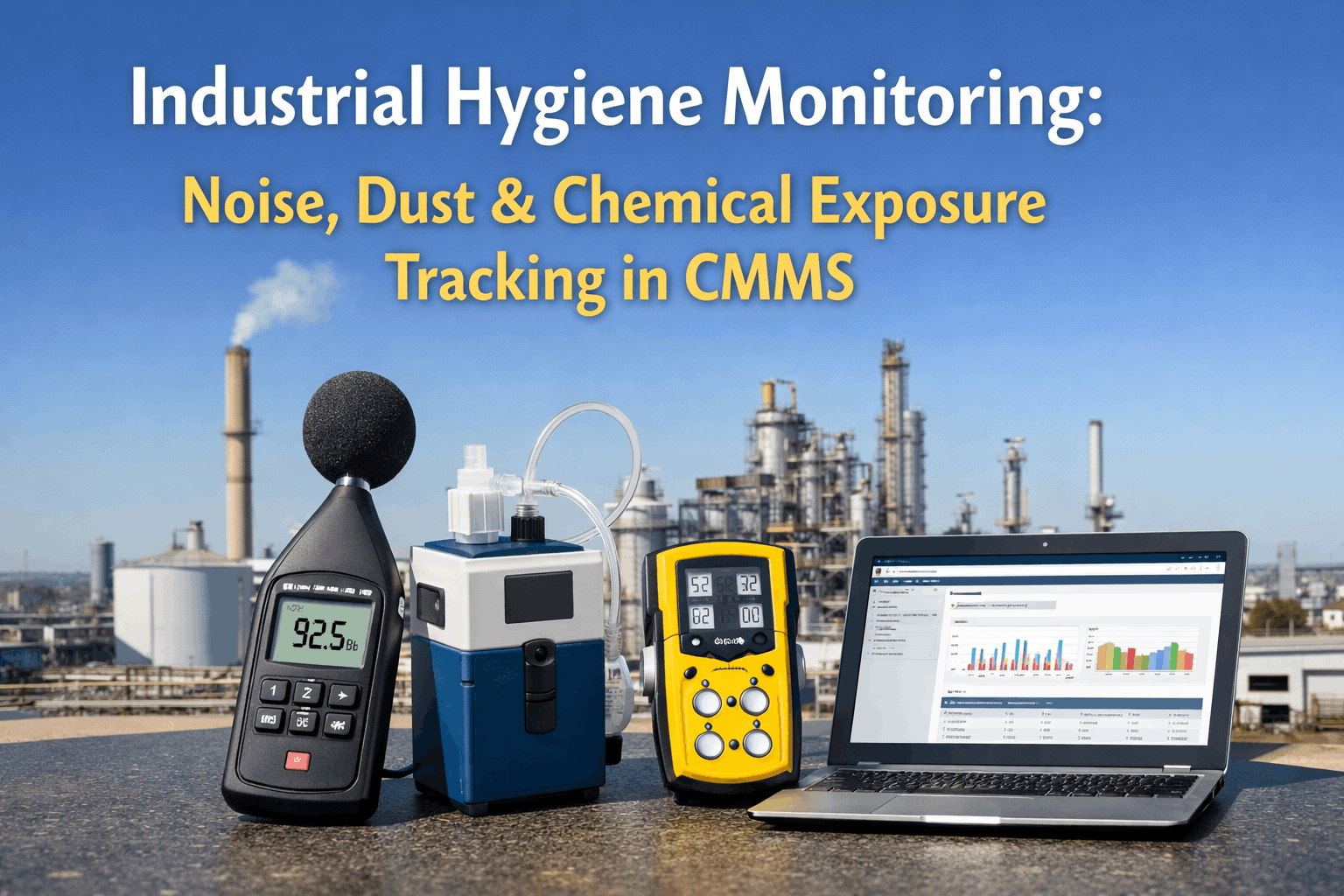
Industrial Hygiene Monitoring: Noise, Dust & Chemical Exposure Tracking in CMMS
In March 2025, a mid-size chemical processing facility in Ohio received a $1.4 million OSHA citation — not for a single catastrophic incident, but for a pattern of systemic failures in exposure monitoring. Fourteen workers on the blending line had been exposed to toluene vapour concentrations exceeding the 200 ppm ceiling limit for over seven months. The area monitors had been calibrated once — at installation — and the quarterly personal dosimetry sampling that OSHA requires had simply stopped when the EHS coordinator transferred to another site. Nobody reassigned the monitoring schedule. The paper-based logs showed "compliant" because nobody was filling them in. Post-investigation air sampling revealed TWA concentrations of 340 ppm in two zones — nearly double the permissible limit. Fourteen workersnow require long-term medical surveillance. A single CMMS-managed monitoring programme with automated scheduling and escalation would have flagged the first missed sampling event within 48 hours. Schedule a demo to see how Oxmaint eliminates industrial hygiene monitoring gaps before they become regulatory disasters.
EHS Compliance 2026
Industrial Hygiene Monitoring: Noise, Dust & Chemical Exposure Tracking in CMMS
Master noise dosimetry scheduling, respirable dust monitoring, chemical exposure tracking, and PPE management through CMMS. Build an airtight industrial hygiene programme that protects workers, satisfies OSHA compliance, and eliminates the monitoring gaps that lead to 68% of workplace exposure citations.
In most facilities, industrial hygiene monitoring exists as a patchwork of spreadsheets, paper logs, and one person's institutional memory. Noise dosimetry badges sit in a drawer uncalibrated. Dust sampling pumps are borrowed and never returned. Chemical exposure records live in a filing cabinet that nobody opens until OSHA arrives. Without a CMMS-enforced monitoring programme that schedules every sample, tracks every result, and escalates every exceedance, industrial hygiene becomes the compliance gap that regulators exploit and workers pay for. Start Free Trial.
The Hidden Costs of Inadequate Hygiene Monitoring
Missed Noise Dosimetry
42%
of manufacturing sites fail to complete required noise exposure assessments — leading to undetected hearing loss and OSHA 1910.95 violations.
Dust Overexposure
$2.1M
average employer cost for a single silicosis claim — preventable with routine respirable dust monitoring and engineering controls.
Chemical Limit Breaches
68%
of OSHA chemical exposure citations trace to gaps in monitoring schedules — not to a lack of controls, but to a lack of documentation.
Lost Paper Records
35%
of facilities cannot produce 3+ years of exposure records during audits — triggering automatic "willful" violation classification and 10x penalty multipliers.
PPE Non-Compliance
28%
of workers use wrong PPE for actual exposure levels because hazard assessments are outdated or never linked to PPE selection matrices.
Calibration Lapses
51%
of monitoring instruments found out of calibration during inspections — invalidating all readings since last verified calibration date.
The CMMS-Managed Industrial Hygiene Lifecycle
A world-class industrial hygiene programme follows a disciplined lifecycle — from hazard identification and exposure assessment through monitoring execution, data analysis, corrective action, and regulatory reporting. Each phase requires documented procedures, calibrated instruments, and CMMS tracking to maintain an audit-proof chain of compliance. Oxmaint automates every stage.
Complete Industrial Hygiene Monitoring Workflow
From hazard assessment to regulatory reporting
1
Hazard Identification & Exposure Assessment
SEGsJHA
Define Similar Exposure Groups (SEGs) by mapping workers to tasks, chemicals, noise zones, and dust sources. Establish baseline exposure profiles using job hazard analysis and preliminary sampling. CMMS stores SEG definitions and links them to monitoring schedules.
2
Instrument Calibration & Readiness
DosimetersSampling Pumps
Schedule and track calibration for noise dosimeters, air sampling pumps, direct-reading instruments, and gas monitors. CMMS manages calibration due dates, certificates, and automatic lockout of overdue instruments to prevent invalid readings.
3
Scheduled Monitoring Execution
Mobile AppDigital Checklists
Technicians follow CMMS-generated monitoring routes — noise dosimetry placements, area dust sampling, personal chemical exposure badges. Each sample is logged with location, duration, worker ID, and environmental conditions. Missed samples trigger immediate escalation.
4
Results Analysis & Limit Comparison
PEL/TLVTWA/STEL
Lab results and direct readings are compared against OSHA PELs, ACGIH TLVs, and company action levels. CMMS auto-flags any exceedance, calculates 8-hour TWA and short-term exposure limits, and generates corrective action work orders when thresholds are breached.
5
Corrective Action, PPE & Regulatory Reporting
OSHA LogsTrend Analysis
Exceedances trigger engineering control reviews, PPE upgrades, and medical surveillance referrals. CMMS generates OSHA-required exposure records, 30-year retention documentation, hearing conservation programme reports, and management dashboards showing exposure trends by zone, SEG, and agent.
Automate Every Monitoring Schedule, Track Every Exposure Result
Oxmaint builds optimised hygiene monitoring routes with digital checklists, instrument calibration tracking, automatic PEL/TLV comparison, and audit-ready compliance reporting — eliminating the monitoring gaps that cause 68% of OSHA exposure citations.
Effective industrial hygiene monitoring doesn't operate in a silo. It requires integration across noise dosimeters, particulate monitors, chemical sampling labs, PPE inventory systems, and medical surveillance databases. Connecting these data streams through CMMS ensures that every exposure reading triggers the right response and every compliance record is instantly retrievable.
Integrated Industrial Hygiene Intelligence Stack
Oxmaint CMMS
Central Hub
Monitoring schedules, work orders, exposure records, calibration tracking, compliance dashboards
Noise Dosimetry
Hearing Conservation
Personal dose badges, area monitors, TWA calculations, audiometric tracking integration
Air Sampling Labs
Chemical Analysis
NIOSH method analysis, PEL/TLV comparison, chain-of-custody documentation, result trending
PPE Management
Protection Assurance
PPE selection matrices, fit-test records, replacement schedules, hazard-to-PPE mapping
Seamless data flow ensures every exposure reading triggers the right corrective action and every compliance record is audit-ready.
Industrial Hygiene Programme KPIs
The success of an industrial hygiene programme is measured by monitoring schedule compliance, exceedance rates, corrective action closure speed, and OSHA recordable exposure incidents. Tracking these metrics allows EHS managers to quantify risk reduction, justify programme investment, and demonstrate regulatory compliance across the facility.
Industrial Hygiene Programme Performance Metrics
Measuring the impact of world-class exposure monitoring
Monitoring Compliance
99%
Target: >98%
All scheduled samples collected on time
Exceedance Response
<4hr
Target: Same-Shift Response
Time from exceedance to corrective action
Instrument Calibration
100%
Target: Zero Overdue
All instruments within calibration window
Exposure Incidents
↓72%
Target: 60–80% Reduction
OSHA-recordable exposure events per year
Before & After: The Industrial Hygiene Transformation
Implementing a structured CMMS-managed industrial hygiene programme yields immediate, measurable improvements across every compliance and safety metric. From eliminating missed monitoring events to proving regulatory compliance with timestamped digital records, the operational transformation is dramatic.
Paper-Based Monitoring vs. CMMS-Managed Programme
Monitoring Compliance
61%
→
99.2%
OSHA Citations
3–5/yr
→
Zero
Audit Preparation
3–5 Days
→
Minutes
Exceedance Response
Days–Weeks
→
<4 Hours
PPE Accuracy
72%
→
98%
Record Retrieval
Manual Search
→
Instant Digital
Annual EHS Cost
$480K
→
$210K
Build Your Audit-Proof Industrial Hygiene Programme
Join EHS-focused facilities using Oxmaint to manage monitoring schedules, track exposure results, enforce calibration compliance, and prove regulatory adherence to auditors — all from one platform.
A standardised monitoring matrix ensures that no exposure assessment is overlooked and no calibration is missed. From daily area noise checks to annual comprehensive exposure surveys, defining frequency, method, regulatory basis, and responsible parties prevents the compliance gaps that regulators target.
Complete Industrial Hygiene Task Schedule
Hazard Category
Monitoring Task
Frequency
Responsible
Noise Exposure
Personal noise dosimetry for SEGs above action level
Quarterly / Annual
IH Technician
Respirable Dust
Personal sampling pump with cyclone — gravimetric analysis
Monthly / Quarterly
IH Technician
Chemical Vapours
Personal badge or charcoal tube sampling per NIOSH method
Quarterly / Event-Based
IH Technician
Area Monitoring
Fixed-point gas detectors, area dust monitors, sound level meters
Continuous / Daily
EHS Coordinator
Instrument Calibration
Dosimeters, pumps, direct-reading instruments, gas monitors
Before Use / Monthly
IH Technician
PPE Assessment
Review PPE selection vs. current exposure data, fit testing
Annual / Post-Exceedance
EHS Manager
Medical Surveillance
Audiograms, pulmonary function tests, biomonitoring
Annual / Baseline
Occupational Health
Programme Audit
Comprehensive IH programme review, trend analysis, gap assessment
Annual
EHS Director
Expert Perspective: Compliance Is Prevention
"
We were running industrial hygiene monitoring on spreadsheets and memory — and it nearly destroyed us. When OSHA showed up after a worker compensation claim for hearing loss, we couldn't produce two years of dosimetry records because the spreadsheet was on a departed employee's laptop. The citation was $340K. When we implemented CMMS-managed monitoring schedules, compliance went from 58% to 99% in 60 days. Every sample is scheduled, every result is auto-compared to PELs, and every exceedance generates a corrective work order before the shift ends. In the first year, we prevented three chemical overexposure events that would have cost $1.2M in medical claims and penalties combined. Industrial hygiene monitoring isn't paperwork. It's the programme that keeps your people breathing.
— EHS Director, Multi-Site Chemical Processing Company
99%
Monitoring compliance
$1.2M
Avoided penalties (Year 1)
60 Days
To full compliance
Zero
Missed monitoring events
Facilities that treat industrial hygiene monitoring as a core EHS discipline rather than a check-the-box exercise consistently achieve near-zero exposure citations and dramatically lower workers' compensation costs. The technology is straightforward; the discipline of executing it every shift is what separates compliant from cited. Schedule a demo to build your industrial hygiene programme.
Eliminate 68% of Exposure Citations With Structured Monitoring
Oxmaint gives your industrial hygiene programme the structure it needs — CMMS monitoring schedules, instrument calibration tracking, automatic PEL/TLV comparison, PPE management, and compliance reporting that satisfies auditors instantly.
How does CMMS manage noise dosimetry and hearing conservation compliance?
CMMS schedules personal noise dosimetry sampling for every Similar Exposure Group (SEG) above the OSHA action level of 85 dBA TWA. The system manages dosimeter calibration, assigns sampling to specific workers on specific shifts, logs 8-hour TWA results, and auto-flags any reading exceeding the 90 dBA PEL or 85 dBA action level. When the action level is exceeded, CMMS automatically generates work orders for audiometric testing enrollment, hearing protection fitting, and annual re-testing — maintaining the complete hearing conservation programme record that OSHA 1910.95 requires. Sign up free to automate your hearing conservation programme.
What dust monitoring methods should we track in CMMS?
A comprehensive dust monitoring programme should track respirable dust (using personal sampling pumps with cyclone separators), total inhalable dust, and specific agents like crystalline silica (NIOSH 7500) or metal fumes (NIOSH 7300). CMMS manages pump calibration pre- and post-sampling, chain-of-custody documentation, lab result tracking, and automatic comparison against OSHA PELs (e.g., 50 µg/m³ for respirable crystalline silica). Area dust monitors with real-time readouts can feed continuous data, while personal samples provide the regulatory-required TWA measurements. Oxmaint tracks both and generates trend reports showing exposure profiles by zone, task, and worker group.
How do we track chemical exposure limits and respond to exceedances?
CMMS stores every regulated chemical's OSHA PEL, ACGIH TLV, company action level, and STEL/ceiling values. When air sampling results are entered — whether from lab analysis of charcoal tubes, silica gel badges, or direct-reading photoionisation detectors — the system automatically compares results against all applicable limits. Any exceedance triggers a multi-step corrective action workflow: immediate worker notification, exposure zone reclassification, engineering control assessment work order, PPE upgrade verification, medical surveillance referral, and management notification. All actions are timestamped and stored for the 30-year retention period OSHA requires for exposure records. Book a demo to see chemical exposure tracking in action.
How does CMMS manage PPE selection and compliance tracking?
CMMS links exposure monitoring data directly to PPE selection matrices. When monitoring confirms that a zone or task exceeds an action level, the system automatically identifies the required PPE — hearing protection NRR ratings matched to noise levels, respiratory protection factors matched to chemical concentrations, or specific glove materials matched to chemical compatibility. The system tracks PPE issuance, fit-test dates and results (critical for respirators under OSHA 1910.134), replacement schedules, and training records. If exposure levels change, CMMS automatically flags workers whose current PPE no longer provides adequate protection — closing the gap between monitoring data and frontline protection.
What regulatory records does CMMS maintain for OSHA compliance?
OSHA requires employers to maintain exposure monitoring records for 30 years (29 CFR 1910.1020), audiometric test records for the duration of employment, and medical surveillance records for 30 years plus duration of employment for certain substances. CMMS automates all of this — storing every air sample result, noise dosimetry reading, instrument calibration certificate, corrective action record, PPE assignment, and medical referral in a searchable digital repository. During audits, EHS managers can pull complete compliance histories by worker, zone, chemical, or date range in seconds rather than days. Most facilities see audit preparation time drop from 3–5 days to under 30 minutes after implementing CMMS-based record management.