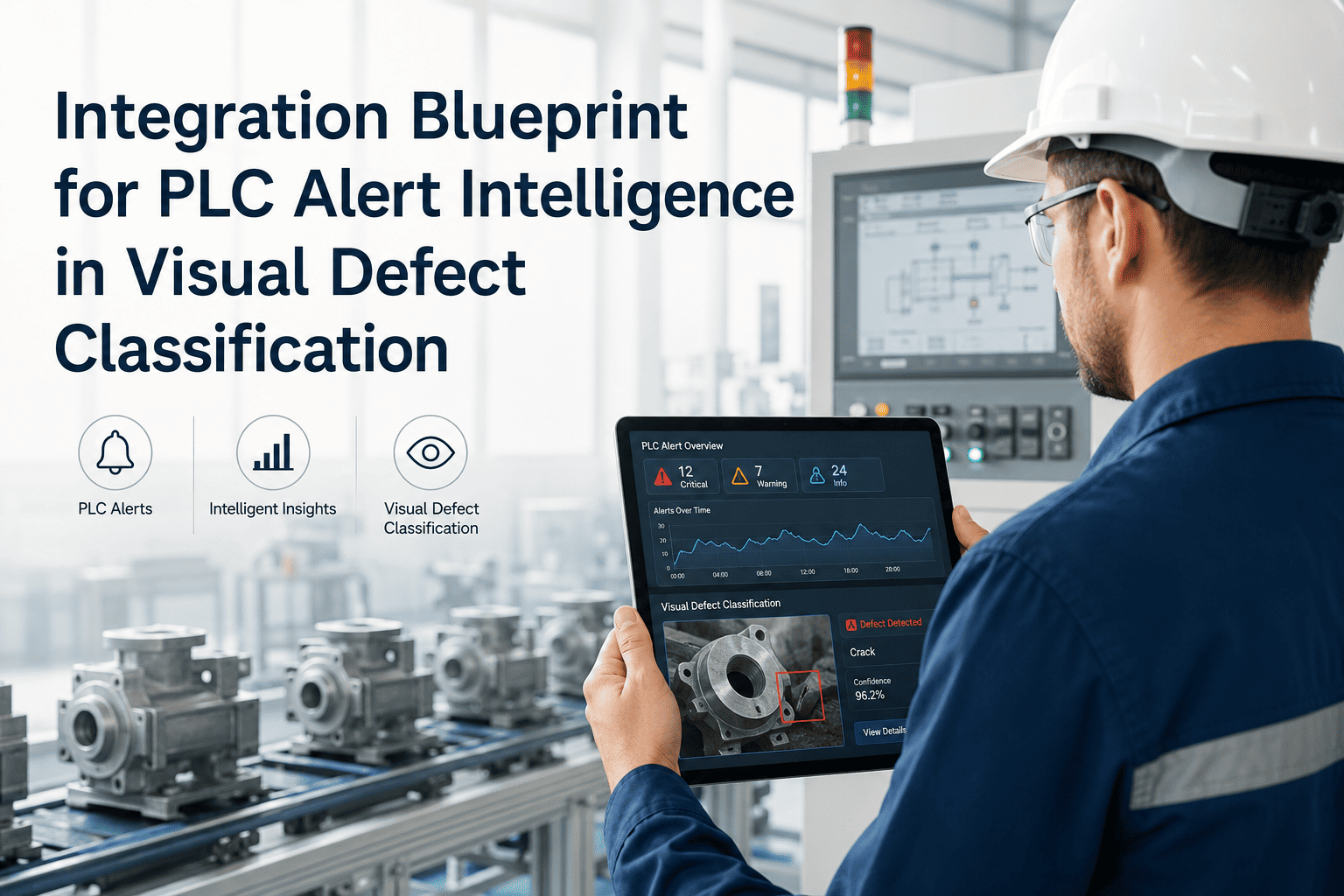
A PLC fault gets logged the moment it happens — timestamped, stored, fully visible in the alarm historian. And in most plants, it sits there unread until a quality excursion forces someone to dig through the log and ask what went wrong. The fault data was never the problem. The gap was always the missing link between a controller fault code and the visual defect it caused three stations downstream. When PLC alert data and AI vision classification are wired into the same intelligence layer, that downstream defect gets traced back to its root cause in seconds, not after a recall review. Connect your PLC alerts to Oxmaint free and close the gap between fault and consequence.
Integration Blueprint for PLC Alert Intelligence in Visual Defect Classification
A practical architecture for linking controller fault codes directly to the visual defects they cause, so maintenance acts before the next bad unit, not after the batch report.
95%+
defect classification accuracy achievable when vision and PLC data are correlated28%
fewer false classifications when PLC-level verification backs up camera-only detectionLogged, not acted on
how most PLC faults sit in the historian before causing a quality excursionThe Three Layers of PLC-to-Vision Intelligence
Stop treating fault codes and defects as separate problems
Oxmaint correlates PLC fault data with vision-classified defects in real time, so a work order names the actual controller behind a quality excursion.
What Correlated Fault Data Actually Reveals
| Visual Defect | Apparent Cause | Actual PLC Root Cause |
|---|---|---|
| Surface scratching | Operator handling error | Intermittent servo fault on transfer arm |
| Dimensional drift | Tooling wear assumed | Encoder fault not yet flagged as critical |
| Coating inconsistency | Material batch variance | Temperature controller cycling fault |
| Label misalignment | Sensor calibration drift | Recurring intermittent I/O fault, same station |
What Correlated PLC-Vision Intelligence Changes
99.8%
detection accuracy reported across 47 million inspected units in a comparable deployment$8M
in avoided recall and rework costs reported after connecting vision data to CMMS work ordersSame shift
typical time to identify the responsible controller versus weeks in a manual root-cause reviewFrequently Asked Questions
Connect the fault to the defect it actually caused
Oxmaint correlates PLC alert data with AI vision classification so root cause is found the same shift, not after the next recall review.