iot-sensor-deployment-predictive

IoT Sensor Deployment for Predictive Maintenance: Hardware & Network Setup Guide


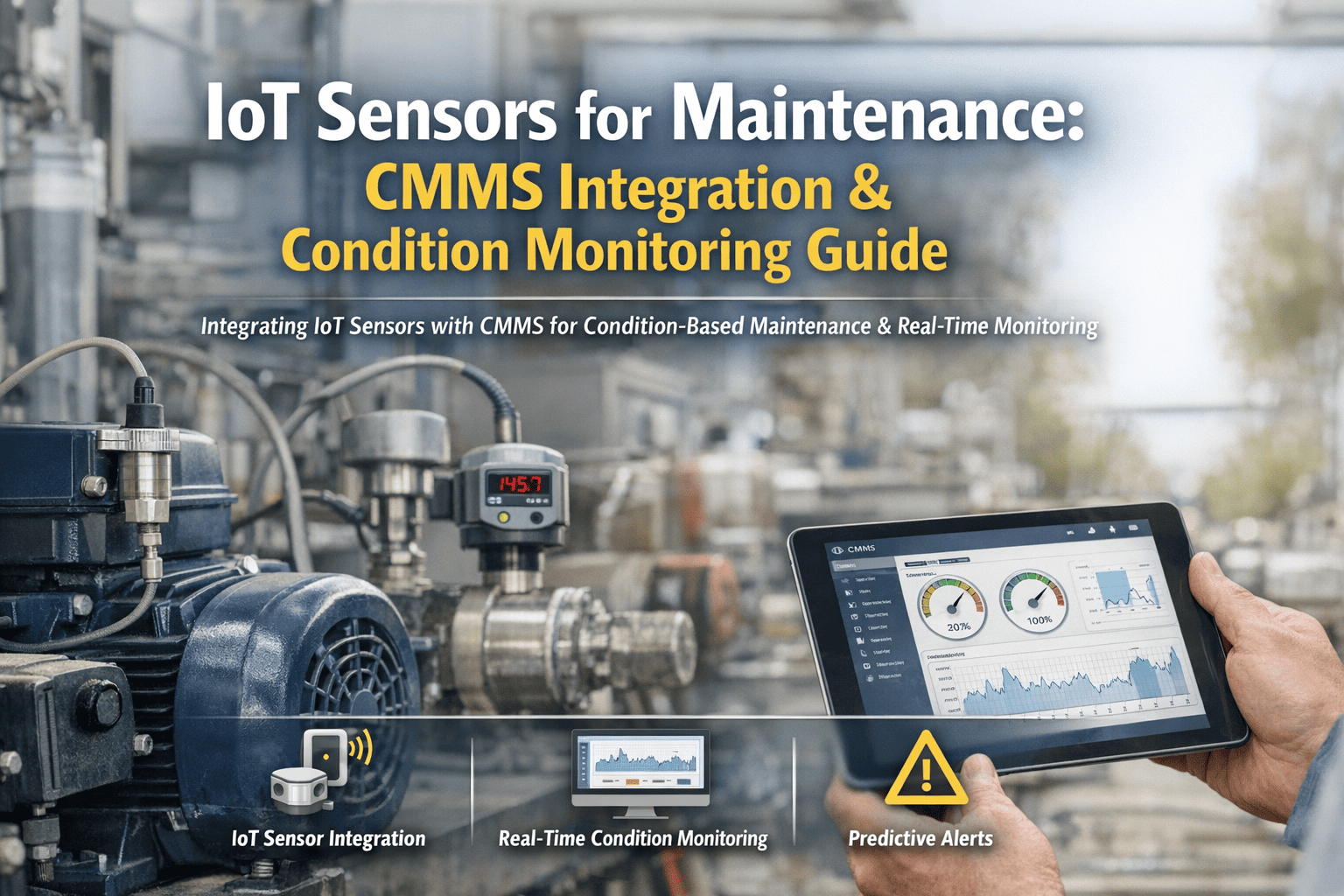
When the plant manager at a Midwest automotive stamping facility reviewed the Q1 2025 downtime report, one number dominated the page: $2.4 million in unplanned failures across 14 hydraulic presses, 22 CNC machining centres, and 8 overhead cranes. The maintenance team had attempted an IoT predictive maintenance pilot six months earlier — purchasing 200 vibration sensors from an online vendor, mounting them on critical assets, and connecting them to a cloud dashboard. Within 90 days, 40% of the sensors had dropped offline due to wireless interference from the plant's steel structure, battery life proved to be 4 months instead of the advertised 3 years, edge gateways couldn't handle the data throughput during peak production, and the remaining sensor data sat in a standalone dashboard that nobody checked because it wasn't connected to a single work order. The $180,000 investment produced zero predictive work orders, zero avoided failures, and zero ROI. The sensors didn't fail — the deployment architecture did. Without proper sensor selection matched to asset failure modes, wireless protocol planning for the actual RF environment, edge computing sized for real data volumes, and a CMMS pipeline that converts sensor anomalies into prioritised work orders, IoT predictive maintenance is just expensive data collection with no operational outcome. Facilities ready to deploy IoT sensors that actually prevent failures can start their free trial today.

The technology to predict equipment failure before it impacts production exists and is proven. But the gap between "sensors installed" and "failures prevented" is an engineering challenge that requires deliberate architecture across four layers: the right sensor types matched to specific failure modes, wireless protocols selected for the actual plant environment, edge computing sized for real-time data processing, and a CMMS data pipeline that converts every anomaly into a prioritised, dispatched, and verified repair action. This guide provides the complete hardware and network setup framework for deploying IoT sensors that deliver measurable predictive maintenance outcomes — not just dashboards. Schedule a consultation to design your IoT-to-CMMS predictive maintenance architecture with Oxmaint.

IoT Predictive Maintenance: Deployed vs. Delivering Value
CMMS-Integrated IoT PipelineStandalone Sensor Dashboard
72%
Of IoT predictive maintenance pilots fail to deliver ROI within 12 months
91%
Failure prediction accuracy when sensors are matched to specific failure modes
$2.4M
Avg. annual unplanned downtime cost for a mid-size manufacturing facility

Why Most IoT Sensor Deployments Fail to Prevent Failures

The failure pattern is remarkably consistent: facilities purchase sensors based on vendor marketing, mount them without matching to specific failure modes, connect them to a standalone dashboard, and wait for "predictive insights" that never materialise into maintenance actions. The root cause isn't bad sensors — it's missing architecture. Without a complete pipeline from sensor selection through edge processing to CMMS work order generation, IoT data becomes noise that maintenance teams learn to ignore. The cascade below shows how a well-intentioned IoT deployment collapses when architecture is missing.

Anatomy of a Failed IoT Predictive Maintenance Deployment
How architecture gaps turn sensor investments into stranded dashboards
Root Cause
No End-to-End Sensor-to-Work-Order Architecture


Week 1-4
Wrong Sensors for the Failure Mode
Vibration sensors installed on assets that fail from thermal degradation — collecting irrelevant data from day one

Month 2-3
Wireless Network Collapses
40% sensor dropout — Wi-Fi can't penetrate metal structures, LoRa gateways undersized, batteries drain in weeks not years

Month 3-6
Edge Computing Bottleneck
Gateway processors overwhelmed during production peaks — data delayed, buffered, or lost before reaching analytics layer

Month 6-12
Dashboard Fatigue & Abandonment
Standalone dashboard generates alerts nobody acts on — no CMMS connection means zero work orders, zero repairs, zero ROI
Total Failed Deployment Impact
$180K+ Wasted
Hardware investment + installation labour + subscription fees + opportunity cost of failures that still occurred

A properly architected IoT deployment prevents this cascade at every layer. Sensor types are matched to documented failure modes through FMEA analysis, wireless protocols are selected based on RF site surveys, edge computing is sized for peak data throughput with 40% headroom, and every sensor anomaly flows through a CMMS pipeline that generates prioritised work orders dispatched to mobile crews. Facilities that follow this architecture don't just collect data — they prevent failures.

The Four Layers of IoT Predictive Maintenance Architecture

Successful IoT predictive maintenance operates across four integrated layers — each solving a specific failure point that collapses standalone sensor deployments. Skip any layer and the pipeline breaks. Implement all four and sensor data transforms from unused dashboards into prevented failures and documented savings.

Complete IoT Predictive Maintenance Architecture
01
IoT Sensor Hardware
Sensor types matched to specific failure modes via FMEA analysis
Detection Layer
02
Wireless Protocols
Network selection based on RF environment, data rate, and range needs
Transport Layer
03
Edge Computing
Local processing, filtering, and AI inference before cloud transmission
Processing Layer
04
CMMS Pipeline
Anomaly-to-work-order automation with priority scoring and dispatch
Action Layer
Each layer builds on the previous — sensors feed protocols, protocols feed edge computing, edge computing feeds CMMS. Break any link and predictions never become prevented failures.

Layer 1: IoT Sensor Types — Matching Hardware to Failure Modes

The single most common IoT deployment mistake is selecting sensors based on vendor availability rather than failure mode analysis. A vibration sensor on a motor that fails from winding insulation breakdown provides zero predictive value — but a current signature sensor on that same motor predicts winding failure 60-90 days in advance. Sensor selection must start with FMEA: what fails, how does it fail, and what physical parameter changes first? The answer determines the sensor type. Schedule a consultation to map your critical asset failure modes to the right sensor types.

IoT Sensor Type Selection Matrix: Match Hardware to Failure Mode
Swipe to see all columns
Sensor TypeDetectsBest ForLead Time
Accelerometer (Vibration) Imbalance, misalignment, bearing wear, looseness Rotating equipment — motors, pumps, fans, compressors 30-90 days before failure
Temperature (RTD/Thermocouple) Overheating, friction, insulation breakdown, cooling loss Bearings, electrical panels, transformers, heat exchangers 7-30 days before failure
Current / Power (CT Clamp) Winding degradation, phase imbalance, overload, locked rotor Electric motors, drives, compressors, conveyor systems 60-120 days before failure
Ultrasonic (Acoustic Emission) Compressed air leaks, steam leaks, bearing defects, cavitation Pneumatic systems, steam traps, valve seats, gearboxes Immediate detection
Pressure Transmitter Filter blockage, pump degradation, system leaks, seal wear Hydraulic systems, HVAC, lubrication systems, pipelines 14-60 days before failure
Oil Condition (Particle Counter) Contamination, wear metals, moisture ingress, viscosity change Gearboxes, hydraulic units, turbines, large bearings 30-90 days before failure
91%Prediction accuracy with correct sensor-to-failure-mode matching
<35%Accuracy with generic "one sensor fits all" deployments

Layer 2: Wireless Protocols — Selecting the Right Network for Your Plant

Wireless protocol selection is the second most common failure point. Wi-Fi sounds familiar but fails in metal-dense industrial environments. Bluetooth has range limitations. LoRaWAN offers kilometres of range but limited data rates. The right protocol depends on four factors: plant RF environment, data payload size, sensor density, and battery life requirements. Most facilities need multiple protocols in a hybrid architecture — LoRaWAN for distributed low-data sensors and Wi-Fi 6/5G for high-bandwidth vibration waveform capture.

Wireless Protocol Comparison for Industrial IoT Deployments
Select based on your plant's actual RF environment, not vendor marketing
Long Range
LoRaWAN
Range2-15 km outdoor / 500m indoor
Data Rate0.3-50 kbps
Battery Life5-10 years
Best ForTemperature, pressure, level — low-frequency data
Ideal for distributed sensors across large facilities and outdoor assets
High Bandwidth
Wi-Fi 6 / 6E
Range30-100m indoor (AP dependent)
Data RateUp to 9.6 Gbps
Battery LifeRequires power / 6-12 months battery
Best ForHigh-res vibration waveforms, acoustic imaging, video
Strong for dense indoor environments with existing AP infrastructure
Mesh Network
WirelessHART / ISA100
Range100-250m per hop (mesh extends)
Data Rate250 kbps
Battery Life3-7 years
Best ForProcess plants with existing HART infrastructure
Industry standard for oil & gas, chemical, and refining environments
Cellular
5G / LTE-M / NB-IoT
RangeCarrier-dependent (km scale)
Data RateNB-IoT: 250kbps / 5G: 10Gbps
Battery LifeNB-IoT: 10yr / 5G: requires power
Best ForRemote assets, fleet equipment, geographically dispersed sites
Best for assets without on-premise network infrastructure

Layer 3: Edge Computing — Processing Data Before It Leaves the Plant

Edge computing is the layer most frequently undersized in IoT deployments. Raw sensor data volumes from vibration accelerometers alone can exceed 1 GB per sensor per day at high sampling rates. Sending all of this to the cloud is expensive, slow, and unnecessary. Edge gateways perform local AI inference, filter noise, detect anomalies, and send only actionable insights upstream — reducing cloud bandwidth by 90%+ while enabling sub-second response to critical equipment events.

Edge Computing Architecture for Predictive Maintenance
Data Aggregation & Normalisation
Collects raw sensor streams from multiple protocols (LoRaWAN, Wi-Fi, HART), normalises timestamps, units, and formats into a unified data model. Handles protocol translation so CMMS sees one clean data format regardless of source hardware.
Local AI Inference & Anomaly Detection
Runs trained ML models directly on the edge gateway — detecting bearing degradation signatures, thermal anomalies, and pressure decay patterns in real time without cloud round-trip. Sub-second response enables immediate alerting for critical failures.
Noise Filtering & False Positive Reduction
Filters transient spikes, environmental noise, and production-related vibration from genuine degradation trends. Only validated anomalies are forwarded — reducing CMMS alert volume by 85% and ensuring maintenance teams receive actionable signals, not noise.
Store & Forward for Network Resilience
Buffers sensor data locally during network outages — no data loss during Wi-Fi drops, cellular dead zones, or cloud service interruptions. Automatically forwards buffered data with preserved timestamps when connectivity restores, maintaining data integrity for trend analysis.
Build Your Sensor-to-Work-Order Pipeline
See how Oxmaint connects IoT sensor data to automated predictive work orders. Our 30-minute demo shows the complete pipeline — from sensor anomaly detection through edge processing to prioritised, dispatched, and verified maintenance actions.

Layer 4: CMMS Data Pipeline — Converting Sensor Data Into Prevented Failures

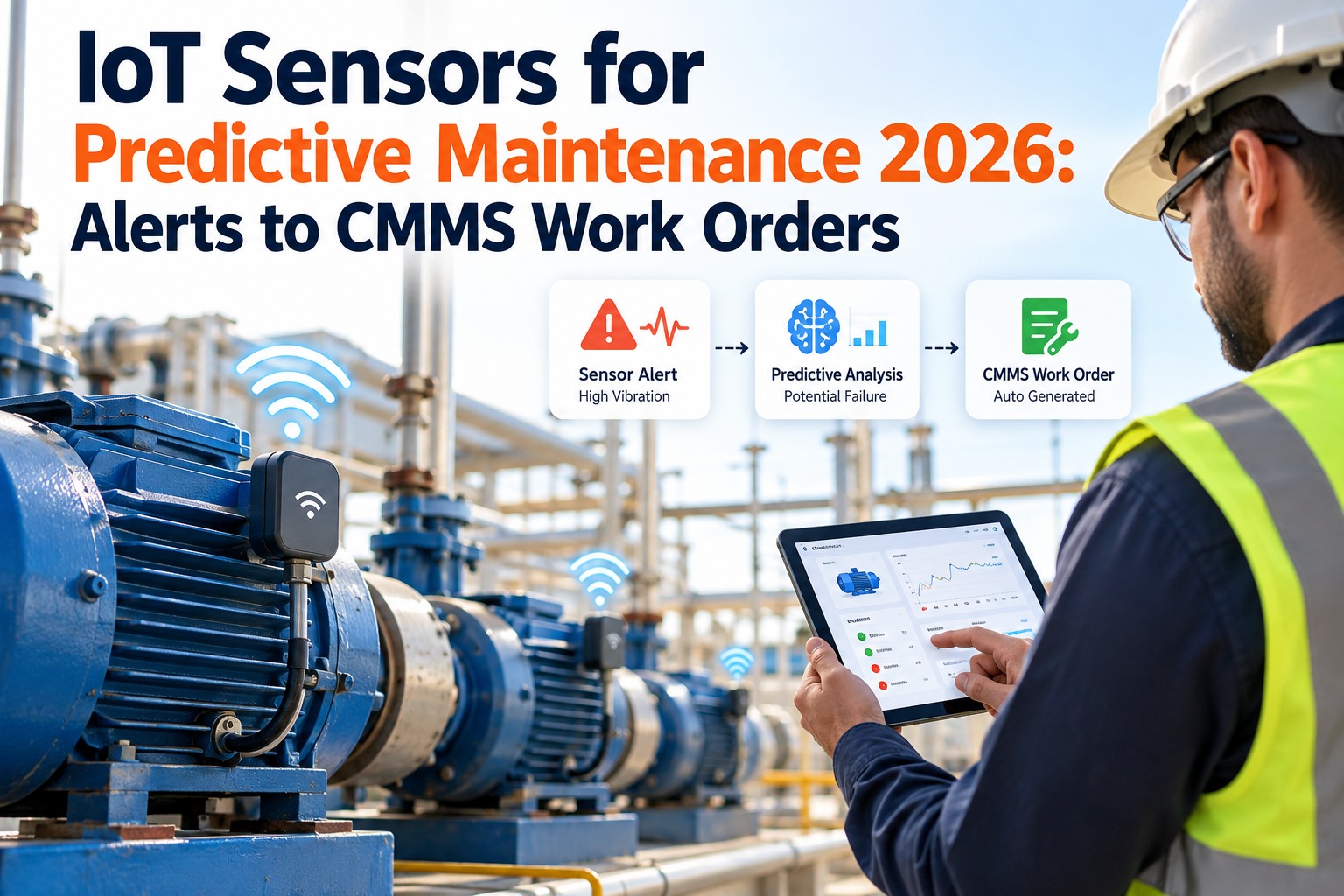
The CMMS pipeline is where IoT deployments either deliver ROI or become expensive dashboards. Without a direct, automated connection between sensor anomalies and maintenance work orders, predictive data sits in a dashboard that nobody checks. Oxmaint's data pipeline ingests edge-processed anomalies, scores them by severity and asset criticality, auto-generates prioritised work orders with sensor evidence, dispatches mobile crews, and verifies repairs through post-maintenance sensor confirmation.

The CMMS Data Pipeline: From Sensor Anomaly to Verified Repair
Every step is automated — no manual transcription, no forgotten alerts, no unverified repairs
Anomaly Ingestion
Edge alerts → CMMS via API

Priority Scoring
Severity × criticality ranking

Auto Work Order
With sensor evidence attached

Mobile Dispatch
Crew receives on device

Repair Execution
Checklist + photo evidence

Sensor Verification
Post-repair data confirms fix

Deployment ROI: Standalone Dashboard vs. CMMS-Integrated Pipeline

The difference between IoT predictive maintenance that delivers ROI and IoT that becomes an expensive science project is the CMMS pipeline. Dashboard-only deployments produce data that maintenance teams ignore. CMMS-integrated pipelines produce work orders that maintenance teams execute. The cost comparison below demonstrates why the integration layer — not the sensors themselves — determines programme success.

Annual Cost Impact: Dashboard vs. CMMS-Integrated IoT
Swipe to compare approaches
MetricNo IoT (Reactive)IoT + Dashboard OnlyIoT + CMMS Pipeline
Unplanned Downtime $2.4M/yr (baseline) $1.8M/yr (25% reduction) $480K/yr (80% reduction)
Alert-to-Repair Time N/A — no alerts Days to weeks (manual) Under 24 hours (automated)
Finding-to-WO Conversion 0% (no findings) 15-30% (manual entry) 100% (auto-generated)
Sensor Data Utilisation N/A Viewed by 1-2 engineers Drives all PdM work orders
12-Month ROI N/A Negative (cost without return) 3x-8x investment recovery
72%Of dashboard-only IoT pilots fail to deliver ROI
6 moAvg. payback for CMMS-integrated IoT deployments

Expert Perspective: Why the Pipeline Matters More Than the Sensor

I've deployed IoT sensors in over 40 manufacturing plants across 8 industries. The pattern is consistent: facilities that buy sensors first and worry about integration later fail. Facilities that design the CMMS work order pipeline first and select sensors to feed it succeed. The sensor is the easy part — it's a $200 device that measures physics. The hard part is turning that measurement into a dispatched, completed, and verified maintenance action that prevents a $50,000 failure. That's an architecture problem, not a hardware problem. Every successful deployment I've seen started with the question "how does this sensor's data become a work order?" and worked backwards to select the right hardware, protocol, edge processing, and CMMS integration. The failures all started with "let's install sensors and see what we get."

Start With FMEA
Document the top 20 failure modes on your critical assets. Each failure mode determines the sensor type, sampling rate, threshold logic, and work order template. Without FMEA, you're guessing at sensor placement.
Do an RF Site Survey
Walk the plant with a spectrum analyser before selecting wireless protocols. Metal structures, EMI from VFDs, and existing Wi-Fi traffic create dead zones that vendor range specs don't account for. Test before you buy.
Size Edge for 2x Peak
Edge gateways that handle normal load fail during production peaks when all sensors fire simultaneously. Size processing, memory, and bandwidth for 2x peak throughput. Under-sized edge computing is the hidden bottleneck that kills deployments.

Facilities that follow this architecture — FMEA-driven sensor selection, RF-validated wireless protocols, properly sized edge computing, and CMMS pipeline integration — achieve 80%+ reduction in unplanned downtime within 12 months. The sensor technology is mature and proven; the differentiator is the deployment architecture that connects sensor data to maintenance action. Schedule a consultation to design your IoT predictive maintenance architecture.

Your First 90 Days: From Zero to Predictive

A phased 90-day deployment delivers first prevented failures within weeks — not months. Start with 5-10 critical assets, prove the sensor-to-work-order pipeline, document ROI, then expand. Attempting to instrument an entire plant at once is the primary cause of deployment failure. The roadmap below structures the deployment for rapid, measurable results that justify programme expansion.

For facilities ready to move from reactive maintenance to sensor-driven predictive operations, the path is clear: match sensors to failure modes first, validate wireless coverage second, size edge computing third, and connect every anomaly to a CMMS work order fourth. Book a consultation to structure your IoT deployment for measurable predictive maintenance results.
Turn Sensor Data Into Prevented Failures — Not Just Dashboards
Oxmaint connects IoT sensor anomalies to automated, prioritised, dispatched, and verified maintenance work orders. See how the complete sensor-to-repair pipeline eliminates unplanned downtime and delivers measurable ROI from day one.

Frequently Asked Questions

How many sensors do we need to start a predictive maintenance programme?
Start with 5-10 critical assets — the equipment whose failure causes the most downtime cost, safety risk, or production impact. Conduct FMEA on each asset to determine the dominant failure mode and select the matching sensor type. A typical pilot deploys 20-40 sensors across these critical assets (multiple sensor types per asset for comprehensive coverage). This focused approach proves the sensor-to-work-order pipeline quickly, generates documented ROI within 90 days, and provides the evidence needed to justify facility-wide expansion. Attempting to instrument 500+ assets at once is the primary cause of deployment failure — start small, prove value, then scale. Sign up free to start building your predictive pipeline today.
Which wireless protocol should we use for our plant?
The answer depends on your plant environment, not vendor marketing. For large facilities with distributed assets and low-frequency data needs (temperature, pressure, level), LoRaWAN provides kilometres of range with 5-10 year battery life. For dense indoor environments collecting high-bandwidth vibration waveforms, Wi-Fi 6 or private 5G provides the throughput needed. For oil & gas and chemical plants with existing HART infrastructure, WirelessHART extends your current ecosystem. Most facilities need a hybrid architecture — LoRaWAN for 70% of sensors (simple scalar data) and Wi-Fi/5G for 30% (high-bandwidth vibration and acoustic data). Conduct an RF site survey before purchasing any hardware to validate coverage in your specific metal-dense, EMI-heavy environment.
What does edge computing actually do in a predictive maintenance deployment?
Edge computing performs four critical functions: First, it aggregates data from multiple wireless protocols into a unified format. Second, it runs AI inference models locally — detecting bearing degradation, thermal anomalies, and pressure decay without cloud round-trips. Third, it filters noise and false positives so only validated anomalies reach the CMMS, reducing alert volume by 85%+. Fourth, it provides store-and-forward capability during network outages so no data is lost. Without edge computing, you're sending terabytes of raw sensor data to the cloud (expensive and slow), relying on cloud-only AI (high latency), and flooding the CMMS with false positives that train maintenance teams to ignore alerts.
How does the CMMS know when to generate a predictive work order?
The CMMS receives edge-processed anomaly alerts via API with four data elements: sensor identification, anomaly type, severity score, and predicted time-to-failure. Configurable threshold rules determine work order generation — for example, a vibration severity score above 7/10 with predicted failure in under 30 days auto-generates a Priority 2 work order. Each work order includes the sensor evidence package (trend charts, spectral analysis, thermal images), asset location, recommended repair action, required parts, and estimated labour hours. Priority scoring ranks every predictive work order by failure cost impact × time urgency, ensuring crews address the highest-ROI items first. Book a demo to see the threshold configuration and work order generation in action.
What is the ROI timeline for an IoT predictive maintenance deployment?
CMMS-integrated IoT deployments typically see first prevented failures within 30-60 days — the sensors detect degradation that would have caused a breakdown, and the automated work order ensures repair happens before failure. Full programme ROI, including all hardware, edge computing, wireless infrastructure, and CMMS integration, is achieved within 6 months for most manufacturing facilities. Facilities spending $2M+ annually on unplanned downtime commonly recover $1-2M per year through prevented failures. Additional value comes from reduced spare parts inventory (planned purchases vs. emergency stock), extended equipment life (early intervention prevents secondary damage), and reduced overtime labour (planned repairs during normal hours). The key ROI accelerator is the CMMS pipeline — without it, sensor data delivers 25% of potential value at best.


Share This Story, Choose Your Platform!