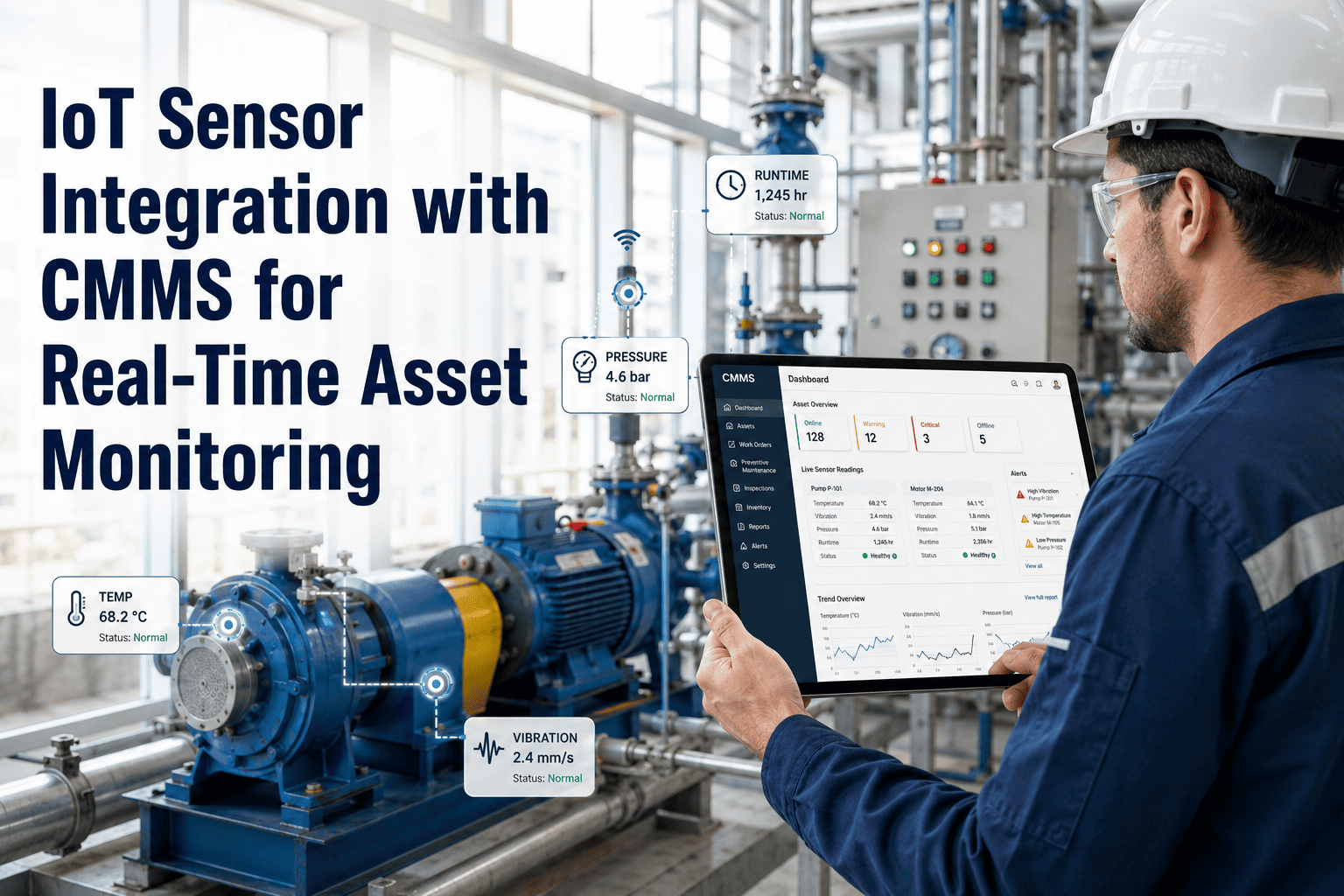
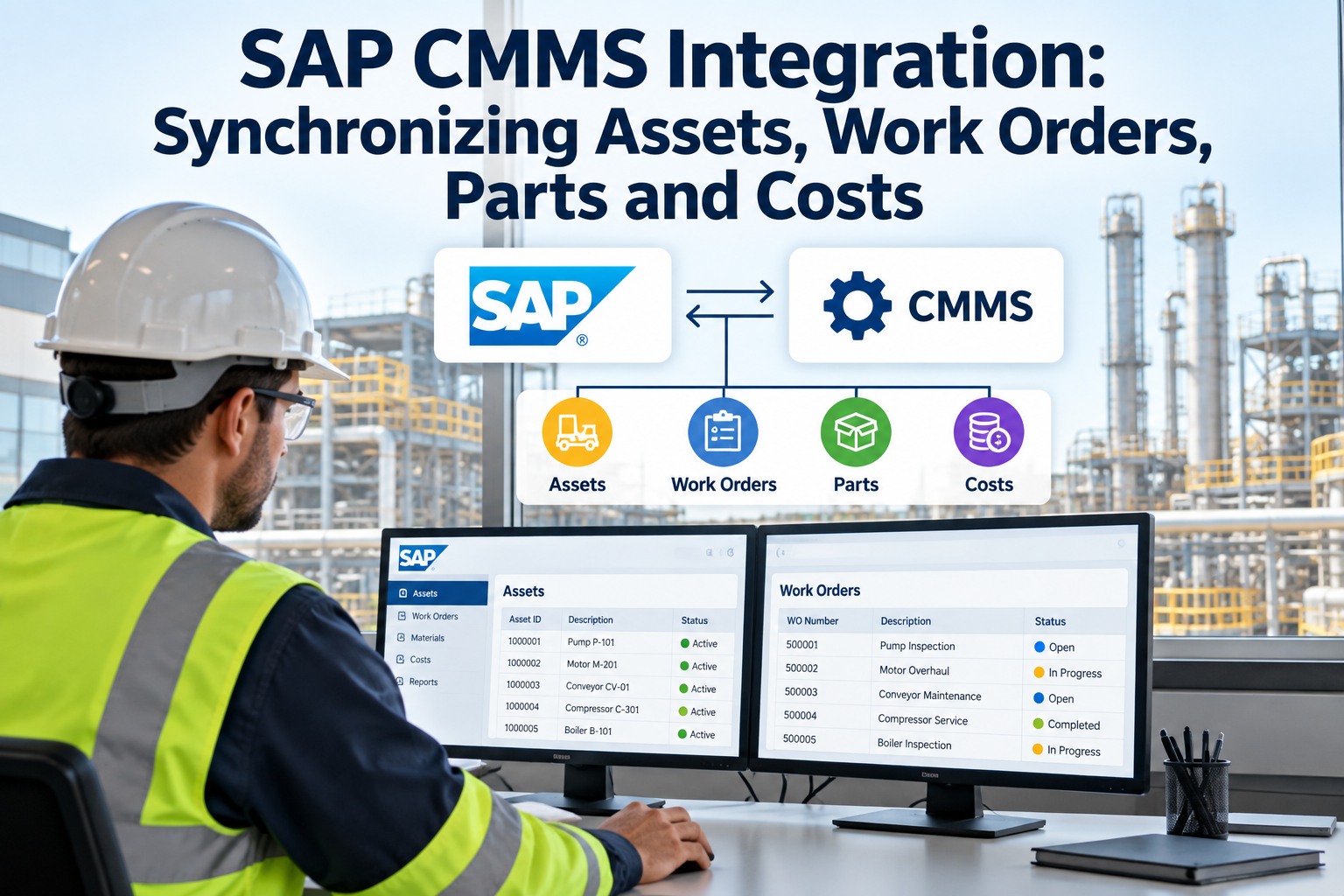
Real-time asset monitoring is no longer a capability reserved for greenfield smart factories. Industrial IoT sensor costs have dropped 80% since 2016, retrofit kits exist for equipment built in the 1980s, and modern CMMS platforms are built to receive, contextualize, and act on sensor data without custom middleware. The remaining barrier is integration architecture — knowing which sensors work for which failure modes, how they connect to a CMMS like OxMaint, and what the data needs to look like before it becomes a maintenance decision rather than just a number on a dashboard. This guide covers all three layers for industrial maintenance teams ready to move from manual inspections to continuous asset intelligence.
Integration Guide — IoT + CMMS
IoT Sensor + CMMS Integration: The Architecture That Actually Works
From sensor selection to CMMS work order — the complete integration path for industrial maintenance teams building real-time asset monitoring without a six-figure IT project.
80%
IoT sensor cost reduction since 2016
45%
Maintenance cost reduction with full IoT-CMMS integration
6 wk
Typical deployment time for 50-asset IoT program
The Three-Layer Integration Architecture
Effective IoT-CMMS integration has three distinct layers. Each layer has specific technical requirements, and integration failures almost always happen because one layer was skipped or incorrectly specified. Understanding the architecture before selecting sensors or platforms saves months of costly rework.
Layer 1 — Edge
Sensor and Gateway
Physical sensors collect condition data. Edge gateways aggregate, timestamp, and compress data for transmission. This layer must match the communication protocol available at the asset location — wired, wireless, or cellular.
Protocols: Modbus, OPC-UA, MQTT, 4-20mA, BACnet
↓
Layer 2 — Processing
Data Normalization and Contextualization
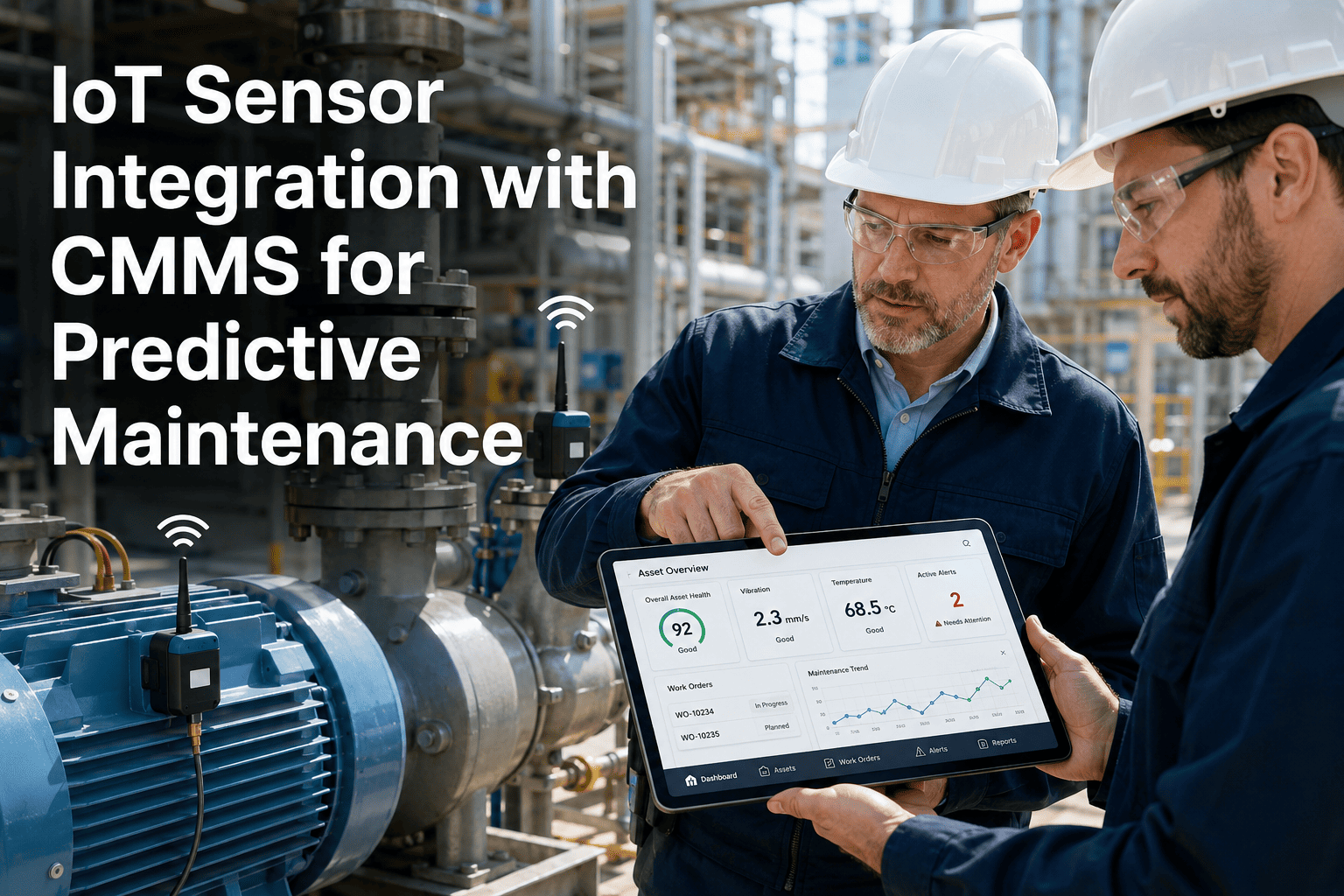
Raw sensor values are converted to meaningful condition indicators. A vibration reading in mm/s means nothing without context about the machine type, speed, and acceptable baseline. This layer transforms raw data into asset health signals.
OxMaint normalizes sensor data against asset-specific thresholds automatically
↓
Layer 3 — Action
CMMS Work Order Trigger
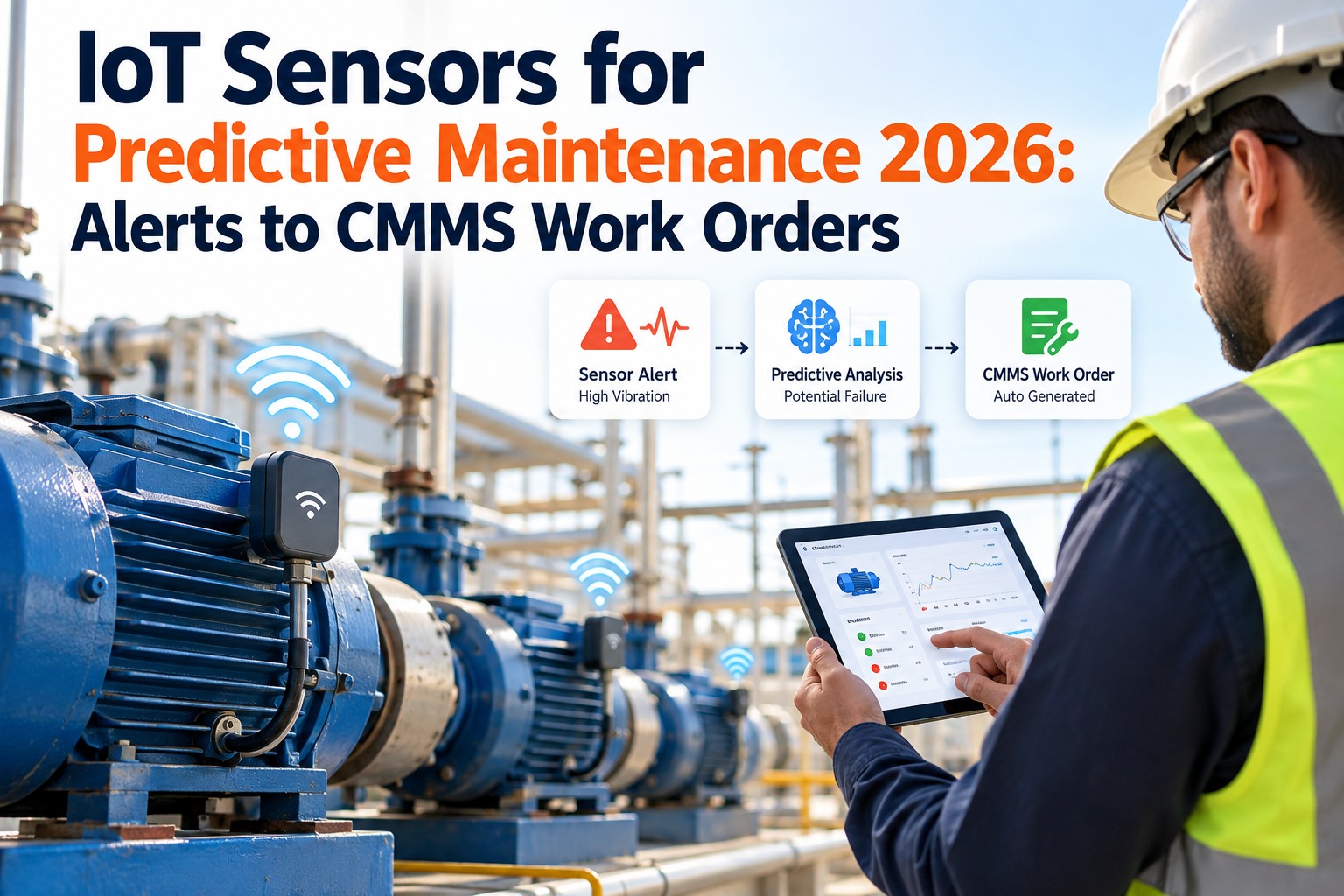
When a contextualized condition signal crosses a threshold, the CMMS receives an alert and — based on configured rules — creates, escalates, or updates a work order automatically. This is where sensor data becomes maintenance action.
OxMaint API handles threshold alerts, work order auto-creation, and technician notification
Sensor Selection by Failure Mode
| Failure Mode |
Recommended Sensor Type |
Lead Time Before Failure |
Asset Types |
Typical Cost Range |
| Bearing wear and fatigue |
Vibration (accelerometer) |
2–8 weeks |
Motors, pumps, fans, gearboxes |
$150–$600 per point |
| Electrical overload / insulation |
Thermal (infrared) + current |
1–4 weeks |
Motors, switchgear, transformers |
$200–$800 per point |
| Lubrication failure |
Ultrasound / acoustic |
4–12 weeks |
Bearings, compressors, cylinders |
$300–$900 per point |
| Cavitation / flow anomaly |
Vibration + flow / pressure |
1–3 weeks |
Pumps, valves, heat exchangers |
$400–$1,200 per point |
| Structural fatigue / crack |
Acoustic emission + strain gauge |
Weeks to months |
Structural elements, pressure vessels |
$800–$3,000 per point |
| Process deviation |
Temperature + pressure + flow |
Hours to days |
Process equipment, reactors, dryers |
$100–$500 per point |
What Changes When IoT Connects to CMMS
Without IoT-CMMS Integration
Manual inspection rounds every 7–14 days — failures invisible between visits
Sensor data in a separate dashboard — no automatic work order creation
Maintenance planner manually reviews dashboards and creates work orders
No connection between sensor trend and maintenance history
Alert fatigue — dashboards generate alarms with no clear ownership or action
Failure events documented after the fact, no lead time captured
With OxMaint IoT Integration
Continuous monitoring — anomaly detection within minutes, not days
Threshold breach auto-creates a prioritized work order in CMMS
Planner reviews AI-generated work orders, not raw sensor dashboards
Sensor trend linked to asset record — full condition history per asset
Actionable alerts only — configured thresholds filter noise before work order creation
Lead time from alert to intervention captured — used to improve thresholds over time
See OxMaint's IoT Integration in Your Environment
OxMaint connects to existing sensor infrastructure through standard industrial protocols — no proprietary hardware required. Book a 30-minute session and our integration team will map your current sensor setup to the OxMaint connection path.
IoT-CMMS Deployment Roadmap: 50-Asset Program in 6 Weeks
Week 1–2
Asset Criticality and Sensor Mapping
Rank assets by downtime cost impact. Select top 20% for phase one. Map failure modes to sensor types. Define communication pathways from asset to gateway to cloud. Deliverable: sensor specification per asset.
Week 3
Gateway Installation and Network Commissioning
Edge gateways installed and connected to plant network or cellular backup. Sensor mounting positions finalized. OxMaint API credentials configured. Test data stream verified end-to-end before sensors are mounted permanently.
Week 4
Sensor Deployment and Baseline Capture
Sensors installed on prioritized assets. 5–7 day baseline captured in normal operating condition. OxMaint establishes per-asset normal bands. Threshold configuration begins based on manufacturer limits and baseline deviation.
Week 5–6
Threshold Tuning and Work Order Rule Configuration
Alert thresholds adjusted based on initial baseline results. Work order auto-creation rules configured by threshold severity. Maintenance team trained on alert review and work order response workflow. First live alerts tested and validated.
Expert Review
"
The most common failure mode in IoT maintenance projects is not sensor failure — it is the gap between the sensor dashboard and the maintenance workflow. Organizations deploy vibration sensors, build beautiful trend graphs, and then ask a maintenance planner to watch dashboards all day and create work orders manually when something looks wrong. That is not integration — it is two disconnected systems with a human in the gap. Real integration means the sensor threshold directly creates, assigns, and prioritizes a work order without human intermediation. That is when IoT actually reduces downtime instead of just visualizing it.
Tom Eriksson
Industrial IoT Integration Architect — 16 years, process and discrete manufacturing sensor programs
Frequently Asked Questions
Does OxMaint require specific IoT hardware or does it work with existing sensors?
OxMaint integrates with existing sensor infrastructure using standard industrial communication protocols including Modbus, OPC-UA, MQTT, and REST API. It does not require proprietary sensors or gateways. For sites starting without sensors, OxMaint's team can recommend sensor packages from compatible vendors that integrate directly — but the platform is hardware-agnostic by design. The available connectors and protocols for your specific environment are reviewed during the
demo session.
How does OxMaint handle alert fatigue from too many sensor notifications?
Alert fatigue is the most common failure point in IoT deployments without CMMS integration. OxMaint addresses it through configurable threshold tiers — each tier mapped to a specific response action (inform, investigate, work order, escalate). Only alarms that cross the "investigate" threshold reach the planner's queue. Alarms that normalize before the response window automatically close without creating a work order. This architecture reduces alert volume to the 3–8 actionable items per day that maintenance teams can actually respond to effectively.
Start a free trial to configure your threshold rules.
Can IoT sensor data be connected to preventive maintenance schedule adjustments in OxMaint?
Yes — OxMaint's condition-based PM module adjusts PM trigger intervals dynamically based on sensor readings rather than fixed calendar dates. A pump that shows elevated vibration during high-load periods can have its bearing inspection PM triggered by sensor condition rather than waiting for the 90-day calendar event. Condition-based PM rules are configured per asset and reviewed automatically as sensor baselines evolve. This capability is demonstrated in the
demo walkthrough using real asset use cases.
What is the minimum viable IoT program for a plant with limited budget?
The highest-ROI entry point for a limited-budget IoT program is vibration monitoring on the three to five assets that generate the highest unplanned downtime cost. Wireless vibration sensors at $150–$400 per monitoring point, connected to a single edge gateway, feeding directly into
OxMaint via MQTT — this architecture can be deployed in under two weeks for under $5,000 in hardware. A single prevented failure on a critical asset typically recovers the entire program cost in the first quarter. The asset selection process is covered in the demo.
Connect Your Sensors to Maintenance Action — Not Just Dashboards
OxMaint closes the gap between IoT sensor data and maintenance work orders. Book a 30-minute integration walkthrough and see how sensor alerts become assigned, costed, and traceable work orders — automatically.