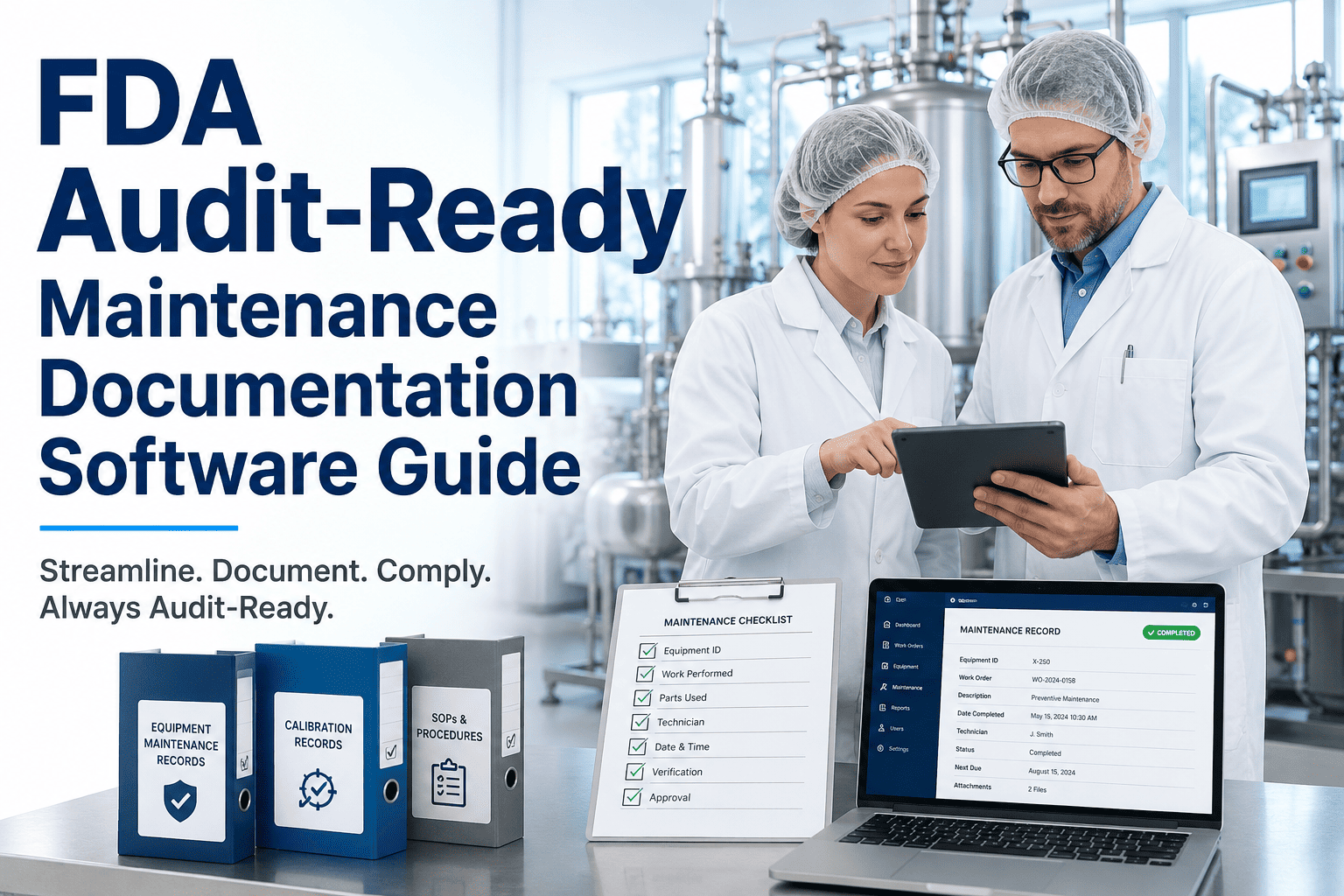
For most asset management teams, ISO 55001 compliance surfaces twice — once when pursuing certification and again when the auditor arrives. Everything in between is fragmented record-keeping across spreadsheets, emails, and disconnected tools. When auditors request documented evidence that risk-based maintenance decisions were made and recorded consistently over the past 12 months, the manual evidence scramble begins. ISO 55001 is not a certification event — it is a living management system that must generate documented proof every single day. Organizations that embed compliance into their CMMS workflow rather than maintaining it separately reduce audit preparation time by over 60% and pass with far fewer findings. Want to see what audit-ready asset management looks like? start a free trial for 30 days or book a demo and see ISO 55001 evidence generated automatically from daily maintenance operations.
ISO 55001 · Asset Management Standard · 2026 Compliance Guide
ISO 55001 Compliance Through Your CMMS in 2026
From initial gap assessment to certification maintenance — the complete CMMS-driven ISO 55001 roadmap for operations and asset management teams managing real portfolios
See ISO 55001 Evidence Generated Automatically — Not Assembled at Audit Time
Oxmaint structures asset data exactly the way ISO 55001 auditors require — hierarchy, lifecycle records, condition history, risk rationale, and performance tracking built into every maintenance operation. No separate documentation system. No 60-day audit scramble. Just clean evidence, always ready. start a free trial or book a demo to see your audit package built in real time.
39%
Audit Failures
of ISO 55001 audits fail due to incomplete or missing maintenance documentation
27%
Fewer Asset Failures
reduction in asset failure rates reported by ISO 55001 certified organizations
60%
Less Audit Prep Time
reduction in evidence preparation when CMMS generates documentation continuously
$1.8M
Annual Savings
average annual savings from ISO 55001-aligned asset lifecycle management decisions
What Is ISO 55001?
ISO 55001 is the international standard for Asset Management Systems (AMS), published by ISO. It specifies requirements for establishing, implementing, maintaining, and improving a system for managing physical assets across their full lifecycle — from acquisition to disposal. Unlike maintenance standards that focus purely on technical performance, ISO 55001 requires alignment between asset management activities and organizational objectives, with documented evidence at every decision point.
Certification means an independent body has verified that your organization's asset management system — including how decisions are made, documented, measured, and improved — meets ISO 55001 requirements. Organizations that achieve this demonstrate asset management as a governed, documented management system, not a reactive maintenance function. When your CMMS is built around these requirements, compliance evidence is generated automatically from daily operations rather than assembled manually before each audit cycle. start a free trial to see how Oxmaint maps to ISO 55001 clause by clause, or book a demo for a guided walkthrough of the compliance framework.
ISO 55000
Overview, principles & terminology
↓
ISO 55001
Requirements — the certification standard
↓
ISO 55002
Guidelines for implementation
6 ISO 55001 Requirements Your CMMS Must Support
Clause 6.2
Asset Register and Hierarchy
Documented inventory of all physical assets with defined relationships, criticality, and condition. A flat spreadsheet list does not meet this requirement. ISO 55001 expects a structured registry demonstrating systematic asset categorization.
Oxmaint: Portfolio > Property > System > Asset > Component with condition scoring
Clause 6.1
Risk-Based Planning
Documented identification and treatment of asset-related risks. Every significant maintenance decision must have a traceable risk rationale — not an undocumented judgment call that auditors cannot verify against the management system.
Oxmaint: Criticality scoring, risk-based PM scheduling, failure mode documentation
Clause 8.1
Lifecycle Management Records
Evidence that acquisition, operation, maintenance, and disposal decisions were made systematically. Lifecycle cost tracking from commissioning to end-of-service, with documented rationale for major investment decisions.
Oxmaint: Full lifecycle tracking, CapEx forecasting, condition-triggered replacement records
Clause 7.5
Documented Maintenance Information
Complete work order records capturing who performed maintenance, when, with what materials, and for how long. Digital signatures and timestamps. Auditors trace asset failures back through maintenance history — incomplete records create audit findings.
Oxmaint: Technician ID, timestamps, parts, labor hours, digital signatures on every work order
Clause 9.1
Performance Measurement
Quantified evidence that asset management objectives are being measured against targets continuously. ISO 55001 requires ongoing KPI tracking with trend data, not a quarterly export pulled from raw data when an audit is approaching.
Oxmaint: Real-time MTBF, MTTR, uptime dashboards with trend reporting over configurable periods
Clause 10
Continual Improvement Evidence
Documented closed-loop improvement cycles — corrective actions taken, rationale recorded, outcomes measured. ISO 55001 requires proof that performance data drives changes, not just that data is collected and ignored.
Oxmaint: Corrective action tracking, PM schedule optimization records, recurring failure analysis
Where ISO 55001 Compliance Breaks Down in Practice
PAIN POINT 01
Evidence Lives Across Multiple Disconnected Systems
Asset condition in a spreadsheet. Work orders in one system. PM schedules in another. Financial records in ERP. When auditors request a unified lifecycle view, teams spend weeks manually compiling evidence — and it still has gaps and date inconsistencies that create findings.
PAIN POINT 02
Maintenance Decisions Are Made but Never Documented
The decision to defer an overhaul, extend an asset's service life, or change a PM interval happens verbally. ISO 55001 requires documented rationale. Without it, auditors cannot verify that risk-based thinking drove the choice — only that an outcome happened.
PAIN POINT 03
Performance Measurement Is Retrospective
KPIs calculated at audit time from raw exports. No ongoing measurement against targets. No trend visibility showing whether performance is improving or declining. ISO 55001 requires continuous measurement — not a quarterly data extraction that happens only when auditors ask.
PAIN POINT 04
Work Order Records Are Incomplete
Completion recorded without timestamps, technician identification, materials used, or labor hours. When auditors trace an asset failure to its maintenance history, incomplete work order records cannot demonstrate the management system functioned as designed — automatic finding.
How Oxmaint Drives ISO 55001 Compliance
Asset Registry
ISO-Structured Asset Hierarchy
Portfolio > Property > System > Asset > Component hierarchy mirrors ISO 55001 asset categorization requirements. Every asset has a defined owner, condition score, criticality rating, and position in the organizational portfolio — exactly what auditors look for in a compliant asset register.
Lifecycle Tracking
Condition-Based Lifecycle Records
Asset condition scores updated with every inspection, generating a continuous condition record demonstrating systematic lifecycle management. Replacement triggers documented and linked to condition thresholds — not undocumented judgment calls that leave audit gaps.
Risk Management
Documented Risk-Based PM Decisions
Maintenance frequency tied to asset criticality scores and failure risk assessments. Documented rationale for each PM interval stored in the asset record. Auditors can trace any maintenance task back to the risk basis that justified the scheduling decision — clause 6.1 evidence built in.
Work Orders
Full Audit Trail on Every Task
Every work order captures technician ID, timestamps, parts consumed, labor hours, and completion notes with digital signature. Full trail from failure detection through repair and return to service. No manual reconstruction required when auditors request maintenance evidence for a specific asset.
Performance
Continuous KPI Dashboards
MTBF, MTTR, uptime, and PM completion rates tracked against defined targets in real time. Trend reporting over configurable periods. Demonstrates to auditors that performance is being measured continuously against objectives — not pulled from raw data at audit time.
Improvement
Corrective Action Documentation
Recurring failures trigger documented corrective action records. PM schedule changes capture rationale, approval, and the performance evidence that drove the decision. Closed-loop improvement cycles documented automatically — clause 10 evidence without extra administrative work.
Manual Compliance vs CMMS-Enabled Compliance
27%
Failure Rate Reduction
among ISO 55001 certified organizations vs non-certified industry peers
60%
Less Audit Prep Time
reduction in evidence preparation when CMMS generates documentation continuously
3.2x
Faster Evidence Retrieval
when auditors request specific asset history, vs manually assembled records
19%
Asset ROI Improvement
average improvement in asset return on investment reported post-ISO 55001 certification
Frequently Asked Questions
What documents does ISO 55001 specifically require organizations to maintain?
ISO 55001 requires documented information covering: an Asset Management Policy stating objectives and commitments; a Strategic Asset Management Plan (SAMP) linking asset activities to organizational goals; Asset Management Plans with operational detail for asset groups; maintenance records evidencing planned and corrective maintenance; risk assessment records documenting hazard identification and treatment; and performance monitoring evidence showing KPIs tracked against targets over time. A properly configured CMMS generates most of this documentation automatically as part of normal operations, eliminating the need for a separate documentation system maintained alongside the operational one.
How long does ISO 55001 certification typically take from start to first audit?
Most organizations take 12-24 months from initial gap assessment to first certification audit. The timeline depends on current asset management maturity, asset portfolio size, and quality of existing documentation. Organizations with a well-configured CMMS already in place typically complete in 12-16 months because the documentation infrastructure ISO 55001 requires already exists. Organizations starting with spreadsheets and paper records typically need 18-24 months to build compliant systems. The certification audit itself takes 2-4 days for a mid-sized operation with a qualified auditor from an accredited certification body.
Can Oxmaint replace an ISO 55001 consultant during certification?
Oxmaint provides the documentation and data infrastructure ISO 55001 requires — it does not replace the management system design, gap assessment, and certification guidance that consultants provide. What it does eliminate is the massive documentation burden that makes consultants necessary at audit time. Organizations using Oxmaint typically spend significantly less on consulting because evidence documentation is handled by the system rather than manually assembled by consultants. Think of Oxmaint as the compliance engine — the consultant helps design the management system that the engine runs continuously.
What is the difference between ISO 55000, ISO 55001, and ISO 55002?
ISO 55000 is the overview standard introducing asset management concepts, principles, and terminology — it is not certifiable. ISO 55001 is the requirements standard specifying what an asset management system must include and is the standard against which organizations achieve certification. ISO 55002 provides guidance on how to apply the requirements from ISO 55001 in practice. When an organization states it holds ISO 55001 certification, it means an independent accredited body has verified the asset management system meets all requirements in the 55001 standard — including documented processes, evidence of implementation, and demonstrated continual improvement.
ISO 55001 Compliance · Oxmaint CMMS Platform
Build ISO 55001 Compliance Into Daily Operations — Not Just Audit Cycles
Oxmaint generates the documentation ISO 55001 auditors require as a natural output of daily maintenance work. Asset hierarchy, lifecycle records, risk-based PM evidence, performance dashboards, and full work order audit trails — structured around ISO 55001 requirements from day one. No separate compliance system. No audit scrambles. Just evidence, always ready.