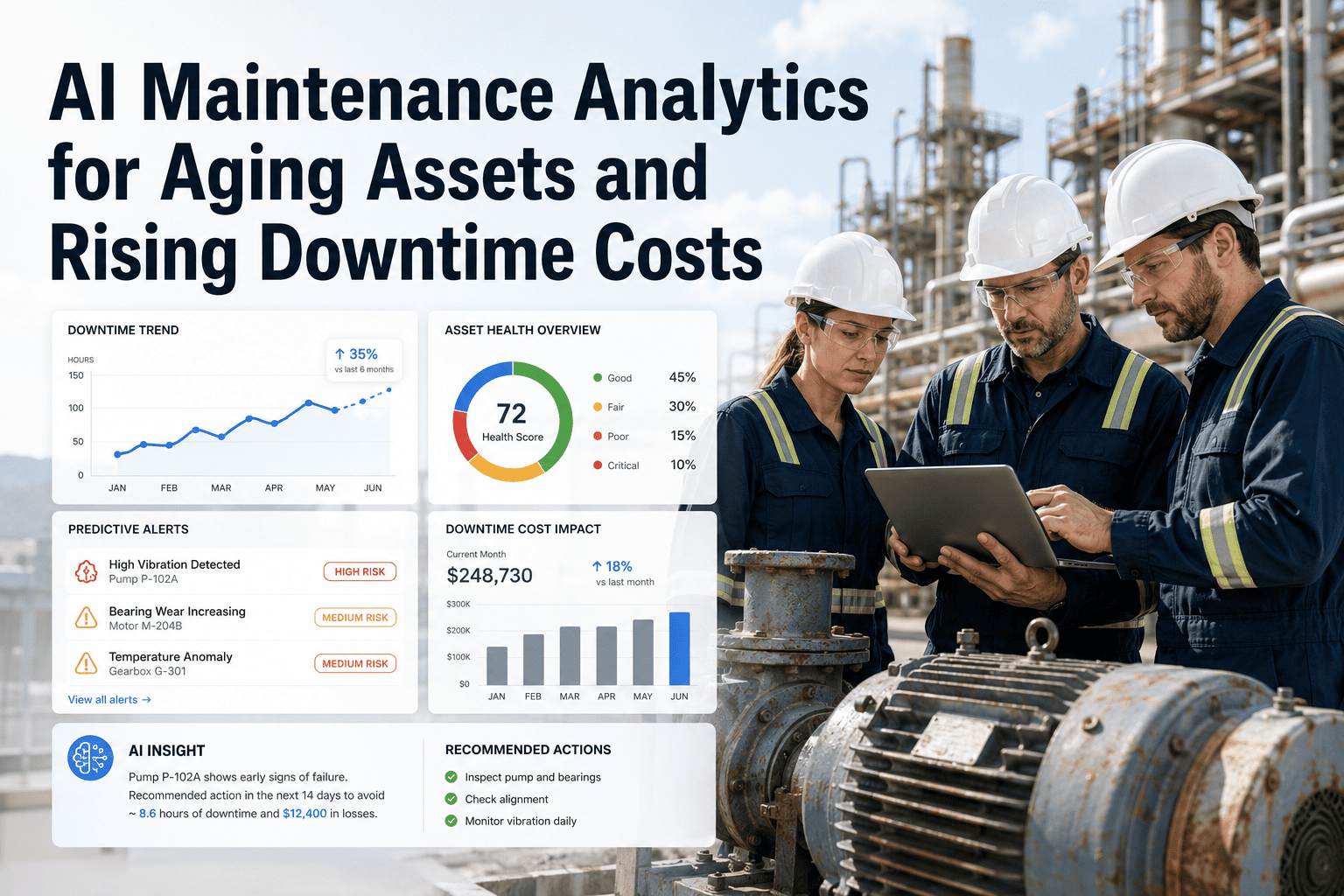
Industrial facilities generate staggering volumes of data—a single manufacturing plant produces approximately 1 terabyte of operational data daily from sensors, control systems, maintenance logs, and equipment monitors. Yet studies reveal that less than 1% of this data is analyzed and acted upon, representing an enormous untapped reservoir of operational intelligence. The predictive maintenance market has reached $10.93 billion in 2024 and is projected to surge to $70.73 billion by 2032, growing at a compound annual rate of 26.5%.
Organizations that successfully harness big data in maintenance report 25-30% reduction in maintenance costs, 35-50% reduction in unplanned downtime, and 95% of adopters achieve positive ROI within the first year. Sign up for Oxmaint to transform your raw equipment data into predictive insights that prevent failures before they occur and optimize every maintenance decision.
Executive Technology Brief
Leveraging Big Data in Maintenance: Unlocking Value from Your Assets
Transform the flood of sensor data into predictive intelligence—the definitive guide to data-driven maintenance
1 TB+
Daily Data per Plant
<1%
Currently Analyzed
Massive untapped value
100K
Readings/Second
Per vibration sensor
95%
Positive ROI Rate
Among adopters
Strategic Insight: The gap between data collection and data utilization represents the single largest opportunity in industrial maintenance. Organizations bridging this gap achieve 25-40% cost reductions while competitors drown in unanalyzed information.
Understanding the characteristics of maintenance data is essential for designing effective analytics strategies. Big data in maintenance exhibits four defining characteristics—Volume, Velocity, Variety, and Veracity—each presenting unique challenges and opportunities for extracting value from industrial operations.
Terabytes of data accumulate daily
- Traditional databases cannot handle scale
- Requires big data storage platforms
- Historical records grow exponentially
- Multi-site aggregation multiplies data
High-frequency sensor streams
- Real-time streaming analytics required
- Immediate anomaly detection needs
- Edge processing for latency reduction
- Continuous data flow management
Diverse formats require integration
- Structured sensor readings
- Unstructured technician notes
- Semi-structured logs and images
- Audio and video inspection data
Data quality determines reliability
- Sensor drift and calibration issues
- Missing values and data gaps
- Data cleansing and validation
- Quality management frameworks
Organizations progress through distinct stages of analytics sophistication. Each level builds on the previous, unlocking greater value from maintenance data. Most industrial operations remain stuck at descriptive analytics while the greatest value lies in prescriptive capabilities. Schedule a consultation to assess your analytics maturity and identify advancement opportunities.
4
Prescriptive
What should we do? AI recommends optimal actions automatically
Highest
3
Predictive
What will happen? ML forecasts failures weeks in advance
High
2
Diagnostic
Why did it happen? Root cause analysis and correlation
Medium
1
Descriptive
What happened? Basic reporting on failures and costs
Foundation
Move beyond descriptive analytics. Oxmaint delivers predictive and prescriptive capabilities through an intuitive interface—no data science team required.
Implementing big data analytics requires a layered technology architecture. Each layer serves a specific function in the data-to-insight pipeline, from capturing raw sensor signals to delivering actionable recommendations to maintenance teams.
Layer 1
Data Sources
Output: 500+ GB daily from vibration, 200+ GB from SCADA, 100+ GB from thermal imaging
Layer 2
Ingestion and Storage
IoT gateways, API connectors, and protocol adapters collect data into scalable data lakes and time-series databases capable of handling terabyte-scale ingestion.
1 TB+
daily ingestion capacity required for large facilities
Layer 3
Processing and Analytics
Stream processing handles real-time data while batch analytics perform deep analysis. Edge computing processes 50% of data locally for immediate response.
Stream Processing
ML Models
Anomaly Detection
Pattern Recognition
Layer 4
CMMS Integration
Analytics insights automatically generate work orders, optimize scheduling, and dispatch technicians—closing the loop from data to action.
Auto Work Orders
Mobile Alerts
Parts Procurement
KPI Dashboards
Organizations implementing big data maintenance analytics achieve measurable improvements across multiple operational dimensions. The following metrics represent documented outcomes from enterprise deployments, not theoretical projections.
35-50%
Through predictive failure detection and optimized interventions
Source: Industry benchmark studies, 2024
25-30%
Maintenance cost reduction through data-driven scheduling
Source: Deloitte industrial analytics
15-25%
Spare parts optimization through demand forecasting
Source: Supply chain analytics research
90%
Failure prediction with mature ML models and quality data
Source: AI predictive maintenance studies
10x
Return on investment with comprehensive CMMS analytics
Source: CMMS implementation benchmarks
<1%
Current industrial data analyzed—99% untapped potential
Source: Industrial IoT research
Ready to Unlock Your Data?
Join the 95% Achieving Positive ROI
Oxmaint transforms raw equipment data into actionable intelligence without requiring data science expertise. Start extracting value from the 99% of data currently going unanalyzed.
<1%
Data Currently Used
95%
Report Positive ROI
27%
Year-1 Payback
What is big data in maintenance and how does it differ from traditional data analysis?
Big data in maintenance refers to the collection, storage, and analysis of massive volumes of equipment data—terabytes daily from sensors, control systems, and maintenance records—that exceed traditional database capabilities. Unlike conventional analysis that samples limited data points, big data analytics processes complete datasets in real-time, applying machine learning algorithms to detect patterns invisible to human analysis.
How much data does industrial equipment actually generate?
A typical manufacturing plant generates approximately 1 terabyte of operational data daily. A single vibration sensor can produce 100,000 data points per second. Modern facilities with thousands of sensors, process control systems, thermal imaging, and operational logs generate hundreds of gigabytes to terabytes daily. Less than 1% of this data is currently analyzed—the vast majority goes unused.
What ROI can we expect from big data maintenance analytics?
Industry data shows 95% of organizations implementing predictive maintenance report positive ROI, with 27% achieving full cost recovery within the first year. Typical results include 25-30% reduction in maintenance costs, 35-50% reduction in unplanned downtime, and 15-25% reduction in spare parts inventory. Organizations implementing comprehensive CMMS with analytics capabilities report up to 10x return on investment.
Do we need to replace existing systems to implement big data analytics?
No, modern big data platforms are designed to integrate with existing infrastructure rather than replace it. Data connectors pull information from existing sensors, SCADA systems, historians, and CMMS without disrupting operations. Cloud-based analytics layers sit on top of existing data sources, enabling organizations to start extracting value from data they already collect.
What skills are needed to implement big data maintenance analytics?
Implementation requires domain expertise in equipment failure modes and maintenance processes, plus data engineering for building pipelines and integrations. However, modern CMMS platforms with built-in analytics increasingly automate the technical complexity, allowing maintenance professionals to benefit from big data without deep data science expertise. The critical need is maintenance domain knowledge to interpret insights.
How accurate are predictive maintenance algorithms?
AI-driven predictive analytics can achieve failure prediction accuracy up to 90% when properly implemented with sufficient training data. Accuracy depends on data quality, completeness of failure history for model training, and appropriateness of algorithms for specific failure modes. Organizations typically start with 70-80% accuracy and improve over time as models learn from more data.