A maintenance director at a food processing plant in Wisconsin presented her annual budget request with a single line: "maintenance costs increased 18% this year." The finance committee cut her budget. Twelve months later, a conveyor gearbox failed during peak production — $94,000 in product loss, equipment damage, and emergency contractor fees. She had the cost data but never the context. Maintenance KPIs — MTBF, MTTR, OEE, PM compliance, and cost-per-asset ratios — are not metrics for auditors. They are the language that turns maintenance from a cost centre into a business case. OxMaint's KPI Dashboard calculates and benchmarks these metrics automatically, so every budget conversation is backed by industry-standard data your finance team already understands.
KPI Dashboard + Benchmarking — OxMaint
MTBF, MTTR, OEE, PM compliance and cost metrics — all calculated automatically, benchmarked against industry standards
Annual industrial downtime cost in North America — most preventable with KPI-driven maintenance
45%
Of facilities have no formal KPI tracking — operating blind on equipment health and maintenance ROI
9×
Return on maintenance investment when MTTR is reduced from 8 hours to under 2 hours on critical assets
The Five KPIs That Define Maintenance Programme Health
Every maintenance programme can be assessed by five metrics that reliability engineers, plant managers, and finance directors in manufacturing, utilities, and facilities management across the USA, Canada, UK, Germany, and Australia use to benchmark performance. OxMaint calculates all five from your work order data — no manual formulas, no spreadsheet builds required.
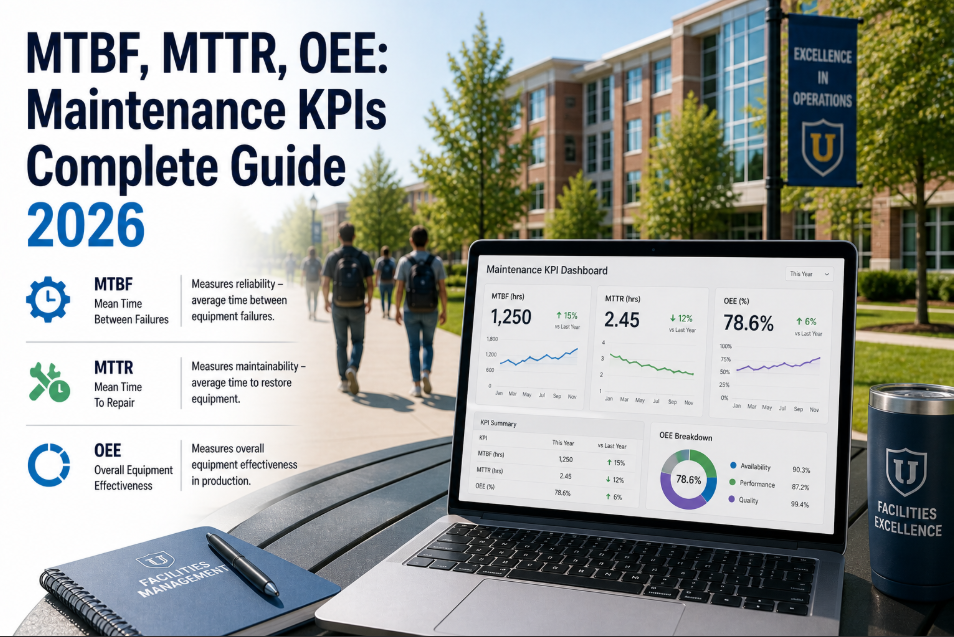
MTBF
Mean Time Between Failures
Total uptime ÷ Number of failures
Reactive:Under 500 hrs
Average:800–1,500 hrs
World Class:3,000+ hrs
MTTR
Mean Time To Repair
Total repair time ÷ Number of repairs
Reactive:8–12 hrs avg
Average:3–6 hrs avg
World Class:Under 2 hrs
OEE
Overall Equipment Effectiveness
Availability × Performance × Quality
Reactive:Under 50%
Average:60–75%
World Class:85%+
PMC
PM Compliance Rate
PMs completed on time ÷ Total PMs scheduled
Reactive:Under 50%
Average:65–80%
World Class:95%+
MCR
Maintenance Cost Ratio
Annual maintenance cost ÷ Asset replacement value
Reactive:8–12% ARV
Average:4–6% ARV
World Class:2–3% ARV
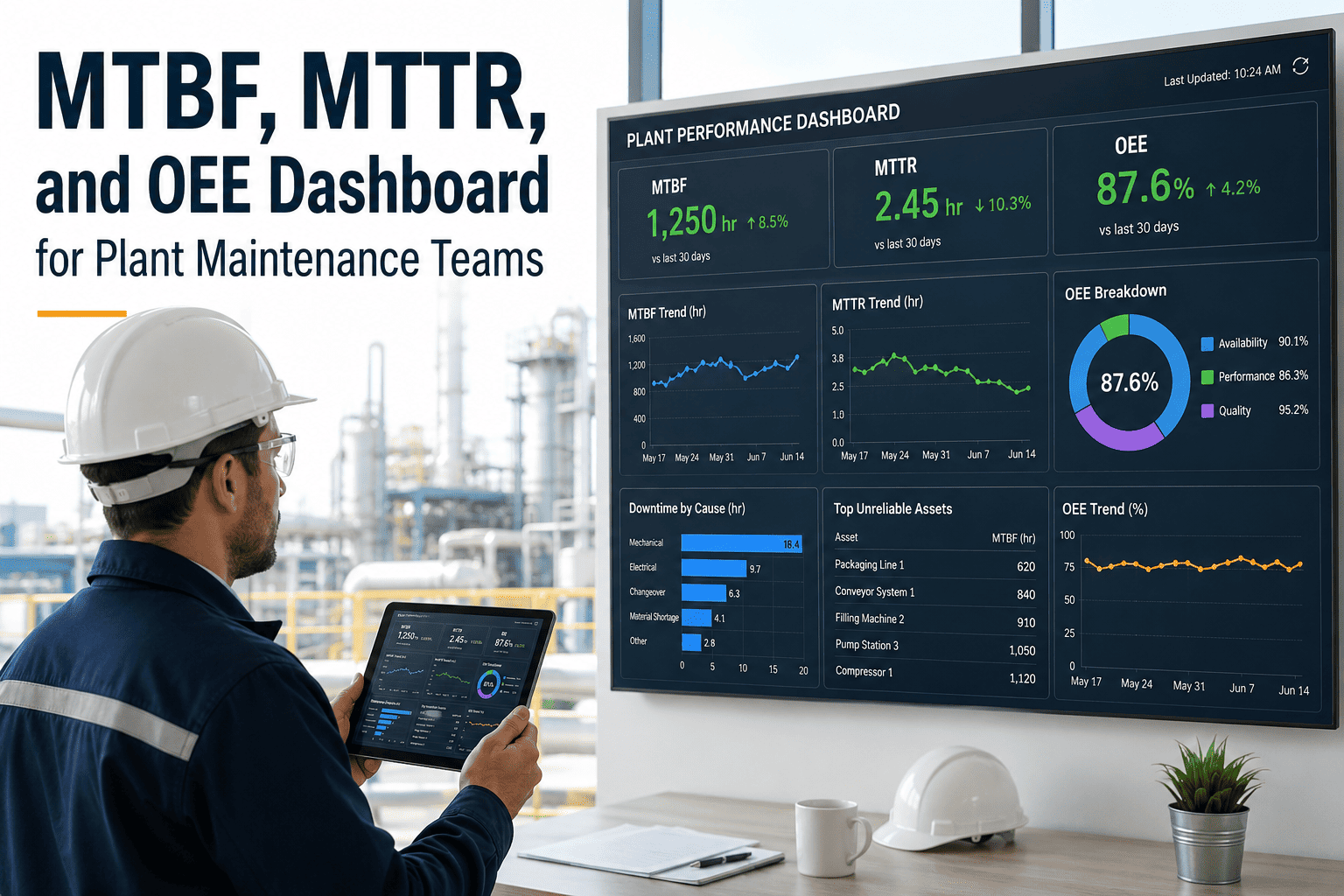
OxMaint KPI Dashboard
All Five KPIs — Calculated Automatically From Your Work Order Data
No spreadsheets. No manual formulas. OxMaint generates your MTBF, MTTR, OEE, PM compliance, and cost ratio from every work order closed in the system.
Industry Benchmarks by Sector — How Does Your Facility Compare?
KPI targets are not universal — a food processing plant runs different OEE targets than a water utility, and a hospital maintenance programme measures MTTR differently than a chemical plant. The benchmarks below reflect published standards from SMRP, OECD, and independent reliability studies across industries in the USA, Canada, UK, Germany, and Australia.
Industry
Target OEE
Target MTBF
PM Compliance
Maint. Cost Ratio
Manufacturing
≥ 75%
2,000+ hrs
≥ 90%
2–4% ARV
Food & Beverage
≥ 70%
1,500+ hrs
≥ 95%
3–5% ARV
Utilities / Energy
≥ 85%
5,000+ hrs
≥ 98%
1.5–3% ARV
Healthcare Facilities
N/A
3,000+ hrs
≥ 99%
2–3.5% ARV
Chemical / Oil & Gas
≥ 80%
4,000+ hrs
≥ 95%
2–4% ARV
Commercial Buildings
N/A
2,500+ hrs
≥ 85%
1–3% ARV
Technology That Calculates and Improves Your KPIs
The facilities achieving world-class KPI benchmarks are not doing it manually — they are connecting IoT sensor data, AI analytics, and ERP integration to their CMMS so every KPI updates in real time and every deviation triggers action automatically.
IoT Sensors → Real-Time MTBF & MTTR
Vibration, current, and temperature sensors detect failures the instant they occur — feeding OxMaint with exact failure timestamps. MTBF and MTTR calculate from real sensor events, not manual log entries that arrive late.
AI Digital Twin → Predictive OEE
Digital twin models simulate how equipment degradation will affect OEE over the next 30–90 days — so plant managers can schedule corrective work before OEE drops, not after it already has.
AI Camera Vision → Quality Loss Detection
Cameras detect product defects and equipment misalignment in real time — feeding quality loss events directly into OEE calculations so the quality factor reflects actual output, not end-of-shift reports.
SAP Integration → Automated Cost Ratio
OxMaint pulls work order cost data and pushes it to SAP — so the maintenance cost ratio updates automatically each period without a manual export, reconciliation, or finance team intervention.
PLC Fault Codes → MTTR Precision
PLC fault timestamps feed OxMaint directly — capturing the exact moment a failure began, not when a technician first logged it. This eliminates the most common source of artificially low MTTR reporting.
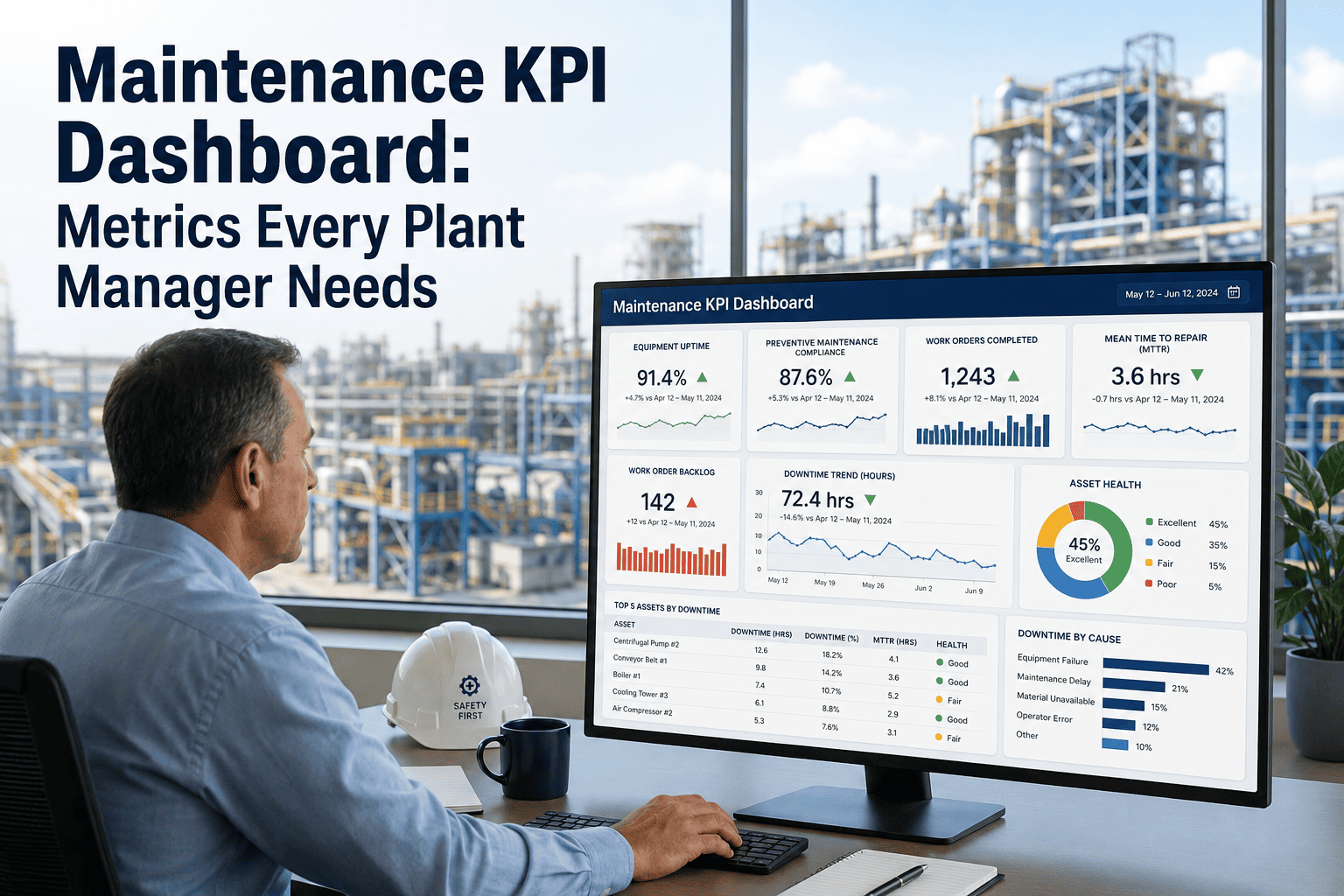
OxMaint KPI Dashboard
All five KPIs in one live dashboard — updated from every work order closed, every PM completed, and every sensor reading logged. Export-ready for board presentations and regulatory audits.
KPI Improvement Checklist — 90-Day Action Plan
Facilities that move from average to world-class KPI performance do not do it in a single overhaul. They make structured changes across 90 days. This is the verified sequence used by OxMaint customers who reached PM compliance above 90% within one quarter.
90-Day KPI Improvement Roadmap
Days 1–30
Establish Baseline
Log all assets with replacement value
Record all open WOs into CMMS
Calculate current MTBF and MTTR
Identify the top 5 failure assets
Days 31–60
Build PM Schedule
Create PM tasks for top 5 assets first
Set response SLA by priority level
Require root cause at all WO closures
Review backlog weekly with team lead
Days 61–90
Track and Improve
Review KPI dashboard every two weeks
Compare MTBF before and after PM launch
Present cost ratio data to finance team
Expand PM schedule to all asset classes
We went from a MTBF of 340 hours to over 1,100 hours on our production line in 8 months — just by getting PM compliance from 48% to 91%. The OxMaint dashboard made the improvement visible in every weekly ops meeting.
— Reliability Manager, Automotive Parts Manufacturer · Michigan · OxMaint user since 2022
Frequently Asked Questions
World-class manufacturing targets 2,000+ hours MTBF on critical assets. Most reactive plants run under 500 hours. Improving PM compliance from 50% to 90% typically doubles MTBF within 6 months.
OEE = Availability × Performance × Quality. World class is 85%+; average facilities run 60–75%. Food, pharma, and energy sectors often set higher OEE compliance thresholds due to regulatory requirements.
World class is 2–3% of asset replacement value annually. Reactive facilities often run 8–12%. A move from 8% to 4% on a $10M asset base is $400,000 saved per year — a compelling budget case.
MTTR and backlog should be reviewed weekly by the maintenance supervisor. MTBF and PM compliance monthly with plant leadership. OEE and cost ratio quarterly for budget and strategic planning.
Yes. OxMaint's dashboard compares your live KPIs to industry benchmarks by sector — flagging metrics below average and tracking improvement trends over time. Start your free trial to see your first benchmark report.
KPI Dashboard — OxMaint
Know Your Numbers. Improve Your Programme. Prove Your Value.