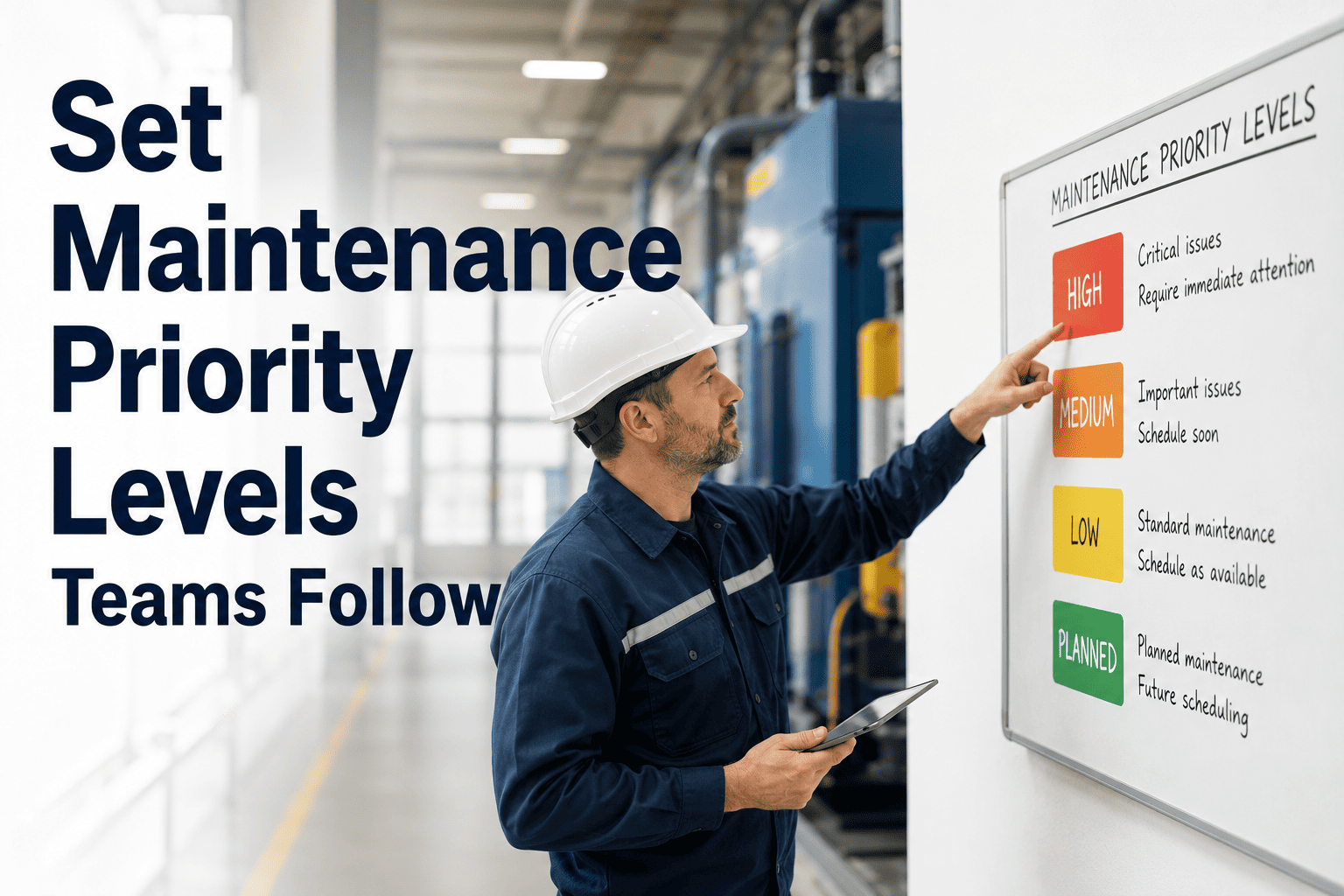
A plant manager at a specialty chemicals facility was asked by her new VP of Operations a simple question: "Where does our maintenance program actually stand — are we reactive, preventive, or something better?" She had been running the plant for seven years. She ran preventive PM schedules. She had a CMMS. She knew the team worked hard. But when she tried to answer honestly, she realized she had no framework to benchmark against. Her reactive work ratio was 38% — was that good? Her PM compliance was 74% — acceptable or embarrassing? Were the plant's next investments supposed to be in more sensors, more process, or more people? The Maintenance Maturity Model exists because this question comes up in every operations review, and no organization can plan forward without knowing where it stands today. If your team needs the same answer, sign up to try Oxmaint free for 30 days or book a demo to benchmark your current state.
Maintenance Maturity — 2026 Benchmark Data
Organizations at Level 1 Experience 30–50% More Downtime Than Those at Level 4 — and Pay 3–5x More Per Operating Hour
57%
Still run to failure
Manufacturing maintenance managers operating at Level 1 in 2025
27%
Apply predictive maintenance
Plant Engineering 2025 — against 88% using preventive PM as the primary approach
50%
Savings on labor & MRO
Documented by organizations moving from Level 2 to Level 4 on critical assets
70%
Breakdown reduction
Deloitte data on AI-enabled Level 4+ maintenance programs vs. Level 1 baseline
The Five Levels of Maintenance Maturity — Know Where You Actually Stand
The Maintenance Maturity Model, first formalized by Winston Ledet in 1999 and refined by ARC Advisory, SMRP, and ISO 55000 in the years since, defines five distinct levels of operational maturity. Each builds on the foundation of the one below it. Skipping levels does not work — an organization cannot credibly operate at Level 4 (Predictive) without the complete asset registry and maintenance history that Level 3 establishes. Here is what each level actually looks like on the plant floor.
L1
Level 1 — Reactive (Run to Failure)
80%+ of work is reactive. No structured PM. Equipment runs until it breaks.
The firefighting stage. Work orders rarely documented, spare parts inventory chaotic, frequent emergency repairs. Downtime is constant. Useful life is shortened and total maintenance cost is 3–5x higher per operating hour than at Level 4.
L2
Level 2 — Preventive (Time-Based PM)
50%+ preventive, 80%+ planned, less than 20% reactive. PM schedules by calendar or mileage.
Most assets on a calendar or meter-based PM schedule. Work orders digitally tracked. The plateau where 88% of manufacturers sit. Reactive work dropping, but still doing maintenance too early on some assets and too late on others because calendar rules don't see actual condition.
L3
Level 3 — Condition-Based (CBM)
95%+ work orders planned. Condition-triggered work orders. Sensor data drives timing.
Instrumentation and monitoring systems in place. Maintenance timing aligned with actual asset condition rather than the calendar. Data becomes part of the maintenance decision. A pragmatic, high-ROI stage — and the foundation that any credible Level 4 program has to be built on.
L4
Level 4 — Predictive (PdM)
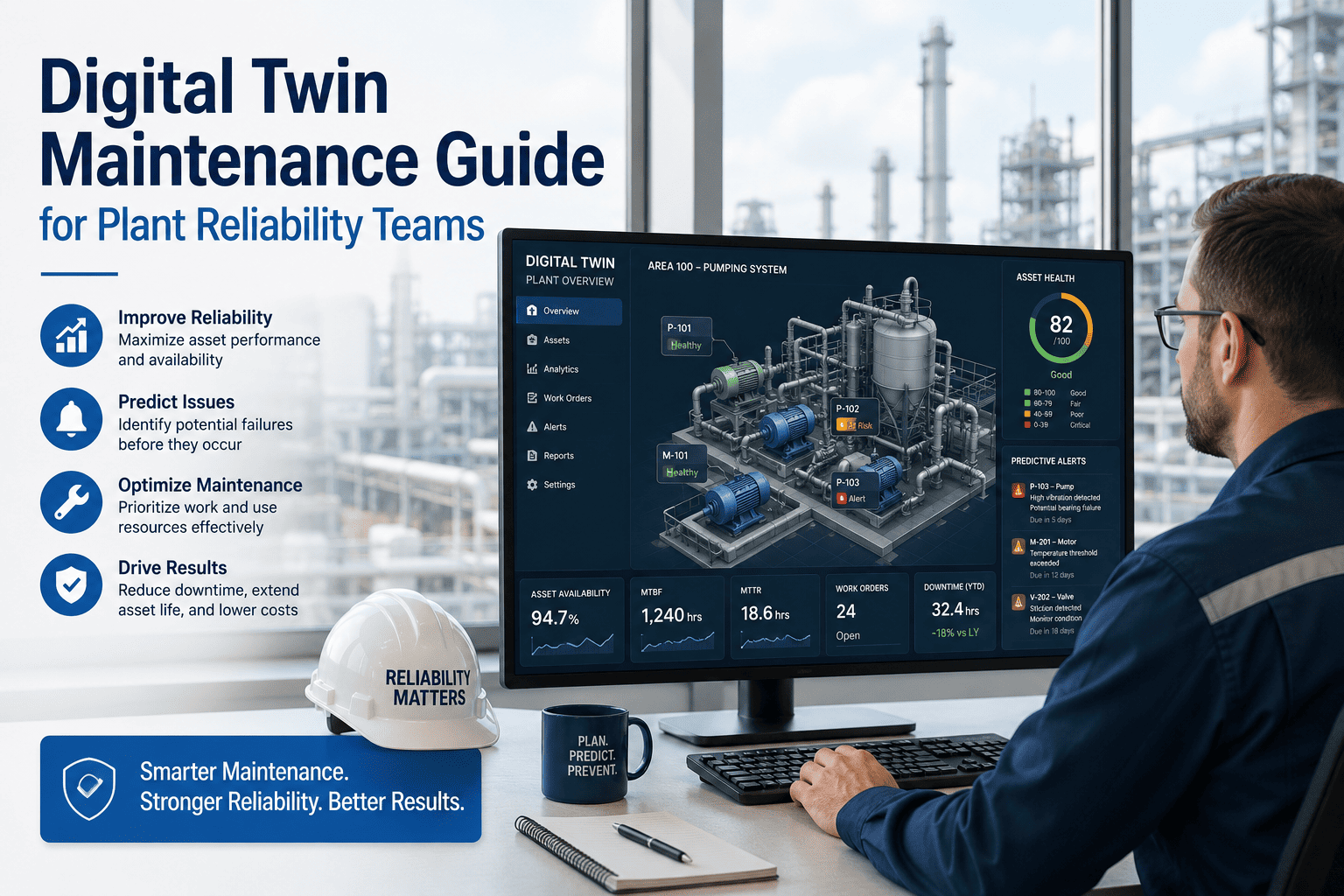
ML models forecast failures. Digital twins for critical assets. RCM and FMEA frameworks applied.
Machine learning, time-series forecasting, and digital twins predicting when assets will need attention — not when they have already started failing. McKinsey benchmark: 18–25% maintenance cost reduction vs. Level 2, 40% vs. Level 1. Where 27% of manufacturers are genuinely operating in 2026.
L5
Level 5 — Prescriptive (AI-Driven)
AI recommends optimal actions. Autonomous work order generation. Continuous optimization.
The destination. Predictive maintenance tells you the asset will fail. Prescriptive maintenance tells you the specific action to take, the cost trade-off, and the scheduling window that minimizes disruption. Near-zero unplanned downtime on critical equipment. 10–30x ROI documented on high-criticality industrial assets.
Four Reasons Maintenance Teams Stay Stuck at Level 1 or 2
If 88% of manufacturers use preventive maintenance but only 27% have moved to predictive, the 61-point gap is where the next decade of maintenance performance lives. It is also where most improvement programs fail. Understanding why teams stay stuck is the first step to not getting stuck yourself.
01
No Credible Baseline to Measure Progress Against
Teams try to advance maturity without first measuring their current state honestly. Without reactive work ratio, PM compliance percentage, MTBF, and maintenance cost per operating hour, there is no way to know whether next quarter's changes actually moved the needle.
Sign up free to start measuring from day one.
02
Attempting to Skip Levels Destroys Credibility
Level 4 predictive maintenance requires a complete asset registry, reliable PM compliance, and full maintenance history. Plants that try to skip straight to IoT sensors without that foundation generate noise that nobody trusts — killing executive support for the next wave of investment.
03
Firefighting Culture Outlasts Process Changes
Individual PM schedules and CMMS logins do not create a proactive culture. That takes tracking planned-vs-reactive ratios publicly, rewarding early fault reports, prioritizing backlog, and running post-failure reviews that feed back into prevention. Culture lags technology by 12–18 months in most deployments.
04
Wrong Platform Creates Adoption Barriers
A CMMS without mobile access stalls at Level 2. A platform without IoT integration caps at Level 3. A system without AI/analytics makes Level 5 impossible. Choosing a platform that supports the target maturity level from the start prevents painful migrations at every step of the journey.
Benchmark Your Current State
Know Where You Stand. Know What Level 3 Looks Like. Know What It Takes to Get There.
Oxmaint is designed to take teams from Level 1 firefighting to Level 4 predictive operations — step by step, without painful migrations, with the reporting that proves progress at every stage.
How Oxmaint Moves Organizations Up the Maturity Ladder
A CMMS is not a maturity level in itself — it is the foundation that makes every level from 2 through 5 achievable. Here are the six capabilities that define the platform's role in maintenance maturity progression, and where each one matters most on the journey. Book a demo to see them mapped to your target maturity level.
L1 → L2
Complete Asset Registry & Work Order Discipline
Every asset documented with hierarchy, criticality ranking, and PM schedule. Every work order captured digitally with technician, time, parts, and outcome. The foundation that every level above depends on.
Reactive ratio drops from 60%+ to under 25% typical
L2 → L3
Preventive Maintenance Scheduling Engine
Time-based, meter-based, and trigger-based PM schedules. Automated work order generation. Compliance tracking per asset, per technician, per site. Eliminates the missed-PM problem that keeps Level 2 programs unreliable.
PM compliance climbs to 95%+ within 6 months
L3
IoT & SCADA Integration
Connect vibration, temperature, pressure, and condition sensors directly to the CMMS. Work orders triggered by actual asset condition — not the calendar. Level 3 becomes a deployed reality, not an aspiration.
Condition-based PMs replacing calendar rules on critical assets
L3 → L4
Maintenance History & Trend Analytics
Complete failure history per asset. MTBF, MTTR, and cost-per-operating-hour tracked continuously. The data foundation that machine learning and predictive models need to train against.
Predictive models trained on your actual plant data, not vendor demos
L4
Predictive Analytics & Degradation Modeling
Pattern recognition across sensor data streams. Early-warning alerts when asset behavior deviates from baseline. Failure forecasts with enough lead time to plan the intervention — not react to the breakdown.
Unplanned downtime reduced 30–50% on monitored assets
L4 → L5
Benchmarking & Maturity Dashboards
Live dashboards for reactive vs. planned ratio, PM compliance, MTBF, maintenance cost per operating hour. Automated maturity-level assessment against industry benchmarks. Evidence that progress is real — not just perceived.
Maturity progression tracked quarter over quarter
The Five Maturity Levels Side by Side — Costs, KPIs, and Business Outcomes
Every level on the maturity ladder maps to a distinct operational reality, cost profile, and business outcome. Here is how the five levels compare against the metrics that matter to operations leaders, finance teams, and investors evaluating maintenance program performance.
| Dimension |
L1 Reactive |
L2 Preventive |
L3 Condition-Based |
L4 Predictive |
L5 Prescriptive |
| Reactive work ratio |
60–80%+ |
20–40% |
10–20% |
5–10% |
Under 5% |
| PM compliance |
Informal |
60–80% |
90–95% |
95%+ |
95%+ (adaptive) |
| Unplanned downtime |
Baseline (high) |
–25% vs L1 |
–50% vs L1 |
–70% vs L1 |
Near-zero on critical |
| Maintenance cost / operating hour |
3–5x L4 baseline |
1.5–2x L4 baseline |
1.2x L4 baseline |
Baseline |
0.8–0.9x baseline |
| Decision making |
Firefighting |
Calendar rules |
Sensor-informed |
Data-driven forecast |
AI-recommended |
| Time to achieve (from L1) |
— |
6–12 months |
12–24 months |
24–36 months |
36–48 months |
| Where 2026 plants sit |
~15% |
~45% |
~20% |
~15% |
~5% |
Frequently Asked Questions
The questions operations leaders, reliability engineers, and plant managers bring to maintenance maturity assessments — from single-site operators to multi-plant industrial enterprises.
How do we objectively assess our current maintenance maturity level?+
A credible assessment measures four indicators: reactive-vs-planned work ratio, PM compliance rate, MTBF on critical assets, and maintenance cost per operating hour. Supplement with qualitative factors — CMMS adoption depth, integration with ERP, mobile accessibility for technicians, condition monitoring coverage. Organizations typically benchmark against SMRP or ISO 55000-aligned frameworks.
Book a demo for a structured current-state assessment.
How long does it realistically take to move from Level 1 to Level 3?+
Most organizations achieve Level 2 (preventive with CMMS adoption) within 6–12 months of focused effort. Level 3 (condition-based on critical assets) typically takes another 6–12 months beyond that — total 12–24 months from reactive firefighting. The timeline compresses when the right platform is in place from day one. It expands significantly when teams try to skip levels or run parallel legacy systems that the team does not fully commit to retiring.
Is it possible to operate at different maturity levels for different asset classes?+
Yes — and this is the realistic deployment pattern for most operations. Mission-critical assets (high-cost, high-downtime-impact, safety-critical) earn Level 4 predictive investment. Medium-criticality assets run Level 3 condition-based. Low-criticality, easily replaceable assets appropriately stay at Level 2 or even Level 1 reactive. Maturity progression is about applying the right level to the right asset, not forcing every asset to Level 5.
What CMMS capabilities are essential for moving past Level 2?+
Mobile access is the minimum bar — without it, technician adoption stalls and Level 3 is impossible. Integration capability is essential for Level 4 because predictive models need data from SCADA, ERP, and IoT sensors together. AI and analytics capability is essential for Level 5. Choosing a platform that supports the target maturity from the start prevents the painful migration that catches most organizations at the Level 3-to-4 transition.
What ROI should we expect at each stage of maturity progression?+
Research benchmarks: moving L1→L2 delivers 12–18% maintenance cost reduction (US DOE, JLL). L2→L3 adds another 18–25% (McKinsey). L3→L4 adds 10–20% more alongside 30–50% downtime reduction. L4→L5 drives 10–30x ROI on high-criticality industrial assets (McKinsey, US DOE). Cumulatively, moving from L1 to L4 typically delivers 50%+ reduction in maintenance cost per operating hour — the benchmark that convinces CFO-level sponsors to fund continued progression.
Maintenance Maturity — Oxmaint
From Firefighting to Forecasting. One Platform. Every Level.
The Maintenance Maturity Model is the framework every world-class operation uses to benchmark current state and plan the next level. Oxmaint is the platform that makes each step achievable — asset registry, PM engine, IoT integration, predictive analytics, and maturity dashboards — without the painful migrations that catch most organizations mid-journey.
L1 → L4
Full maturity progression in one platform
50%+
Maintenance cost reduction documented
95%+
PM compliance at Level 3 typical
Live
Maturity dashboards and benchmark tracking