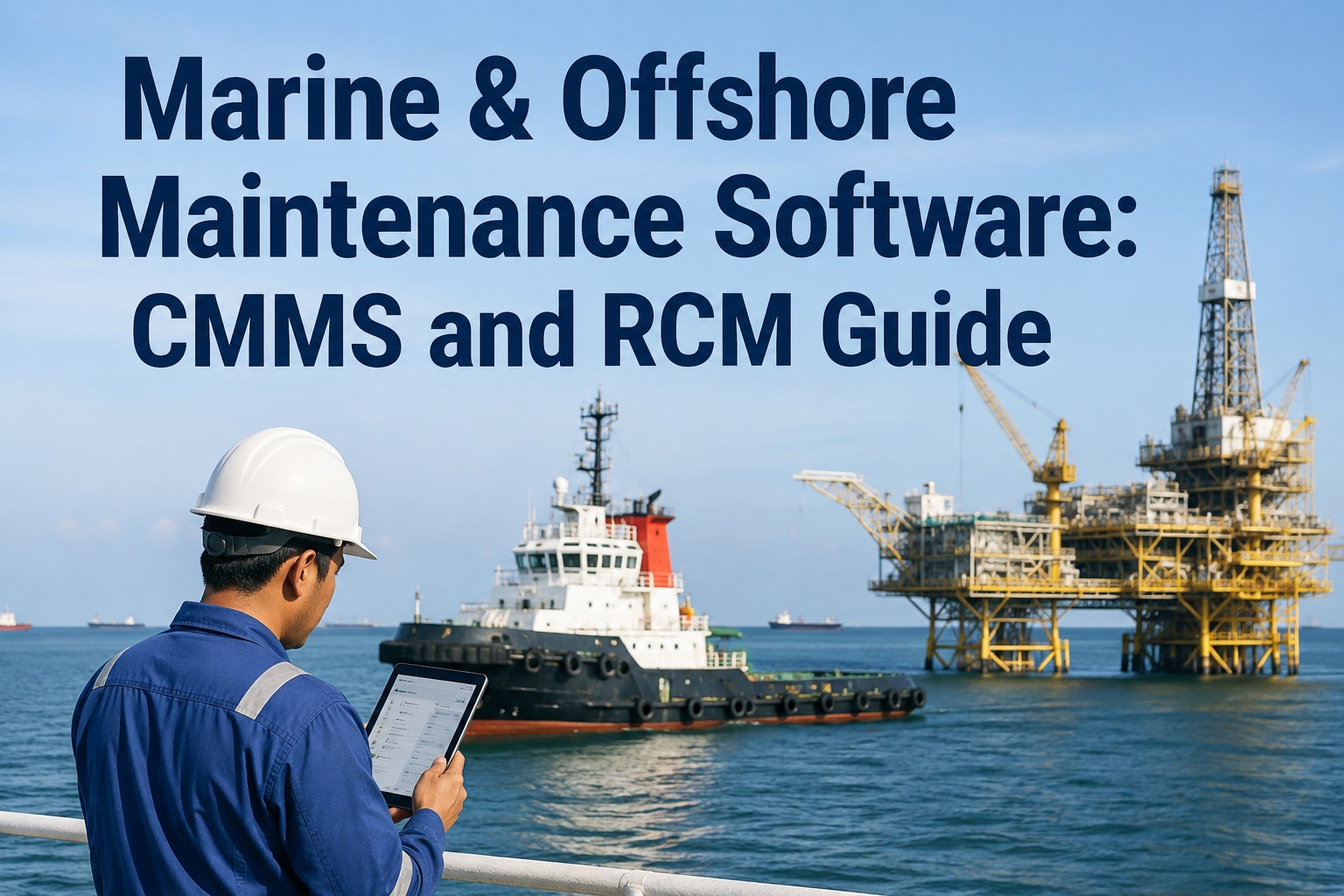
Marine and offshore maintenance software built on a modern CMMS and RCM framework can cut unplanned downtime by 30–50% and extend the life of critical rotating equipment by years. For teams managing vessels, rigs, and offshore platforms, integrating reliability-centered maintenance (RCM) with marine and offshore work order automation is the difference between reacting to catastrophic failures and engineering them out of existence. This guide walks through the seven classic RCM questions, top failure modes for marine assets, and how to deploy a CMMS for marine and offshore reliability. Ready to replace reactive maintenance with a data-driven reliability program? Start Free Trial and launch your RCM pilot today.
Marine & Offshore RCM Guide
What if your next major equipment failure was scheduled?
Reliability-Centered Maintenance shifts marine and offshore operations from firefighting to precision engineering. By linking every failure mode to a specific task inside a marine and offshore maintenance system, top-performing teams prevent 70–80% of unplanned breakdowns before they happen.
RCM Fundamentals
The 7 RCM Questions Every Marine & Offshore Team Must Answer
Reliability-Centered Maintenance is the difference between a marine and offshore maintenance software operation that reacts to breakdowns and one that engineers them out. The RCM framework, standardized in SAE JA1011, is built on seven questions that map every critical asset to the right maintenance strategy. Teams that skip these questions default to time-based PMs for everything — overservicing cheap assets and underservicing critical ones. Below, each question is paired with how a marine and offshore CMMS turns the answer into automated, traceable action.
What are the asset's functions & performance standards?
Define what each pump, compressor, and thruster must deliver — flow rate, pressure, RPM — at peak operating context. OxMaint stores performance baselines on the asset record so deviations trigger automated alerts.
In what ways can it fail to fulfill those functions?
Catalog functional failures (e.g., "cannot sustain rated discharge pressure"). OxMaint links each functional failure to a failure-mode library so every work order carries the full failure context.
What causes each functional failure?
Drill down to root causes — bearing wear, seal degradation, cavitation. OxMaint's failure-code tree ensures technicians tag the correct failure mode on every completed work order.
What happens when each failure occurs?
Document failure effects: production loss, safety risk, environmental spill, secondary damage. OxMaint ranks assets by criticality score so high-risk failures surface first in the maintenance backlog.
How does each failure matter (safety, ops, environment)?
Classify failure consequences as hidden, safety/environmental, operational, or non-operational. OxMaint enforces this classification so safety-critical failures always require a proactive task — never run-to-failure.
What proactive task, if any, is appropriate?
Match each failure mode to the right strategy: on-condition monitoring, time-based PM, failure-finding, or redesign. OxMaint auto-generates the PM schedule and triggers tasks on runtime hours, calendar intervals, or sensor thresholds.
What must be done if no proactive task fits?
If no task reduces risk to acceptable levels, the default is redesign or modification. OxMaint tracks modification requests as capital projects and links them to the original failure analysis for full audit traceability.
Strategy Selection
Choosing the Right Maintenance Strategy for Marine & Offshore Assets
A 180-asset offshore platform spending $420K/year on maintenance typically applies the wrong strategy to 35–45% of its equipment. Overservicing non-critical valves wastes labor budget; underservicing a critical gas compressor risks a $2M+ unplanned shutdown. The table below maps the four RCM strategy options — run-to-failure, time-based PM, condition monitoring, and redesign — to the asset profiles they fit best and the CMMS automation that supports each one.
| Strategy | Best-Fit Asset Profile | Marine & Offshore Example | CMMS Automation | Typical Cost Impact |
|---|---|---|---|---|
| Run-to-Failure (RTF) | Low criticality, low replacement cost, no safety/environmental risk | Non-essential lighting, standard water filters, deck fittings | Auto-generate work order on failure report; track MTTR | –60% maintenance labor vs. scheduled PM |
| Time-Based PM | Age-related wear pattern, predictable failure distribution | Lube oil changes, filter replacements, valve overhauls | Schedule PM on calendar interval or runtime hours | –30% unplanned downtime for wear-out failures |
| Condition Monitoring (CBM/PdM) | High criticality, random failure pattern, detectable warning signs | Gas turbines, main propulsion, large compressors, generators | Trigger work order on sensor threshold (vibration, temp, oil) | –50% unplanned downtime; 20–40% longer asset life |
| Redesign / Modification | No proactive task reduces risk to acceptable level | Recurring seal failures on a high-pressure injection pump | Track modification project; link to failure analysis | Eliminates recurring failure mode permanently |
CMMS + RCM Integration
How OxMaint Powers Marine & Offshore CMMS Integration
OxMaint's AI-powered CMMS and EAM platform is built specifically for maintenance and reliability teams putting RCM into practice. From asset hierarchies that mirror your plant to failure-mode libraries linked to every work order, OxMaint closes the gap between RCM theory and daily execution. Here is how four core capabilities map directly to the marine and offshore reliability challenges this guide covers.
Asset Hierarchies That Mirror Your Plant
Build multi-level asset trees — vessel to system to component — that match your P&ID and FMEA documentation. Every work order, failure code, and PM rolls up to the correct asset node, giving reliability engineers a complete maintenance history at any level.
Outcome: 100% audit-ready asset records; 40% faster root-cause analysis.
PM Triggers on Runtime or Sensor Data
Automate preventive and predictive maintenance with triggers based on engine hours, cycle counts, or live sensor feeds. OxMaint generates work orders the moment a threshold is crossed — no manual scheduling, no missed intervals.
Outcome: Cut unplanned downtime 30–50% with condition-based PMs.
Failure-Mode Libraries Linked to Work Orders
Standardize failure codes across every vessel and platform. Technicians select from a structured failure-mode tree on completion, so every shutdown, breakdown, and repair feeds your RCM analysis with clean, filterable data.
Outcome: Eliminate paper work orders; 3x faster MTBF reporting.
Maintenance Analytics That Prove RCM ROI
Track MTBF, MTTR, planned maintenance percentage (PMP), and availability in real time. OxMaint dashboards show whether your RCM program is actually cutting downtime — and which failure modes still need attention.
Outcome: 15–25% lower total maintenance cost in year one.
Implementation Roadmap
How to Launch an RCM Pilot in 90 Days
A focused RCM pilot on your most critical marine and offshore equipment can produce measurable results in weeks — not the 12–18 months typical of plant-wide rollouts. The timeline below assumes a pilot scope of 8–15 critical assets (e.g., main propulsion, power generation, ballast systems) on a single vessel or platform. Each phase maps directly to OxMaint CMMS features so the pilot scales seamlessly into a plant-wide reliability program.
Select critical assets & build the hierarchy
Rank assets by criticality (safety, production, environmental risk). Build the asset hierarchy in OxMaint, import existing PM schedules, and establish baseline MTBF, MTTR, and availability metrics. Target: 8–15 assets, one platform.
Run FMEA & assign maintenance strategies
Conduct failure mode and effects analysis on each pilot asset. Assign the right strategy — RTF, time-based PM, condition monitoring, or redesign — to each failure mode. Load failure-mode libraries and PM triggers into OxMaint. Target: every failure mode mapped to a task.
Automate work orders & track KPIs
Activate automated PM triggers and condition-based work orders. Technicians complete tasks with failure codes on mobile devices. Compare MTBF, MTTR, and unplanned downtime against the Month 1 baseline. Target: 15–25% reduction in unplanned downtime on pilot assets.
KPI Tracking
Marine & Offshore CMMS KPI Tracking: Metrics That Matter
A marine and offshore maintenance system is only as valuable as the decisions it drives. The KPIs below are the core metrics reliability teams track inside OxMaint to prove RCM impact, justify maintenance budgets, and benchmark performance across vessels and platforms. Each KPI is calculated automatically from work order data — no spreadsheets, no manual data entry.
Tracks the average operating time between unplanned failures for each asset. A rising MTBF proves your RCM strategy is working. Target: 15–30% improvement within 6 months of pilot launch.
Measures the average time from failure report to repair completion. Lower MTTR means better spare-parts availability and technician readiness. Target: 20–40% reduction with OxMaint inventory tracking.
The percentage of maintenance labor hours spent on planned vs. unplanned work. World-class marine operations exceed 80% PMP. Most reactive teams start at 40–50% and reach 75%+ within a year of RCM + CMMS deployment.
Combines availability, performance, and quality into a single asset-health score. OxMaint calculates OEE per asset, system, and platform — giving offshore managers a real-time reliability pulse across the entire fleet.
See OxMaint on Your Assets
Book a 30-Minute Demo and See RCM in Action
Watch how OxMaint builds asset hierarchies, automates PM triggers, and links failure modes to work orders — all on a live system configured for marine and offshore operations.
FAQ
Marine & Offshore CMMS and RCM — Frequently Asked Questions
What is CMMS RCM for marine & offshore?
CMMS RCM for marine and offshore is the integration of a Computerized Maintenance Management System with Reliability-Centered Maintenance methodology. The CMMS software automates work orders, PM scheduling, and failure-mode tracking, while RCM provides the analytical framework for matching each failure mode to the right maintenance strategy. Together, they let marine and offshore teams move from reactive repairs to data-driven reliability programs that cut unplanned downtime 30–50%.
How long does it take to deploy a marine and offshore CMMS?
A focused CMMS deployment for a single vessel or platform typically takes 4–8 weeks. This includes building the asset hierarchy, importing existing PM schedules, configuring failure-mode libraries, and training technicians. A full fleet-wide rollout spans 3–6 months. You can Book a Demo to see a live deployment plan tailored to your operation.
What are the top failure modes for marine and offshore equipment?
The most common failure modes on marine and offshore assets include bearing wear and lubrication degradation in rotating equipment, seal and gasket failures in pumps and compressors, corrosion and erosion in piping and pressure vessels, electrical faults in switchgear and generators, and control-system failures in automation hardware. RCM analysis typically reveals that 20% of failure modes cause 80% of unplanned downtime — the Pareto principle that makes RCM prioritization so effective.
Can OxMaint integrate with existing marine maintenance systems?
Yes. OxMaint supports data import from spreadsheets, legacy CMMS exports, and ERP systems commonly used in marine and offshore operations. The platform also integrates with IoT sensor platforms and condition-monitoring hardware for predictive maintenance triggers. Most teams migrate from spreadsheets or reactive paper-based systems to fully automated digital maintenance within 4–6 weeks. Start Free Trial to test the migration tools yourself.
What is the ROI of marine and offshore maintenance software?
Marine and offshore teams implementing CMMS with RCM typically see a 15–25% reduction in total maintenance cost, a 30–50% reduction in unplanned downtime, and a 20–40% extension in asset life within the first 12 months. For a 180-asset platform spending $420K/year on maintenance, that translates to $60K–$105K in annual savings — plus the avoided cost of a single major unplanned shutdown, which can exceed $2M per day on a producing offshore asset.
Start Your Reliability Journey
Replace Reactive Maintenance With a Data-Driven Reliability Program
Join the marine and offshore teams using OxMaint to automate work orders, track KPIs, and link every failure mode to a task. Launch your RCM pilot in days — not months.
Free 14-day trial · No credit card