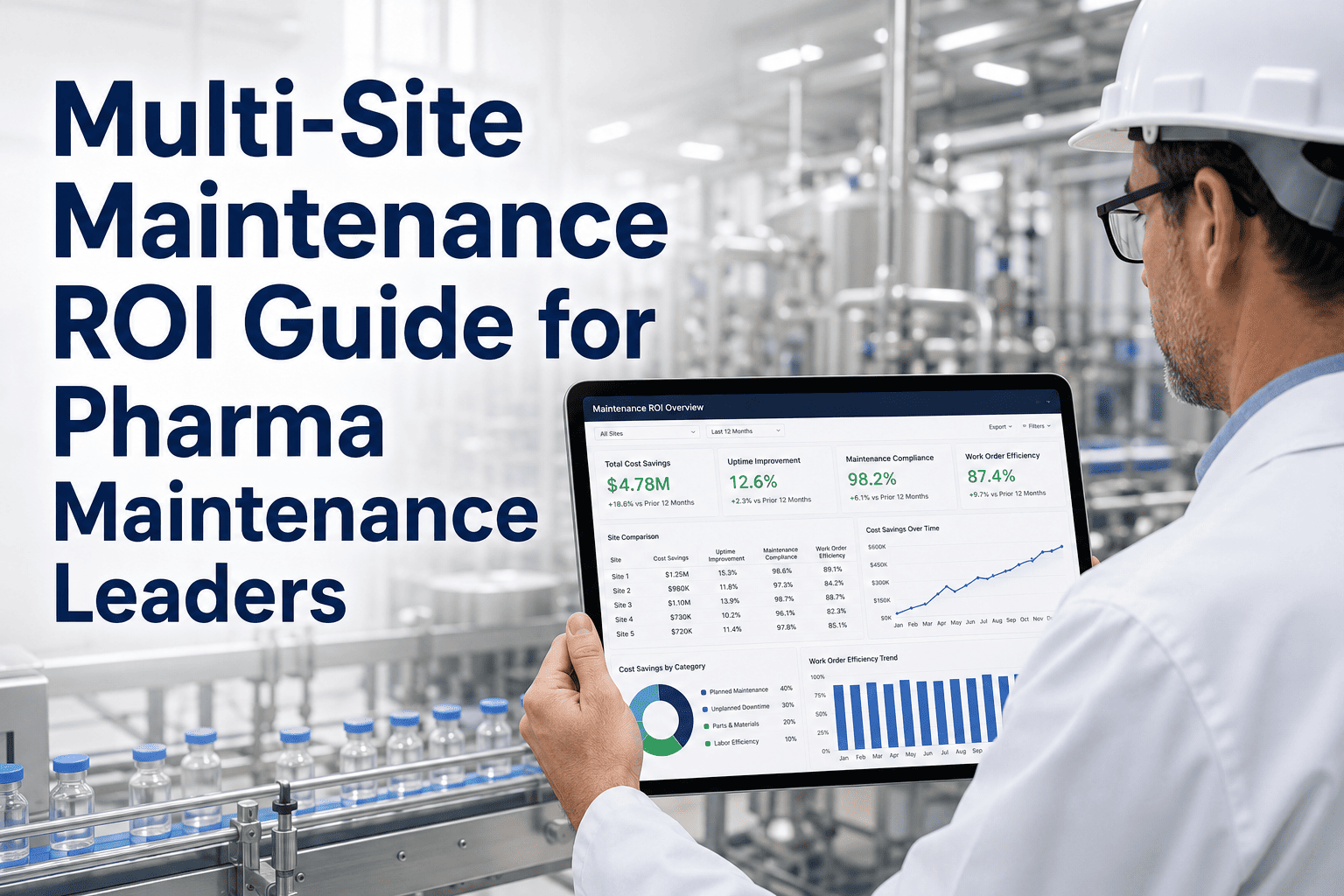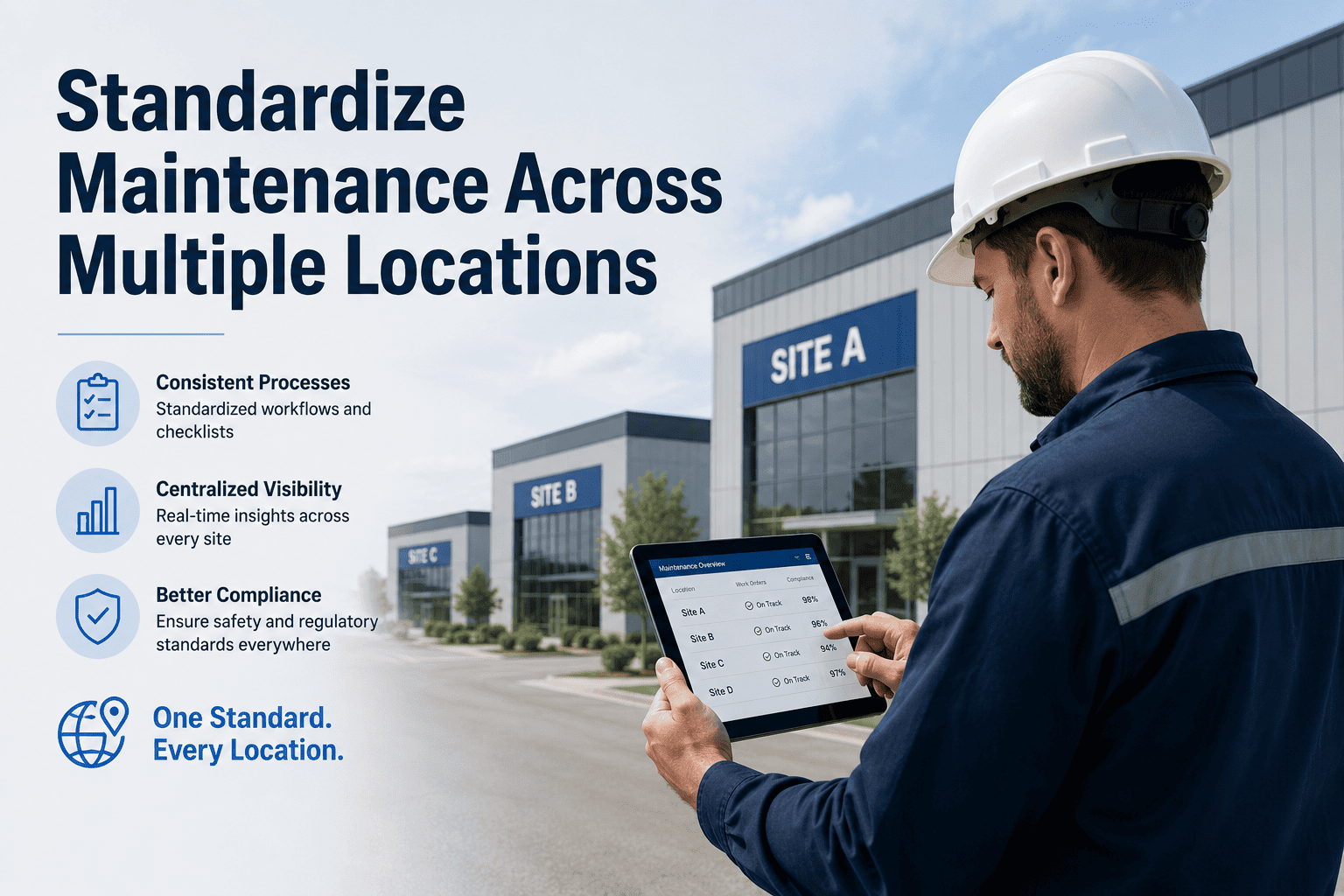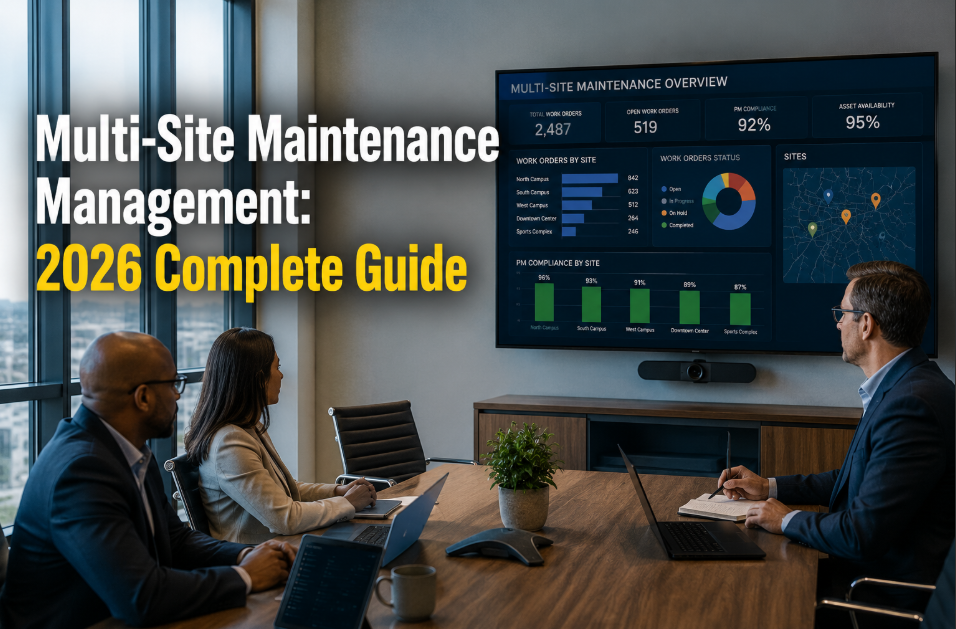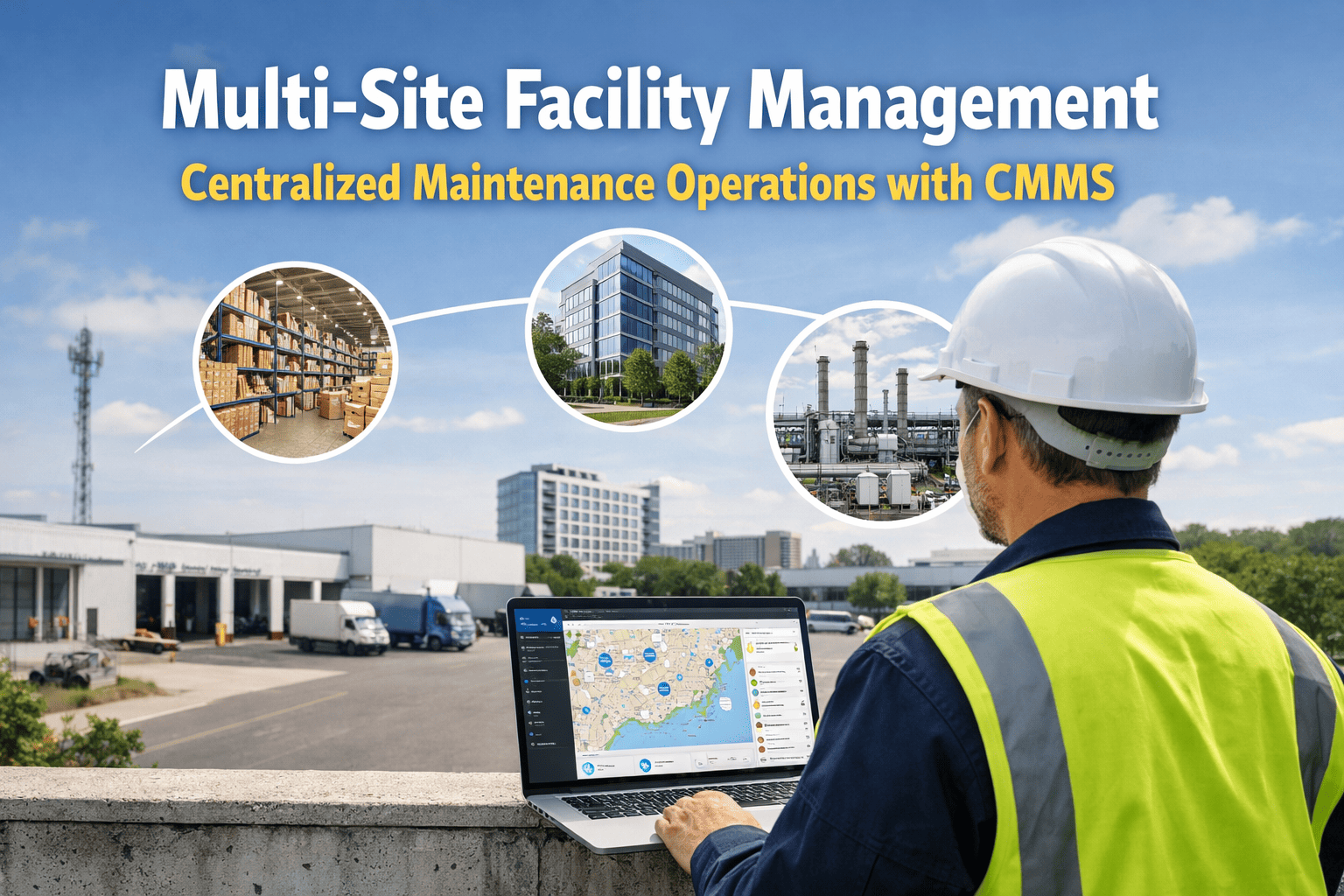
It is 6:15 AM on a Monday when the VP of Operations opens her laptop to prepare for the quarterly board review. She needs one number: the average maintenance cost per asset across all 14 facilities. Three hours later, she is still waiting — because the Chicago plant tracks costs in SAP, the Dallas facility uses a spreadsheet last updated in November, the Miami team logs everything in a filing cabinet, and the new Phoenix site has not started tracking at all. By the time her team manually reconciles the data, the board meeting is over and the number they produced is unreliable anyway. This is not an edge case — it is the daily reality for 82% of multi-site organizations that experienced at least one unplanned downtime event in the last three years. The global CMMS market reached $1.29 billion in 2024 and is growing at 11.1% CAGR because organizations managing distributed operations can no longer afford to run each facility as a disconnected island. Oxmaint's CMMS platform gives multi-site teams the single source of truth that makes every location's data comparable, every technician transferable, and every performance gap visible in real time.
What It Costs to Operate Multi-Site Maintenance in Silos
When each facility manages maintenance independently — different tools, different naming conventions, different vendors, different data formats — the organization does not just lose efficiency. It loses the ability to answer the most basic operational questions: Which site has the most open work orders right now? Which facility spent the most on emergency repairs last quarter? Are all locations current on their safety inspections? Without answers, leadership makes decisions on gut feeling — and wrong decisions at scale compound exponentially across the portfolio.
Financial Drain of Fragmentation
Manufacturers lose an estimated $260 billion annually to unplanned downtime globally. For multi-site operators, the costs compound because a failure at one location can cascade to disrupt supply chains, customer commitments, and revenue targets across the entire portfolio. Emergency spare parts cost 18–25% more than planned purchases, and each site making independent procurement decisions eliminates bulk purchasing leverage entirely.
Operational Complexity at Scale
Managing a single facility is complex. Managing a portfolio of geographically dispersed facilities introduces exponential complexity because each location develops its own maintenance culture, its own vendor relationships, its own interpretation of "completed work order." Without centralized standards, every facility becomes a data silo — and data silos are where operational intelligence goes to die. The result is a structural inability to benchmark, improve, or prove compliance across the organization.
The organizations pulling ahead have stopped treating each facility as an independent operation and started treating their entire portfolio as a single data-connected ecosystem. Sign up for Oxmaint free to see how the platform connects every site into one unified maintenance operation.
Six Domains You Must Unify Across Every Site
Successful multi-site standardization touches six interconnected operational domains. Weakness in any single domain undermines the value of the others — you cannot benchmark sites without standardized data, and you cannot standardize data without a single technology platform.
Asset Taxonomy
Every asset across every site classified using the same hierarchical naming, criticality ratings, and failure mode categories. When the data language differs, you cannot run a global report or share spare parts because part numbers do not match.
Work Order Processes
Identical creation, assignment, execution, and close-out workflows at every location. Same fields, same priorities, same completion criteria. "Completed" must mean verified, documented, and digitally signed — not just "technician left the area."
PM Schedules
Preventive maintenance templates defined centrally — frequency, procedure steps, required tools, acceptance criteria — but execution scheduling adapts to local operating hours, seasonal demands, and production cycles.
Inventory & Parts
Shared catalog with identical part numbers across all locations. Enables bulk purchasing, cross-site transfers, and elimination of redundant MRO stock — typically reducing inventory carrying costs by 15–25%.
Workforce Standards
Standardized certifications, safety protocols, and training across all sites. Uniform procedures make technicians interchangeable between locations — critical when 40% of the manufacturing workforce retires by 2030.
KPI Reporting
MTTR, MTBF, planned vs. reactive ratio, PM compliance — all calculated identically. Portfolio-wide dashboards enable apples-to-apples comparison identifying underperformers and practices that should scale.
Unify All Six Domains From One Platform
Oxmaint delivers centralized asset management, standardized workflows, shared inventory, and portfolio-wide KPI dashboards — deployed across unlimited sites from a single cloud platform in days.
The Operational Shift: Fragmented vs. Standardized
The difference between multi-site organizations managing maintenance in silos and those on a standardized platform is not incremental — it is structural. Every dimension improves simultaneously because the data foundation changes from fragmented and delayed to unified and real-time.
Multi-Site Maturity Model: Where Are You Today?
Not every organization starts at the same point. This maturity model identifies your current state and maps a realistic path. Most operations fall between Level 1–3 — the jump from 3 to 5 is where the largest ROI concentrates.
Reactive & Fragmented
Each site independent. No shared platform. Paper or spreadsheets. Zero cross-site visibility. Pure reactive maintenance.
Basic Digital
Some sites use CMMS — different platforms at each. PM schedules exist but are not standardized. Metrics are site-specific and incomparable.
Centralized Platform
All sites on same CMMS. Basic taxonomy defined. Workflows partially standard. Corporate sees high-level metrics but drill-down limited by inconsistent data entry.
Data-Driven
Fully unified taxonomy, processes, KPIs. Active cross-site benchmarking. Shared inventory. PM compliance tracked centrally with automated escalation.
Predictive
AI-driven failure prediction. Best practices auto-propagated from top sites. Real-time condition monitoring. Continuous improvement embedded in the system.
Most organizations jump from Level 1–2 to Level 3–4 within 6–12 months of deploying a centralized CMMS. Book an Oxmaint demo to map your operation to this model and identify where measurable returns start fastest.
Deployment Roadmap: Standardize Without Disrupting Operations
You cannot shut down facilities to implement software. Successful multi-site deployment follows a phased approach delivering value at each stage without operational risk. Most teams achieve core systems in 1–2 weeks per site, with full portfolio integration within 30–60 days.
Foundation & Data Architecture
Define universal asset taxonomy, naming conventions, criticality ratings, failure codes. Standardize work order templates, fault categories, completion criteria. Configure CMMS with centralized structure, role-based access, reporting dashboards. Select one pilot site.
Pilot Site Activation
Register all pilot assets with standardized taxonomy. Deploy PM schedules, inspection checklists, auto-routing rules. Train all personnel with hands-on sessions. Run 3 weeks to collect feedback and refine before scaling.
Scaled Enterprise Rollout
Expand to remaining sites in waves of 2–5 locations. Assign site champion at each facility. Migrate legacy data to centralized platform. Activate cross-site benchmarking dashboards once 3+ sites are live.
Optimization & Predictive Evolution
Quarterly system reviews. Cross-site benchmarking against industry standards. Centralized procurement for bulk purchasing. Advance from preventive to predictive maintenance using accumulated condition data.
Technology Requirements: Non-Negotiable Capabilities
Not every CMMS is built for multi-site operations. These are the six capabilities your platform must deliver — anything less will not support true standardization across a distributed portfolio.
Multi-location structure with configurable role-based access at each level. Site managers see their facility; regional directors see their region; corporate sees the entire portfolio.
PM schedules, checklists, and SOPs push automatically from headquarters to all sites. Procedure updates reach every location instantly — no manual distribution.
Real-time cross-site KPI comparison with drill-down from portfolio to region to site to asset to individual work order — one interface, no system-switching.
Centralized parts catalog with real-time stock visibility across all locations. System identifies inter-site transfer opportunities before triggering emergency orders.
Full offline capability. Technicians download work orders, complete inspections, attach photos, log parts — all without connectivity. Auto-sync when connection resumes.
Start a free Oxmaint trial and experience a CMMS built for multi-site operations — every capability above included out of the box, deployable in a single afternoon.
KPIs That Matter: Measuring Success Across Sites
Standardization only works if you measure it. These KPIs should surface automatically from your CMMS dashboards — not require manual compilation from disconnected systems. Organizations that start a free Oxmaint trial see these metrics live within their first week of deployment.
Stop Managing Maintenance in Silos
Join operations teams managing 5 to 500+ facilities on Oxmaint. Standardize workflows, benchmark sites in real time, and deploy new locations in hours.