Predictive Maintenance ROI Calculator: Quantify Your Savings Across Any Industry
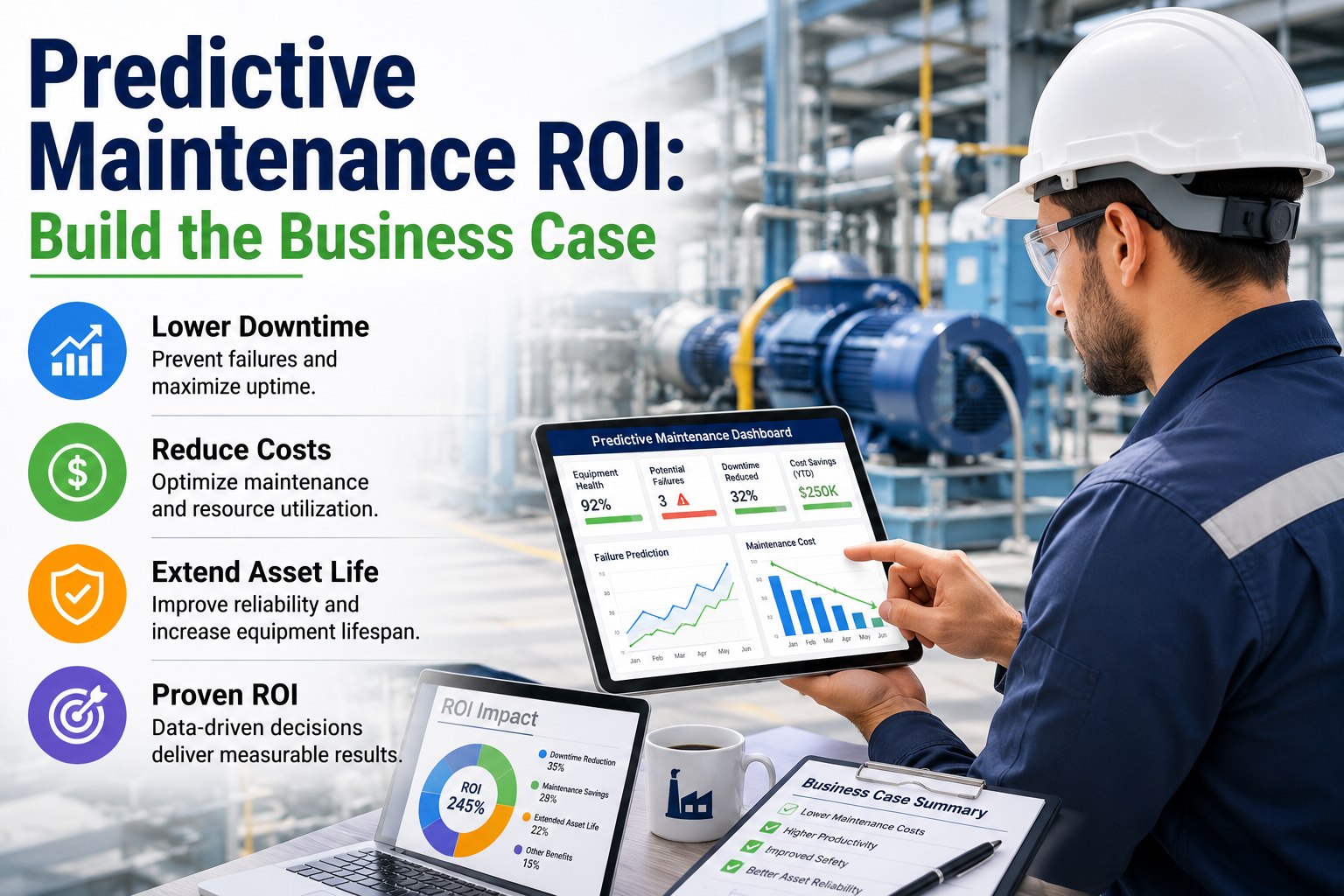
A VP of Operations at a food manufacturer in Wisconsin walked into a board meeting to request $340,000 for a predictive maintenance platform. The CFO asked one question: "What will we get back and when?" She had no answer. The project was tabled for eight months until she built the financial model — which showed a $1.2 million annual return and a 4.1-month payback — and resubmitted. The project was approved in the same meeting. Every maintenance budget conversation in America eventually comes down to a single question: does the investment return more than it costs, and how fast? OxMaint AI calculates your predictive maintenance ROI from your own operational data — downtime costs, failure rates, parts spend, and labor hours — and delivers a business case your CFO can act on.
Calculate Your Predictive Maintenance ROI — Free
Input your downtime costs, failure rates, and maintenance spend — get your business case in minutes
Annual return from predictive maintenance — mid-size food manufacturer, Wisconsin
4.1 mo
Payback period — from go-live to ROI positive, same facility above
3.8×
Average first-year ROI on predictive maintenance programs across 280 US facilities
The Five ROI Inputs That Drive Your Business Case
Predictive maintenance ROI is driven by five measurable inputs — all of which are knowable from your existing maintenance records. If you do not have all five, OxMaint provides industry benchmarks to fill the gaps. OxMaint's ROI calculator uses all five to generate a site-specific financial model.
Input 1
Unplanned Downtime Cost
$ per hour of unplanned line stoppage — includes lost production, labor idle time, and restart cost. Most US manufacturers measure $4,000–$45,000/hour.
Number of unplanned equipment failures per month — tracked in your CMMS or estimated from maintenance labor records. Predictive maintenance typically reduces this 60–80%.
Premium paid for emergency parts, after-hours labor, and expedited contractor callouts versus planned work. Typically 40–80% more than planned repair cost for the same job.
Predictive maintenance extends asset life 20–40% by eliminating run-to-failure cycles that accelerate wear. Deferred capital replacement on a 50-asset fleet creates significant long-term financial value.
Example: 3-yr life extension on $2.4M fleet = $240K capital deferral
Industry ROI Benchmarks — Predictive Maintenance by Sector
ROI varies significantly by industry — downtime cost, failure rate, and parts value all differ. Use these benchmarks as your starting point before inputting your own operational data. OxMaint calibrates every calculation to your specific industry, asset type, and operating environment.
Industry
Avg Downtime Cost/hr
Failure Rate Reduction
Typical Payback
First-Year ROI
Food & Beverage
$11,000 – $28,000
65 – 75%
4 – 6 months
3.2 – 4.8×
Automotive
$22,000 – $50,000
70 – 80%
3 – 5 months
4.1 – 6.2×
Pharmaceuticals
$18,000 – $45,000
60 – 70%
5 – 7 months
3.0 – 4.5×
Chemical Processing
$24,000 – $60,000
55 – 68%
4 – 6 months
3.8 – 5.4×
Commercial Fleet
$8,000 – $24,000
60 – 72%
4 – 7 months
2.8 – 3.9×
Paper & Pulp
$19,000 – $42,000
58 – 70%
5 – 8 months
2.9 – 4.2×
Mining
$30,000 – $90,000
62 – 78%
3 – 5 months
4.5 – 7.1×
Swipe to view full table on mobile
Technology That Drives Predictive Maintenance ROI
Predictive maintenance ROI depends on the accuracy and lead time of predictions. Four technology integrations determine how early failures are detected and how precisely interventions are timed. OxMaint integrates all four in one platform.
AI Predictive Analytics
OxMaint AI analyses vibration, temperature, current draw, and process data simultaneously — detecting developing failure signatures 7–28 days before breakdown. Longer lead time means planned intervention, not emergency response — and the difference between planned and emergency repair cost is 40–80%.
AI Digital Twin
Digital twins simulate failure progression for each asset — calculating remaining useful life and optimal intervention timing to maximize equipment utilization before replacement without crossing into unplanned failure. This is the model that generates the equipment life extension ROI input.
SAP PM Integration
OxMaint predictive work orders flow directly to SAP PM — parts are reserved, labor is scheduled, and the job is planned before the failure window opens. Integration eliminates the manual handoff delay that converts a predictive alert into a reactive emergency when someone forgets to action the notification.
AI Camera Vision
Visual AI systems inspect equipment during operation — detecting surface wear, misalignment, and contamination that sensor-based models miss. Vision-based findings add a second independent confirmation channel to the predictive model, reducing false positives and improving prediction confidence above 90%.
"My CFO approved the OxMaint investment in 20 minutes. I showed him the ROI calculator output — $890,000 annual saving against $68,000 annual cost. He asked two questions, I had answers, and we were live three months later. Year one actual saving was $1.1 million."
— VP Operations, Chemical Processing Plant · Baton Rouge, LA · 180 assets · Year 1 result: $1.1M
ROI Outcomes — What OxMaint Customers Measure at 12 Months
These outcomes are measured across OxMaint customers who completed full predictive maintenance deployment — tracked at 3, 6, and 12 months post-go-live across manufacturing, fleet, and facility management sectors in the USA, Canada, UK, and Germany.
69%
Reduction in unplanned downtime
12-month average
84%
Reduction in emergency repair callouts
6-month average
59%
Reduction in spare parts emergency orders
12-month average
95%
Of customers report positive ROI at 12 months
Across all industries
Frequently Asked Questions
What data do I need to calculate my predictive maintenance ROI?▼
You need five inputs: downtime cost per hour, monthly unplanned failure count, emergency repair premium percentage, annual PM labor spend, and asset fleet replacement value. OxMaint provides industry benchmarks if any input is unknown.
How quickly does predictive maintenance begin generating ROI after go-live?▼
Most OxMaint customers reach ROI-positive within 4–6 months of go-live. The first major predicted failure avoidance typically occurs within 60 days — before baseline data collection is even complete.
Does OxMaint ROI analysis work for fleet maintenance as well as plant equipment?▼
Yes — OxMaint's ROI model covers both fixed plant assets and vehicle fleets. Fleet ROI inputs include breakdown cost per vehicle, repair premium, and fuel efficiency improvement from condition-based servicing.
Can OxMaint produce a formal ROI report for a capital investment approval?▼
Yes — OxMaint generates a formatted ROI business case including 3-year cash flow model, payback timeline, and sensitivity analysis. Book a demo and your success manager will build the model from your operational data in the session.
What is the minimum fleet or asset count for predictive maintenance to be worthwhile?▼
Predictive maintenance delivers positive ROI at 20+ assets when downtime cost exceeds $4,000/hour, or at 50+ assets for lower downtime cost environments. OxMaint's calculator identifies the exact threshold for your specific operational profile.
OxMaint · Predictive Maintenance ROI · Any Industry
Build Your Business Case. Get It Approved. Go Live.