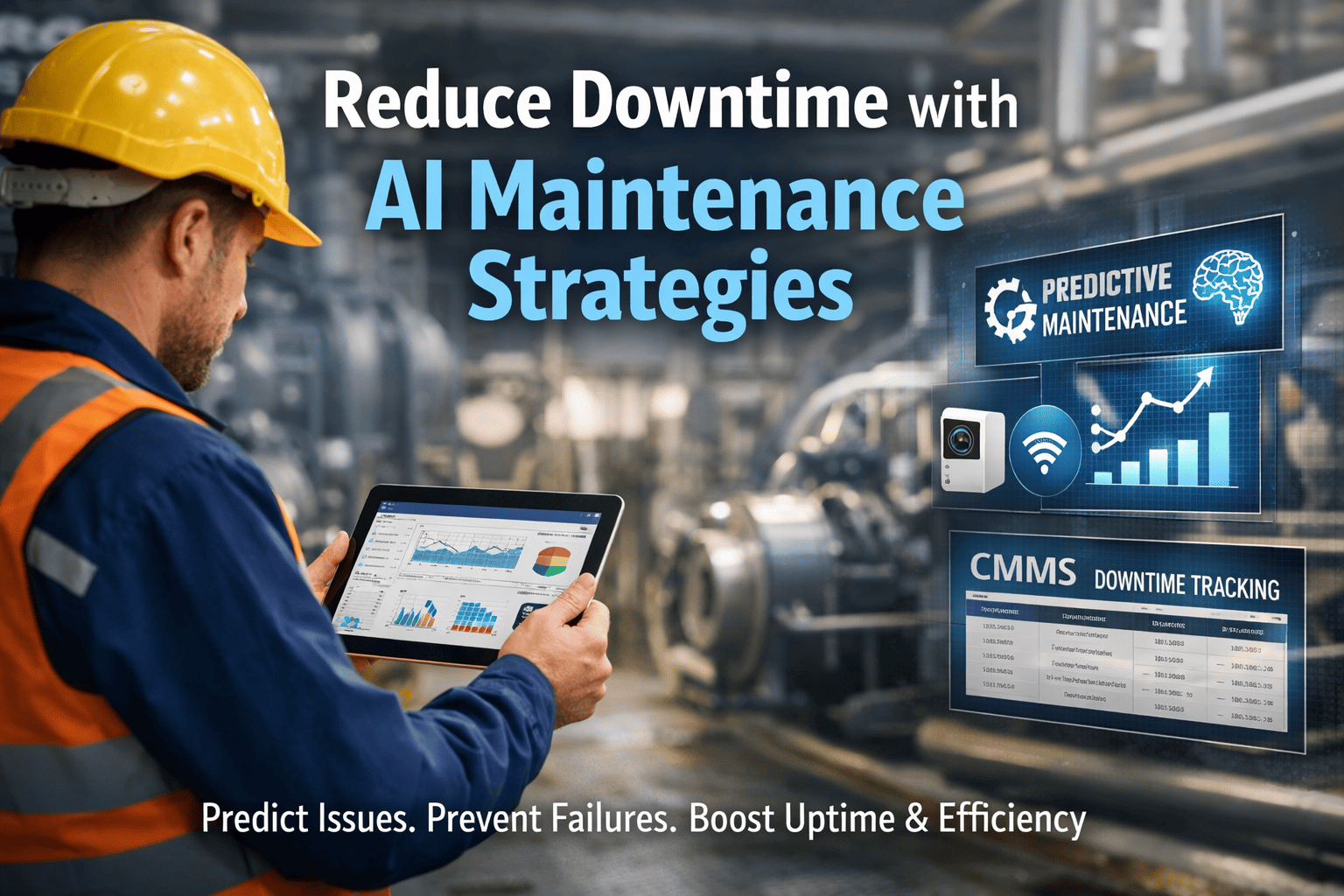
Unplanned downtime costs industrial manufacturers an estimated $50 billion annually — not because the equipment failures that cause it are unpreventable, but because the signals that precede them go undetected. A motor bearing that will seize in 18 days is vibrating differently today than it was three weeks ago. A pump that will fail next Tuesday has been drawing 7% more current than its baseline for the past five days. A hydraulic cylinder that will develop a leak next shift has been losing microns of seal integrity every heat cycle for the past two months. None of these signals are invisible. They are simply unread — by a maintenance programme that has not yet connected sensor data to the AI pattern recognition that would convert those readings into scheduled work orders rather than emergency shutdowns. The difference between a plant that averages 15 unplanned downtime hours per week and one that averages 2 hours is not better equipment. It is better information, acted on faster. Sign up for Oxmaint to start capturing that information today.
The Four Reasons Plants Keep Experiencing Unplanned Downtime Despite Knowing Better
82% of industrial plants experience at least one significant unplanned downtime event per month. Most maintenance managers at these plants know, in principle, that predictive maintenance would prevent many of these events. The gap between knowing and doing is almost never about budget or technology — it is about four specific operational patterns that resist change without a structured intervention. Sign up for Oxmaint to eliminate all four from your operation.
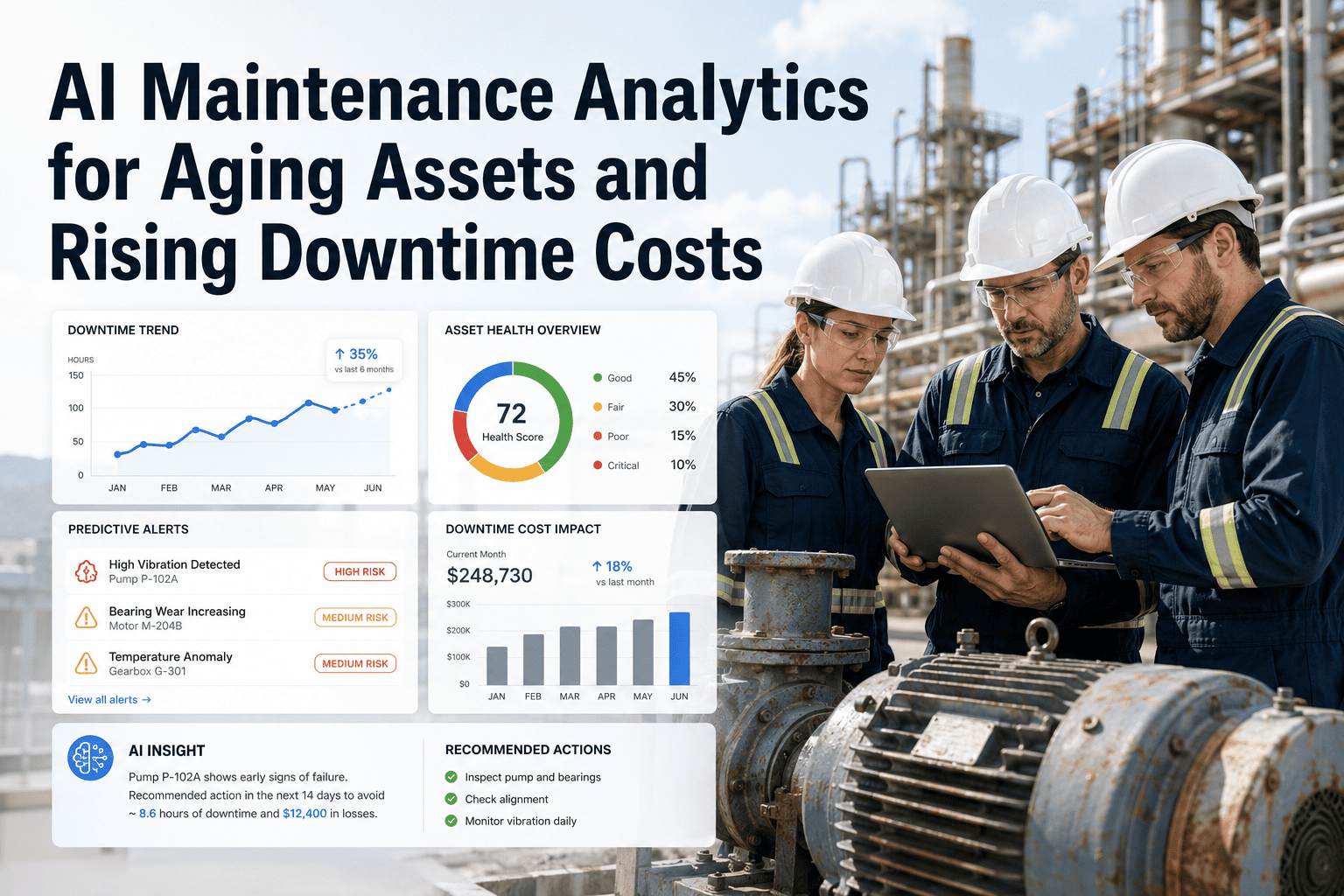
Most instrumented industrial assets generate continuous sensor data — vibration, temperature, current, pressure — that is either stored in a process historian that nobody regularly queries for maintenance signals, or displayed on a SCADA screen that is only checked when something has already gone wrong. The data that would have predicted the failure existed. It was simply not connected to a system that would detect the failure pattern and generate a maintenance action before the failure occurred. This is the most common single cause of avoidable downtime in instrumented plants.
A preventive maintenance programme with a 50–60% completion rate — typical for paper-based or poorly digitalised operations — is not a preventive programme. It is a partial programme where the assets whose PM was deferred this month become the reactive failures next month. The pattern is consistent and predictable: overdue PM leads to accelerated degradation, which leads to failure during production, which creates the emergency that then defers this week's PM because the technicians are occupied with the breakdown. Book a demo to see how Oxmaint drives PM completion rates above 80%.
Paper-based or fragmented maintenance records mean that when an asset fails, the technician arrives without knowledge of whether this same asset failed six months ago, what was found then, whether the previous repair addressed the root cause, or whether the failure is part of a repeating pattern that would benefit from a different maintenance approach. Every failure is investigated from scratch. Patterns that a searchable digital maintenance history would reveal in seconds remain invisible until the equipment fails for the fourth or fifth time in the same way. The MTTR stays high because the root cause is never found and fixed.
The financial signature of a reactive maintenance programme is visible in the procurement records: a high proportion of parts ordered on expedited delivery, at premium pricing, for failures that had no advance warning signal visible to the maintenance team. An AI-driven predictive system that provides 14–21 days advance warning of impending failure converts every one of those emergency procurement events into a standard purchase order — same part, standard delivery, standard price. Over a year, for a typical industrial plant, this procurement premium elimination alone represents $200k–$600k in recoverable spend. Sign up for Oxmaint to start eliminating emergency procurement from your maintenance budget.
What AI-Driven Downtime Reduction Delivers Across Four Key Performance Areas
The documented impact of AI-driven maintenance on industrial operations is measurable across four distinct performance dimensions. Each drives independent value, but they compound — the same AI system that reduces unplanned downtime also extends equipment life, reduces energy consumption, and eliminates emergency procurement costs. Book a demo to see a custom impact projection for your facility.
For a mid-size integrated steel plant operating at $150/tonne output value, one hour of unplanned blast furnace downtime represents approximately $800k–$1.2M in lost production value. The sensor, software, and CMMS infrastructure needed to prevent that single downtime event costs a fraction of its hourly consequence. The economics of AI predictive maintenance are not marginal — they are overwhelming. Sign up for Oxmaint to start protecting against this cost today.
Seven Proven AI Maintenance Strategies That Reduce Downtime in 2026
Each strategy below represents a specific operational change that AI-driven maintenance enables — not a general principle, but a specific mechanism with a specific downtime reduction outcome. Sign up for Oxmaint to activate each of these strategies at your facility.
Strategies 1–3: Detect, Predict, and Act Earlier
The first three strategies share a common theme: shifting the point at which the maintenance team becomes aware of an emerging problem from "the equipment has failed" to "the equipment is degrading." The earlier the detection, the lower the response cost and the higher the scheduling flexibility.
- Strategy 1 — Anomaly detection on critical assets: Deploy AI anomaly detection on the assets whose unplanned failure causes the most downtime. The model learns normal operation and flags deviations 14–42 days before failure symptoms appear to human inspection. Book a demo to see this configured.
- Strategy 2 — Fault classification for parts pre-staging: AI that identifies not just that something is wrong but which specific component is failing enables parts to be ordered and staged before the repair crew arrives. First-attempt fix rate on planned predictive repairs exceeds 90% versus 60% on reactive repairs.
- Strategy 3 — Process parameter efficiency trending: Monitor pump discharge heads, compressor efficiency ratios, and heat exchanger approach temperatures against baseline. Equipment efficiency decline is often detectable 30–90 days before process-limiting failure — providing the longest advance warning window of any sensing method.
Strategies 4–7: Respond Faster, Learn Continuously
The second group of strategies focuses on what happens after a problem is detected — how quickly the maintenance team can mobilise, what they do with the data from each repair, and how the system improves over time. These strategies compound the value of the first three.
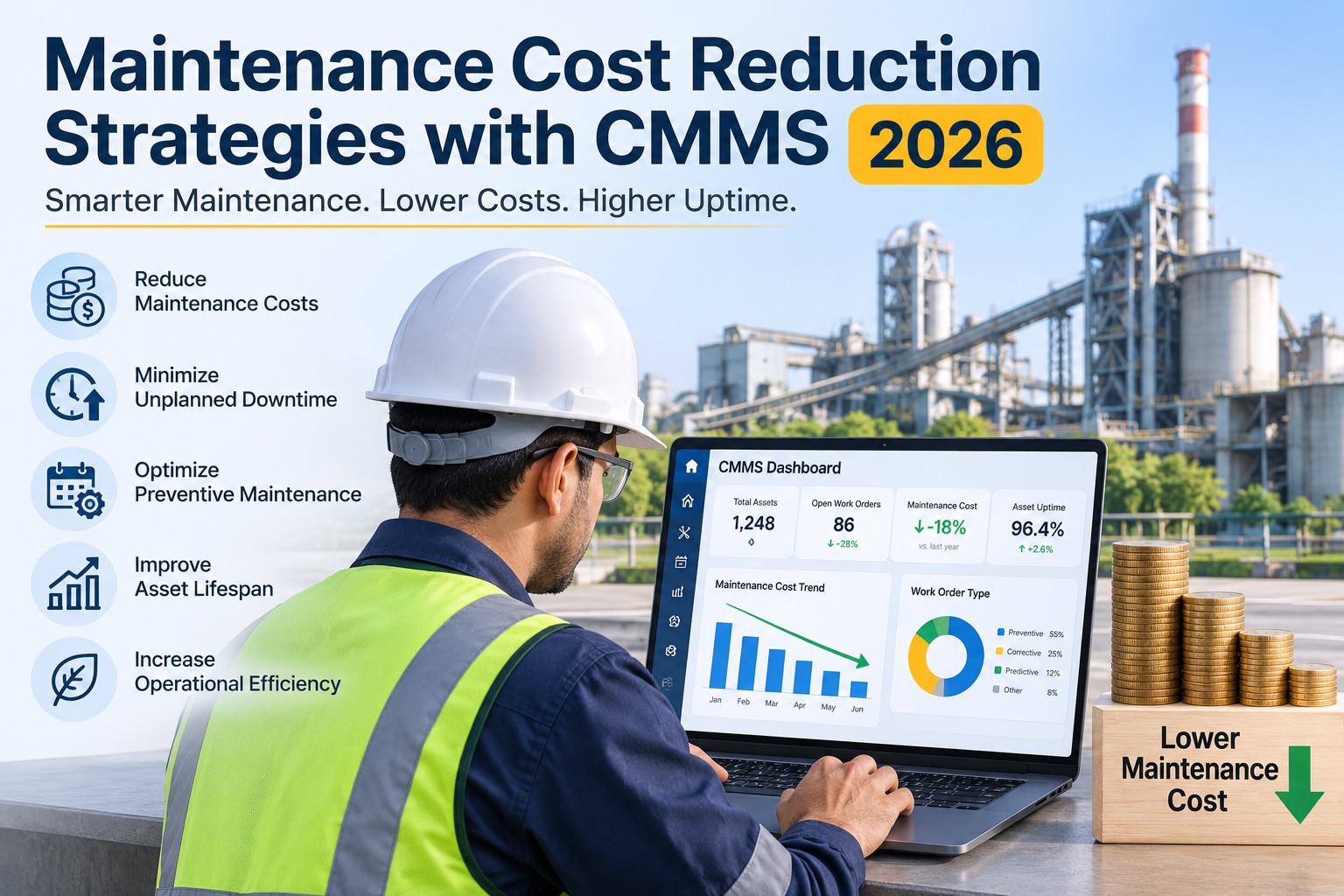
- Strategy 4 — PM completion rate management: A CMMS dashboard that shows every overdue PM by asset, crew, and consequence severity converts an invisible problem into a manageable one. Plants that implement real-time PM completion visibility consistently see completion rates move from 50–60% to 75–85% within 90 days.
- Strategy 5 — Root cause capture and recurrence prevention: Each closed work order in Oxmaint captures what was found, what was replaced, and whether the root cause was confirmed or suspected. Over 6–12 months, failure pattern analysis identifies assets with recurring failure modes that require a different maintenance approach. Sign up to enable root cause tracking.
- Strategy 6 — Inventory alignment to AI failure forecasts: Parts consumption forecasting from AI failure predictions converts reactive emergency procurement into planned standard orders. A 14-day advance failure warning is enough to source any standard industrial spare part at standard pricing.
- Strategy 7 — Continuous model improvement from work order feedback: Every repair outcome recorded in Oxmaint feeds back to the AI model — confirming or disconfirming the prediction, refining the failure signature for that specific asset in that specific operating environment. Prediction accuracy improves with every completed repair cycle.
Documented Downtime Reduction Results Across Industrial Sectors
The following results are drawn from documented AI maintenance deployments across manufacturing, energy, and heavy industry — the sectors with the highest unplanned downtime costs and the most to gain from predictive AI. Sign up for Oxmaint to build your own results record.
| Industry | Before AI Maintenance | After AI + CMMS | Key Downtime Driver Resolved |
|---|---|---|---|
| Steel & Metals | 15+ unplanned hrs/week | 2–3 hrs/week | Rotating equipment bearing failures — AI vibration monitoring |
| Automotive Assembly | $22k/min downtime cost | 90% fewer events | Robotic weld head actuator failures — current signature monitoring |
| Food & Beverage | Monthly line stops from CIP pump failure | Zero pump-related line stops | Centrifugal pump cavitation — process parameter trending |
| Oil & Gas | $800k avg unplanned shutdown | Scheduled every event | Compressor valve wear — acoustic emission monitoring |
| Pharmaceuticals | GMP compliance stops from HVAC failure | Zero unplanned GMP stops | AHU bearing failures — thermal trending with AI alert |
| Plastics & Packaging | Daily injection moulding stops | Weekly scheduled PM only | Hydraulic cylinder seal wear — AI oil analysis trending |
Swipe to view full table
What Maintenance Managers Say After AI Downtime Reduction
We went from averaging 19 unplanned downtime events per month to 4 in the 12 months after deploying Oxmaint with AI anomaly detection on our 38 critical rotating assets. The change was not dramatic or sudden — it was a slow replacement of emergency calls with scheduled work orders. By month six, the maintenance team had stopped dreading Saturday nights. By month ten, the production manager had stopped factoring unplanned downtime into the weekly capacity plan. The plant is running at 97.4% OEE this quarter. Before Oxmaint, 94% was considered a good week.
Every Unplanned Downtime Event You Experience This Month Could Have Been a Scheduled Work Order
Oxmaint's AI maintenance platform connects your sensor data to failure prediction, work order automation, and parts inventory management — converting the reactive emergency programme that is costing you 3–5x too much into a planned maintenance strategy that runs your equipment at 95%+ OEE.
Reducing Downtime with AI — Common Questions
The first measurable downtime reduction typically appears within the first 30–60 days — not from AI prediction, which requires data accumulation time, but from improved PM completion rate. When a CMMS dashboard makes every overdue PM visible in real time, completion rates improve immediately and the deferred PM cascade that produces reactive failures begins to clear. AI anomaly detection typically begins producing actionable predictions within 60–90 days on assets with relatively consistent operating conditions. By month 6, most plants report 40–60% fewer unplanned downtime events. The full 85% reduction documented in mature deployments is typically achieved within 12–18 months. Sign up for Oxmaint to start your downtime reduction programme today.
Yes — retrofit wireless sensors are the standard deployment path. Wireless accelerometers can be mounted on existing motors, pumps, and gearboxes without modification in a single installation day per asset. For assets where sensor installation is impractical, Oxmaint's manual inspection round templates with structured data entry and trend tracking produce significant downtime improvement even without IoT sensors — because the act of consistently measuring and recording equipment condition parameters, combined with CMMS trend analysis, identifies deteriorating assets before they fail. The full AI prediction capability is available from day one on assets with existing instrumentation connected to a process historian. Book a demo to see retrofit sensor integration in Oxmaint.
The single most impactful first step for a reactive maintenance operation is to digitise work orders and establish a PM schedule with real-time completion visibility. Before AI anomaly detection adds value, the fundamental maintenance data infrastructure — digital asset register, work order history, and PM adherence tracking — must exist. Most Oxmaint customers achieve 15–20% maintenance cost reduction from this first step alone, before any AI predictive capability is activated. The AI layer then builds on this foundation as sensor data accumulates and the model trains on plant-specific failure signatures. Starting with software before sensors is almost always the faster path to measurable results. Sign up for Oxmaint to begin with the foundation today.
The 85% Downtime Reduction That Other Plants Have Already Achieved Is Available to Your Operation.
The technology exists. The data your equipment generates already contains the failure signals. The economics are overwhelming — a single prevented unplanned shutdown at most industrial plants pays for a year of Oxmaint subscription. The only variable is when you choose to act on it.


.png)

