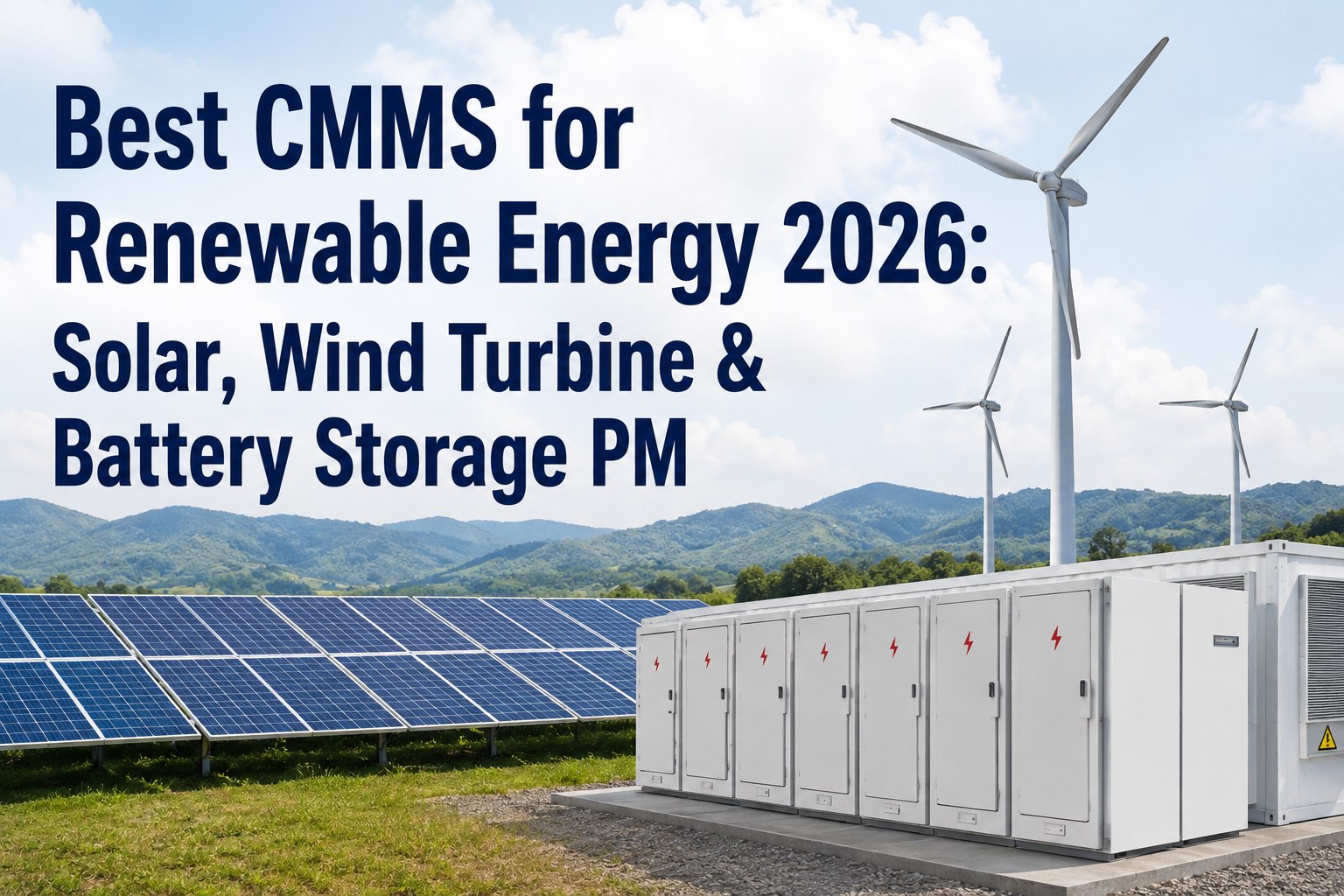
Solar farms and wind turbines share a maintenance challenge no other industrial sector faces at the same scale: assets spread across hundreds of acres or miles of coastline, in environments hostile to both equipment and field crews, with performance degradation that is invisible until it shows up in the monthly generation report — weeks after the revenue was already lost. Start managing your renewable energy assets with Oxmaint and close the gap between field reality and control room visibility.
Renewable Energy Maintenance: Solar and Wind Farm CMMS
A complete guide to structuring preventive maintenance for utility-scale solar and wind assets — covering panel inspection scheduling, turbine condition monitoring, weather-triggered PM, remote site logistics, and performance-based maintenance tracking.
Why Renewable Energy Assets Are Harder to Maintain Than They Look
A 200MW solar farm has 500,000+ individual panels. A 50-turbine offshore wind farm has 50 major rotating machines, each with gearboxes, pitch systems, yaw drives, blade integrity, and electrical systems that must be maintained in access conditions that are weather-dependent, tide-dependent, and crane-dependent. The maintenance challenge is not what to do — it is doing it at scale, in remote locations, with crews that are expensive to mobilise, on a schedule that must account for weather windows, generation obligations, and grid curtailment requirements.
Without a CMMS built for remote asset operations, renewable energy maintenance defaults to reactive: panels are cleaned when output drops noticeably, turbines are inspected when they alarm, and the connection between maintenance activity and generation performance is never made explicit. The result is avoidable degradation that compounds quietly over the 20–25 year asset life.
Solar Farm Maintenance Program: What to Inspect and When
Solar PV maintenance is high-frequency, high-volume work. A 100MW solar farm typically requires 6–8 cleaning cycles per year per panel string, quarterly IV-curve testing for performance verification, annual thermographic surveys for hotspot detection, and continuous string-level monitoring for inverter faults. The challenge is not the individual task — it is managing 500,000+ assets systematically. Oxmaint handles this through hierarchical asset structure — farm, block, string, and panel — with inspections assigned at the appropriate level and deviations escalated automatically.
Soiling is the single largest preventable cause of energy yield loss in solar farms — dust, pollen, bird droppings, and pollution accumulate faster than most operators assume. Cleaning frequency should be driven by soiling rate monitoring (daily irradiance vs output comparison), not a fixed calendar. Configure weather-triggered cleaning PM tasks in Oxmaint that activate automatically when soiling thresholds are crossed.
- Soiling ratio measurement — compare actual vs expected output per string before and after cleaning cycle; document yield recovery per MW cleaned
- Panel surface inspection during cleaning — record visible cracks, delamination, cell discolouration, or frame corrosion; flag units for follow-up inspection
- Water consumption and wash quality logging — track volume per MW cleaned to benchmark crew efficiency and optimise route scheduling
- Post-clean performance verification — confirm string output returns to expected level within 24 hours; persistent underperformance indicates electrical fault, not soiling
Infrared thermography is the most effective method for detecting hotspots, bypass diode failures, and cell-level defects in solar panels. Annual drone-based thermal surveys of the full site are now industry standard, with follow-up ground inspection for any anomaly above the severity threshold. Post-storm surveys should be triggered within 48 hours of any weather event that could cause impact damage.
- Full-site drone thermographic survey — classify anomalies by delta-T severity: below 10K (monitor), 10-40K (inspect within 30 days), above 40K (immediate ground inspection and replacement assessment)
- Hotspot panel location and mapping — record GPS coordinates and string reference for every flagged panel; link to asset record in CMMS for trend analysis across campaigns
- Bypass diode failure identification — module-level thermal patterns indicate diode failure; affected modules should be tested with IV-curve analyser before replacement decision
Inverters, combiner boxes, AC collection systems, and substation equipment require systematic electrical inspection beyond what monitoring systems capture. Connection loosening, insulation degradation, and earthing continuity failures develop slowly and are invisible to remote monitoring until they cause a fault or fire. Bi-annual ground inspection with thermal imaging of all electrical enclosures is the minimum standard.
- Inverter inspection and performance log — record AC output, efficiency ratio, cooling fan operation, and error code history; compare against inverter-specific baseline
- Combiner box thermal imaging and torque check — all DC cable connections checked for thermal anomaly; retorque to specification; inspect fuse condition and string protection devices
- Earthing continuity measurement — measure earth resistance at regular test points across the site; any resistance above threshold triggers immediate investigation to prevent fire risk
Wind Turbine PM Program: Onshore and Offshore Requirements
Wind turbine maintenance combines the complexity of rotating machinery (gearbox, main bearing, generator), high-altitude structural inspection (blades, nacelle, tower), and weather-dependent access logistics. The OEM maintenance schedule defines minimum requirements, but a performance-driven CMMS program goes beyond minimum — using vibration data, oil analysis, and power curve monitoring to identify degradation before it forces a major component replacement. Book a demo to see how Oxmaint structures turbine PM programs.
Blade Inspection and Erosion Management
Blade leading-edge erosion is the most financially significant maintenance issue in onshore and offshore wind — AEP losses of 2–5% are common on mid-life turbines with uninspected blade erosion. Annual drone visual inspection combined with 5-yearly close visual access inspection (rope access or blade access platform) gives the full picture needed for erosion repair scheduling.
Drivetrain and Gearbox Condition Monitoring
Gearbox failure is the single most expensive unplanned event in wind turbine operation — replacement costs of $250,000–$500,000 plus crane hire and lost generation. Oil sampling every 6 months, continuous vibration monitoring on main bearing and gearbox, and power curve analysis against site wind data provide the multi-layer detection needed to catch gearbox degradation before catastrophic failure. Trending matters more than single data points: a single elevated oil metal particle count should be trended against previous samples, not acted on in isolation.
Pitch and Yaw System Maintenance
Pitch system failure — whether hydraulic or electric — causes immediate turbine shutdown and, in storm conditions, can result in blade runaway with catastrophic structural consequences. Monthly DAS error log review provides early detection of pitch performance deviation before it escalates to a fault. Yaw system wear is slower-developing but directly impacts AEP through misalignment losses that accumulate undetected without alignment checks.
Weather-Triggered Maintenance: The Differentiator for Renewable Assets
Conventional CMMS systems schedule maintenance on calendar dates. Renewable energy assets require maintenance on condition triggers — including weather events. A fixed-tilt solar farm after a hailstorm needs a thermographic inspection within 48 hours, not at the next quarterly survey. A wind turbine after a lightning strike needs a blade inspection before it returns to service, not when the annual survey falls due. Oxmaint supports weather-triggered PM task creation that activates work orders based on configurable event criteria.
Post-Storm Response Protocol
Soiling-Rate PM Trigger
Wind Speed Access Planning
Seasonal Maintenance Campaigns
Managing Solar Panels and Wind Turbines Reactively Costs You More Than the Maintenance Itself
Avoidable degradation, missed weather windows, and unplanned crew mobilisation compound over a 20-25 year asset life. Deploy Oxmaint for your renewable energy operation free today and start replacing reactive response with structured PM.
Managing Maintenance Across Remote and Geographically Dispersed Sites
A renewable energy O&M team managing multiple sites — solar farms across three states, or a cluster of wind farms in different grid regions — faces a coordination challenge that paper logs and spreadsheets cannot handle. Crew location, parts availability, weather window status, and overdue inspection backlog across all sites must be visible in one place for an operations manager to make effective dispatch decisions. Oxmaint provides this cross-site visibility — every site, every asset, every open work order, on one dashboard.
Multi-Site Asset Register
Each site is a node in the asset hierarchy — solar farm or wind farm, then blocks or turbine numbers, then strings or components. Cross-site inspection dashboards aggregate compliance status across the portfolio, so overdue tasks at Site C are visible alongside on-track inspections at Site A.
Offline Mobile Execution
Solar farm technicians and wind turbine service engineers work in areas where cellular connectivity is unreliable. Oxmaint mobile works offline — inspection forms are completed, photos captured, and readings logged without network access. Data syncs automatically when connectivity is restored.
Contractor and Crew Management
Renewable energy maintenance uses a mix of in-house staff and specialist contractors — blade inspection rope access teams, drone survey operators, OEM service engineers. Oxmaint allows external contractors to be issued specific work orders, complete them via the mobile app, and have their output integrated into the site's audit trail without a full system account.
OEM Warranty and Lender Compliance
Project finance lenders and OEM warranty conditions require documented maintenance records that demonstrate schedule adherence. Oxmaint generates compliance reports by site, asset type, or time period in PDF format — suitable for Technical Advisor review, lender reporting, and OEM warranty claim support without manual compilation.
Renewable Energy CMMS: Frequently Asked Questions
How should solar panel cleaning frequency be determined?
Cleaning frequency should be driven by soiling rate monitoring, not a fixed calendar. The best practice is to measure the ratio between actual irradiance-corrected output and expected output per string, and trigger a cleaning cycle when the soiling loss exceeds a configured threshold — typically 1–2% energy yield loss. In dry, dusty climates this may mean monthly cleaning. In high-rainfall temperate climates, quarterly cycles may be sufficient. Oxmaint allows soiling-trigger PM configuration so cleaning is dispatched when the data warrants it, not on a fixed date.
What is the most cost-effective inspection method for large solar farms?
For large utility-scale sites (above 10MW), drone-based thermographic inspection combined with automated anomaly detection software is the most cost-effective approach for annual surveys. Drone inspections reduce inspection time from weeks to days and provide a complete dataset of hotspot severity and location. The drone data should be linked to the CMMS asset record for each affected panel string, so follow-up work orders are generated automatically for ground investigation above the severity threshold.
What wind turbine components cause the most unplanned downtime?
Based on industry failure rate data, the major sources of unplanned downtime in descending order are: pitch system faults (high frequency, moderate duration), electrical system failures including converter and switchgear (moderate frequency, moderate duration), gearbox failures (low frequency, very high duration and cost), and main bearing failures (low frequency, high duration). A CMMS-driven PM program should concentrate predictive monitoring effort on gearbox condition (oil analysis, vibration) and pitch system performance tracking, as these offer the highest return on maintenance investment. Book a demo to see how Oxmaint tracks turbine component health.
How does Oxmaint handle maintenance scheduling around weather access windows?
Oxmaint supports weather-based PM configuration through manual weather-event task triggers and configurable scheduling rules that hold access-dependent tasks in a pending state until a weather window is confirmed by the operations team. For offshore sites, crew transfer vessel dispatch conditions and significant wave height limits can be built into the work order approval workflow — tasks require supervisor confirmation of weather clearance before field execution begins. This prevents mobilisation cost on days where access conditions will not permit task completion.
Can Oxmaint integrate with SCADA systems for automatic alarm-to-work-order generation?
Oxmaint supports API integration with most wind and solar SCADA platforms, enabling automatic generation of corrective maintenance work orders when specific alarm types are triggered. This closes the gap between a SCADA alarm and a maintenance work order — without requiring a control room operator to manually create the task. Alarm-generated work orders can be pre-populated with asset details, priority rating, and recommended action, reducing response time significantly. Integration scope and SCADA vendor compatibility can be confirmed during the demo session.
What documentation does Oxmaint produce for OEM warranty compliance?
Oxmaint generates timestamped work order completion records, inspection forms with field readings and photo evidence, and maintenance schedule compliance reports showing task completion rate against required intervals. These records cover the documentation requirements of most major wind turbine OEM warranty conditions including Vestas, Siemens Gamesa, GE, and Nordex. For lender Technical Advisor reporting, Oxmaint can generate site-level compliance summaries covering a defined reporting period in PDF format. Start your renewable energy asset register in Oxmaint free today.
Build the Maintenance Program That Protects 20 Years of Renewable Energy Revenue
Solar panel soiling, blade erosion, and gearbox wear all progress quietly — but they show up loudly in annual generation reports. Oxmaint gives your O&M team the tools to catch degradation early, plan maintenance around weather windows, and produce the compliance records that protect OEM warranties and lender relationships.


.png)