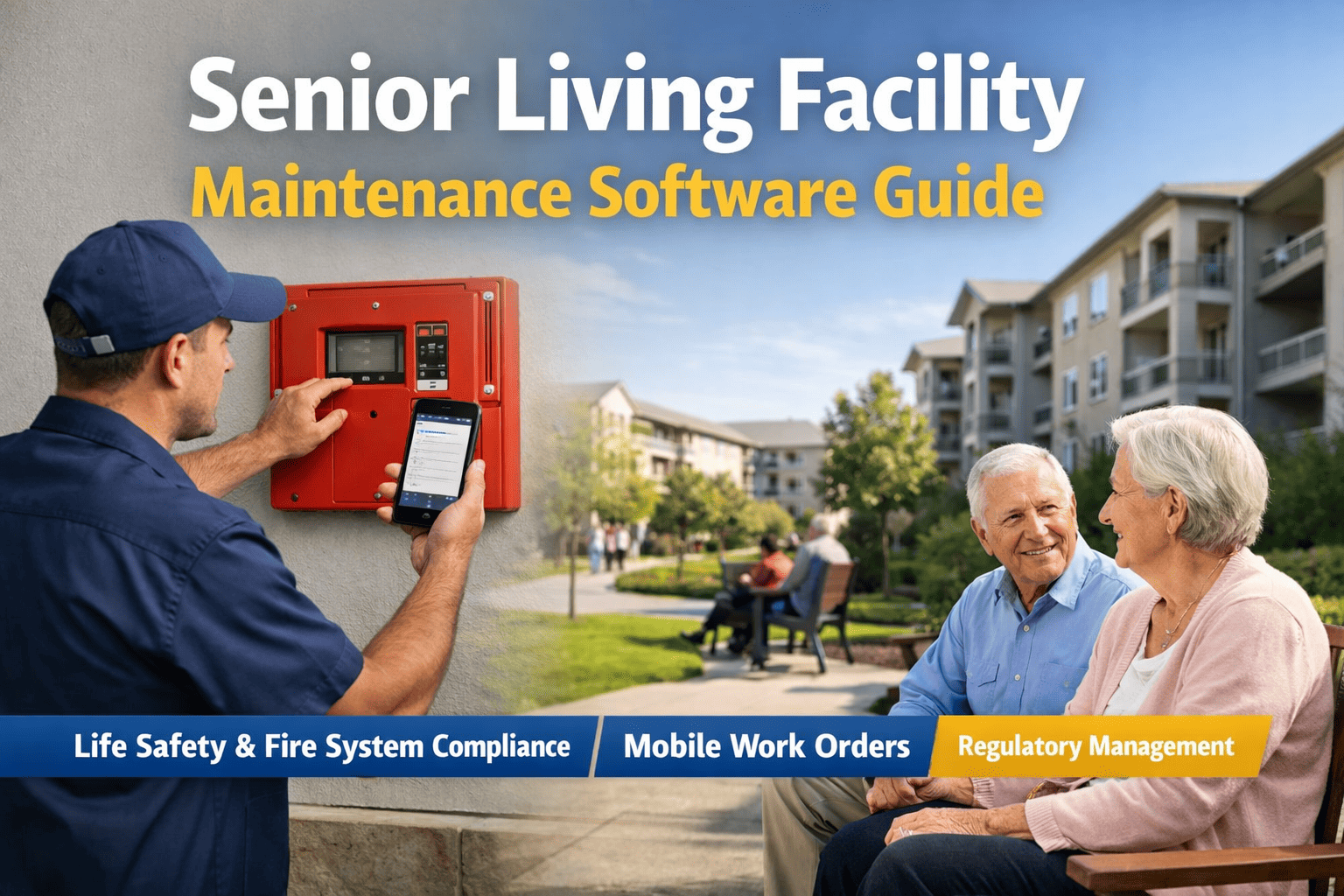
When a state surveyor walks into a senior living facility, the first thing they look for is paper — inspection logs, maintenance records, fire drill documentation, corrective action notices. If that paper is missing, incomplete, or contradicts what they observe, the consequence is not a warning notice. It is a citation that can threaten a facility's Medicare and Medicaid certification. Title 42 CFR Part 483.70 requires nursing home facilities to meet the provisions of NFPA 101 Life Safety Code — a standard that imposes more than 40 distinct recurring inspection tasks, each at a different frequency, each requiring a documented result, each requiring a corrective action record if a deficiency was found. Senior citizens over 65 are twice as likely to be injured in a fire compared to the general US population. The residents in your care are the people with the least ability to self-evacuate. The fire alarm that has not been tested, the sprinkler head that has been painted over, the emergency lighting that has a dead battery — these are not administrative failures. They are safety failures with documented, foreseeable consequences. A CMMS for senior living does not make compliance optional. It makes the compliance programme systematic, documented, and defensible — turning the state surveyor visit from an anxiety event into a records presentation. Sign up for Oxmaint to implement life safety compliance management at your senior living facility today.
Why Paper-Based Maintenance Management Fails Senior Living Facilities — Three Compounding Gaps
Senior living maintenance is not primarily about fixing things. It is about proving, at any moment an inspector asks, that everything has been inspected, tested, and maintained on schedule — and that every deficiency found has a corrective action record. Paper systems cannot produce this proof reliably. Sign up for Oxmaint to replace paper-based compliance records with a systematic CMMS.
A single fire alarm panel requires weekly visual inspection, monthly signal transmission testing, semi-annual comprehensive testing, and annual full-system verification — four separate inspection frequencies that must all run simultaneously and independently. A missed monthly test does not reset the weekly test clock. Spreadsheet calendar systems and paper logs cannot handle this frequency complexity across dozens of systems without generating gaps. Staff turnover makes it worse — institutional knowledge about which tasks are due when leaves with the person who was managing it, and the facility does not know what it missed until the inspector asks.
When an inspection finds a deficiency — a fire door that does not self-close fully, a sprinkler head with a missing escutcheon, an emergency light with a failed battery — the regulatory requirement is not just to fix it. It is to document that it was found, assign a corrective action, record the repair, and verify the repair held at the next inspection. Paper systems frequently capture the finding but lose the corrective action chain. The surveyor finds an outstanding deficiency from six months ago with no repair record — and what was a minor maintenance oversight becomes a compliance citation. Book a demo to see corrective action tracking in Oxmaint.
CMS surveys are unannounced. When the surveyor arrives and asks for the last 12 months of fire alarm testing records, emergency generator test logs, and elevator maintenance documentation, the answer cannot be "let me check the file room." The records must be immediately retrievable, complete, and legible. A digital CMMS where every work order is timestamped, technician-signed, and searchable by system and date range produces this record as a report generated in seconds. Paper filing systems produce anxiety, searching, and potentially incomplete records that suggest non-compliance even when the work was done.
NFPA Standards Applicable to Senior Living — What Oxmaint Schedules and Documents
Each NFPA standard applicable to senior living facilities imposes inspection and testing requirements at multiple frequencies. Oxmaint schedules all of these simultaneously and independently — each task generating at its correct interval from the last completion date, regardless of what other tasks are due. Sign up for Oxmaint to activate multi-frequency life safety scheduling.
| NFPA Standard | System Covered | Frequency Tiers | Key Documentation Requirement |
|---|---|---|---|
| NFPA 72 | Fire alarm and notification systems | Weekly, monthly, semi-annual, annual | Test results by device, signal transmission verification, panel condition record |
| NFPA 25 | Water-based fire suppression (sprinklers) | Weekly, monthly, quarterly, annual, 5-year | Sprinkler head condition, flow test results, backflow preventer certification |
| NFPA 101 | Life Safety Code — egress, doors, corridors | Daily, monthly, annual | Egress path clear, fire door self-closure, exit sign illumination |
| NFPA 80 | Fire doors and fire-rated assemblies | Annual | Annual inspection by qualified inspector, deficiency record and corrective action |
| NFPA 10 | Portable fire extinguishers | Monthly visual, annual inspection, 6-year | Monthly visual check tag, annual service certificate, hydrostatic test record |
| NFPA 99 | Healthcare facilities — electrical, gas systems | Monthly, quarterly, annual | Emergency power system test, medical gas system inspection |
| NFPA 110 | Emergency and standby power (generators) | Weekly, monthly, annual | Weekly visual, monthly 30-min load test, annual load bank test record |
Swipe to view full table
The Five Maintenance Areas That Determine State Survey Outcomes at Senior Living Facilities
A senior living facility's maintenance programme covers systems that affect resident safety, comfort, and regulatory compliance simultaneously. The five areas below are the ones most frequently cited in CMS survey deficiencies and most directly managed through a CMMS. Book a demo to see each area configured for your facility type.
Life Safety Systems — Fire Alarm, Sprinklers, Emergency Lighting, and Egress
Life safety system maintenance is the highest-stakes maintenance discipline in senior living — because a system that fails to activate when needed kills residents. Weekly fire alarm panel visual checks, monthly sprinkler system walk-throughs, quarterly emergency lighting battery tests, and annual full-system certifications must all run on independent schedules without any one frequency resetting another. Oxmaint manages each inspection task independently — the fire alarm panel simultaneously carries a weekly visual work order, a monthly signal test work order, and an annual certification work order, each generating from the last completion date of that specific task. When the CMS surveyor arrives unannounced, the facility director opens the Oxmaint compliance dashboard and exports the last 12 months of life safety inspection records in 30 seconds. Sign up for Oxmaint to activate life safety scheduling.
- Fire alarm panel: weekly visual, monthly signal test, annual full-system — all independent
- Sprinkler heads: monthly visual, quarterly flow testing, annual inspection by certified contractor
- Emergency lighting: monthly 30-second test, annual 90-minute battery duration test
- Exit signs: monthly visual illumination check, corrective work order for any dark sign
- Fire doors: annual NFPA 80 inspection with qualified inspector; deficiency-to-corrective action tracked
HVAC and Indoor Air Quality — Resident Comfort, Infection Control, and Energy
HVAC systems in senior living facilities affect resident health directly — inadequate temperature control during extreme weather events is a documented cause of resident harm, and poor air quality contributes to respiratory infections in immunocompromised populations. Filter changes every 1–3 months maintain air quality and system efficiency. Coil cleaning, drain pan inspection, and refrigerant level checks are seasonal tasks. Annual professional inspection verifies system performance against specification. Oxmaint schedules HVAC PM by unit — each air handler, fan coil unit, and rooftop unit carries its own PM schedule based on its location, usage, and manufacturer recommendation. Sign up to configure HVAC PM scheduling.
- Filter replacement: monthly to quarterly depending on unit location and occupancy density
- Coil cleaning: semi-annual — dirty coils reduce efficiency and force compressor overload
- Condensate drain pan inspection: quarterly — blocked drains cause mold growth and water damage
- Annual full system inspection by licensed HVAC contractor with service record attached
Emergency Power — Generator Testing and Transfer Switch Maintenance
Emergency generator reliability is non-negotiable in senior living. Medical equipment, lighting, HVAC, and call systems that depend on emergency power during a utility outage are all potentially life-sustaining for residents. NFPA 110 requires weekly visual inspection, monthly 30-minute loaded exercise, and annual load bank testing to rated capacity. A generator that has passed weekly visual checks but has never been tested under load is not a compliant generator — and more critically, it is a generator that may not start when it is needed. Oxmaint schedules all three generator PM levels independently, records the test results (output voltage, frequency, load, runtime) as mandatory measured data fields, and flags any generator that has failed a test or is overdue. Book a demo to see generator PM tracking configured.
- Weekly visual: fuel level, coolant level, battery condition, oil level — Oxmaint mobile checklist
- Monthly 30-minute exercise: loaded test — output voltage, frequency, and runtime recorded
- Annual load bank test to rated capacity: third-party certificate attached to work order in Oxmaint
- Transfer switch annual inspection: response time, transfer sequence, manual bypass test
Plumbing and Water Systems — Legionella Risk, Hot Water, and Resident Safety
Plumbing in senior living facilities carries a specific risk that does not apply to most other building types: Legionella. Elderly, immunocompromised residents are disproportionately vulnerable to Legionnaire's disease from contaminated water systems. A water management programme (WMP) with documented monitoring of domestic hot water temperatures (minimum 120°F at the heater, maximum 110°F at resident fixtures), cooling tower treatment, and low-flow fixture flushing is increasingly required by state health departments for licensed care facilities. Plumbing maintenance also covers call system integrity in resident bathrooms, grab bar and handrail condition, and anti-scald device function — all directly related to resident fall prevention and safety. Sign up to configure water management PM.
- Hot water temperature monitoring: monthly check at heater and at representative resident fixtures
- Low-use fixture flushing: weekly — low-flow fixtures develop Legionella biofilm in stagnant water
- Anti-scald device verification: annual — ensures residents with reduced sensation are protected from burns
- Grab bar and handrail inspection: monthly — loose fixture is a fall incident waiting to be documented
How Oxmaint Manages Senior Living Maintenance — The Three Capabilities That Matter Most
Senior living maintenance has a specific combination of requirements that differentiates it from general facility management: regulatory compliance documentation with audit-ready records, multi-frequency life safety scheduling, and resident request management that does not compete with compliance work orders for the maintenance team's attention. Sign up for Oxmaint to deploy a CMMS purpose-built for these requirements.
Each life safety inspection task in Oxmaint carries its own independent recurrence schedule. A fire alarm panel simultaneously carries a weekly visual work order, a monthly signal test work order, and an annual certification work order — each generating independently from the last completion date of that specific task. Staff turnover does not create gaps because the schedule lives in the system, not in someone's memory. When a new maintenance technician starts, their work queue is already populated with the correct tasks for that day.
Every work order in Oxmaint is timestamped, technician-signed, and linked to the specific asset it covers. When the CMS surveyor arrives unannounced and asks for the last 12 months of fire alarm testing records, the facility director opens Oxmaint on a tablet and exports the complete record set in 30 seconds. The record includes what was tested, the result, who performed the test, when it was completed, and any corrective action raised. This is the record that converts a surveyor visit from a compliance risk into a compliance demonstration. Book a demo to see compliance reporting.
Residents and family members submit maintenance requests through the Oxmaint request portal — a simple form accessible from any device, no login required. Requests arrive directly in the maintenance team's work queue, assigned by area and priority. The maintenance team responds to resident requests from the same platform they use for life safety PM — with visibility that prevents a flood of resident requests from pushing a fire alarm test past its due date. The compliance work orders carry higher priority and are never hidden behind resident requests. Sign up to activate the resident request portal.
Maintenance technicians complete all inspections and work orders on mobile — recording test results, attaching photos, and closing work orders at the equipment location. When an outside contractor performs an annual fire alarm inspection, they complete the work order in Oxmaint on their own device, attach their inspection certificate, and sign off digitally — their report becomes part of the facility's permanent compliance record without paper transcription or email follow-up. Offline mode covers areas with limited WiFi coverage. Book a demo.
When an inspection finds a deficiency — a fire door that does not self-close, a sprinkler head with paint on it, a grab bar that has worked loose — Oxmaint generates a corrective action work order automatically from the inspection finding. The corrective action is linked to the original inspection, assigned to the appropriate technician, and tracked to completion. When the surveyor asks to see the corrective action record for a deficiency found on the last inspection, Oxmaint shows the complete chain: finding, work order, repair completion, and verification inspection. Sign up for deficiency tracking.
Oxmaint maintains a complete asset register for the senior living facility — every HVAC unit, every fire alarm panel, every sprinkler system zone, every elevator, every generator, every hot water heater — each with its installation date, model and serial number, warranty information, and complete maintenance history. When the facility changes maintenance staff or management, the institutional knowledge lives in Oxmaint, not in someone's head. The asset register becomes the foundation for capital planning — showing which assets are approaching end of life and which have recent replacement history. Book a demo to see the asset register.
When the Surveyor Arrives Unannounced, Your Compliance Records Should Be in Oxmaint — Not in a Filing Cabinet.
Multi-frequency life safety scheduling, mobile work orders, automatic corrective action tracking, and 30-second compliance record export — designed for the specific requirements of senior living facility maintenance.
Senior Living Facility Maintenance Software — Common Questions
Yes. Each inspection task in Oxmaint carries its own independent recurrence schedule. A fire alarm control panel can simultaneously carry a weekly visual inspection work order, a monthly signal transmission test work order, and an annual full-system test work order — each generating independently at its configured interval from the last completion date of that specific task. The weekly work order does not reset the monthly work order's clock. All NFPA 72 frequency tiers run simultaneously without any manual coordination. This is the fundamental capability gap that spreadsheet and paper systems cannot bridge — and the reason facilities managed by paper frequently have gaps in one frequency tier that are invisible until the surveyor asks. Sign up for Oxmaint to activate multi-frequency life safety scheduling.
Yes. External contractors can be set up as contractor users in Oxmaint with access to their assigned inspection work orders. The contractor's inspector completes the work order on mobile at the device location, records test results, attaches their inspection certificate and photos, and signs off digitally. Their report becomes part of the facility's permanent compliance record without any paper transcription or email follow-up. This eliminates the compliance gap that exists when contractor reports arrive on paper, are filed in a physical folder, and are not discoverable when the surveyor asks for them. Book a demo to see contractor inspection integration.
The first phase of an Oxmaint deployment for a senior living facility — building the asset register for the critical life safety and mechanical systems and configuring the PM schedules — typically takes 2 to 3 weeks for a single facility. During that configuration period, all incoming corrective work orders can be managed in Oxmaint digitally from day one, building the maintenance record from the implementation date. A facility that begins today will have a 12-month compliance record available for surveyor review within 12 months of go-live. For facilities that have an upcoming survey, Oxmaint can be prioritised to get the highest-risk life safety systems scheduled and documented first — fire alarm, sprinklers, emergency power, and egress — within the first week of deployment. Sign up for Oxmaint to begin the implementation conversation.
Staff turnover is one of the most damaging conditions for paper-based maintenance programmes — institutional knowledge about which tasks are due when, which vendor handles which system, and which corrective actions are outstanding leaves with the person who was managing it. Oxmaint eliminates this vulnerability entirely. The PM schedule, the asset register, the maintenance history, and the open corrective action list all live in the system. When a new maintenance technician starts, they open Oxmaint and their work queue is already populated with the correct tasks for that day. The facility director can see every open work order, every overdue PM, and every outstanding corrective action without asking anyone. The compliance programme survives staff changes intact because it is not held in anyone's memory. Book a demo to discuss your facility's specific needs.
The Fire Door That Does Not Close, the Generator That Has Never Been Loaded, the Inspector Who Arrives Without Notice — Oxmaint Makes Sure Your Records Are Ready Before They Ask.
Life safety compliance scheduling, mobile work orders, automatic deficiency-to-corrective-action tracking, contractor digital inspection integration, and 30-second compliance record export — built for the regulatory reality of senior living facility maintenance.



.png)


