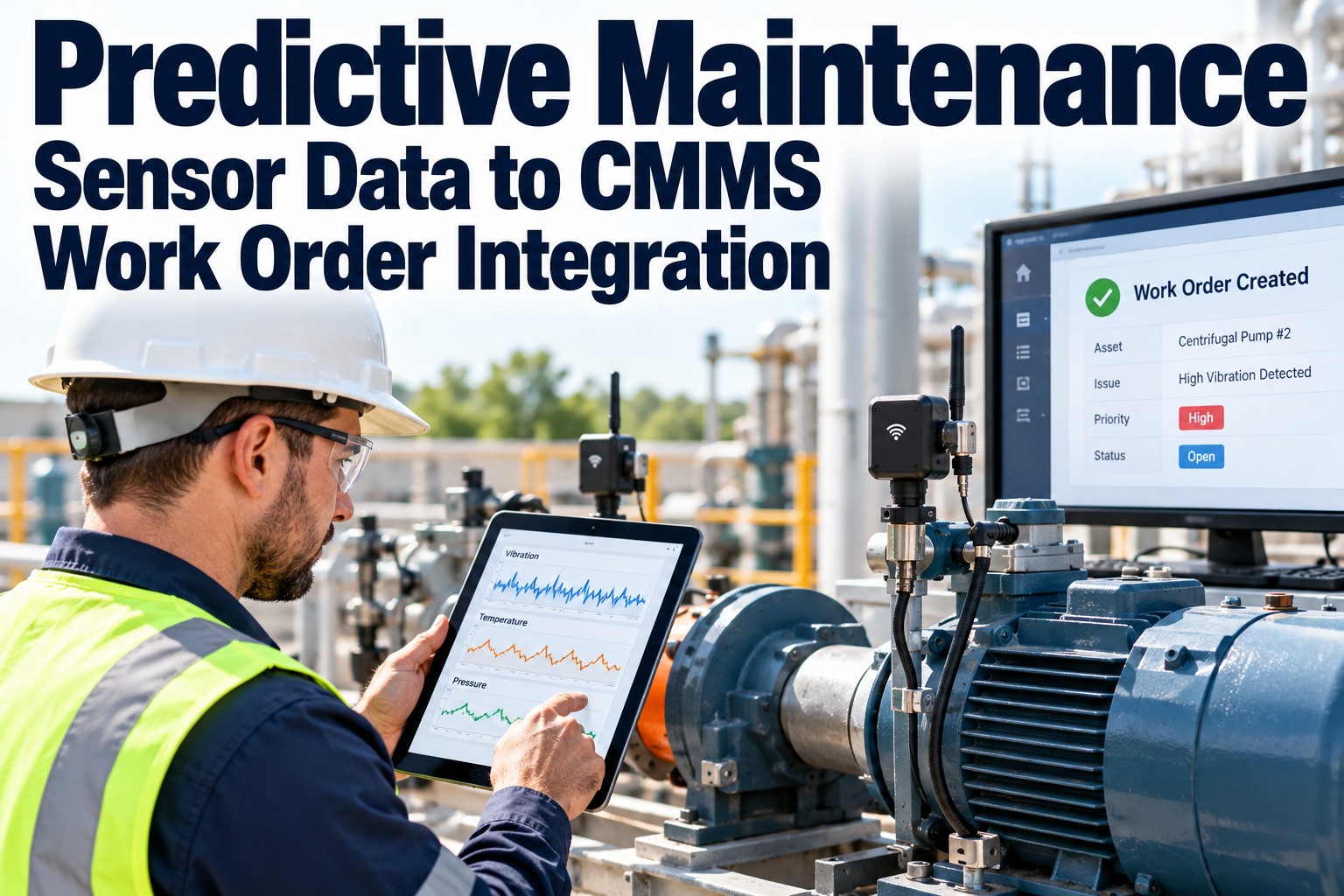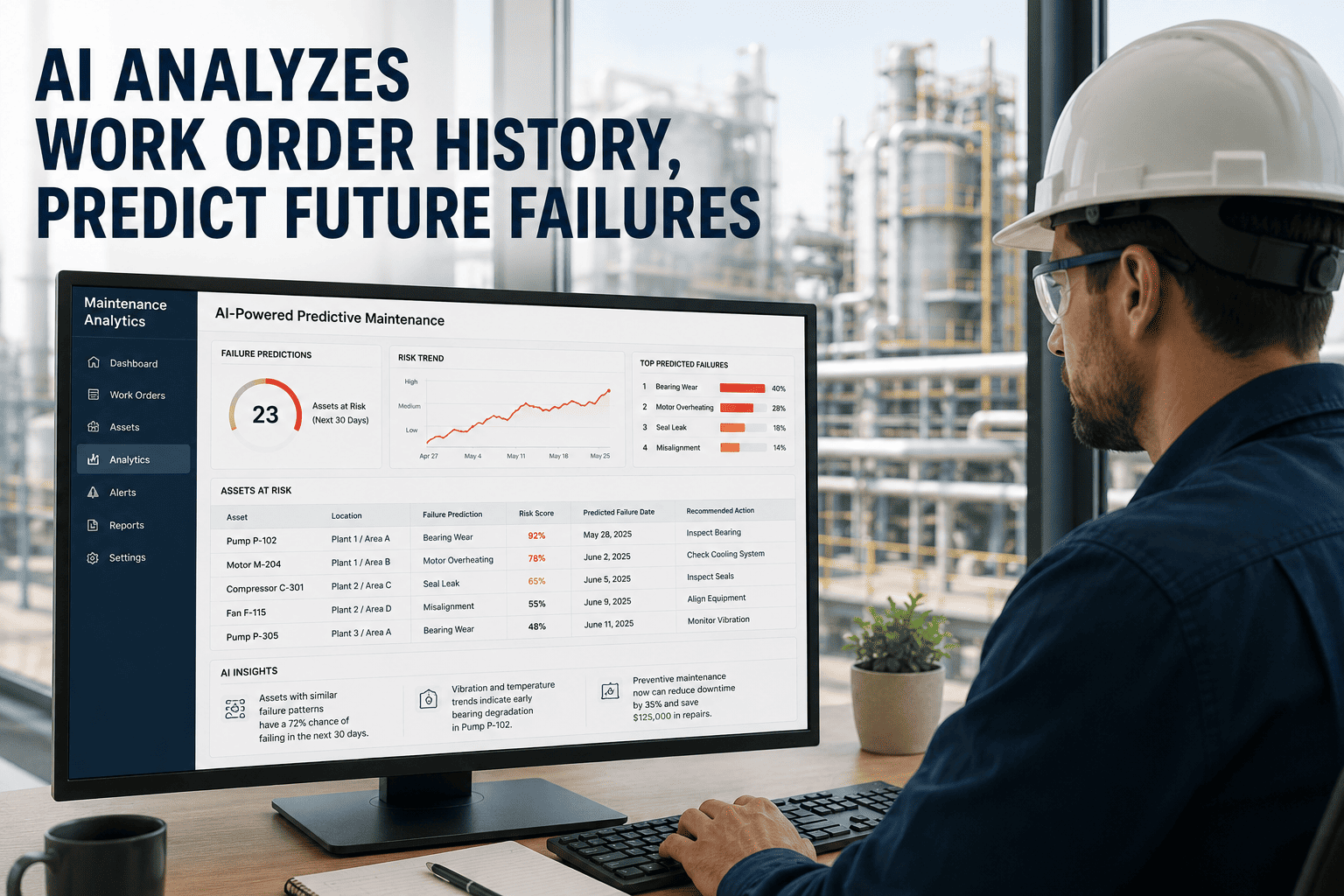
AI work order analysis turns the maintenance history your team has been collecting for years into a failure prediction engine — and most organizations are sitting on enough data to start today. Every corrective work order your CMMS has ever closed contains a signal: what failed, when, how often, how long repair took, what parts were used. AI that reads that history doesn't just report the past. It forecasts which assets are statistically overdue for their next failure, and how soon.
Connect your existing work order history to Oxmaint's AI and see which assets are statistically approaching failure — in 30 minutes.
- 94% AI prediction accuracy from maintenance history + live sensor data
- Auto-generated work orders before failures activate
- MTBF trending, failure pattern detection, repeat fault identification
Trusted by 1,000+ maintenance teams across 9+ industries · Live in days, not months
How AI analyzes work order history to predict equipment failures
AI work order analysis is the process of applying machine learning models to historical maintenance records — every closed corrective work order, every failure code, every repair duration, every parts consumed record — to identify statistical patterns that precede equipment failures. The AI doesn't need to be told what a failure looks like. It finds the pattern itself: which sequence of repair events, which shortening of intervals between similar fault codes, which combination of parts consumed reliably precedes the next breakdown on a given asset class.
The data already exists in most organizations' CMMS platforms. The problem is that it sits as rows in a database, not as a prioritized forecast. A maintenance manager reviewing 18 months of work orders for motor M-07 sees a list of closed jobs. An AI analyzing the same records sees that this motor has had three bearing replacements in 24 months where the inter-replacement interval is shortening — from 11 months to 8 months to 5 months — and that the current interval is now 4 months in. The AI calculates that the next bearing event has a high probability of occurring within the next 6–8 weeks. The maintenance manager gets a predictive alert. The AI gets trained on the outcome. See how Oxmaint's predictive engine processes this across your full asset register simultaneously.
Work order history analysis is most powerful when combined with live sensor data — vibration and temperature readings that confirm whether the statistical prediction is also showing an early physical signature. But even without sensors, historical maintenance record analysis alone produces actionable predictions that significantly outperform any fixed-interval PM schedule.
6 work order data signals AI uses to forecast equipment failures
The most direct signal. If failure code FC-14 (bearing wear) has appeared on asset M-07 three times in 24 months with each interval shorter than the last, the trend line predicts when the fourth occurrence is statistically due. AI fits a regression model to the inter-failure intervals and generates a probability-weighted time-to-failure estimate. No sensor required — just consistent failure coding at work order close-out.
When a routine maintenance task that historically takes 2 hours begins taking 4–5 hours, the extended duration signals increasing fault complexity — more wear damage found, more components replaced, more unexpected conditions encountered. Repair duration escalation on the same fault type is a leading indicator of approaching major failure before the technician's narrative captures it explicitly.
An asset that has consumed the same parts at the same intervals for years, then begins consuming additional or different part categories, is exhibiting a condition change. Switching from replacing a bearing to also replacing a shaft seal in the same corrective job indicates that the failure mode is expanding — a strong signal that the underlying wear mechanism is progressing faster than the PM schedule accounts for.
When a corrective work order is closed on an asset and a new work order for the same or related fault code appears within 30–90 days, the AI classifies this as a recurrence event — a strong signal that the root cause was not resolved by the prior repair, or that a secondary failure mode was activated by the same underlying condition. Recurrence pattern detection is one of the highest-precision failure predictors available in maintenance history analysis.
At the fleet level, reactive-to-planned ratio is a program health metric. At the individual asset level, it is a failure precursor. An asset that was generating 1 reactive work order per 8 planned PMs, and is now generating 3 reactive per 8 planned, has moved into a condition regime where its PM schedule is no longer adequate to prevent fault development between PM visits. This ratio shift triggers a PM frequency review flag in the AI model.
AI trained on failure history across an asset fleet can identify when Asset B begins exhibiting the same pre-failure work order pattern that Asset A showed in the 8 weeks before its major failure. Cross-asset pattern matching propagates the failure intelligence from one event to protect every similar asset in the register — without requiring each asset to independently accumulate its own failure history to the point of breakdown.
4 ways unused work order history costs maintenance teams every quarter
The data proving an asset was approaching failure was in the CMMS the whole time — three recurrence events, shortening repair intervals, expanding parts consumption. No one read the pattern because it required manual analysis across dozens of work order records no maintenance manager has time to review. AI reads every record simultaneously. Oxmaint's analytics layer surfaces failure patterns automatically, without manual query construction.
Fixed-interval PM schedules designed at asset commissioning don't reflect 5 years of operational wear data. The intervals may be too long — allowing failure modes to develop between visits — or too short — consuming labor on assets that don't need it. AI analysis of actual failure intervals recalibrates PM frequency to match real degradation rates, not theoretical ones. Preventive maintenance scheduling built on real data performs measurably better than schedules built on OEM defaults.
Parts stocking decisions made without failure frequency data from work order history routinely stock the wrong parts at the wrong quantities. Assets with shortening failure intervals need higher stock levels of their specific failure mode parts — before the next event, not during it. AI-driven parts and inventory management uses failure prediction to stage the right parts before AI-predicted failure windows open.
The pattern recognition that experienced maintenance technicians develop over years — knowing that motor M-07 always fails its bearing before the annual PM, that pump P-31's seal goes two months after the bearing — lives in their heads, not in a system. When they leave, the pattern recognition leaves with them. AI-encoded work order history is institutional memory that doesn't retire. Complete work order close-out data is what makes this possible.
How Oxmaint turns work order history into a live failure prediction engine
Every corrective WO closed in Oxmaint requires failure code selection, actual labor hours, and parts consumed before the job can be marked complete. This mandatory structure ensures the AI has clean, categorized data to analyze — not free-text notes that resist pattern matching. The close-out is the data foundation that makes prediction possible. Work order management details.
Oxmaint's AI continuously runs failure code frequency trending, repair duration analysis, parts consumption shifts, recurrence detection, reactive ratio monitoring, and cross-asset pattern matching across every asset in the register. The analysis runs in the background — no manual queries, no spreadsheet exports, no reliability engineer needed to run the analysis cycle.
Where IoT sensors are connected, live vibration, temperature, and pressure data is layered on top of work order history analysis. An asset that the history model has flagged as high-risk, and which is also showing an elevated vibration baseline, generates a higher-confidence alert than history alone. Sensor integration is additive — work order history analysis delivers value before any sensors are deployed. Predictive maintenance module.
When the AI's confidence threshold for a failure prediction is crossed, it doesn't generate a raw alert that waits for human triage. It auto-creates a work order, scored by asset criticality, routed to the nearest certified technician, with the predicted failure mode documented, relevant history attached, and parts availability checked. Prediction converts directly into action with no manual step. AI and automation capabilities.
When the technician closes the predictive work order — confirming whether the predicted failure mode was found, what was actually repaired, what parts were consumed — that outcome feeds back into the AI model. Confirmed predictions strengthen the model's confidence on similar pattern sequences. False predictions reduce weighting on the triggering signal combination. Prediction accuracy improves with every closed work order.
Manual work order review vs AI-driven failure prediction
| Capability | Manual History Review | Oxmaint AI Analysis |
|---|---|---|
| Failure pattern detection | Requires manual query per asset | Continuous, all assets, all signals simultaneously |
| Interval trend analysis | Spreadsheet export, manual calculation | Automatic — flags shortening intervals in real time |
| Cross-asset learning | Not possible at scale | P-44 learns from P-31's pre-failure sequence |
| Prediction lead time | Post-failure (reactive) | 2–4 weeks before failure event |
| PM schedule optimization | Manual, annual or less frequent | Continuous — flags intervals that no longer match failure rates |
| Parts staging | Based on age or gut feel | Pre-staged to match AI-predicted failure windows |
| Institutional memory | Leaves with experienced technicians | Encoded in AI model — never retires |
| Action path | Manual alert → manual triage → manual WO | Auto work order, assigned, prioritized, history attached |
What AI work order analysis delivers in practice
The richer your work order history, the more accurate the predictions — and the value compounds over time as the model learns your specific asset fleet. Calculate your predictive maintenance ROI, or book a demo and we'll run a pattern analysis on a sample of your existing work order data.
Common questions about AI work order analysis and failure prediction
How much work order history does AI need to predict equipment failures accurately?
Can AI predict failures from work order history alone, without sensors?
What work order fields are most important for AI failure prediction?
How does AI work order analysis differ from standard CMMS reporting?
AI That Learns From Every Closed Work Order to Prevent the Next Failure
Every corrective work order your team has ever closed is a data point. Oxmaint's AI reads the full history — failure code trends, repair duration escalation, parts consumption shifts, recurrence patterns — and tells you which assets are statistically approaching failure, weeks before the breakdown. Prediction becomes a work order. The work order gets done. The failure doesn't happen.
- 94% prediction accuracy from work order history + live sensor data
- Six failure signals analyzed simultaneously across every asset
- Institutional knowledge encoded in AI — never retires with your technicians
Trusted by 1,000+ maintenance teams turning maintenance history into failure prevention · Live in days, not months