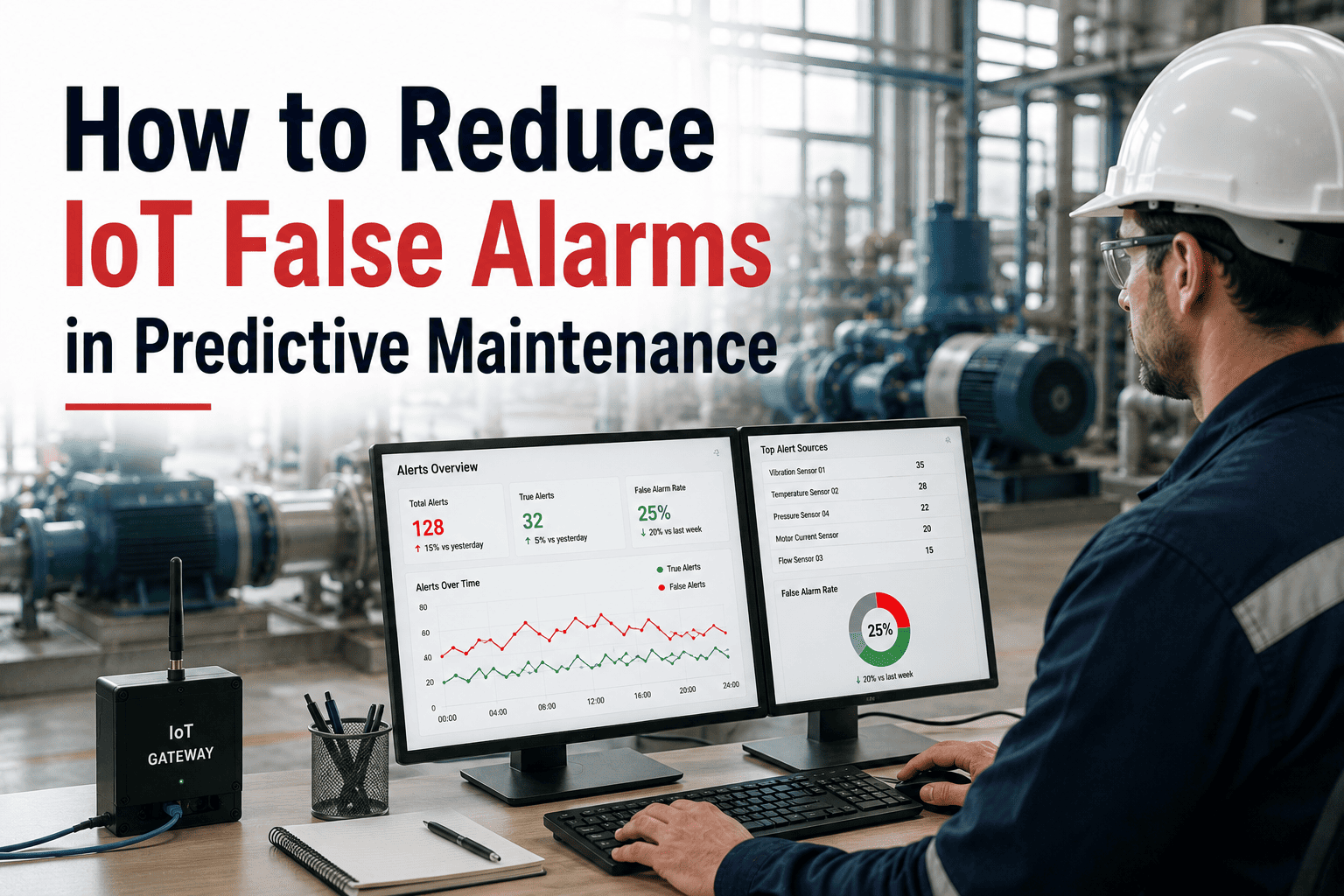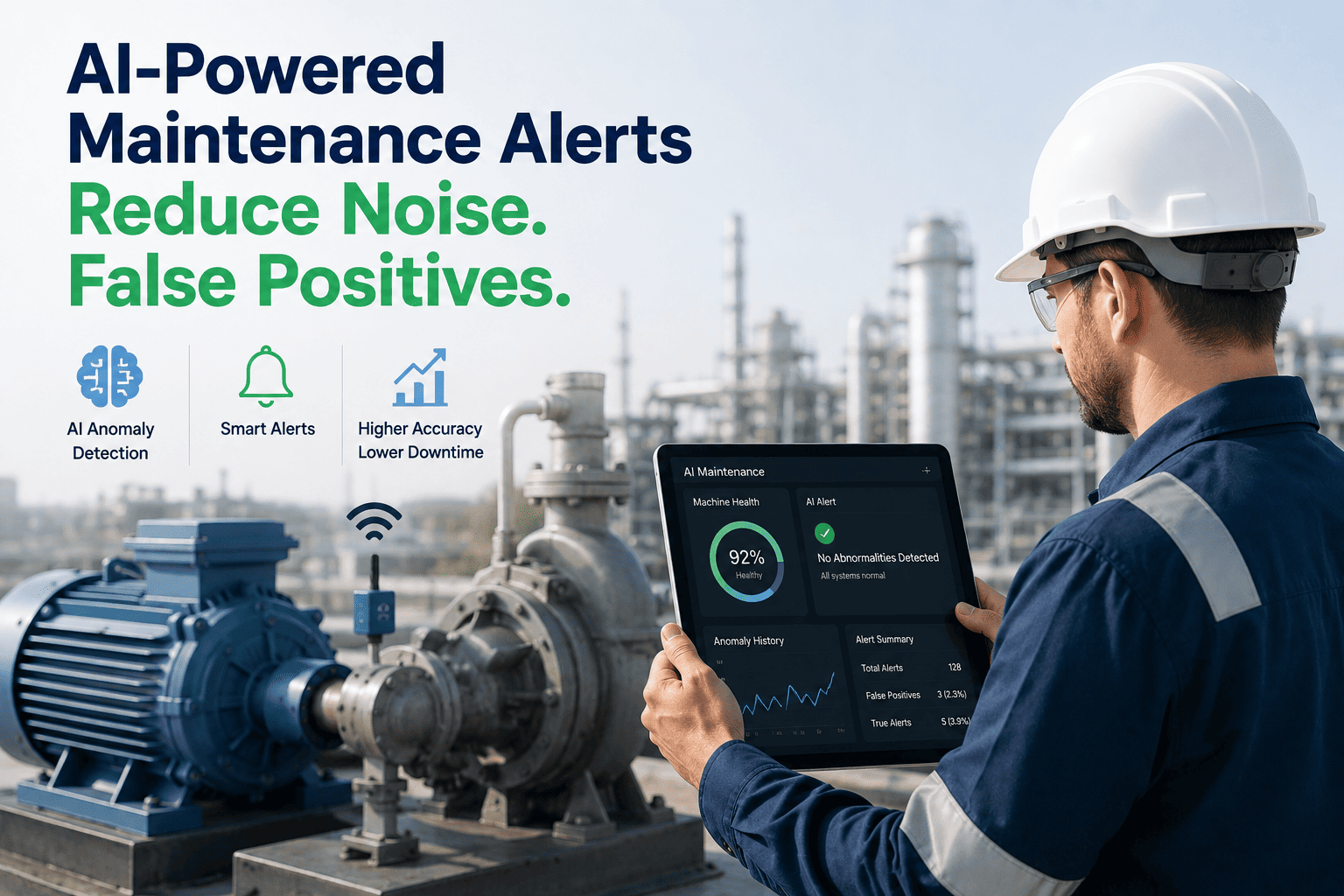
AI-powered maintenance alerts are only valuable when technicians trust them — and trust collapses fast when false positives flood the queue. Studies show that maintenance teams experiencing more than 20% false alert rates begin ignoring notifications within 30 days, effectively turning an expensive AI monitoring investment into a dashboard nobody watches. Reducing false positives and alert fatigue is not a tuning problem. It is an architecture problem, and solving it requires AI that understands asset context, not just threshold breaches.
See how Oxmaint's AI alert engine filters noise, learns asset baselines, and delivers only the alerts that need action — in 30 minutes.
- 94% prediction accuracy — signal without the noise
- Context-aware alerts — asset age, load, history factored in
- Auto-generated work orders from confirmed anomalies only
Trusted by 1,000+ maintenance teams across 9+ industries · Live in days, not months
AI-powered maintenance alerts: how to cut false positives and stop alert fatigue
AI maintenance alert fatigue occurs when the volume of low-quality or false notifications overwhelms a maintenance team's ability to triage them meaningfully. Technicians begin applying a mental filter — ignoring alerts from specific assets, dismissing alerts below a certain severity, or muting notification channels entirely. The result is the worst of both worlds: the AI monitoring system is running, but its outputs are no longer driving action.
False positives in maintenance alert systems have three primary causes. The first is static threshold alerting — systems that fire an alarm whenever a reading crosses a fixed value, regardless of whether that value is unusual for that specific asset under its current operating conditions. The second is insufficient baseline learning — alerts triggered before the AI has established what normal looks like for each asset. The third is no alert prioritization — every anomaly treated with equal urgency regardless of its actual failure risk. Oxmaint's AI automation layer addresses all three through dynamic baselines, context-weighted scoring, and intelligent work order routing.
The measurable outcome of well-designed AI alerting is a predictive maintenance program where every alert that reaches a technician represents a genuine anomaly, the anomaly is ranked by actual failure risk, and a work order is auto-generated with the right priority and the right technician assignment — without any manual triage in between.
8 mechanisms behind intelligent maintenance alert filtering
Rather than alerting when a value crosses a fixed threshold, AI establishes a rolling baseline for each individual asset under its actual operating conditions. An alert fires when a reading deviates from that asset's own normal — not from a generic fleet-wide limit.
Vibration readings during startup, ramp-down, or high-load cycles look different from steady-state operation. Context-aware AI suppresses transient anomalies that are expected under known operating states, so technicians only see readings that are genuinely abnormal for the conditions present.
A single sensor spike is often noise. When vibration, temperature, and current draw all shift simultaneously in a correlated pattern, the probability of a real fault rises sharply. Multi-sensor correlation dramatically reduces false positives by requiring evidence across data streams before firing an alert.
Genuine fault signatures persist and progress. Noise spikes are transient. Requiring an anomaly to appear across multiple consecutive readings before triggering an alert eliminates the majority of single-sample noise events without meaningfully delaying detection of real failures.
AI trained on known failure mode signatures — bearing defect frequencies, cavitation patterns, imbalance harmonics — can distinguish a signal that matches a real failure mode from one that is simply an elevated reading. Pattern matching elevates detection precision beyond pure amplitude comparison.
Not every anomaly requires the same response urgency. Criticality scoring weights alerts by asset failure consequence — production impact, safety risk, replacement lead time — so the same anomaly amplitude on a critical asset generates a high-priority work order while the same reading on a non-critical asset generates a scheduled inspection.
When a technician marks an alert as a false positive or adds a close-out note, that feedback re-trains the AI model for that asset. Systems that learn from technician actions progressively reduce false positive rates over 60–90 days of deployment as the model refines its asset-specific understanding.
A single fault can trigger alerts from multiple sensors or multiple analysis methods simultaneously. Without deduplication, one real fault becomes five separate alerts — each requiring triage. Intelligent systems consolidate related alerts into a single notification with all supporting evidence attached.
4 ways poor alert systems destroy maintenance program ROI
Variable frequency drives, compressors that cycle, and HVAC equipment with seasonal load profiles all operate across a wide range of "normal" readings. A fixed threshold that was calibrated at one operating point will fire false alarms constantly at other points. Teams either raise the threshold until they miss real faults, or drown in alerts they've learned to ignore. Dynamic baseline AI solves this without manual recalibration.
When 80 alerts arrive with the same severity tag, technicians triage by recency rather than impact — which means the critical compressor fault that arrived at 7 AM gets cleared while the non-critical pump alert from 8 AM gets actioned first. AI-prioritized work order routing ensures the highest-consequence alerts always reach the right technician first.
Alert systems that don't learn from technician actions maintain their initial false positive rate indefinitely. The AI doesn't know that the alert it fired for asset P-31 was the 12th consecutive false positive because no one fed that outcome back. Without a technician feedback mechanism, the model never refines — and the fatigue never resolves. Oxmaint's analytics track false positive rate by asset and model version.
An alert that tells a technician "anomaly detected on motor M-07" but doesn't auto-generate a work order, assign it to the right skill set, or confirm parts availability creates a decision burden at every notification. Over high volumes, that burden becomes the bottleneck. Auto-generated, pre-prioritized work orders from confirmed alerts remove the triage step entirely.
4 Oxmaint capabilities that deliver precision alerts, not alert floods
Oxmaint's AI establishes a unique operational baseline for each connected asset by learning its normal vibration, temperature, and current signatures across all operating states. Alerts fire when readings deviate from that asset's own baseline under its current conditions — not from a generic fleet average. False positive rate drops sharply within the first 30–60 days of deployment as baselines mature. Predictive maintenance details.
Single-sensor spikes don't generate alerts. Oxmaint requires correlated anomaly evidence across multiple data streams — vibration amplitude, thermal shift, and current draw moving together in a pattern consistent with a known failure mode — before a notification is triggered. This single mechanism eliminates the majority of false positives in sensor-dense environments. AI and automation capabilities.
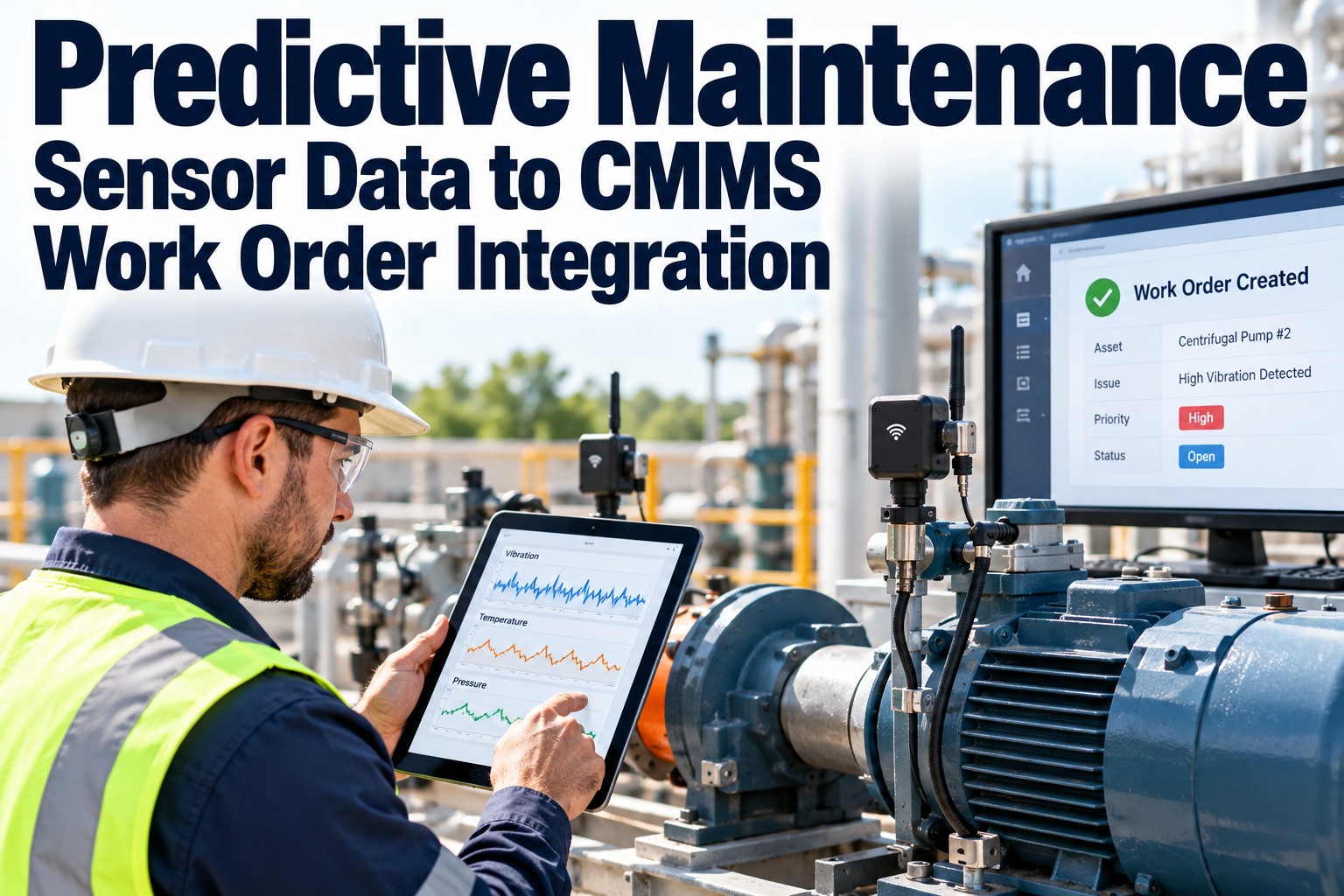
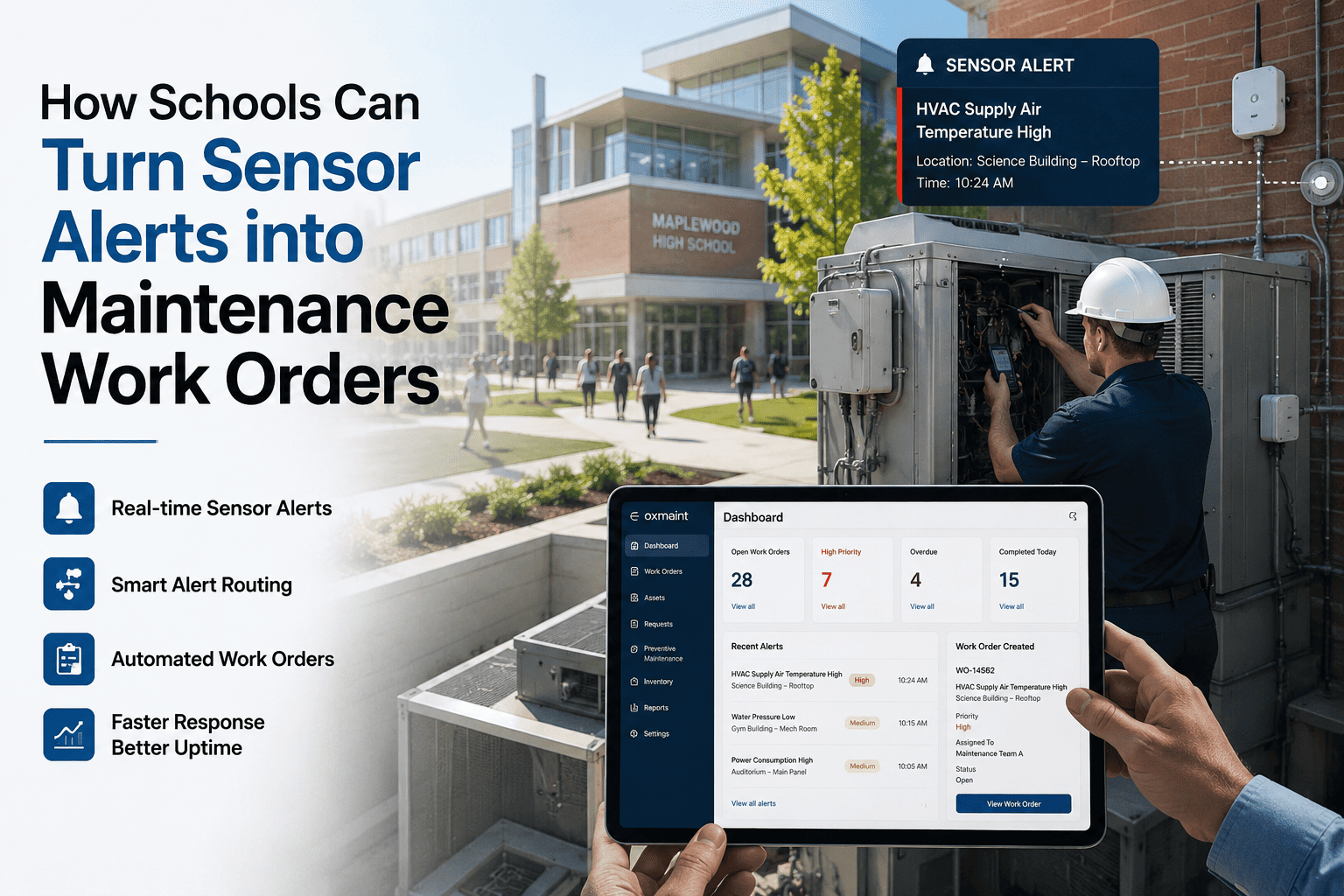
When a confirmed anomaly passes Oxmaint's alert threshold, it doesn't generate a notification that waits for a human to decide what to do. It auto-generates a work order scored by asset criticality and failure risk, routes it to the nearest certified technician, and flags it in the dashboard with all supporting sensor evidence attached. The technician sees one action item, not one raw alert. Smart work order routing.
When a sensor alert fires on an asset, Oxmaint's NVIDIA-powered AI Vision cameras can immediately validate whether a visible anomaly exists — thermal hotspot, surface corrosion, seal leak — without sending a technician on a walkdown to confirm. Visual validation before work order escalation is a direct false positive suppression mechanism. AI Vision Camera details.
Static threshold alerting vs AI-powered intelligent alerts
| Alert characteristic | Static Threshold System | Oxmaint AI Alert Engine |
|---|---|---|
| Alert trigger | Fixed value crossed, regardless of context | Deviation from asset-specific dynamic baseline |
| Operating context | Not considered — same threshold at all loads | Context-weighted — startup, load, cycle state factored |
| Multi-sensor correlation | Single sensor fires independently | Correlated evidence required across data streams |
| False positive rate | Typically 40–60% in variable-load environments | Progressively drops to under 10% within 60 days |
| Alert priority | All alerts equal severity by default | Criticality-scored, highest consequence first |
| Action path | Notification only — manual triage required | Auto work order, assigned, prioritized, parts checked |
| Feedback loop | No — model stays static | Technician close-out re-trains the model per asset |
| Alert deduplication | Same fault generates multiple alerts | Consolidated into single notification with all evidence |
What precision AI alerting delivers in practice
Teams that replace static-threshold alerting with AI-driven precision alerts recover the platform cost within the first prevented failure event — calculate your alert ROI, or book a demo and we'll show you the false positive rate reduction timeline for your asset mix.
Common questions about AI maintenance alerts and false positive reduction
What causes false positive alerts in AI maintenance monitoring systems?
How long does it take for AI alert systems to reduce false positive rates?
What is the difference between an alert and a work order in AI maintenance systems?
How do you measure alert quality in a predictive maintenance program?
94% Accurate AI Alerts. Auto-Generated Work Orders. Zero Manual Triage.
Alert fatigue is a solvable problem — but not with more dashboards or more thresholds. Oxmaint's AI learns each asset's individual baseline, requires multi-sensor correlation before alerting, scores every anomaly by real failure risk, and converts confirmed alerts into prioritized work orders automatically. Your technicians act on the alerts that matter. They stop hearing about the ones that don't.
- Dynamic per-asset baselines — false positive rate under 10% within 60 days
- Multi-sensor correlation — noise filtered before it reaches the team
- Auto work orders from confirmed alerts — no manual triage required
Trusted by 1,000+ maintenance teams running AI-powered predictive monitoring · Live in days, not months