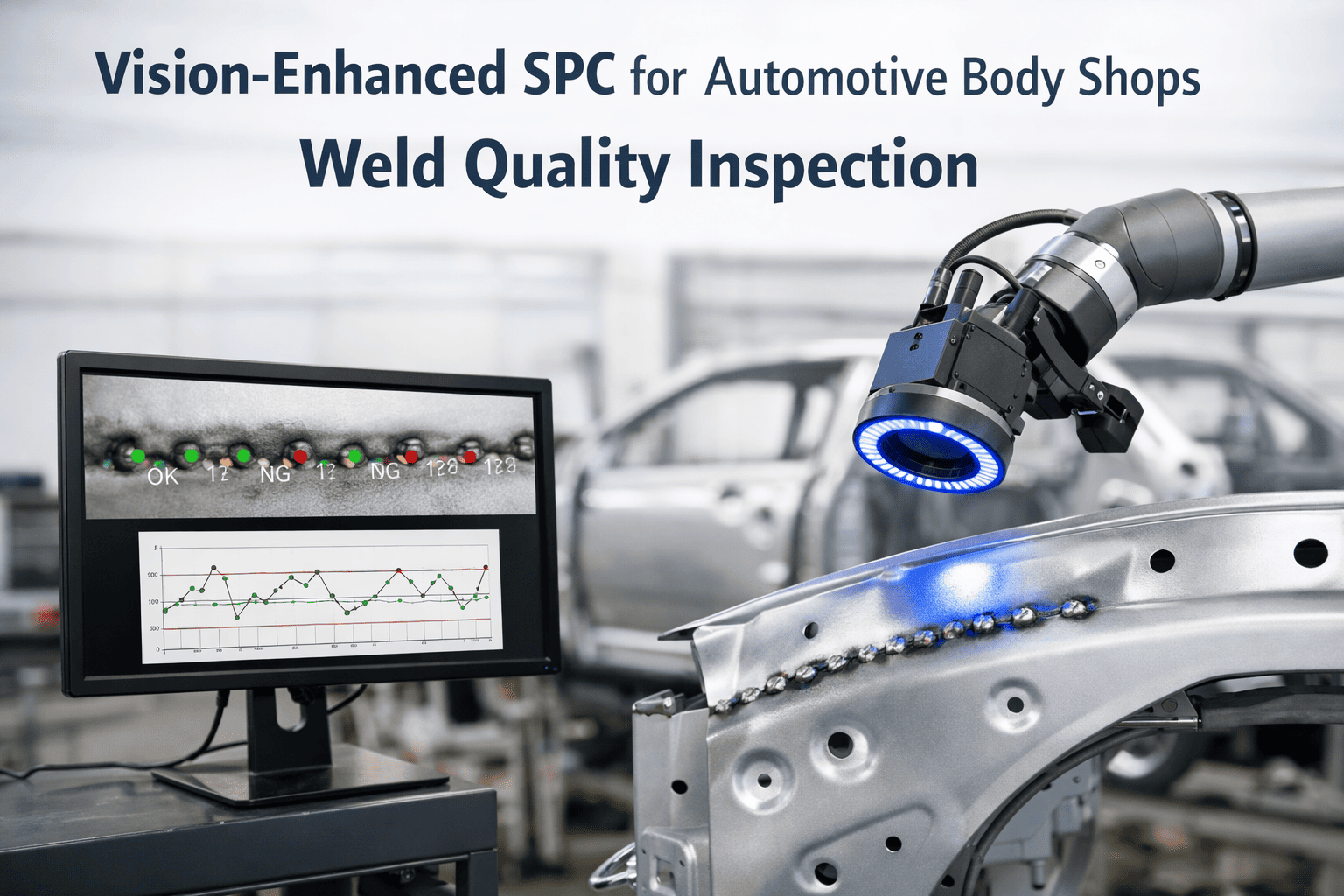
A modern automotive body shop produces 3,000 to 5,000 welds per vehicle—spot welds, MIG seams, laser joints, and brazed connections—each one a potential point of structural failure if quality drifts unnoticed. Traditional inspection catches only a fraction through manual sampling and destructive teardowns, while most welds pass through on process assumptions alone. Vision-enhanced SPC changes this by pairing AI camera systems with real-time statistical process control—and when that SPC data flows directly into a CMMS like Oxmaint, every out-of-tolerance trend automatically triggers the right maintenance work order, asset inspection, or equipment calibration before a single defective body leaves the line. Schedule a consultation to see how Oxmaint connects vision SPC to your body shop maintenance workflows.
Why Weld Quality in Body Shops Demands More Than Manual Inspection
Body-in-white welding is the most quality-critical stage in vehicle manufacturing. Resistance spot welding joins sheet metal panels at hundreds of points per body, MIG/MAG seams seal structural members, and laser welding bonds high-strength steel assemblies at production speed. When a welding robot's electrode cap wears down, gas flow drops, or a fixture loosens by fractions of a millimeter, defect rates climb—but traditional sampling inspects only 1-5% of joints, so the problem often goes undetected until dozens of bodies have already moved downstream.
3,000–5,000
Welds per vehicle body that must meet OEM crash safety and structural tolerances
<200ms
Vision SPC inspection time per weld—AI classification at full line speed
57%
Documented reduction in weld non-pass rates with vision SPC deployments
Turn Every Out-of-Tolerance Weld Into an Automatic Corrective Action
Oxmaint connects vision-based SPC inspection directly to work order management, asset tracking, and preventive maintenance scheduling—so your body shop acts on quality data instantly, not days later.
How Vision SPC and CMMS Work Together in the Body Shop
Vision-enhanced SPC is not just about detecting weld defects—it is about connecting inspection intelligence to the maintenance actions that prevent them. When cameras and AI models identify a trending problem, the real value comes from what happens next: the right work order, assigned to the right technician, with the right diagnostic context, triggered automatically through Oxmaint.
01
Vision Systems Capture Every Weld
Robot-mounted cameras and 3D laser sensors inspect 100% of welds at line speed—measuring nugget diameter for spot welds, bead geometry for seams, keyhole stability for laser joints, and gap/flush for panel fit. Every measurement is tagged with station ID, robot cell, timestamp, and shift data.
02
SPC Charts Monitor Process Health in Real Time
X-bar and R charts, Cpk calculations, and Western Electric rules continuously analyze weld measurements across every station. The system detects drift patterns—six ascending points, two beyond 2-sigma—before control limits are actually breached, giving your team time to act proactively.
03
Oxmaint Receives SPC Alerts and Triggers Work Orders
When SPC flags a trend—electrode wear on Station 12, gas flow drop on Robot Cell B, fixture drift on the underbody line—Oxmaint automatically generates a prioritized work order with full context: which asset, what measurement drifted, how far from tolerance, and recommended corrective action. No manual reporting. No delays.
04
Technicians Execute with Full Context on Mobile
Maintenance technicians receive assignments on the Oxmaint mobile app with attached SPC charts, photos from the vision system, and step-by-step procedures. They log parts consumed, labor hours, and completion status—building a maintenance history that feeds back into future SPC analysis.
05
Preventive Maintenance Schedules Adapt to Real Data
Oxmaint uses SPC trend data to optimize PM schedules—adjusting electrode tip dressing intervals, camera calibration frequency, and fixture inspection cycles based on actual wear rates instead of fixed time intervals. This condition-based approach reduces unnecessary maintenance while preventing quality escapes.
Weld Defects Vision SPC Detects and the Maintenance Actions They Trigger
Each type of weld defect maps to a specific equipment issue that Oxmaint can track, schedule, and resolve. The connection between what the camera sees and what the maintenance team does is what makes vision-enhanced SPC actionable rather than just informational.
Defect-to-Action Mapping in Oxmaint
Weld Defect Detected
Root Equipment Cause
Oxmaint Action Triggered
Undersized Spot Weld Nuggets
Electrode cap wear, welding force decay, current drift
Auto work order for tip dressing or cap replacement; PM schedule adjusted based on wear curve
Porosity in MIG Seams
Shielding gas flow degradation, nozzle contamination, surface oil
Gas system inspection work order; nozzle cleaning task assigned; surface prep checklist triggered
Excessive Spatter
Contact tip erosion, wire feed speed drift, voltage mismatch
Consumable replacement order generated; wire feeder calibration PM moved forward
Undercut Along Seam Welds
Travel speed too high, incorrect torch angle, parameter drift
Robot TCP verification work order; welding parameter audit assigned to process engineer
Panel Gap Out of Tolerance
Fixture wear, clamping force loss, stamping die drift
Fixture calibration work order; die maintenance escalated; clamping system PM triggered
Incomplete Fusion / Cold Welds
Power supply degradation, joint preparation failure
Power supply diagnostic work order; upstream cleaning station inspection scheduled
Every work order includes the SPC chart that triggered it, photos from the vision system, and the asset's complete maintenance history from Oxmaint—so technicians arrive with full context.
See how SPC alerts become work orders automatically. Book a demo and we will walk through the full defect-to-action workflow in Oxmaint for your body shop equipment.
Different welding processes produce different measurable characteristics. Oxmaint tracks each as a monitored asset parameter, linking the right SPC chart type to the right equipment maintenance triggers.
Consumable tracking, gas system PM, tip replacement
Laser Welding
Seam width, keyhole stability, surface roughness
EWMA
Optic cleaning schedule, power supply diagnostics
Brazing
Fillet geometry, wetting angle, continuity
Individual-MR
Wire feed calibration, temperature controller PM
Panel Fit
Gap width, flush offset, datum alignment
Multivariate T-squared
Fixture PM, die maintenance, clamp force checks
Manual Inspection vs. Vision SPC with Oxmaint CMMS
The shift from manual sampling to vision-enhanced SPC integrated with Oxmaint transforms body shop quality from a periodic audit into a continuous, self-correcting system.
Manual Sampling
1-5% of welds inspected per body
Destructive teardown tests for spot welds
Defects found hours or shifts after occurrence
Maintenance orders written manually, often delayed
No link between quality data and PM schedules
8-15%defect escape rate downstream
Vision SPC + Oxmaint
100% of welds inspected at line speed
Non-destructive AI classification in <200ms
Drift detected and alerted within seconds
Work orders auto-generated with full SPC context
PM schedules adapt to actual equipment wear data
<0.5%escape rate with closed-loop control
Close the Loop Between Weld Quality and Maintenance
Oxmaint is the CMMS that turns SPC data into action—auto-generating work orders, tracking asset health, and adapting PM schedules based on real weld inspection data from your body shop floor.
When vision SPC feeds directly into Oxmaint's work order and asset management system, the measurable impact extends beyond defect reduction into maintenance efficiency, equipment uptime, and total cost of quality.
57%
Reduction in weld non-pass rates
90%
Faster defect-to-action response time
70%
Less rework labor through early intervention
45%
Fewer warranty claims from weld failures
Calculate your savings potential. Create a free Oxmaint account and our team will model the ROI of connecting vision SPC to your maintenance operations.
Getting Started: Pilot to Full Body Shop Deployment
Oxmaint supports a phased rollout—starting with a single welding cell to validate the SPC-to-CMMS workflow, then scaling across the entire body shop as the system proves its value.
Weeks 1-3
Audit and Setup
Weld map review and critical asset identificationSPC parameters defined with quality engineeringOxmaint asset hierarchy configured for body shop equipment
Weeks 4-6
Pilot Cell
Vision hardware installed on pilot welding stationSPC alert rules connected to sign up in Oxmaint work order systemAI models trained on your site-specific weld images
Weeks 7-9
Validation
Detection accuracy verified against teardown auditWork order auto-generation tested and refinedTechnician training on Oxmaint mobile app workflows
Week 10+
Full Rollout
Scale to all welding stations and robot cellsPM schedules adapted to SPC-driven wear dataContinuous improvement through Oxmaint analytics
The gap in most body shops is not detecting defects—it is connecting that detection to the maintenance action that prevents them from recurring. When your SPC system talks directly to your CMMS, every quality signal becomes a corrective workflow instead of a report sitting in someone's inbox.
— Automotive Body Shop Quality Engineering Lead
Connect Weld Inspection to Maintenance Action with Oxmaint
Your vision SPC system sees every defect. Oxmaint makes sure every defect gets fixed—auto-generating work orders, tracking equipment health, scheduling preventive maintenance based on actual wear data, and giving your technicians full context on mobile. Stop letting quality data sit in dashboards. Start turning it into action.
How does Oxmaint receive data from vision SPC systems?
Oxmaint integrates with vision SPC platforms through its API and IoT connectivity layer. When an SPC alert fires—whether from a control limit breach, a Cpk drop, or a trending pattern—Oxmaint receives the alert data, maps it to the relevant asset in your equipment hierarchy, and automatically generates a work order with the SPC context attached. Schedule a consultation to discuss integration with your specific vision system.
Can Oxmaint adjust preventive maintenance schedules based on SPC data?
Yes. Oxmaint supports condition-based maintenance triggers alongside time-based and meter-based scheduling. When SPC data shows an electrode wearing faster than expected or a fixture drifting sooner than its PM interval, Oxmaint automatically moves the next maintenance task forward. This keeps your PM program aligned with actual equipment condition rather than fixed assumptions.
Does this work for all weld types in a body shop?
Yes. Vision SPC systems handle spot welds, MIG/MAG seams, laser welds, and brazed joints with separate AI models for each. Oxmaint tracks each welding station and robot as a managed asset, so the defect-to-maintenance mapping works across all weld processes in your body shop. Sign up for Oxmaint to see how asset hierarchy maps to your body shop layout.
What if we do not have a vision SPC system yet?
Oxmaint works independently as a full CMMS for body shop maintenance—managing work orders, asset tracking, PM scheduling, and spare parts inventory regardless of your inspection technology. As you add vision SPC capabilities, Oxmaint is ready to integrate and close the loop between quality detection and maintenance action.
How quickly can we see results?
Most body shops see measurable improvement within the first 30 days of connecting SPC alerts to Oxmaint work orders. The immediate wins come from faster response to equipment drift—catching problems in minutes instead of hours or shifts. Long-term gains compound as Oxmaint's analytics optimize PM intervals based on accumulated SPC trend data. Book a demo to discuss expected timelines for your operation.
By oxmaint
✨
Experience Oxmaint's Power
Take a personalized tour with our product expert to see how OXmaint can help you streamline your maintenance operations and minimize downtime.