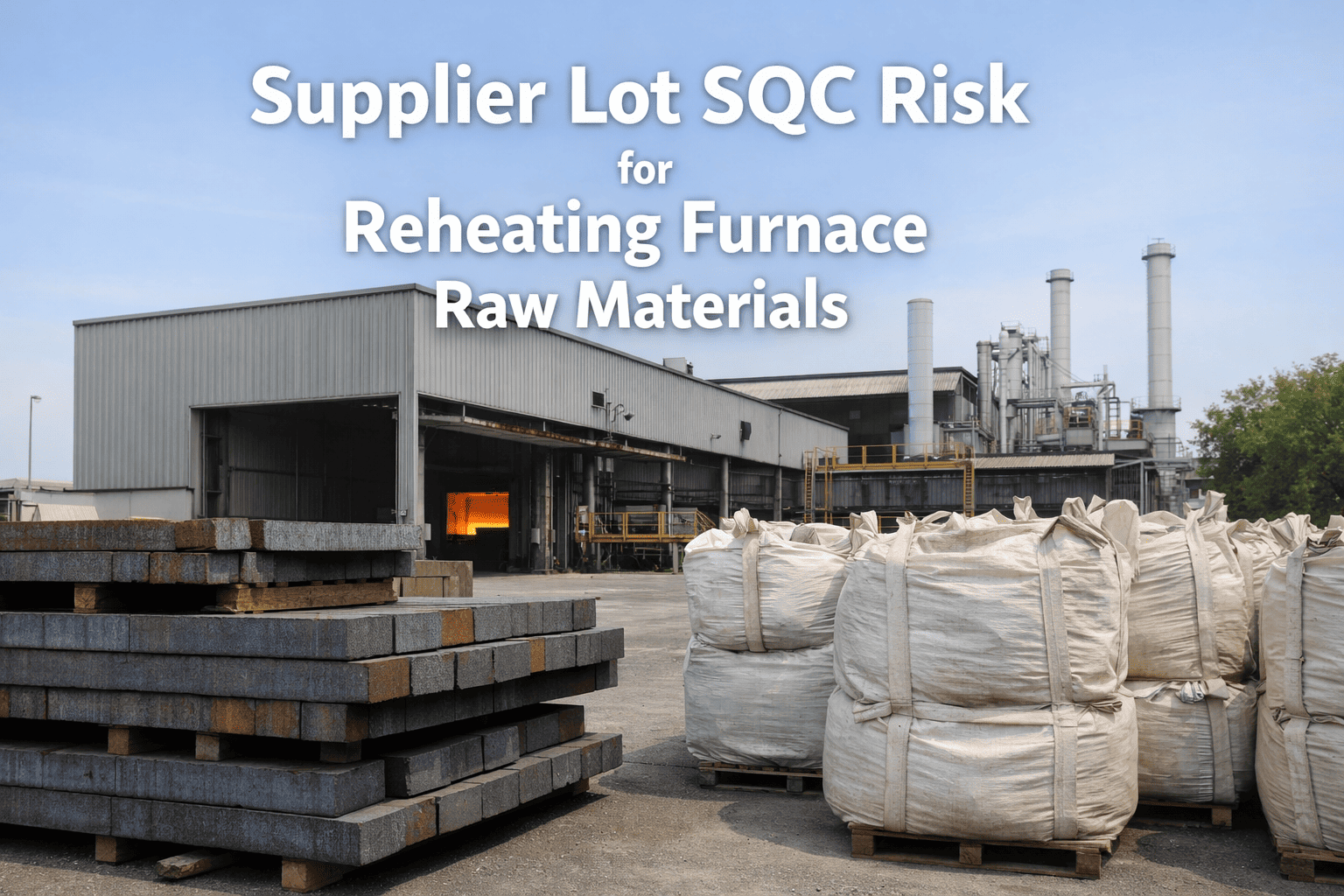
Every steel plant knows the frustration: a seemingly normal batch of billets enters the reheating furnace, only to produce excessive scale, uneven heating, or surface cracks that ripple through the entire rolling line. The root cause often traces back to unchecked variability in incoming raw materials—chemical composition shifts, dimensional inconsistencies, or surface defects that slipped past a basic mill certificate review. Supplier Lot Statistical Quality Control (SQC) risk scoring changes this equation entirely, using control charts, capability indices, and acceptance sampling to catch problematic lots before they ever reach your furnace hearth. Schedule a consultation to explore how Oxmaint helps steel plants build automated SQC risk gates for incoming furnace materials.
The Hidden Price of Ignoring Incoming Material Variability
Reheating furnaces operate in a narrow window—typically between 1,100 C and 1,280 C—where even small deviations in billet chemistry or geometry create outsized consequences. Most steel plants discover these problems after the damage is done: rejected product, worn refractory, wasted energy, and lost production hours. SQC risk scoring shifts the point of detection upstream, where the cost of intervention is a fraction of the cost of failure.
67%
of rolling mill surface defects
are traceable to raw material quality issues that entered the furnace without statistical screening
3-8%yield loss from scale and decarburization tied to inconsistent billet chemistry
12-18 hrsaverage monthly unplanned furnace downtime caused by off-spec material lots
$1.2M+annual savings achievable with automated incoming lot risk scoring
Tired of chasing furnace quality problems that start at the receiving dock? Oxmaint's CMMS connects incoming material data to furnace outcomes—giving your quality team the statistical tools to stop defects before they start.
From Receiving Dock to Furnace Gate: The SQC Risk Workflow
Traditional incoming inspection checks a mill certificate and maybe pulls a random sample. SQC risk scoring replaces guesswork with a structured, statistically grounded workflow that evaluates every lot against your furnace's actual performance baselines—not just the supplier's declared spec range.
Step 01
Capture Lot Data at Receiving
Record supplier heat analysis (C, Mn, Si, P, S, Cr, Ni, Cu, Sn), billet dimensions, weight, and visual surface condition. Digital data capture eliminates transcription errors and feeds directly into statistical models.
Step 02
Plot Against Control Chart Baselines
Each critical parameter is plotted on X-bar and R-charts built from historical lot data. The system instantly flags lots that fall outside upper/lower control limits or show trend patterns indicating supplier process drift.
Step 03
Calculate Composite Risk Score
A weighted algorithm combines chemical deviation severity, dimensional Cpk values, supplier trend data, and furnace-specific sensitivity factors into a single risk grade: Green (proceed), Yellow (conditional), or Red (hold).
Step 04
Automated Disposition and CMMS Integration
Green lots queue for furnace charging. Yellow lots trigger additional sampling or furnace recipe adjustments. Red lots generate hold notices, supplier NCRs, and corrective action requests—all tracked in your Oxmaint CMMS - sign up with us with full audit trails.
What Your SQC Program Should Measure and Why
Not every incoming material parameter carries the same weight for reheating furnace performance. A well-designed SQC program focuses inspection and charting resources on the parameters that most directly impact heating uniformity, scale formation, refractory longevity, and downstream product quality.
Carbon Content (C%)
SQC MethodX-bar and R-chart per heat
Furnace EffectControls decarburization rate and required soak time
Out-of-Spec RiskSurface softness, inconsistent mechanical properties after rolling
Sulfur and Phosphorus (S%, P%)
SQC MethodIndividual value chart with spec limits
Furnace EffectHot shortness and grain boundary embrittlement at furnace temperatures
Out-of-Spec RiskCracking during rolling, full lot rejection
Billet Cross-Section Uniformity
SQC MethodHistogram plus Cpk capability analysis
Furnace EffectDetermines heating uniformity and skid mark severity
Out-of-Spec RiskCold spots, cobbles, uneven deformation in rolling
Out-of-Spec RiskEnergy waste, irregular furnace loading, reduced tons per hour
Not sure which parameters matter most for your steel grades? Our team will help you design a tailored SQC parameter matrix matched to your specific reheating furnace profile and product requirements.
Manual Certificate Checks vs. Statistical Risk Scoring
Most steel plants still rely on reviewing supplier mill certificates and occasional spot sampling—an approach that catches only the most obvious violations while missing the subtle statistical patterns that signal growing supplier quality problems and future furnace issues.
Without SQC Risk Scoring
Mill certificates reviewed but not trended over time
Random sampling with no statistical validity
Quality problems discovered after furnace processing
No correlation between lot data and furnace outcomes
Paper records that are difficult to audit or analyze
5-12%
of at-risk lots reach the furnace undetected
With SQC Risk Scoring
Every lot plotted on control charts with automatic alerts
Statistically valid sampling plans matched to AQL levels
Risk detected and acted on before furnace charging
Furnace performance directly linked to supplier lot data
Digital audit trail with automated CAPA workflows
Under 1%
of at-risk lots reach the furnace undetected
The SQC Toolkit That Protects Your Furnace
Effective supplier lot evaluation requires multiple SQC methods working together—each tool addressing a different dimension of quality risk. Here is the essential toolkit for reheating furnace raw material control.
X-bar and R Control Charts
Monitor lot-to-lot variation in chemical composition, dimensions, and weight. Detect supplier process drift—shifts, trends, runs—weeks before out-of-spec lots arrive, giving your procurement team time to intervene.
Process Capability Index (Cpk)
Quantify each supplier's ability to consistently deliver material within your furnace-specific specification limits. A Cpk below 1.33 signals that the supplier's process variability is too wide—even if individual lots appear acceptable.
Pareto Analysis for Root Cause Focus
Pinpoint which suppliers and which specific quality parameters are responsible for the majority of furnace-related incidents. Concentrate corrective actions where they deliver the greatest cost and quality impact.
Scatter Correlation Analysis
Map relationships between incoming material properties (carbon %, residual copper, billet geometry) and downstream furnace metrics (scale loss %, heating time, energy consumption per ton) to quantify the true cost of material variation.
Acceptance Sampling Plans
Define statistically valid sample sizes and accept/reject criteria for each lot size and steel grade, based on AQL levels calibrated to your reheating furnace sensitivity and final product grade requirements.
Connect SQC Data to Maintenance Workflows Automatically
When a lot fails risk scoring, Oxmaint can auto-generate inspection work orders, furnace parameter adjustments, supplier NCRs, and preventive maintenance tasks for refractory checks—all from a single platform.
Risk Classification: Matching Actions to Lot Quality Levels
Not every supplier lot carries the same threat to your furnace. A tiered risk classification framework ensures that inspection effort, charging decisions, and supplier management intensity scale with actual statistical risk—so your team spends time where it matters most.
LOW RISKGreen — Direct to Furnace
SQC CriteriaAll parameters within control limits, Cpk 1.33 or above, no trend violations
ActionLot proceeds to charging queue. Routine monitoring and annual supplier audit.
MODERATE RISKYellow — Conditional Accept
SQC Criteria1-2 parameters near control limits or showing trend/run patterns
ActionPull additional samples, adjust furnace recipe if charged. Supplier placed on watch list.
HIGH RISKOrange — Hold for Re-inspection
SQC CriteriaParameters outside control limits, Cpk below 1.0, or multiple warning signals
ActionFull lot re-inspection, segregated storage. Formal NCR and corrective action issued to supplier.
CRITICAL RISKRed — Reject and Return
SQC CriteriaMultiple spec violations, confirmed potential for furnace damage or safety risk
ActionLot rejected and returned. Supplier suspended pending root cause analysis and CAPA review.
Ready to move beyond pass/fail inspections?Sign up for Oxmaint and implement automated risk classification that scales inspection intensity with actual statistical evidence—protecting your furnace while optimizing your quality team's time.
Measurable Returns from SQC-Based Material Control
Implementing statistical quality control on incoming supplier lots delivers returns that compound across furnace operations, product quality, and supplier management. Here is what steel plants report after deploying structured SQC risk scoring.
70%
Fewer furnace-related quality rejections
50%
Less unplanned furnace downtime from material issues
40%
Faster incoming inspection turnaround
30%
Improvement in supplier on-spec delivery rates
Getting Started: A Practical Deployment Path
You do not need to overhaul your entire quality system overnight. A phased SQC deployment builds statistical baselines first, validates against furnace outcomes, and then progressively automates risk scoring and supplier management workflows.
Phase 1Week 1-2
Define and Baseline
Select critical SQC parameters per steel grade and furnace typeImport 6-12 months of historical lot data and supplier recordsEstablish initial control chart limits and Cpk thresholds
Phase 2Week 3-4
Pilot and Validate
Run SQC scoring on live incoming lots in parallel with existing processCross-reference risk scores against actual furnace performance dataRefine risk weightings and alert thresholds based on real outcomes
Phase 3Week 5-6
Automate and Integrate
Connect SQC outputs to CMMS work orders and supplier NCR workflowsEnable automated lot disposition and furnace recipe adjustmentsLaunch supplier scorecards with statistical performance data
Phase 4Week 7+
Scale and Optimize
Expand coverage to additional grades, furnaces, and product linesCorrelate incoming lot SQC data with rolling mill and finishing outcomesContinuously refine statistical models as data accumulates
Want a deployment plan tailored to your plant?Schedule a free assessment and our steel industry specialists will map the optimal SQC rollout for your specific furnace operations and supplier base.
Defend Your Reheating Furnace with Statistical Evidence, Not Guesswork
Every billet that enters your furnace carries a quality risk you can either measure or ignore. Oxmaint gives your quality team the SQC tools to score that risk automatically—connecting supplier lot data, incoming inspection results, and furnace performance into a unified CMMS platform that prevents defects, reduces downtime, and holds suppliers accountable with data they cannot dispute.
What is supplier lot SQC risk scoring for reheating furnaces?
It is a systematic approach that applies statistical quality control methods—control charts, process capability indices (Cpk), and acceptance sampling—to evaluate every incoming raw material lot before it enters the reheating furnace. Each lot receives a composite risk grade based on chemical composition, dimensional consistency, surface quality, and the supplier's historical quality trend. This prevents off-spec material from causing furnace damage, excessive scale loss, or downstream rolling defects. Sign up for Oxmaint to start automating SQC risk scoring at your plant.
Which quality parameters are most critical for reheating furnace inputs?
The highest-priority parameters include carbon content (controls decarburization rate), sulfur and phosphorus (cause hot shortness and cracking), billet cross-section uniformity (affects heating evenness), surface condition (impacts scale formation), and residual elements like copper and tin (cause surface hot shortness at furnace temperatures). The relative weighting depends on your specific steel grades, furnace operating profile, and downstream product requirements.
How does SQC risk scoring connect with our CMMS and maintenance workflows?
When a lot receives a high-risk classification, the system can automatically generate inspection work orders, furnace parameter adjustment tasks, or preventive maintenance checks on refractory linings. Supplier NCRs and corrective action requests are tracked through the same platform, creating a closed-loop quality-maintenance feedback system. Book a demo to see the integration in action.
How quickly will we see measurable results?
Most steel plants see meaningful improvements within 30-45 days of deployment. Early wins come from identifying lot variability patterns that were previously undetected and correlating them with furnace performance issues that had been attributed to other causes. Within 90 days, accumulated data supports reliable supplier risk scores and predictive quality management decisions.
Can this approach work with multiple suppliers and steel grades simultaneously?
Yes. The system maintains separate statistical baselines for each supplier-grade combination, enabling performance comparison across suppliers delivering the same grade and across grades from the same supplier. This multi-dimensional analysis is essential for data-driven sourcing decisions and targeted supplier development programs.
By oxmaint
✨
Experience Oxmaint's Power
Take a personalized tour with our product expert to see how OXmaint can help you streamline your maintenance operations and minimize downtime.