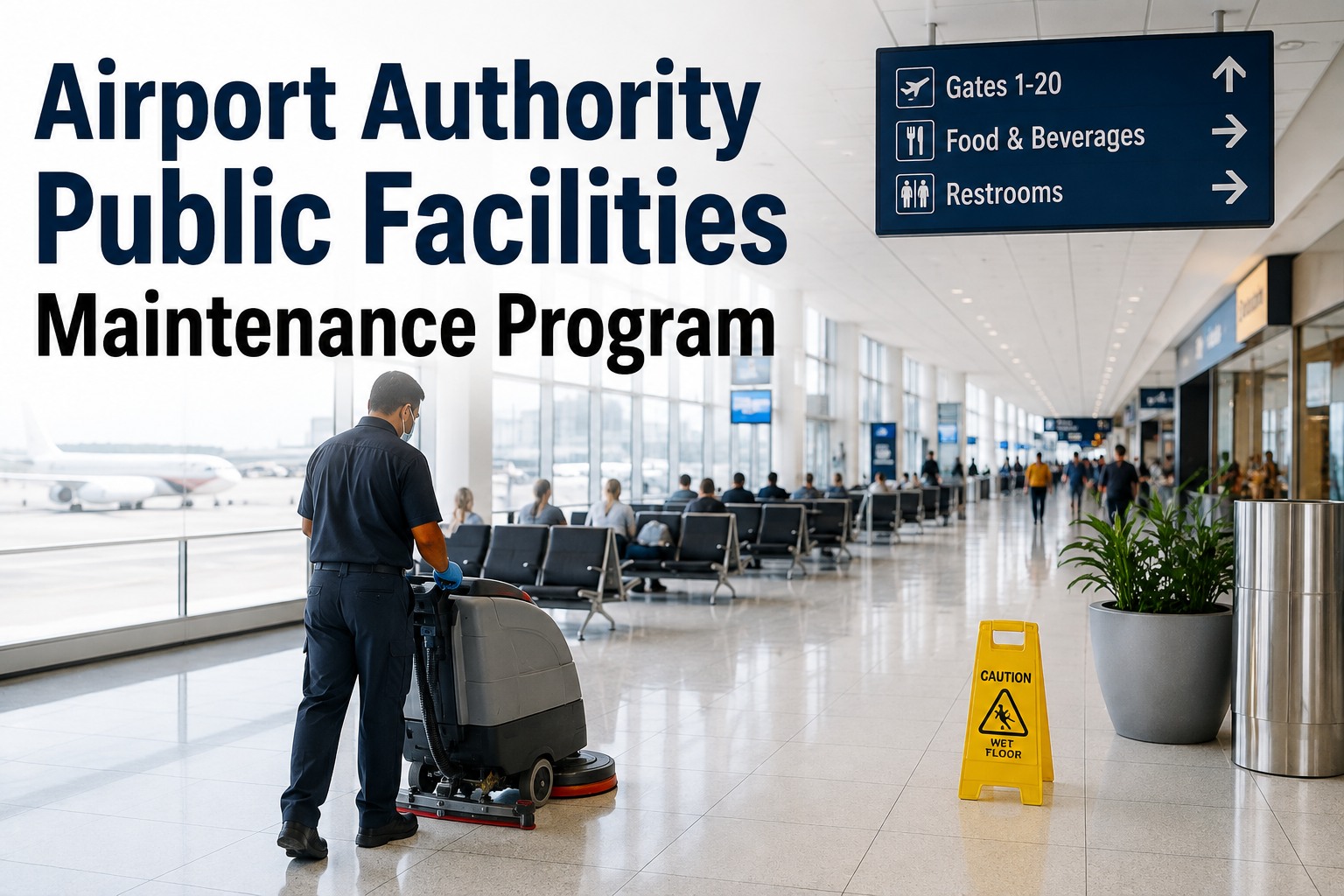
Every maintenance decision in an airport terminal is really a decision about time. The escalator that carried forty thousand people today can only be serviced in the three dark hours before the morning rush. The jet bridge can only be recalibrated while its gate sits empty overnight. Miss that window and the same job that cost nothing at 2 AM costs a delayed departure at 7 AM. This guide is built around the clock that governs everything a terminal maintenance team does — the flight day — and how a CMMS schedules against it instead of fighting it. Start a free Oxmaint trial to schedule terminal PM around your own flight banks, or book a demo to see a full terminal day mapped in the platform.
Aviation · Terminal Facilities · CMMS Guide
Airport Terminal Maintenance, Hour by Hour
Escalators, jet bridges, baggage systems, HVAC, and life-safety equipment never stop — so terminal maintenance has to run on the flight-day clock. Here is how airports schedule every task around the banks that matter, across multiple terminals, from one platform.
The Flight-Day Clock
One Terminal, One Day: When Maintenance Can Actually Happen
A terminal has no closing time — only quieter hours. The dial below maps a typical operating day. The gold arc is the maintenance window; the navy arcs are departure banks where passenger-facing assets are protected from planned work unless it is safety-critical.
- 11 PM – 5 AM · Maintenance trough. The window for escalator PM, FIDS servicing, jet-bridge calibration, and non-critical baggage work. The same task here costs nothing in throughput.
- Morning & evening departure banks. Peak passenger flow. A CMMS blocks planned PM on high-flow assets in these hours — a checkpoint escalator serviced at 7 AM costs about $4,200 an hour in lost concession revenue.
- Shoulder hours. Lower-flow periods usable for zone-limited work, contractor jobs, and inspections that do not close a passenger route.
Read Left to Right
A Maintenance Shift Across the Terminal Day
- 23:00 Trough opens Overnight crew picks up the day's auto-scheduled PM queue on mobile — sorted by zone, no desk trip.
- 01:00 Deep work Escalator step-chains, jet-bridge hydraulics, baggage belt swaps — the jobs that cannot touch a live passenger route.
- 04:30 Sign-off Life-safety tests logged, work orders closed with photos, compliance auto-tagged before first departures.
- 06:00 Bank 1 PM on high-flow assets is frozen. Only safety-critical or reactive dispatch runs. Throughput is protected.
- 14:00 Shoulder Zone-limited jobs and contractor work with badging and escort managed inside the work order.
- 18:00 Bank 2 Evening peak. Predictive alerts queued now are scheduled forward into tonight's trough, not forced live.
This is the core idea a terminal CMMS enforces: the flight schedule decides when work happens, so preventive maintenance protects passenger flow instead of interrupting it. Book a demo to watch a full terminal day auto-scheduled into the overnight troughs.
The Departure Board of Assets
What the Terminal Team Maintains, and What Fails If They Do Not
A major terminal carries thousands of assets. Read this like a departure board — each row is a system, its criticality tier, the signal that warns before it breaks, and the consequence when it does.
| System | Tier | Early Signal | Consequence If It Fails |
|---|---|---|---|
| Jet Bridges | T1 | Hydraulic pressure & docking calibration, monitored continuously | Every flight at the gate delayed; cascading gate shortage |
| Fire & Life Safety | T1 | Per-shift suppression & emergency-lighting tests | Lives at risk; direct NFPA and building-code breach |
| Escalators & Elevators | T2 | Step-chain tension, handrail speed, motor current — 2–4 week lead | 12-min queue extension; 18% drop in retail dwell time |
| Baggage Handling | T2 | Vibration & motor current on belts, diverters, scanners | Mishandled bags; $50–$200 airline compensation per bag |
| Terminal HVAC | T3 | Chiller & air-handler trends; 40–50% of terminal energy | Air-quality & comfort failure; complaints and press |
| Access & Wayfinding | T3 | FIDS display health, accessible-fixture checks | ADA exposure; passenger confusion and missed gates |
T1 safety-critical · T2 operational · T3 facility — maintenance priority follows the tier, not the price tag.
The Same Task, Two Timelines
Timed Right vs Timed Wrong
-
Peak-Aware
- Escalator PM at 2 AM — zero throughput cost
- Baggage belt swapped predictively overnight
- Jet bridge serviced in the gate's empty window
- Compliance auto-tagged; one-click agency report
- Reorder alert fires before the spare runs out
-
Reactive
- Escalator PM at 7 AM — $4,200/hr lost revenue
- Belt fails mid-bank; bags mishandled
- Emergency bridge fix; gate closed, flights held
- Audit scramble through paper binders
- $2K motor becomes a $20K rush order
How One Fault Becomes a Headline
The Cascade a CMMS Interrupts
- 1Overdue taskAn escalator PM or fire-panel test slips past due. No alert, no escalation on paper.
- 2Silent wearSecondary faults logged as separate work orders, each closed, none linked to the pattern.
- 3Peak-hour failureThe asset fails during a departure bank; no crew free, no spare staged. Queues cascade.
- ⚑Broken at step 1Automated PM, cross-asset pattern alerts, and pre-staged spares stop it before a passenger ever sees it.
The ROI Is One Failure Away
One Prevented Gate Delay Pays for a Year of CMMS
A single avoided boarding-bridge or baggage-system failure runs $85K to $340K — more than a year of platform cost. Emergency repairs otherwise run four to eight times the price of planned work, and teams recover 25–35% of their hours by dropping manual scheduling and paper dispatch.
Frequently Asked
Airport Terminal CMMS Questions
How does a CMMS schedule maintenance without disrupting flights?
It reads flight-schedule data to find low-traffic windows and slots preventive work into the overnight trough, roughly 11 PM to 5 AM, or between departure banks. High-flow assets like checkpoint escalators are protected from planned PM during peak hours unless the work is safety-critical. Sign up for Oxmaint to schedule terminal PM around your own flight banks.
Can one platform manage multiple terminals and both landside and airside assets?
Yes. Terminal and airfield assets share one registry, work-order, and compliance system, tagged by location and class. Directors can filter to a single terminal, view the whole portfolio, or focus on one asset class from the same dashboard. Book a demo to see multi-terminal maintenance from one dashboard.
How does predictive maintenance work for baggage systems and jet bridges?
Sensors track vibration, motor current, and hydraulic pressure on critical components. Models compare those signals against failure history to predict when a belt, bearing, or bridge system needs service, then auto-generate a work order timed for an overnight window — catching degradation 30 to 90 days before it reaches passengers.
What is the realistic ROI for a terminal CMMS?
ROI arrives with the first prevented disruption. A single avoided jet-bridge or baggage failure ($85K–$340K) exceeds a year of platform cost, and teams recover 25–35% of their hours from eliminated manual scheduling. Sign up for Oxmaint to model your terminal's maintenance ROI from real asset data.
Time It Right
The Failure That Reaches a Passenger Was Preventable Overnight
Every overdue escalator PM, every unlogged conveyor fault, every missed fire-panel test is a link in the chain that ends in a delayed flight or a compliance finding. Oxmaint gives airport facilities teams one platform to register every terminal asset, schedule PM around live operations, predict failures before they land, and prove compliance in one click.