A driver calls in: the truck is pulling hard to the left and the dash is lit up like a Christmas tree. At the same moment, another vehicle has a cracked mirror and a third is due for a routine service. Your workshop has two technicians free and one tow truck. Who gets help first? Without a clear rule, the loudest caller wins, and the wrong vehicle gets fixed. A fleet repair triage matrix replaces guesswork with a simple scoring system for safety, fault severity, service impact and escalation. This guide gives you a template you can use today, and shows how OXMAINT AI, the AI-powered CMMS for fleet teams, applies it automatically to every breakdown.
Fleet Maintenance · Work Orders & Workshop · Free Template
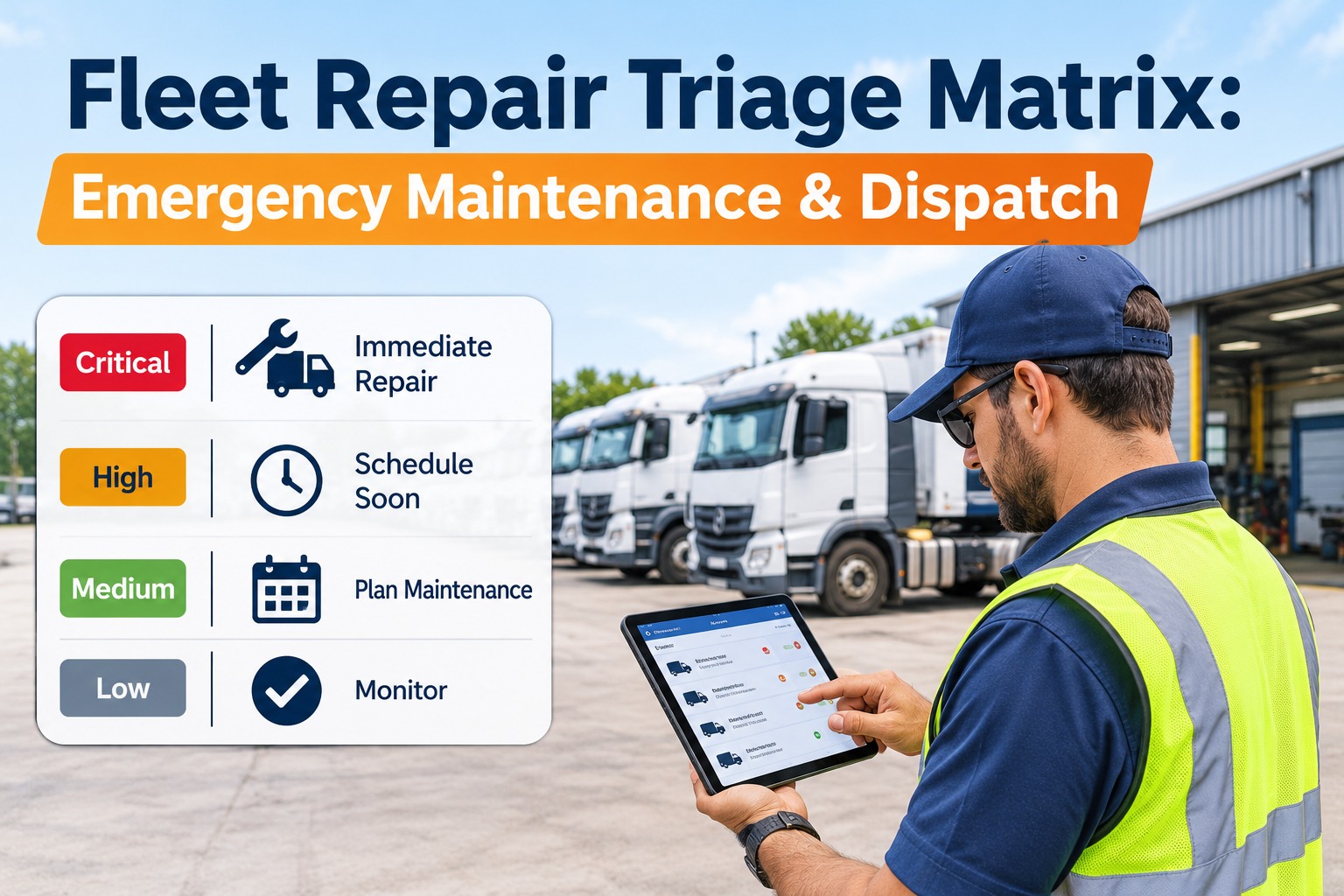
Fleet Repair Triage Matrix: Emergency Maintenance & Dispatch.
A four-factor triage matrix tells your dispatcher which repair comes first, who to send, and who needs to know. OXMAINT AI builds it into every work order.
P1–P4 Priority Levels
Copy-Ready Template
Dispatch Rules
The Matrix at a Glance
Start with the quick view. Cross safety risk with service impact and the priority appears. Sign up free and load this matrix into your workshop.
Quick Priority Matrix
Safety ↓ / Service impact →
High
Medium
Low
High safety risk
P1
P1
P1
Medium safety risk
P1
P2
P3
Low safety risk
P2
P3
P4
Rule one: any high safety risk is P1, whatever else the vehicle is doing.
Four Factors, Scored 1 to 3
For full triage, score each factor from 1 (low) to 3 (high). Total them for a score from 4 to 12. Book a demo to see scoring on a live work order.
FACTOR 1
Safety Risk
3 Brake, steering, tyre or fuel-system fault, fire risk, warning lights that mean stop
2 Lighting, wipers or mirror defect, minor leak, reduced visibility
1 Cosmetic or comfort issue, no effect on safe operation
FACTOR 2
Fault Severity
3 Vehicle cannot move, or will fail very soon
2 Limp mode, reduced power, intermittent fault
1 Minor defect, vehicle operates normally
FACTOR 3
Service Impact
3 Critical route or job, no spare vehicle, deadline at risk
2 Delays likely, a spare can cover with effort
1 Vehicle idle or easily replaced
FACTOR 4
Escalation Level
3 Driver stranded, incident, customer or regulatory exposure
2 Repeat defect, warranty or compliance question
1 Routine, no one else needs to be told
Total Score → Priority → Response
The response times below are starting points. Adjust them to your fleet, your workshop capacity and your service commitments. Start free and set your own targets.
P1Score 10–12 or any safety 3
Emergency: stop and dispatch nowTake off the road. Send mobile technician or tow immediately. Supervisor and manager notified.
P2Score 7–9
Urgent: fix this shiftSlot into the workshop ahead of planned work. Arrange a spare if service is affected.
P3Score 5–6
Soon: schedule within daysBook into the next available bay. Monitor for any change in symptoms.
P4Score 4
Planned: bundle with next serviceAdd to the next preventive maintenance visit and close in one pass.
A Matrix on Paper Gets Ignored. In the Work Order, It Gets Used.
OXMAINT AI scores each breakdown as it is logged, sets the priority and alerts the right people automatically.
Dispatch Decision: Roadside, Tow, Workshop or Swap?
Priority tells you how fast. The dispatch decision tells you how. Answer three questions in order. Book a demo to see dispatch in action.
Q1
Is it safe to drive?
If no, the vehicle stays put. Go to Q2. If yes, drive to the workshop at the next safe window.
▼
Q2
Can it be fixed on the spot?
If yes (battery, tyre, hose, fuse), send the mobile technician. If no, arrange a tow.
▼
Q3
Is the job at risk?
If yes, send a replacement vehicle or reassign the load while the repair is underway.
Example: A Scored Triage Work Order
Here is what a completed entry looks like. Copy these fields into your own template, or let OXMAINT AI fill them in. Sign up free and create your first triage order.
Triage Work Order · Illustrative Example
VehicleTruck 14 · Delivery
Reported byDriver, 07:42
FaultPulls left under braking, brake warning light on
Safety risk3
Fault severity2
Service impact3
Escalation2
ResultP1 · Score 10 · Safety 3 override
ActionVehicle parked. Tow dispatched. Spare truck assigned to route. Workshop supervisor notified.
Who Needs to Know? The Escalation Ladder
P2
+ Operations / dispatch manager
P1
+ Fleet manager & safety lead
Triage Mistakes That Cost You Time
Loudest caller wins
Urgency by volume instead of score sends technicians to the wrong vehicle.
Nobody re-scores
A fault gets worse or better. Priority should change when the facts change.
Safety gets averaged away
A high safety score must override a low total. Never let it be outvoted.
No record of the decision
If you cannot show why a call was made, you cannot improve it or defend it.
What OXMAINT AI Does for Your Workshop
Mobile Breakdown Reporting
Drivers and technicians log faults with photos from a phone.
Automatic Priority Scoring
Your matrix applied to every work order, with safety overrides built in.
Dispatch & Assignment
Send the right technician, in-house or external, with the full fault history.
Escalation Alerts
P1 and overdue jobs notify the people who need to act, automatically.
Vehicle Repair History
Spot repeat failures and make better repair-or-replace decisions.
Workshop Reporting
Response time, downtime and backlog by priority level.
Frequently Asked Questions
What is a fleet repair triage matrix?
It is a scoring framework that ranks vehicle repairs by safety risk, fault severity, service impact and escalation level, so emergency work is dispatched in the right order.
Sign up free and try it.
Can I change the scores and response times?
Yes. The thresholds here are a starting point. Adjust them for your vehicle types, workshop capacity and customer commitments, then review them after a month of real data.
Book a demo to tailor yours.
Who should do the scoring: the driver or the workshop?
Drivers describe the symptoms, and a dispatcher or supervisor confirms the score. A simple guided form helps drivers report consistently without needing technical knowledge.
Start free and set up the report form.
Does this replace preventive maintenance?
Does it work for small fleets?
Yes. Even a fleet of ten vehicles benefits from a clear rule for who gets repaired first, especially when there is only one technician or one bay.
Sign up free and start small.
Stop Guessing Which Truck Is Next.
Put a triage matrix into every work order. Try OXMAINT AI free, or book a short demo and watch a breakdown go from driver report to dispatched repair.