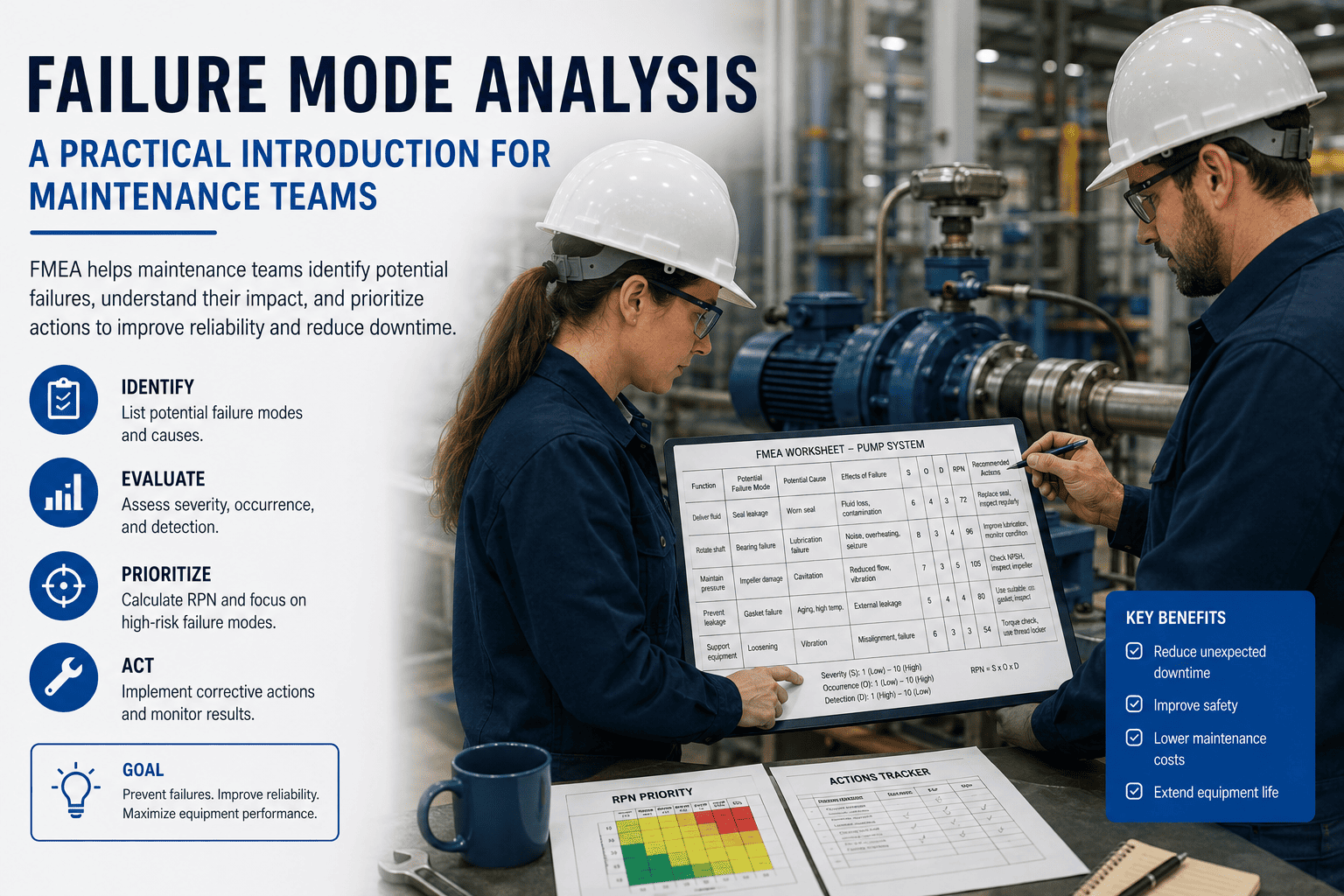
Criticality analysis for electric motors is the foundation of any effective Reliability-Centered Maintenance (RCM) program, sorting your motor population by consequence of failure so you can direct maintenance dollars where they protect production, safety, and profit the most. When you rank electric motors criticality correctly, you shift from reactive firefighting to a targeted strategy where your highest-risk assets receive condition monitoring and predictive interventions, while low-impact motors are safely allowed to run to failure. OxMaint's AI-powered CMMS and EAM platform automates this electric motors risk assessment, linking failure modes directly to work orders so your team can execute the right maintenance strategy at the right time. You can Start Free Trial today to build your asset hierarchy, or book a personalized demo to see how automated criticality scoring transforms your maintenance priority framework.
RCM CRITICALITY GUIDE
What if 15% of your motors cause 85% of your unplanned downtime?
Electric motors criticality ranking uses consequence-of-failure scoring to identify those high-impact assets before they fail. Stop treating every motor the same — engineer a prioritized, data-driven maintenance strategy that protects production and slashes emergency repair costs by up to 40%.
- Build a weighted risk matrix for every motor
- Map failure modes to maintenance strategies
- Track real-time health with OxMaint CMMS
CONSEQUENCE OF FAILURE
Why Electric Motors Criticality Ranking Drives RCM Success
In a plant with 500+ electric motors, treating every asset as "critical" guarantees you will overload your maintenance team and miss the true high-risk equipment. Effective electric motors criticality ranking forces a disciplined evaluation of what actually happens when a specific motor fails.
Scores are typically scaled 1–10 for each factor. A motor driving the main plant air compressor will score high in production loss, while a redundant backup motor may score low across the board.
Production Impact
Measures downtime minutes and throughput loss. A 100 HP motor on a primary production line can cause $15,000+ per hour in lost output, instantly pushing it to Tier 1 criticality.
Safety & Compliance
Evaluates risk to personnel and regulatory exposure. Motors in hazardous areas or driving safety-critical ventilation fans carry severe consequence weights.
Repair & Replacement Cost
Calculates parts, labor, and lead time. A custom 800 HP motor might have a 16-week lead time and $45,000 replacement cost, necessitating aggressive predictive maintenance.
Redundancy & Mitigation
Checks if a standby motor exists. If failure automatically transfers to a healthy backup without process interruption, the criticality tier drops significantly.
RISK MATRIX
Electric Motors Risk Assessment: Building Your 5x5 Matrix
An electric motors risk matrix maps the probability of failure against the severity of consequences. This visual tool standardizes your electric motors priority scoring across the entire facility, removing subjective bias from maintenance planning.
| Probability of Failure | Severe (1) | High (2) | Moderate (3) | Low (4) | Negligible (5) |
|---|---|---|---|---|---|
| Almost Certain (5) | 5 - Critical | 10 - Critical | 15 - High | 20 - Medium | 25 - Low |
| Likely (4) | 4 - Critical | 8 - High | 12 - High | 16 - Medium | 20 - Low |
| Possible (3) | 3 - High | 6 - High | 9 - Medium | 12 - Medium | 15 - Low |
| Unlikely (2) | 2 - Medium | 4 - Medium | 6 - Medium | 8 - Low | 10 - Low |
| Rare (1) | 1 - Medium | 2 - Medium | 3 - Low | 4 - Low | 5 - Low |
*Scores represent Probability (1-5) multiplied by Severity (1-5). Lower total scores indicate higher criticality risk. Critical (Red) assets require immediate condition monitoring; Low (Green) assets qualify for run-to-failure.
TIERED STRATEGY
Electric Motors Tier Ranking & Maintenance Strategy Selection
Once your electric motors consequence analysis is complete, you must assign a maintenance strategy based on the asset's tier. Applying the wrong strategy wastes resources — putting a $500 motor on a $5,000/year vibration analysis program destroys your maintenance ROI.
Critical Assets
Top 10-15% of motor population
- Strategy: Predictive Maintenance (PdM)
- Actions: Vibration analysis, oil analysis, thermography, motor circuit evaluation (MCE)
- Goal: Detect bearing failure and insulation degradation weeks before failure
Essential Assets
Next 25-35% of motor population
- Strategy: Preventive Maintenance (PM)
- Actions: Time-based lubrication, visual inspections, filter changes, amperage checks
- Goal: Slow degradation through scheduled, routine upkeep
General Assets
Bottom 50-65% of motor population
- Strategy: Run-to-Failure (RTF)
- Actions: Keep spare parts in inventory; replace upon failure
- Goal: Minimize maintenance overhead on low-impact, easily replaceable motors
WORKED EXAMPLE
Real-World Scenario: A 180-Motor Manufacturing Plant
Consider a mid-sized manufacturing plant operating 180 electric motors, spending approximately $42,000 annually on reactive maintenance, emergency labor, and expedited shipping for replacement parts. By implementing an electric motors asset priority system, the reliability team scored every motor against the consequence matrix.
By focusing their condition monitoring budget strictly on the 24 critical motors, they caught two impending bearing failures and one insulation breakdown before they caused catastrophic, line-stopping failures. The plant saved an estimated $28,500 in emergency repair costs and lost production in the first year alone. This is the power of proper electric motors importance ranking.
Ready to stop guessing which motors matter most?
See how OxMaint automates your criticality scoring, maps failure modes to work orders, and prevents unplanned downtime. Book a 30-minute demo with our reliability engineers today.
PLATFORM CAPABILITIES
How OxMaint Powers Your Electric Motors Reliability Program
Executing an RCM strategy on paper is one thing; sustaining it across hundreds of rotating assets is another. OxMaint's AI-powered CMMS and EAM platform translates your electric motors criticality criteria into automated, executable maintenance workflows.
Asset Hierarchy & Criticality Scoring
Build a digital twin of your plant that mirrors parent-child asset relationships. Assign weighted criticality scores to each motor, and OxMaint automatically filters and prioritizes your maintenance backlog based on risk tier.
Outcome: Eliminate spreadsheet chaos and ensure your highest-risk motors are never skipped.
Predictive Maintenance Triggers
Connect IoT vibration and temperature sensors directly to asset profiles. When a Tier 1 motor deviates from baseline ISO 10816 vibration limits, OxMaint automatically generates a predictive work order before bearing failure occurs.
Outcome: Cut unplanned downtime by 30-50% by catching failures weeks in advance.
Failure Mode Libraries
Link standardized failure modes (e.g., bearing degradation, stator insulation breakdown, rotor bar failure) directly to completed work orders. This builds a historical database that refines your electric motors risk assessment over time.
Outcome: Move from reactive descriptions to data-driven reliability engineering.
Spare Parts Criticality Linking
Automatically align spare parts inventory with motor tiers. OxMaint ensures you always have bearings and seals in stock for Tier 1 assets, while minimizing capital tied up in parts for Tier 3 run-to-failure motors.
Outcome: Reduce emergency expedited shipping costs by up to 60%.
IMPLEMENTATION TIMELINE
Deploying Your RCM Pilot in 4 Months
You do not need to rank every motor on day one. The most successful electric motors reliability programs start with a focused pilot on a single production line or critical system, then scale using proven data. Here is a standard 4-month implementation roadmap.
Data Collection & Hierarchy Setup
Audit your motor population, nameplate data, and historical failure logs. Build the asset hierarchy in OxMaint and document existing PMs.
Criticality Scoring Workshop
Gather operations, maintenance, and safety teams to assign consequence scores. Input the weighted formulas into OxMaint to auto-generate Tier 1, 2, and 3 classifications.
Strategy Assignment & PM Optimization
Map PdM, PM, and RTF strategies to each tier. Begin scheduling condition monitoring routes for Tier 1 and optimizing PM frequencies for Tier 2 motors.
Measure & Scale
Review OxMaint analytics dashboards to compare downtime, MTBF, and maintenance costs against baseline. Refine strategies and scale the program to the rest of the plant.
FREQUENTLY ASKED QUESTIONS
Electric Motors Criticality Analysis FAQs
What is criticality analysis for electric motors?
Criticality analysis for electric motors is the process of evaluating and ranking each motor based on the consequence of its failure on safety, production, environment, and cost. By scoring these factors, maintenance teams can prioritize resources toward high-risk assets rather than treating all motors equally. You can easily manage and automate this scoring within a CMMS like OxMaint — Start Free Trial to see how.
How do you perform an electric motors risk assessment?
You perform an electric motors risk assessment by plotting each motor on a risk matrix that evaluates the probability of failure against the severity of its consequences. Teams assign weights to factors like downtime cost, safety hazards, and redundancy to generate a numeric criticality score. This score determines whether the motor receives predictive maintenance, preventive maintenance, or is allowed to run to failure.
What are the most common failure modes in electric motors?
The most common electric motors failure modes are bearing failure (responsible for over 50% of motor breakdowns), stator winding insulation degradation, rotor bar failures, and external contamination. Electric motors maintenance programs must target these specific failure modes with strategies like vibration analysis for bearings and motor circuit evaluation for insulation. Proper electric motors reliability tracking helps identify which failure modes are most prevalent in your specific operating environment.
When should an electric motor be assigned a run-to-failure strategy?
An electric motor should be assigned a run-to-failure (RTF) strategy when its criticality ranking is low, meaning it has minimal impact on safety, production, or total cost, and is easy to replace or has a redundant backup. RTF is ideal for small, non-critical motors where the cost of preventive maintenance exceeds the cost of simply replacing the motor upon failure. Ensure you still keep adequate spare parts in inventory to minimize replacement downtime.
How does CMMS software improve electric motors maintenance priority?
CMMS software improves electric motors maintenance priority by digitizing the asset hierarchy, automating criticality scoring, and triggering work orders based on real-time condition data rather than guesswork. It ensures that Tier 1 critical motors receive mandatory predictive maintenance routes while preventing maintenance teams from wasting time on low-priority assets. To see this automated prioritization in action, Book a Demo with our team.
Transform Your Motor Reliability Program Today
Stop reacting to motor failures and start engineering them out. OxMaint gives you the AI-powered tools to rank asset criticality, automate work orders, and eliminate unplanned downtime.
Free 14-day trial · No credit card required