Remote equipment monitoring with IoT sensors is the single most effective way to catch rotating machinery failures — motors, pumps, compressors, and fans — weeks before they take a production line offline. Unlike scheduled inspections that only reveal conditions at one point in time, continuous IoT sensor monitoring streams live vibration, temperature, and current data so your CMMS can act on what the machine is actually telling you right now.
See how Oxmaint connects IoT sensor data to predictive failure alerts for rotating equipment — in 30 minutes.
✓ 24/7 vibration and temperature monitoring on motors, pumps, fans
✓ AI flags failure probability weeks before breakdown
✓ Auto-generated work orders with full sensor context
Trusted by 1,000+ maintenance teams · 94% AI prediction accuracy · Live in days
85%+
Rotating equipment faults detectable via vibration monitoring
Industry condition monitoring benchmark
62%
Reduction in unplanned downtime with AI-driven predictive maintenance
Oxmaint client outcomes
94%
AI prediction accuracy for equipment failures using IoT sensor feeds
Oxmaint predictive maintenance
3–6 weeks
Advance warning typical for bearing and coupling faults via vibration
Condition monitoring research
What Is Remote Rotating Equipment Monitoring
Remote monitoring for rotating equipment: what it is and why it works
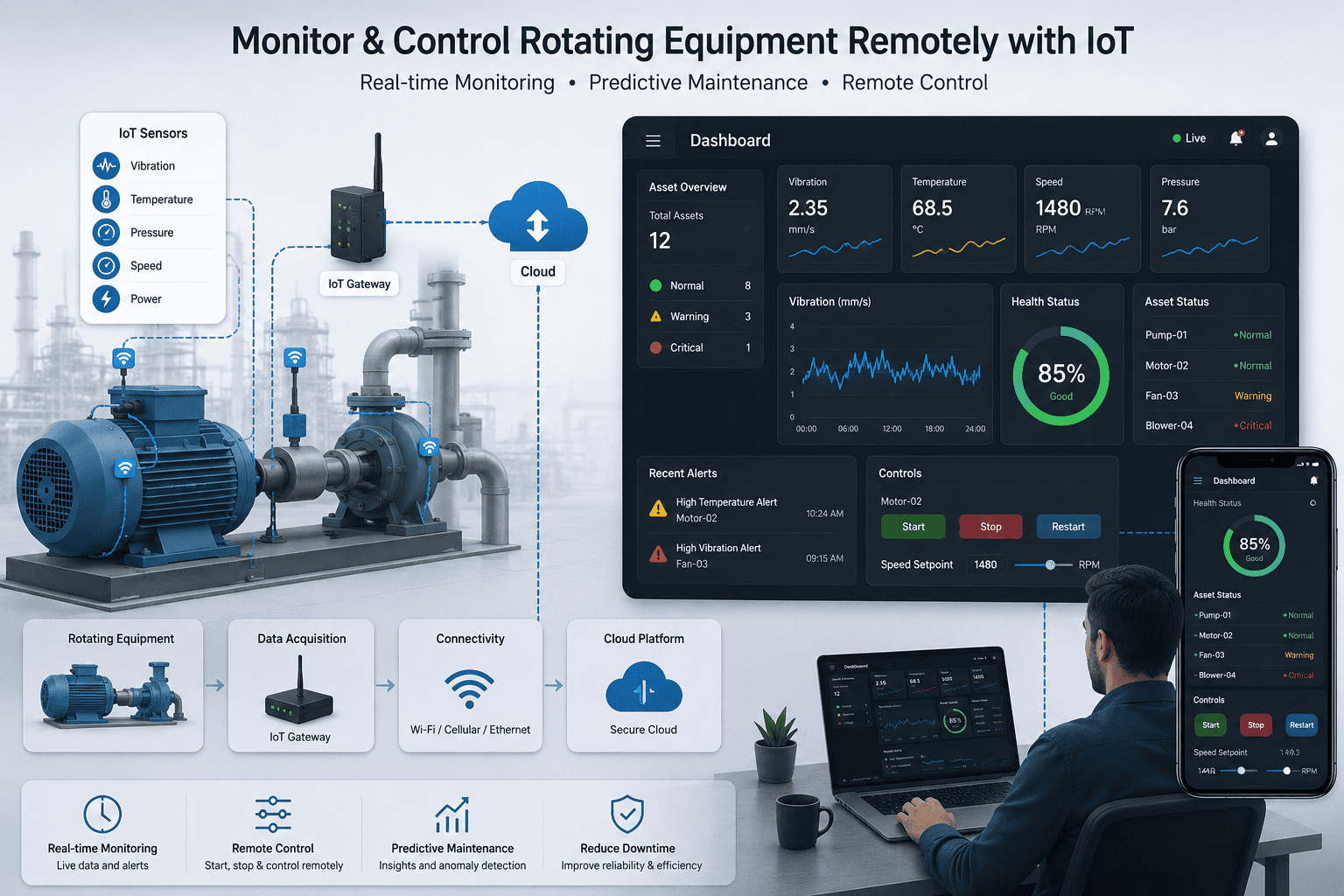
Remote equipment monitoring for rotating machinery means placing IoT sensors — vibration, temperature, current, ultrasonic — directly on motors, pumps, compressors, and fans, then streaming that data continuously to a central platform for AI analysis. Instead of a technician walking the floor every two weeks, the machine reports its own condition every second.
Rotating equipment fails in predictable patterns. Bearing wear increases vibration amplitude at specific frequencies. Misalignment creates harmonic signatures in the vibration spectrum. Cavitation in pumps generates characteristic ultrasonic noise. Every one of these failure modes announces itself in sensor data 3–6 weeks before the machine trips offline — which is exactly the window you need to schedule a planned repair instead of absorbing an emergency shutdown.
Connecting IoT sensor streams to a predictive maintenance platform closes that window by converting raw sensor readings into maintenance decisions automatically. Teams that make this connection report 62% less unplanned downtime and maintenance cost reductions of 10–25% — start a free trial to map your rotating assets into Oxmaint, or book a demo and we'll walk through your highest-criticality machines first.
Key Sensor Types and Failure Modes
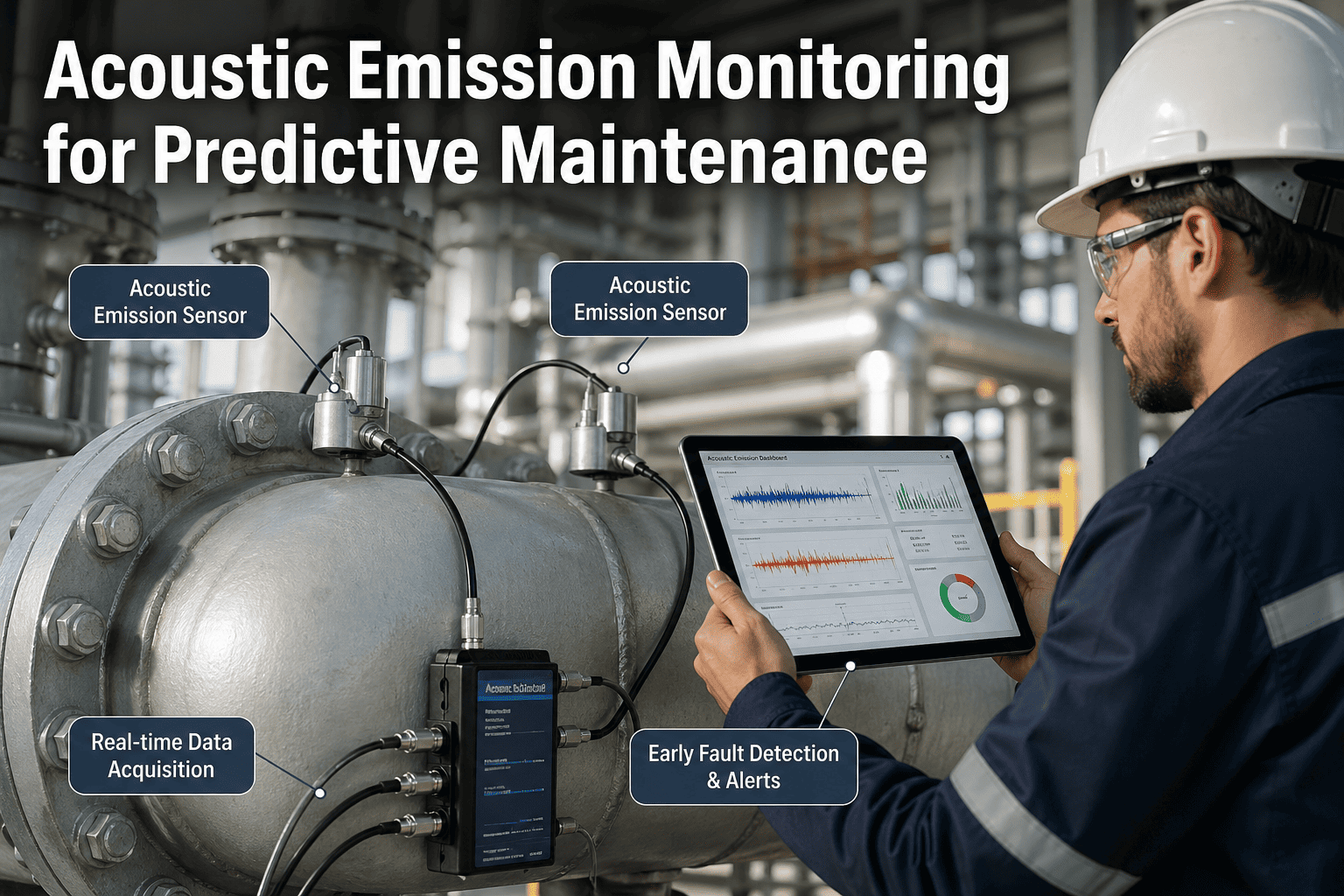
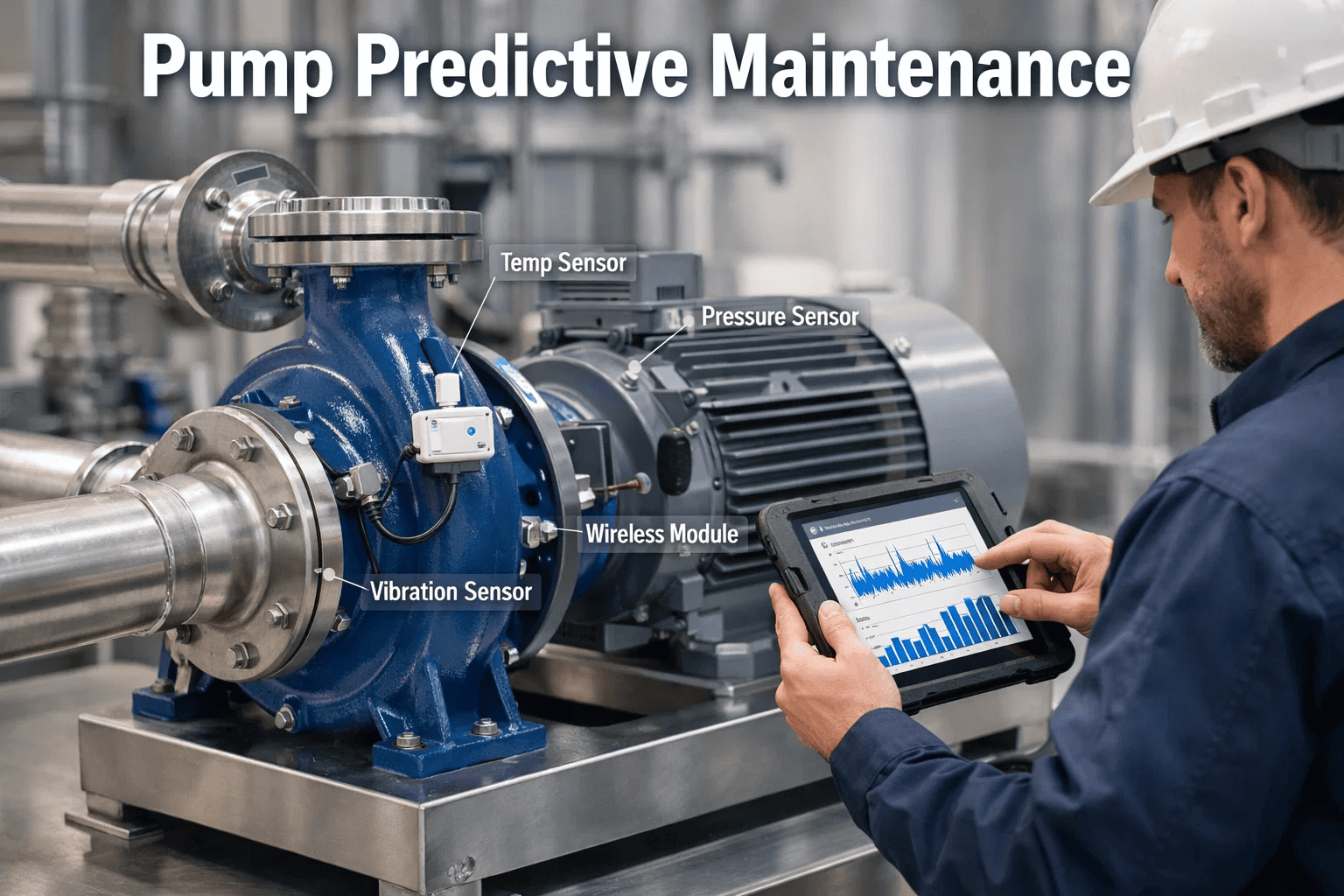
Six IoT sensor types every rotating equipment monitoring program needs
Vibration sensors
Motors, pumps, fans, compressors
Detects bearing wear, imbalance, misalignment, looseness. Most comprehensive fault coverage of any single sensor type.
Temperature sensors
Bearings, motor windings, gearboxes
Heat is a downstream indicator confirming vibration-detected faults. Winding temperatures exceeding class limits point to insulation failure before winding burnout.
Current sensors (MCM)
Motors, drives, compressors
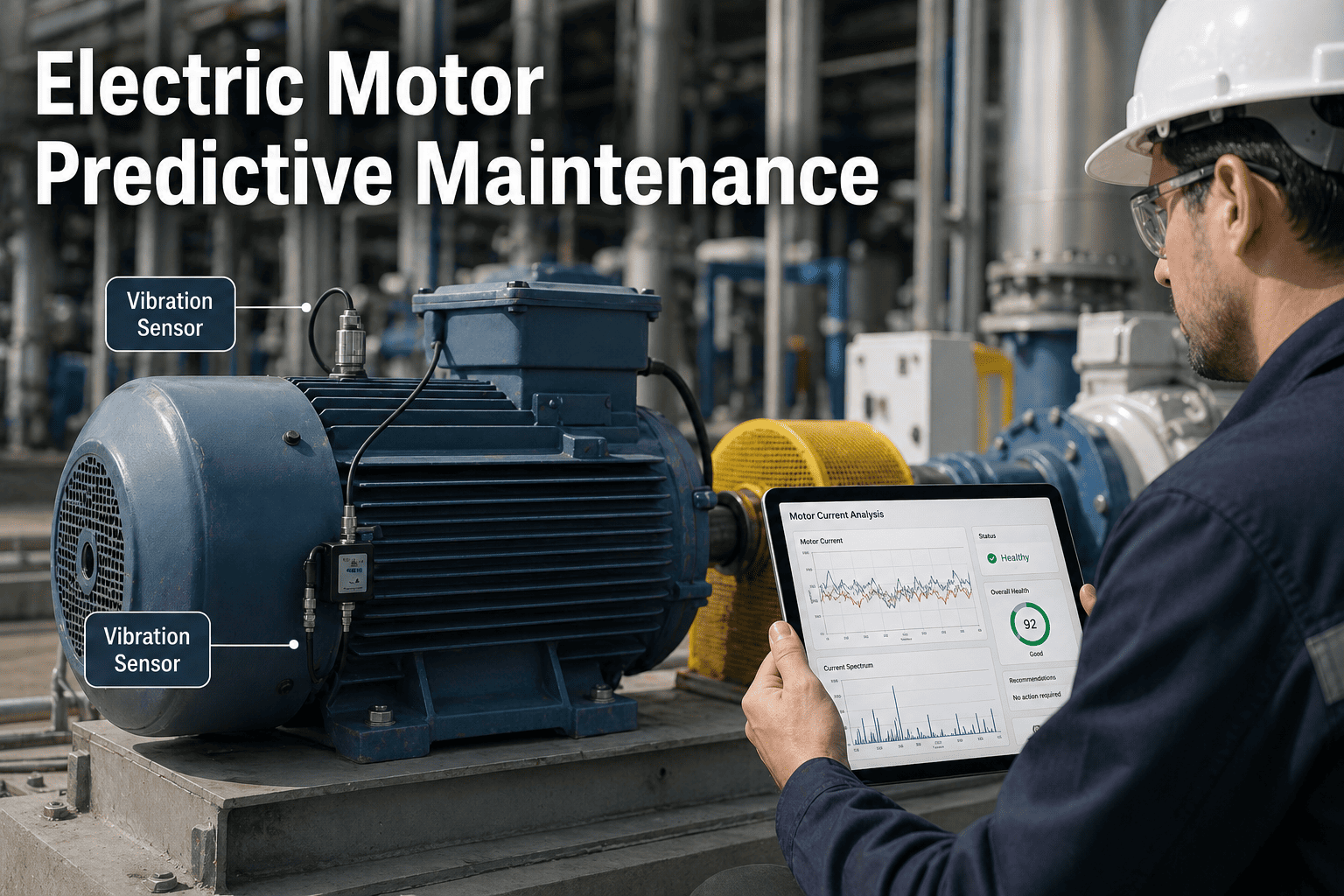
Motor current signature analysis detects rotor bar faults, eccentricity, and load changes without physical contact with the machine. Particularly effective on inaccessible motors.
Ultrasonic sensors
Pumps, valves, bearings, steam traps
Detects cavitation in pumps, turbulence in valves, and early-stage bearing defects at frequencies above the vibration sensor range. Excellent for detecting lubrication failures.
Speed and RPM sensors
Fans, conveyors, gearboxes, turbines
Speed deviations from setpoint indicate drive issues, mechanical binding, or process overloads. Used to normalize vibration readings to RPM so that load-dependent baselines remain accurate.
Oil condition sensors
Gearboxes, compressors, hydraulic systems
Monitors viscosity, particle count, and water contamination in lubricant systems. Oil degradation accelerates bearing and gear wear — detecting it before a lubrication failure extends component life significantly.
A pump bearing failing over 6 weeks generates a vibration signature that is visible from Week 2 onward. Without remote monitoring, the first alert your team gets is the pump alarm — or the flooded floor.
Industry Pain Points
Why traditional inspection approaches keep failing rotating equipment teams
01
Scheduled rounds miss the failure window
A bearing that starts degrading on Tuesday will not appear on a Thursday inspection route until the following Thursday — by which time the damage has progressed past low-cost repair. Fortnightly rounds are not designed for the 3–6 week failure development timeline of rotating equipment.
02
Remote and hazardous locations go unchecked
Cooling tower fans, confined space pumps, rooftop HVAC compressors, and switchroom motors are often skipped or abbreviated on inspection rounds due to access constraints. These are frequently the assets that fail without warning because no one was regularly close enough to notice early signs.
03
Vibration data collected but never analyzed
Many teams own handheld vibration analyzers but the readings sit in a spreadsheet that nobody has time to trend. Spot readings without context — no baseline, no trend, no threshold — provide almost no predictive value. Data collection without analysis is not condition monitoring.
04
Sensor data does not connect to the CMMS
Even facilities with IoT sensors often find that the sensor dashboard lives in a separate system from the CMMS. An alert in the monitoring platform requires a human to log into the CMMS, create a work order, assign it, and follow up — adding hours of delay to a signal that demanded immediate action.
05
Alert thresholds are set wrong, producing noise
Generic sensor thresholds — set to OEM defaults or global standards — generate false alarms on normal operational variation. Technicians learn to ignore high-frequency alerts. When a real fault eventually fires, it competes with the noise that trained the team to dismiss alerts.
06
No failure probability score to prioritize response
An alert saying "vibration high" on 12 machines simultaneously gives a maintenance team no way to decide which machine to go to first. Without a failure probability score and a criticality weighting, the team defaults to first-reported-first-served, which is rarely the right triage order.
If your rotating equipment monitoring is producing noise instead of clarity, see how Oxmaint AI automation filters sensor signals into prioritized, actionable work orders.
How Oxmaint Solves It
How Oxmaint turns IoT sensor data into rotating equipment protection
Direct IoT and PLC sensor integration
Oxmaint connects to vibration, temperature, current, and process sensors via IoT and PLC integrations, tagging every reading to the specific asset in the
asset management register. No manual data transfer, no separate monitoring dashboard to log into.
AI baseline learning and anomaly detection
Oxmaint's AI learns each asset's normal vibration and temperature profile under its specific operating conditions. Alerts fire on statistically significant deviations from that learned baseline — not generic thresholds — dramatically reducing false positives on normal operational variation.
Failure probability scoring with criticality weighting
Every anomaly gets a failure probability score combined with the asset's criticality class and production impact rating. Maintenance teams see a single ranked list of machines that need attention, ordered by risk — not a queue of raw sensor alerts to interpret manually.
Auto-generated work orders with sensor evidence attached
When Oxmaint detects a developing fault, it automatically creates a
work order with the sensor trend, the anomaly timestamp, and the recommended inspection steps already populated. Technicians arrive with context, not just a machine name.
Teams using reactive maintenance on rotating equipment spend 3–5x more per failure event than teams using IoT-driven predictive programs. The sensor hardware pays for itself after the first prevented breakdown.
Reactive vs Predictive: IoT Monitoring Comparison
Reactive rounds vs. continuous IoT monitoring: what the difference actually costs
| Factor |
Reactive / Scheduled Rounds |
Continuous IoT Monitoring |
| Fault detection lead time |
0 days — discovered at failure |
3–6 weeks before failure develops |
| Coverage frequency |
Every 1–2 weeks per walkround |
Continuous, 24/7 every second |
| Remote asset coverage |
Often skipped due to access constraints |
Full coverage regardless of location |
| Repair type triggered |
Emergency — machine already failed |
Planned — bearing/part replaced early |
| Average repair cost ratio |
3–5x higher per event |
Baseline component replacement cost |
| Production impact |
Unplanned line stoppage |
Scheduled maintenance window |
| Work order generation |
Manual, after failure report |
Automatic, on AI anomaly detection |
| Technician safety |
Exposure to failed equipment during emergency |
Planned access under controlled conditions |
ROI and Results
What IoT rotating equipment monitoring delivers in practice
Less unplanned downtime
Oxmaint predictive maintenance clients across manufacturing and industrial
AI prediction accuracy
Equipment failures flagged by Oxmaint IoT sensor analysis before occurrence
Faults detectable early
Share of rotating equipment faults visible in vibration data before failure
Less inspection time
Reduction in manual inspection hours when continuous monitoring replaces walkarounds
Use the Oxmaint ROI calculator to estimate downtime cost savings based on your specific asset count and failure history, or book a demo to see how predictive monitoring maps to your rotating equipment fleet.
Frequently Asked Questions
IoT rotating equipment monitoring: common questions from maintenance managers
How do IoT sensors predict rotating equipment failures before they happen?
IoT sensors — primarily vibration and temperature — detect the physical signature of developing faults weeks before failure. A bearing with early-stage spalling generates high-frequency vibration at specific fault frequencies. A misaligned coupling produces characteristic harmonic patterns. AI running against continuous sensor streams identifies these patterns, compares them to established baselines, and generates a failure probability score. The earlier the fault signature appears, the more lead time maintenance teams have to plan a repair.
What types of rotating equipment benefit most from remote IoT monitoring?
Induction motors, centrifugal pumps, axial and centrifugal fans, reciprocating and screw compressors, and gearboxes all have well-characterized failure modes that appear clearly in vibration and temperature data. The highest ROI typically comes from critical assets — those whose failure causes a production line stoppage, safety hazard, or compliance breach — regardless of physical size. Start with your highest-criticality machines and expand coverage as the program matures.
How does remote IoT monitoring integrate with a CMMS like Oxmaint?
Oxmaint integrates directly with IoT sensor platforms and PLC systems via API and standard industrial protocols. Sensor readings are tagged to individual assets in the asset register. When the AI detects an anomaly, it creates a work order automatically — the sensor data, anomaly trend, and recommended inspection steps are pre-populated in the work order that arrives on the technician's mobile device. No separate monitoring dashboard, no manual data entry, no delay between signal and action.
How do you reduce false positives from IoT vibration monitoring?
The most effective approach is baseline learning: the AI establishes each asset's normal vibration profile under its specific load conditions, then alerts only on statistically significant deviations from that learned baseline. Generic thresholds from standards or OEM data trigger false alarms on normal process variation. Oxmaint's predictive engine learns asset-specific baselines, dramatically reducing alert noise. Combining multiple sensor types — vibration plus temperature plus current — also significantly improves fault confirmation accuracy before a work order is generated.
Stop Finding Out About Failures After They Happen
Remote IoT monitoring for rotating equipment: your assets are already broadcasting fault signals
Every motor, pump, compressor, and fan in your facility is generating a continuous condition signal. Without IoT monitoring connected to a predictive maintenance platform, those signals expire unread every day. Oxmaint connects sensor data to AI analysis to automatic work orders, so your team responds to developing faults weeks before they become emergency repairs.
✓ 94% AI prediction accuracy on IoT sensor data streams
✓ Auto-generated work orders on anomaly detection, no manual step
✓ 62% less unplanned downtime reported by Oxmaint maintenance clients
Trusted by 1,000+ maintenance teams across 9 industries · Live in days, not months


.png)
