A swing hanger worn thin, an S-hook opened just enough to catch a drawstring, loose-fill surfacing kicked down to bare dirt under the slide — on a public playground, the gap between a routine finding and a serious injury is one busy Saturday, and when a claim lands the first question is not whether you inspected but whether you can prove it. This safety workflow puts tiered playground inspections on a schedule, turns every finding into a tracked work order, and keeps the record that defends the municipality. It runs on OXMAINT AI, the AI-powered CMMS built for public works and parks teams.
Public Works · Parks & Playgrounds · Inspection Safety Workflow
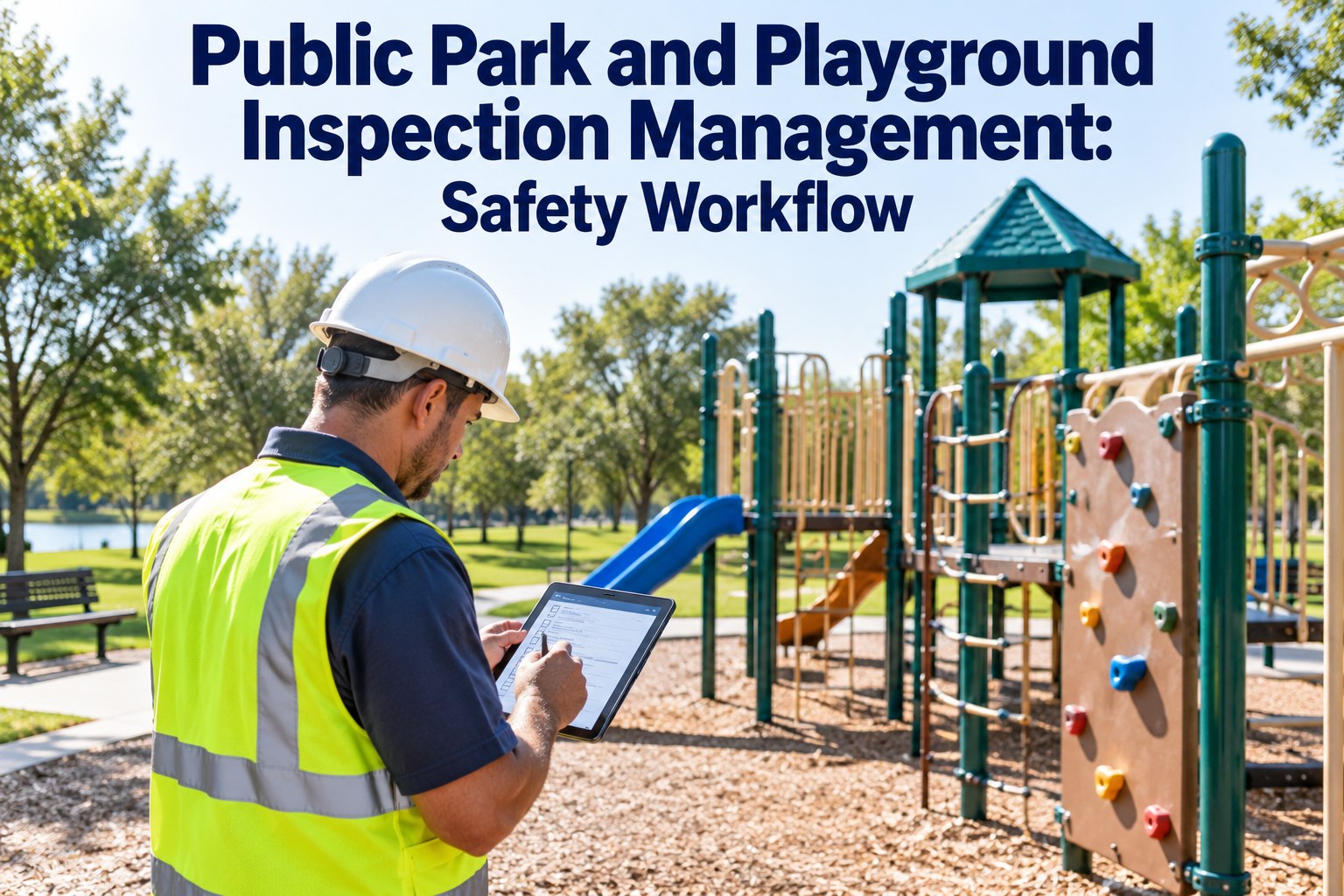
Public Park and Playground Inspection Management: Safety Workflow.
Public playground safety is a child-protection duty and a liability exposure on the same equipment. OXMAINT AI runs the whole inspection program on one platform — routine, detailed and annual-audit inspections scheduled by risk, every finding routed to a work order, and a timestamped, photo-backed record for every structure in every park.
1 Inspect
2 Flag
3 Fix
4 Record
Pub #325
the CPSC handbook that sets the national benchmark
3.5"–9"
the head-entrapment gap to design out and check for
6 ft
minimum use zone around most play equipment
Cited in Court
voluntary standards that still decide liability
Why Playground Inspection Is a Liability Program, Not a Chore
The CPSC Public Playground Safety Handbook and the ASTM standards that sit beside it are voluntary — and they are also the benchmark an attorney reaches for the moment a child is hurt. An inspection nobody documented is, in a courtroom, an inspection that never happened. Across a park system of dozens of sites, the program cannot live in one supervisor's memory and a stack of clipboards in a truck. It has to be scheduled by risk, carried out consistently, and recorded in a way you can produce on demand. Sign up free and put your parks inspection program in OXMAINT AI.
The Three Inspection Tiers — Frequency by Risk
A sound program runs on three cadences, not one. High-use equipment gets a quick look often; the detailed inspection comes less frequently; and a qualified inspector audits the whole site once a year. Each tier catches what the others miss.
ROUTINE
Daily to weekly
A quick visual check on high-use sites — surfacing, debris, obvious damage, missing hardware. Carried out by parks staff on their rounds.
DETAILED
Monthly to quarterly
A thorough, hands-on inspection against the full checklist — hardware, wear, entrapment gaps, use zones and surfacing depth. By trained staff.
COMPREHENSIVE AUDIT
Annual · plus after any change
A full audit against CPSC and ASTM by a Certified Playground Safety Inspector (CPSI) — yearly, and after any installation or major repair.
The Hazards Every Inspection Looks For
Whatever the tier, the inspector is hunting the same families of hazard — the ones that turn up again and again in injury data and in the standards. Book a demo to see hazard-based checklists in OXMAINT AI.
1
Entrapment
Openings that can trap a head or neck — the 3.5" to 9" range designed out and checked on every structure.
2
Entanglement & Protrusion
Hooks, open S-hooks, protruding bolts and gaps that can catch clothing, drawstrings or skin.
3
Sharp Edges, Pinch & Crush
Burrs, broken edges and moving joints that can cut, pinch or shear small fingers.
4
Fall & Use Zones
A 6 ft use zone around most equipment, swings extending twice the top-bar height front and back, guardrails above 30".
5
Protective Surfacing
Correct material and depth, meeting impact attenuation (ASTM F1292) — the single biggest factor in fall-injury severity.
6
Structure & Hardware
Loose bolts, worn components, rust, cracked welds and missing caps — the slow failures a routine look is meant to catch.
The Routine Inspection Checklist
Six areas, the backbone of every detailed inspection. Tick as you go — the boxes are live. Start free and run this checklist on mobile, one tap per check.
03Entrapment & Entanglement
From Finding to Fixed — Respond by Severity
Not every finding is an emergency, and not every finding can wait. What matters is that each one gets the right response at the moment it is found — and that all three leave a record. Book a demo to see severity routing in OXMAINT AI.
CLOSE IT NOW
An immediate hazard to a child. Take the equipment out of service on the spot — bag the swing, cordon the structure — before anything else, then raise the work order.
FIX ON SCHEDULE
A real defect, but not an immediate danger. Raise a ranked work order and repair it within the program's window, tracked to close.
MONITOR
Early wear worth watching. Log it, set the re-check date, and let the trend decide when it becomes a work order of its own.
The Record Is the Defense
When a parent files a claim, a reasonable-care program is proven on paper or not at all. A timestamped, photo-backed history — what was inspected, when, by whom, what was found and what was done — is the difference between a defensible program and an expensive settlement. It also answers an open-records request in minutes instead of a weekend of digging. Start free and build an audit-ready record per structure.
Every Swing, Every Park, Every Inspection on the Record.
Put the tiered schedule, the hazard checklist, the severity response and the inspection history on one platform — so playground safety is a program you can run, prove and defend across the whole park system.
How OXMAINT AI Runs the Parks Inspection Program
One platform behind the whole program — the sites, the schedule, the checklist, the work orders and the record. This is the maintenance management software that keeps every playground inspected on cadence and evidenced for every claim and audit.
REGISTER IT
Every Park and Structure on File
Each park, play structure and component on one asset register — so nothing is inspected from memory and nothing is missed.
SCHEDULE IT
Routine, Detailed & Annual Cadences
Each inspection tier fires on its own schedule per site, so the quick look and the full audit both happen on time.
INSPECT IT
Checklist on Every Phone
The CPSC and ASTM-aligned checklist on mobile, with a photo on every finding — the same inspection at every playground.
FLAG IT
Finding Becomes a Work Order
A hazard opens a ranked work order — or an immediate close-out for a live danger — assigned and tracked to re-inspection.
ANALYZE IT
Overdue and Recurring, Across Sites
Overdue inspections and repeat hazards across every park in one view — so a problem site surfaces before an incident does.
PROVE IT
Audit- and Claim-Ready Record
A timestamped, photo-backed inspection history per structure — the reasonable-care evidence a claim or an auditor asks for.
"
We inspected our playgrounds — we just could not always prove it. When a family's attorney requested two years of records for one site, it took us the better part of a week to assemble paper logs from three different crews, and the gaps were not a good look. After we moved to scheduled mobile inspections with photos, the next records request took twenty minutes. The inspections did not get more thorough. They got findable — and that is what actually protects the city.
Parks & Recreation Operations Manager · Municipal Public Works
Frequently Asked Questions
How often should public playgrounds be inspected?
On three cadences: a quick routine visual on high-use sites daily to weekly, a detailed hands-on inspection monthly to quarterly, and a comprehensive annual audit by a certified inspector — plus an audit after any new installation or major repair. High-traffic and higher-risk sites move to the shorter intervals.
What standards govern public playground safety?
The CPSC Public Playground Safety Handbook (Publication #325) is the national benchmark, alongside ASTM F1487 for equipment and ASTM F1292 for protective surfacing. They are voluntary, but they are the standards cited when an injury becomes a liability claim.
What is a CPSI?
A Certified Playground Safety Inspector — a person trained and certified to audit playgrounds against CPSC and ASTM. The annual comprehensive audit is best done by a CPSI; the software schedules and records it but does not replace that qualified judgment.
What counts as an immediate hazard?
Anything that could seriously hurt a child before a scheduled repair — a broken structural member, an exposed entrapment, a protrusion that can catch clothing, or surfacing worn to bare ground under a fall zone. Take the equipment out of service on the spot, then raise the work order.
Why manage playground inspections in a CMMS?
It schedules each inspection tier per site, runs the same checklist with photos, turns findings into tracked work orders, and keeps the timestamped record that proves reasonable care — across a whole park system, not one clipboard.
Sign up free to set it up in OXMAINT AI.
Scheduled. Inspected. Fixed. Proven.
Move your parks and playground safety program onto OXMAINT AI — tiered inspections on schedule, a hazard-based checklist with photos, findings routed to work orders, and an audit-ready record for every structure in every park. Protect the children, and protect the municipality.