FAA Part 139 Daily Airport Self-Inspection Checklist (Complete Guide)
By Lewis Abbott on April 28, 2026
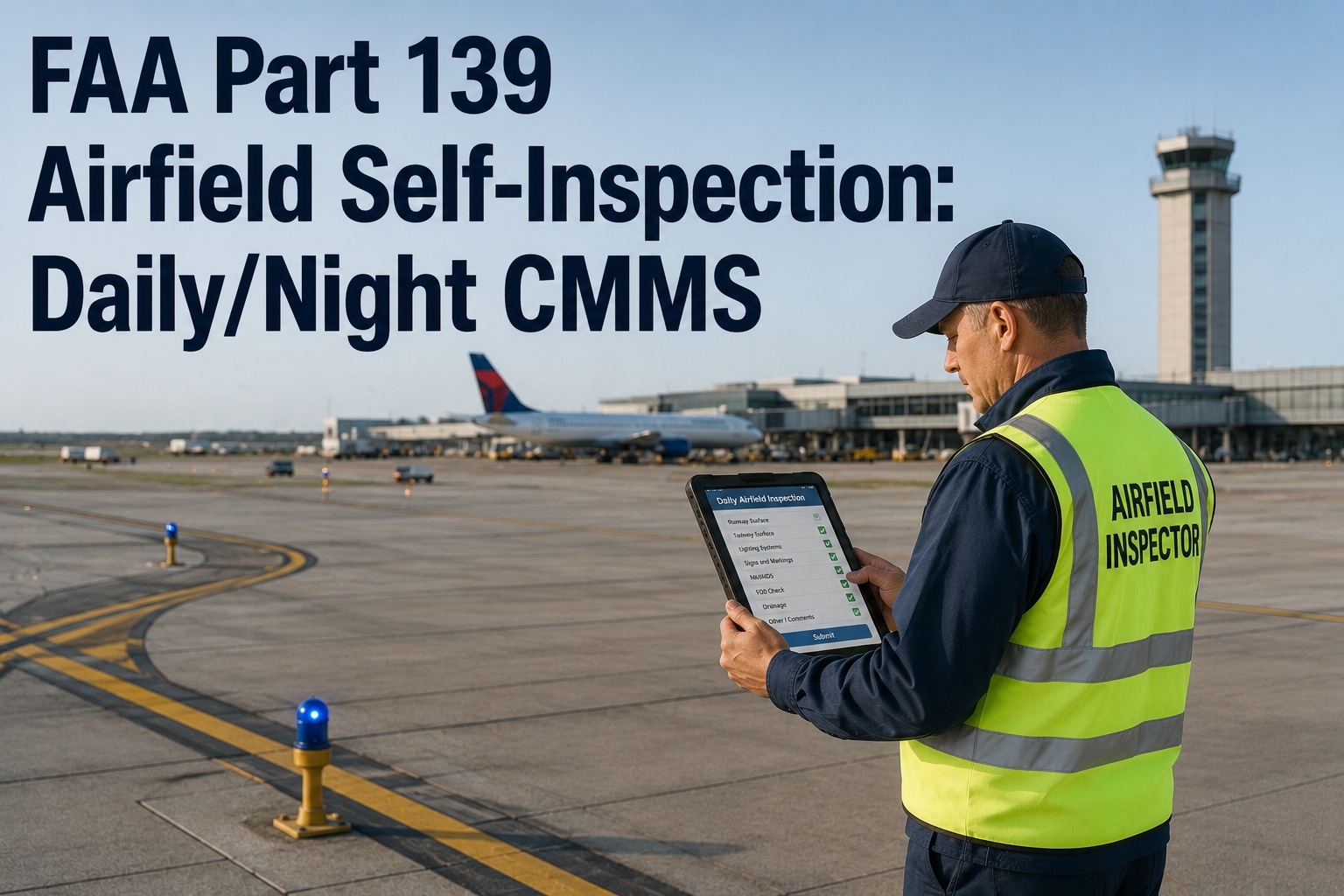
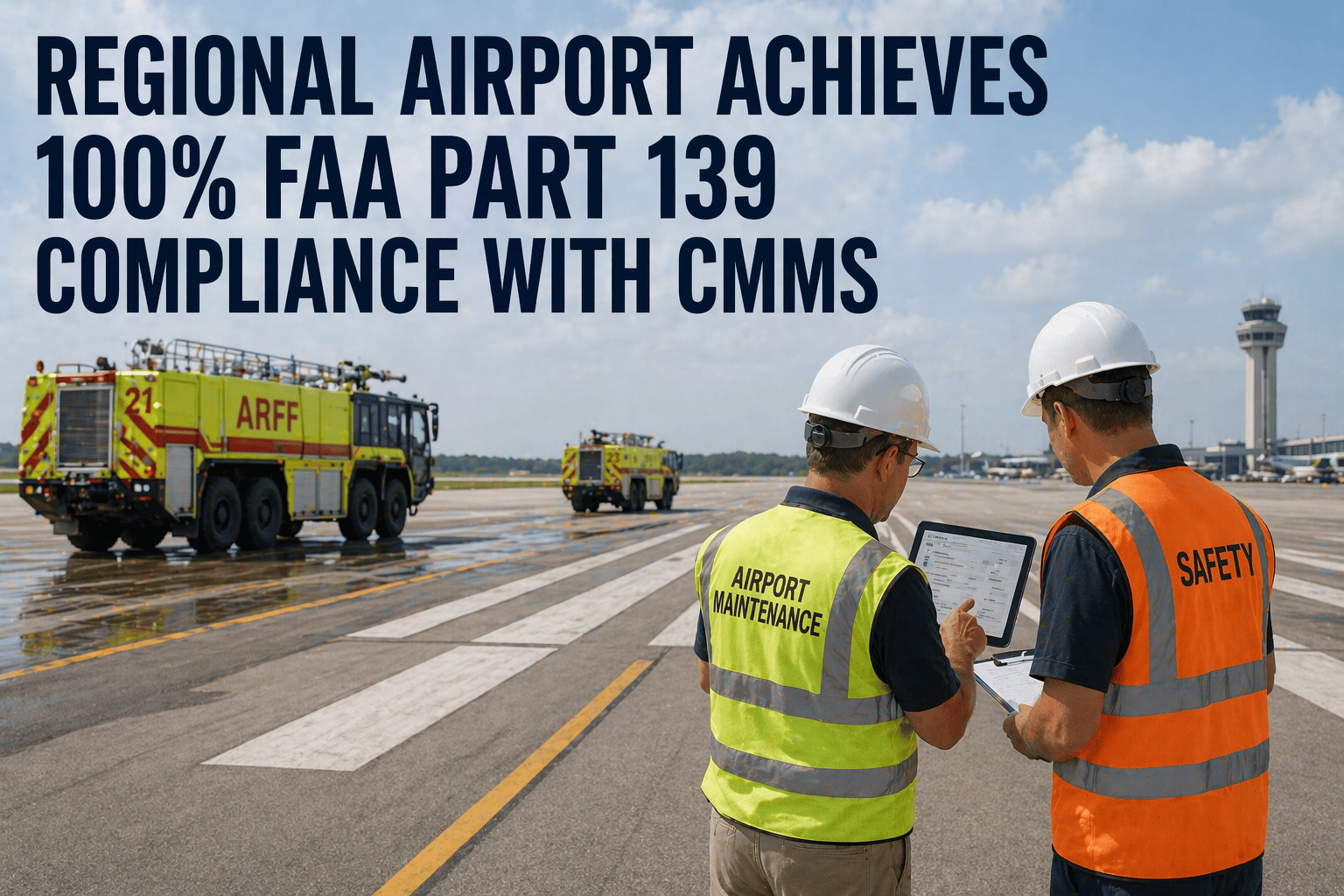
FAA Part 139.327 is unforgiving in a specific way. The airport must conduct a complete self-inspection daily, before the first air carrier operation, and must document every finding with corrective action tracked to closure. There is no partial credit. Missing daily records, unsigned checklists, and untracked deficiencies are the single most cited deficiency in FAA Part 139 inspections — and a finding-laden audit can land an airport with a Letter of Correction, financial penalty, or in extreme cases certificate revocation. This guide breaks down the complete daily self-inspection checklist airport operations teams need to satisfy AC 150/5200-18C, with zone-by-zone coverage of runways, taxiways, lighting, signage, safety areas, NOTAM coordination, and construction zones — plus the common findings the FAA flags every year. Want to run this checklist on auto-pilot with audit-ready records — start a free trial and book a demo to walk through the digital Part 139 workflow with our team.
Compliance GuideFAA Part 139AC 150/5200-18C
FAA Part 139 Daily Airport Self-Inspection Checklist — The Complete Operational Guide
A zone-by-zone, audit-grade walkthrough of the daily self-inspection every Part 139 certificated airport must complete — with the documentation, NOTAM coordination, and corrective-action workflow that pass FAA scrutiny.
24 moMandatory self-inspection record retention per AC 150/5200-18C
2 hrMaximum NOTAM filing window from discovery of qualifying defect
Stop running daily inspections on paper.
A single missed self-inspection record, an unsigned checklist, or a pavement deficiency that closed verbally instead of in writing is enough to trigger an FAA Letter of Correction. OxMaint runs the entire Part 139 daily inspection cycle digitally — checklists, NOTAM coordination, photo evidence, corrective action tracking, and 24-month retention — in one platform. Start a free trial to see the workflow, or book a demo with the airport operations team.
A complete Part 139 self-inspection covers six operational zones. Every zone has specific Advisory Circular references and minimum verification steps. Run them in sequence, document each finding, and route every deficiency to a closure work order. The list below is the working version OxMaint deploys with airport operations teams.
01
§139.305 · Movement Area Pavement
Runway, Taxiway & Apron Surfaces
Highest-priority element of every daily inspection. Surface condition directly affects aircraft safety. Inspect before the first air carrier operation and after any precipitation, snow, frost, or fluid spill event.
Lips, holes, cracks, surface variations on all runways and taxiways
FOD sweep — fasteners, debris, vegetation, displaced rubber
Standing water, ponding, drainage drift after weather
Chemical spill, fuel, hydraulic fluid contamination
Rubber buildup in touchdown zones — friction degradation
Joint sealant condition and pavement spalling
RwyCC values published per RCAM after winter conditions
Stub taxiways inspected to runway hold position
02
§139.311 · Marking, Signs & Lighting
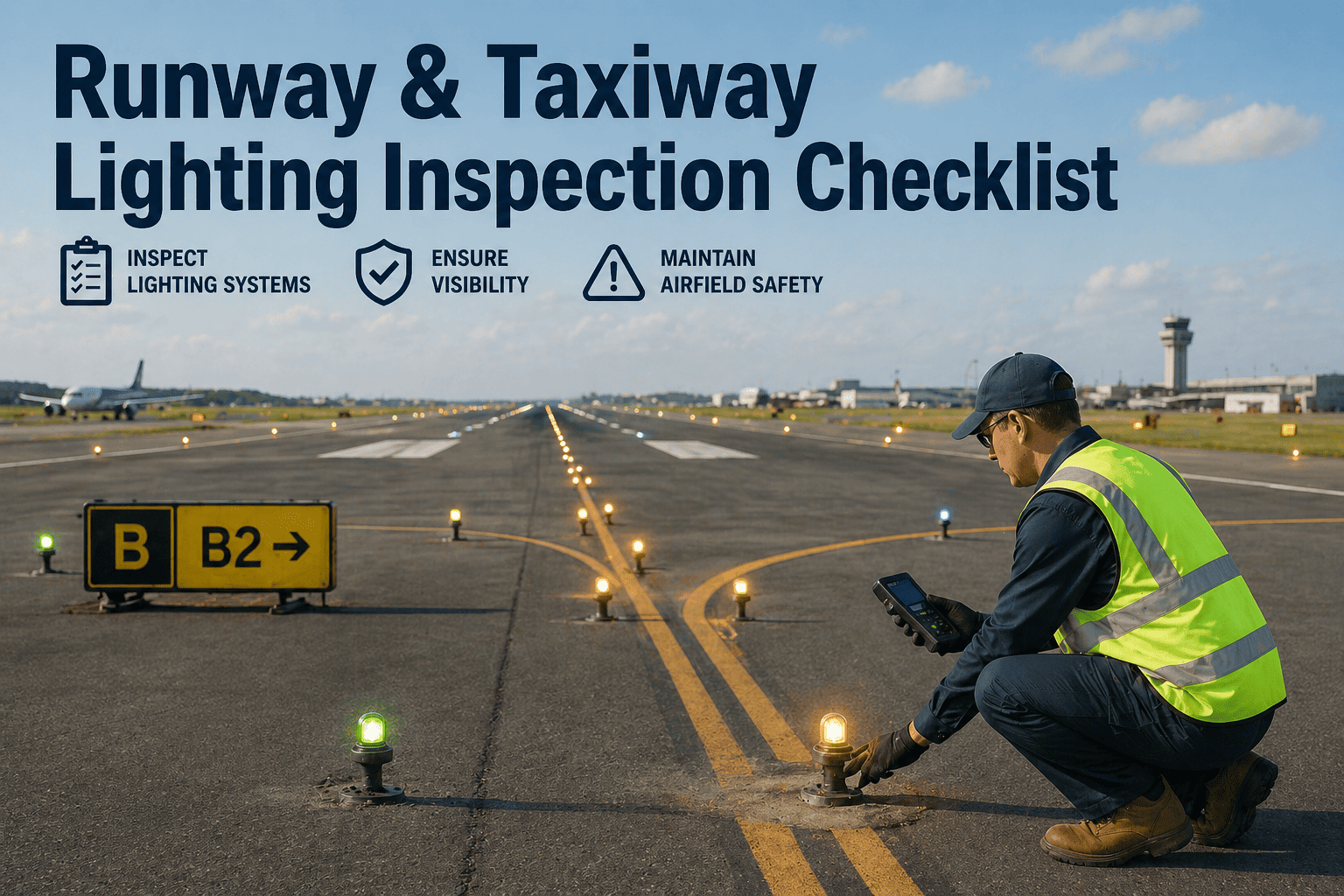
Visual Aids & Airfield Lighting
Visual aids drive safe ground movement and instrument approach availability. Outages must be reported to ATC within 2 hours and NOTAMed where required. Night inspection mandatory if air carrier operations occur after dusk.
Runway and taxiway markings — visibility and contrast at 70% threshold
Holding position markings clearly visible from cockpit angle
ILS critical area markings & runway centerline reflectivity
Mandatory instruction signs — illumination and panel condition
Taxiway directional, location, and information signs
Approach lighting if airport-owned — outage reported within 2 hr
03
§139.309 · Safety Areas
RSA, RESA & Safety Area Integrity
Runway Safety Areas and Runway End Safety Areas must be free of obstructions, ruts, and unauthorized equipment. Any obstruction triggers either correction before operations or operational shortening with NOTAM and threshold displacement.
RSA cleared of vehicles, equipment, and material stockpiles
RESA surfaces inspected for ruts, debris, standing water
Surface gradient and grading consistent with ACM specification
Frangible mounting integrity on lighting and signs
Object Free Areas clear of penetrating obstructions
Drainage ditches free of standing water and erosion
Jet blast fence integrity and apron edge condition
Threshold displacement markings if RESA reduction in effect
04
§139.339 · NOTAM & ATC Coordination
Conditions Reporting & NOTAM Filing
Every qualifying deficiency must be NOTAMed with correct identifiers and filed within the FAA window. ATIS must reflect current closures, RwyCC values, and operational restrictions before the next affected operation.
NOTAMs filed for runway edge light failures affecting approach
Approach lighting outages reported with airport identifier
Taxiway closures published with ICAO indicator and effective time
RwyCC condition codes posted on ATIS after weather events
ARFF Index status confirmed and NOTAMed if degraded
Post-ATIS field condition changes reported to ATC immediately
Air carrier operators notified of ARFF Index reductions
NOTAM cancellation confirmed once corrective action complete
05
§139.341 · AC 150/5370-2 · Construction
Active Construction Zone Compliance
Construction adjacent to movement areas requires the most intensive scrutiny. AC 150/5370-2 mandates inspection before each operational period. CSPP boundaries, barricades, and exclusion fencing must be verified — and gaps corrected before operations begin.
Barricades positioned per approved CSPP — no perimeter gaps
Lighted barricades operational where required at night
Taxiway closure X markings positioned and visible
Exclusion fencing integrity verified along boundary line
No vehicles, fuel storage, or stockpiles outside CSPP-approved zone
Open trenches in safety areas covered or barricaded
Mandatory instruction signs lit even on closed taxiways
Construction lighting and equipment removed from movement areas
06
§139.319 / §139.337 · ARFF & Wildlife
ARFF Readiness & Wildlife Hazard
ARFF personnel must be on duty meeting the required Index before the first air carrier arrival. Wildlife observed must be logged and runway strikes reported per the FAA-approved Wildlife Hazard Management Plan.
ARFF Index level confirmed per scheduled aircraft
Required ARFF personnel on duty and certified
ARFF vehicle readiness and agent quantities verified
Index downgrades NOTAMed before operations commence
Drainage ditches checked for seed-bearing vegetation
Perimeter areas inspected for rodent burrows and nesting
Wildlife observed logged with species, count, and location
Strike reports filed on FAA Form 5200-7 within window
The Common Findings
Where Airports Lose Points on FAA Audits
Across the 35 FAA Airport Certification Safety Inspectors who conduct Part 139 reviews, the same six failure patterns drive the majority of citations. Every one is a documentation problem before it is a maintenance problem.
01
Missing Daily Records
An inspection happened. The form did not get signed. To the FAA, an unsigned record is a missing record — and a missing record is a §139.327 violation.
02
Untracked Closures
A pavement deficiency found on Tuesday closed verbally on Friday. No corrective action timestamp. Open finding on the audit until the closure is reconstructed.
03
ARFF PM Gaps
Quarterly pump tests, hose inspection records, foam proportioner verification — top-5 finding category at Class I and II airports.
04
Training Records Out of Sync
Personnel training logs in three locations, partial since last FAA cycle, hard to produce on demand. Immediate finding.
05
NOTAM Cancellation Lag
Defect corrected, NOTAM still active. Reviewers see the disconnect between operational reality and published advisory immediately.
06
Marking Reflectivity Drift
Faded markings below the 70% threshold without a documented repaint schedule. Small finding that compounds over multiple cycles.
Every Part 139 finding starts the same way — a record that should have been written, but was not.OxMaint runs the entire daily inspection cycle digitally. See the workflow in a 30-minute walkthrough.
Inspectors run the six-zone walk on tablet or phone. Every finding photographed, GPS-tagged, and timestamped automatically — no transcription gap.
Auto Work Order Routing
Each deficiency creates an open work order. Severity routing assigns priority and target closure window. Open findings cannot be lost.
NOTAM Coordination Log
NOTAM filing and cancellation tracked as a workflow step. ATIS and ATC notification timestamps captured on the inspection record.
Closure Verification Photos
Corrective action photo required before closure. Reviewer sees the before-and-after image trail without leaving the platform.
24-Month Retention
Self-inspection records retained per AC 150/5200-18C with searchable archive. Audit production is one export, not three weeks of binder review.
Personnel Training Tracker
Self-inspection personnel certifications, recurrent training, and ACM familiarity tracked with expiration alerts and on-demand records.
FAQ
Questions Airport Operations Teams Ask
How often must Part 139 daily self-inspections be conducted?
FAA Part 139.327 requires at minimum one complete inspection daily before the first air carrier operation. Additional inspections are required after unusual conditions — accidents, weather events, construction activity changes — and night inspections are mandatory if air carrier operations occur after dusk or the airport supports an instrument approach.
What records must be retained, and for how long?
AC 150/5200-18C requires self-inspection records be retained for 24 months minimum, including each daily inspection form, all discrepancies logged, corrective actions taken, and closure documentation. Records must be available on demand to FAA inspectors during certification or unannounced inspections. Start a free trial to see how OxMaint structures this archive.
Can the same person conduct the inspection and sign the closure?
Yes — but the inspection personnel must be qualified per §139.327(b)(3), trained in vehicle and pedestrian operations, and familiar with the FAA-approved Airport Certification Manual. At Part 139 airports the certificate holder remains ultimately responsible for the airport's safe operation, regardless of which personnel conduct individual inspections.
What happens if an FAA inspector finds documentation gaps?
The post-inspection briefing produces a Letter of Correction listing violations with agreed correction dates. Continuing violations can trigger financial penalties per day of non-compliance. In severe cases the FAA may revoke the airport's certificate or limit areas where air carriers can operate. Book a demo to walk through how OxMaint eliminates documentation gaps as a finding category.
Trusted by Part 139 Airport Operations Teams
Daily Self-Inspection. Audit-Ready. Every Day.
Join airport operations teams using OxMaint to run Part 139 self-inspections digitally — checklists, NOTAMs, corrective actions, and 24-month retention in one platform. Live in 3 to 5 days, no implementation fees.