Manual borescope inspections take 5+ hours per engine, miss defects under fatigue, and ground aircraft that should be flying. Robotic inspection systems are cutting that time by up to 90% while catching significantly more findings under controlled trials. With the aerospace AI market projected to scale past several billion dollars and white-light robot inspectors already moving into production MRO shops, the shift from subjective human observation to consistent, data-rich robotic assessment isn't coming—it's here. The aviation maintenance teams connecting these inspection capabilities to digital work order workflows aren't just faster—they're building the data foundation that predictive maintenance demands. This is the operational guide for MRO professionals and airline maintenance teams ready to move.
Manual HPT Inspection Time
Per engine using traditional borescope—8–12 hrs for full turbine disk review
More Findings Detected
AI-assisted inspection consistently surfaces more anomalies than human-only review
Review Time Reduction
AI-powered borescope footage analysis can cut review time roughly in half
AI Defect Classification
Modern deep learning models achieve strong accuracy on common engine defect classes
Labor Hour Reduction
AI-powered robotic surface preparation cuts manual hours on cowls and inlet sleeves
Aerospace AI Market
Projected multi-billion-dollar market with strong compound growth through 2030
These aren't future projections—they represent capabilities already deployed or in advanced testing across major OEMs, airline maintenance organizations, and independent MROs worldwide. The question for every MRO facility and airline maintenance team isn't whether robotic inspection is coming. It's whether your maintenance workflow is ready to capture and act on the data these systems generate. Teams building that digital foundation today can start with OxMaint's inspection and work order management built for aviation operations.
From Flashlights to Robots: How Engine Inspection Evolved
An aircraft engine is the most valuable single asset in commercial aviation—a high-bypass turbofan costs $15–40 million. Keeping it airworthy depends on inspections inside spaces no human hand can reach: turbine blades, combustion chambers exceeding 1,500°C, and compressor stages with tolerances measured in thousandths of an inch. Each generation of inspection technology solved a specific problem—but also created data management challenges that only became clear at the next stage.
Legacy Era
Manual Visual Inspection
Technicians using flashlights and mirrors, physically disassembling engines for access. Time-intensive, fully subjective, paper-documented. Still used as final authority in many operations today.
Standard Practice
Video Borescope Inspection
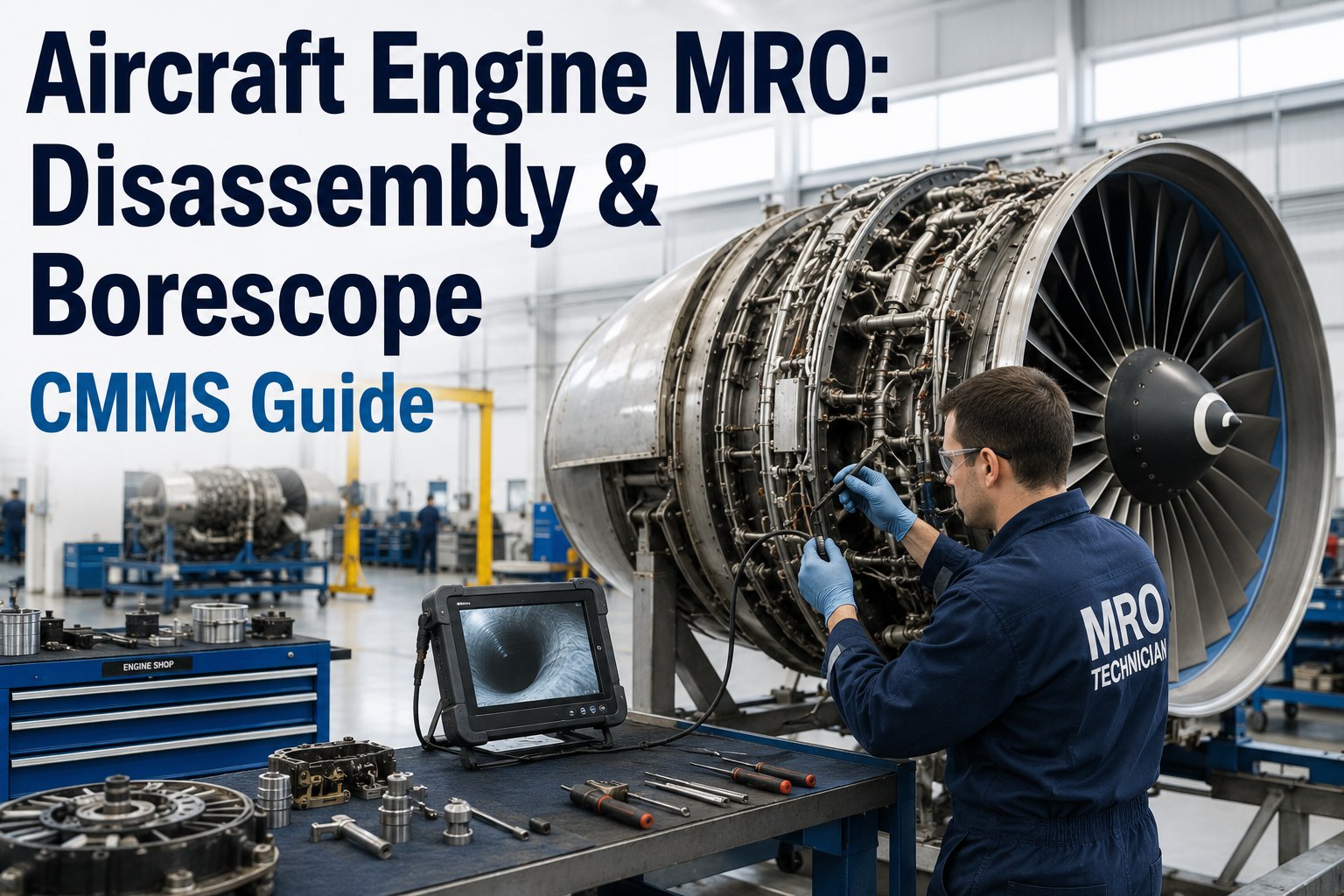
Flexible fiber-optic and video borescopes inserted through engine access ports. Non-destructive, on-wing capable, with image capture. Reduced disassembly needs but remains operator-dependent and time-consuming.
Current Frontier
AI-Assisted Borescope Analysis
Deep learning models analyze borescope footage to auto-detect cracks, erosion, corrosion, and coating damage. AI flags findings, measures defects, counts blades—while humans make final disposition. Already deployed across major airline maintenance organizations and independent MROs.
Emerging Now
Autonomous Robotic Inspection
Soft inchworm-style robots, white-light scanning robot arms, and miniature collaborative micro-bots navigate engine internals autonomously. Capture consistent digital records every cycle. First production deployments are now underway at advanced MRO facilities.
Next Horizon
Self-Inspecting Engines
Permanently embedded sensor networks and micro-cameras providing continuous in-flight health monitoring. Thermally protected periscope-style concepts aim to make the engine aware of its own condition in real time.
Every step in this evolution generates more data, faster, with higher precision. But data without a system to capture it, link it to the right asset, trigger the right work order, and build a searchable compliance trail is just noise. That's where CMMS integration becomes the critical infrastructure beneath the robotic capabilities. Aviation teams ready to build that foundation can book a demo to see how OxMaint connects inspection findings to maintenance action.
The Robotic Systems Redefining Engine Inspection
Four categories of robotic technology are reshaping how engines get inspected—each addressing a different challenge in the maintenance workflow. What unites them is the shift from subjective human observation to consistent, measurable, digitally-recorded assessment.
White-Light Robot Inspectors
Articulated robotic scanning systems
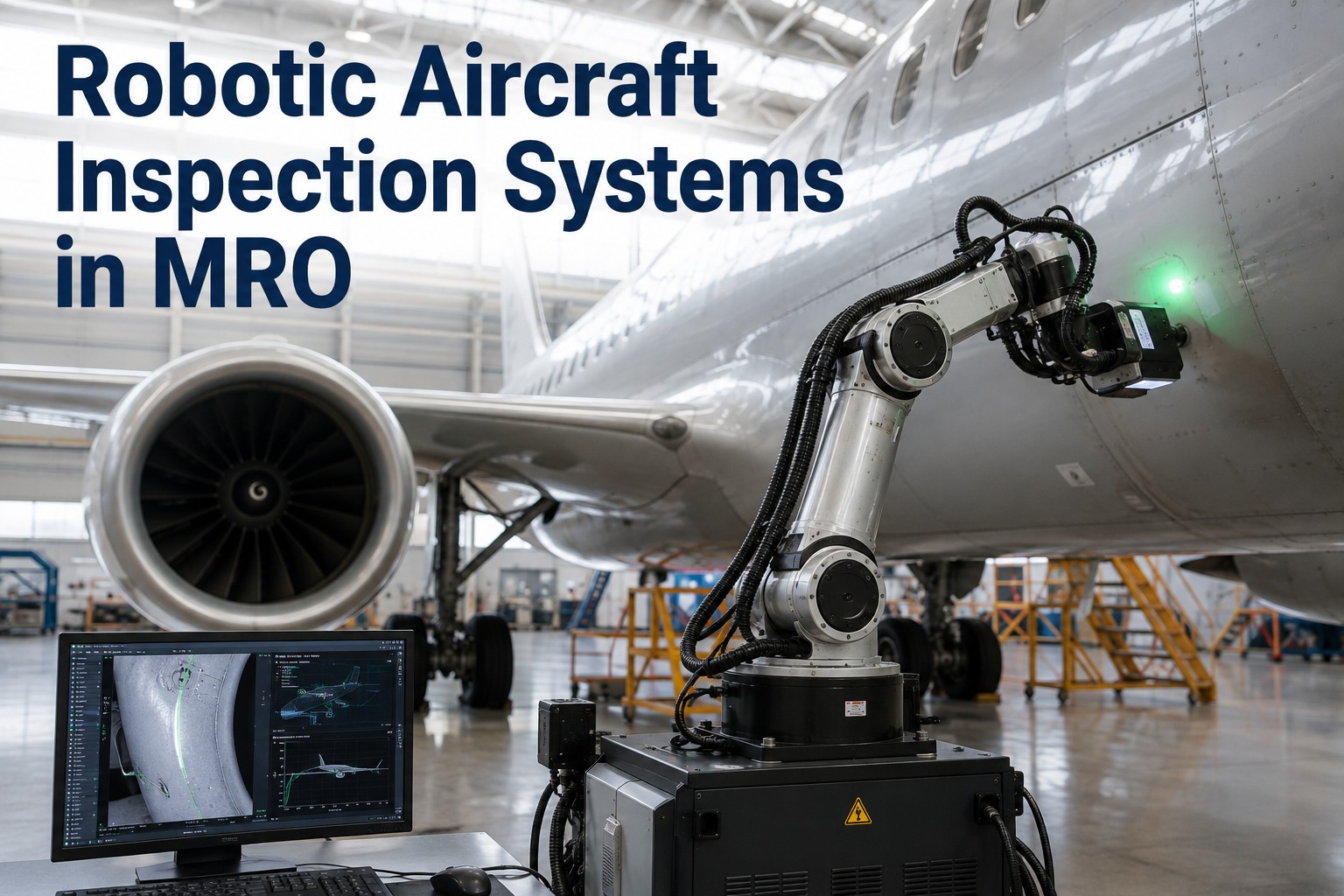
Two articulated industrial robots with white-light optical scanners perform choreographed scans of turbine disks. Line-scan cameras produce video-like streams matching human eye resolution. Every anomaly gets a numerical severity value and chronological part narrative stored in the cloud.
Replaces 8–12 hour manual staring sessions with consistent digital records
Soft Inchworm Robots
Bio-inspired untethered platforms
Inchworm-style robots using untethered soft robotics to navigate curved surfaces and narrow passages. Flexible body adapts to complex geometries inaccessible to rigid tools. Operated via controller with programmable inspection paths.
Reaches areas impossible for rigid borescopes—no engine removal needed
Collaborative Micro-Robots
Insect-inspired swarm systems
Miniature collaborative robots measuring around 10mm in diameter, deployed into combustion chambers via snake-style delivery robots. Each carries a miniature camera for live video feed. Designed to work autonomously and collaboratively to map engine internals.
Target: 5-minute inspections replacing the 5-hour manual process
AI Borescope Analysis Software
Cloud-based vision platforms
Cloud-based AI analyzing borescope video from any MRO. Auto-detects defects, counts blades, performs speed analysis. Typically offered in two flavors: real-time inspection assistance and post-inspection QA review. Already in production use across major maintenance organizations.
Roughly 50% faster reviews and 2–3x more findings vs. human-only inspection
What all four technologies share is a fundamental need: structured digital infrastructure to receive, organize, and act on the data they produce. The robot finds the defect. The CMMS ensures it gets fixed, documented, and tracked. Aviation teams building that infrastructure can sign up for OxMaint to connect inspections with automated maintenance workflows.
Manual vs. Robotic: What Actually Changes in Practice
The shift to robotic and AI-assisted inspection isn't just about speed. It changes the quality, consistency, and downstream utility of every inspection event across the metrics that matter most to MRO operations.
Metric
Manual Borescope
Robotic / AI-Assisted
Inspection Time per Engine
5–12 hours
30 min – 2 hours
Defect Detection Consistency
Varies by inspector fatigue and experience
Consistent across every inspection cycle
Documentation Output
Manual reports, photos saved separately
Auto-generated digital records with severity scoring
Engine Disassembly Required
Often required for deep inspection
On-wing inspection through access ports
Predictive Data Generation
None—point-in-time snapshots only
Chronological defect tracking enables trend analysis
Audit Trail Quality
Depends on individual paperwork discipline
Automatic, timestamped, searchable, complete
Your Inspection Data Is Only as Good as Your Workflow
Whether you're using traditional borescopes or preparing for robotic systems, OxMaint connects every finding to a work order, every work order to a resolution, and every resolution to an audit-ready record.
Connecting Robots to Results: The CMMS Integration Imperative
Here is the reality most robotic inspection discussions miss: the robot is just the sensor. What happens after it finds a defect determines whether you prevent a failure or just document one. The workflow from robotic finding to verified resolution is where operational value is created—or lost.
01
Detect
Robot or AI flags defect with location, type, and severity score
02
Log
Finding auto-logged in CMMS linked to engine serial number
03
Prioritize
System assesses criticality and generates work order automatically
04
Execute
Technician completes repair, logs parts, labor, and actions taken
05
Verify
Supervisor confirms resolution, CMMS closes loop with full audit trail
Without CMMS integration, robotic findings sit in disconnected databases. With it, every detection becomes a tracked, resolved, auditable maintenance event.
This closed-loop workflow is where the investment in a CMMS platform pays the highest return. It transforms robotic inspection from an expensive data-collection exercise into a predictive maintenance engine. Every defect logged and resolved builds the historical dataset that AI models need to predict failures before they happen. Organizations ready to build this capability can book a demo to see how OxMaint automates the finding-to-resolution workflow.
What This Means for Your Team Right Now
You don't need a fleet of micro-robots to benefit from the inspection automation revolution. The most impactful step any MRO or airline maintenance team can take today is digitizing the workflow between finding a defect and confirming its resolution. Here's why the urgency is real—and what to do about it.
Pressure
Massive Aircraft Backlog
New deliveries are years out. Your current engines need to last longer, perform harder, and stay airworthy under increasing utilization.
Your Move
Digitize engine inspection records and build complete maintenance histories that support extended service life and informed repair-vs-replace decisions.
Pressure
MRO Workforce Shortage
Fewer qualified inspectors must cover more engines. Manual borescope review is the most fatiguing, error-prone task in the shop—and there aren't enough people to do it.
Your Move
Adopt AI-assisted borescope analysis to multiply inspector effectiveness and pair it with automated work order generation so findings don't wait on human routing.
Pressure
Expanding SMS Mandates
Expanded Safety Management System rules, regional Part 145 requirements, and international annex updates all demand more documentation, more traceability, more proof of compliance—not less.
Your Move
Implement a CMMS that auto-generates audit trails linking every inspection finding to its corrective action and verified resolution—continuous compliance, not pre-audit scrambles.
Expert Perspective: The Real Bottleneck Isn't the Robot—It's the Workflow
After nearly two decades in engine MRO—from hands-on borescope inspection across narrow-body turbofan platforms to managing inspection programs across mixed fleets—one thing is clear. The technology coming out of major OEM labs is genuinely impressive, but here's what most people in this industry already know: the bottleneck was never the inspection itself. It's what happens after. Findings get flagged, photographed, even marked as critical—and then sit in someone's inbox for days because there's no system to route them automatically to a work order, assign a technician, stage the parts, and track the resolution. The shops with the best on-time performance and the cleanest audit records aren't necessarily running the newest robots. They're the ones where every finding, from every borescope session, feeds directly into a CMMS that won't let anything fall through. That discipline—detection to documentation to resolution in one closed loop—is what separates the MROs that pass audits without scrambling from the ones pulling all-nighters before every regulatory review. If you're investing in AI-assisted inspection tools, invest in the workflow infrastructure first. The data is only useful if it drives action.
Senior Engine MRO Operations Consultant
Nearly two decades in aviation engine maintenance, repair, and overhaul operations
The inspection technology is advancing rapidly—but without a digital workflow connecting findings to work orders, even the best robotic data goes unactioned
MROs with the cleanest audit records share one trait: every borescope finding links to a corrective action, and every action links to a verified closure in their CMMS
Start with workflow discipline and structured data capture today—that's the foundation AI-driven predictive maintenance will require tomorrow
Frequently Asked Questions
How do robotic borescope systems work for aircraft engine inspection?
Robotic borescope systems use flexible or miniature robots equipped with high-resolution cameras and sensors to navigate the internal structures of aircraft engines through small access ports. They capture detailed imagery of turbine blades, compressor sections, and combustion chambers without requiring engine disassembly. Systems range from articulated robot arms with white-light scanners to soft inchworm-style robots and miniature collaborative micro-bots. All transmit live video and measurement data for real-time defect analysis, and the newest systems automatically assign severity scores to every finding.
What time savings do robotic inspection systems deliver compared to manual methods?
Time savings vary by system maturity. AI-powered borescope analysis software available today can reduce footage review time by roughly half and save several hours per inspection cycle. White-light robot inspectors eliminate the 8–12 hour manual staring sessions for turbine disk inspection. Emerging micro-robot concepts target reducing 5-hour manual inspections to a handful of minutes—though many are still in development. Even current tools deliver substantial gains when paired with a CMMS that auto-generates work orders from findings.
Why is CMMS integration essential for robotic engine inspections?
CMMS integration creates the closed loop between detection and resolution. Without it, robotic findings sit in disconnected databases. With CMMS integration, every defect is automatically logged against the specific engine serial number, linked to the affected component, prioritized by criticality, assigned to qualified technicians, tracked through repair, and verified at closure. This builds the searchable audit trails regulators expect and generates the structured historical data that predictive maintenance analytics require.
Can small MRO operators benefit from inspection automation?
Yes. While advanced micro-robots and white-light scanning arms are still concentrated at major OEM facilities, cloud-based AI borescope analysis is already accessible to any MRO—upload inspection video and receive AI-processed findings within minutes. More importantly, small operators immediately benefit from digital inspection workflows and CMMS platforms that automate finding documentation, work order generation, and compliance tracking. These deliver measurable efficiency gains without massive capital investment and build the data foundation for more advanced capabilities as they become available.
What role does AI play in aircraft engine borescope inspections?
AI serves three functions in modern borescope inspection. First, defect detection: deep learning models trained on large libraries of engine images automatically identify cracks, erosion, corrosion, coating delamination, and foreign object damage with strong classification accuracy. Second, measurement and severity scoring: AI assigns numerical values to anomalies and tracks them chronologically, building a condition history for each part. Third, quality assurance: AI review tools analyze footage after the fact to ensure no findings were missed, consistently surfacing more relevant defects than human-only inspection. In all cases, the human inspector retains final disposition authority—AI augments rather than replaces expert judgment.
Build the Foundation Robotic Inspection Demands
Join aviation maintenance teams using OxMaint to digitize inspection workflows, automate work order generation from findings, and build the compliance-ready documentation that keeps engines flying and regulators satisfied.