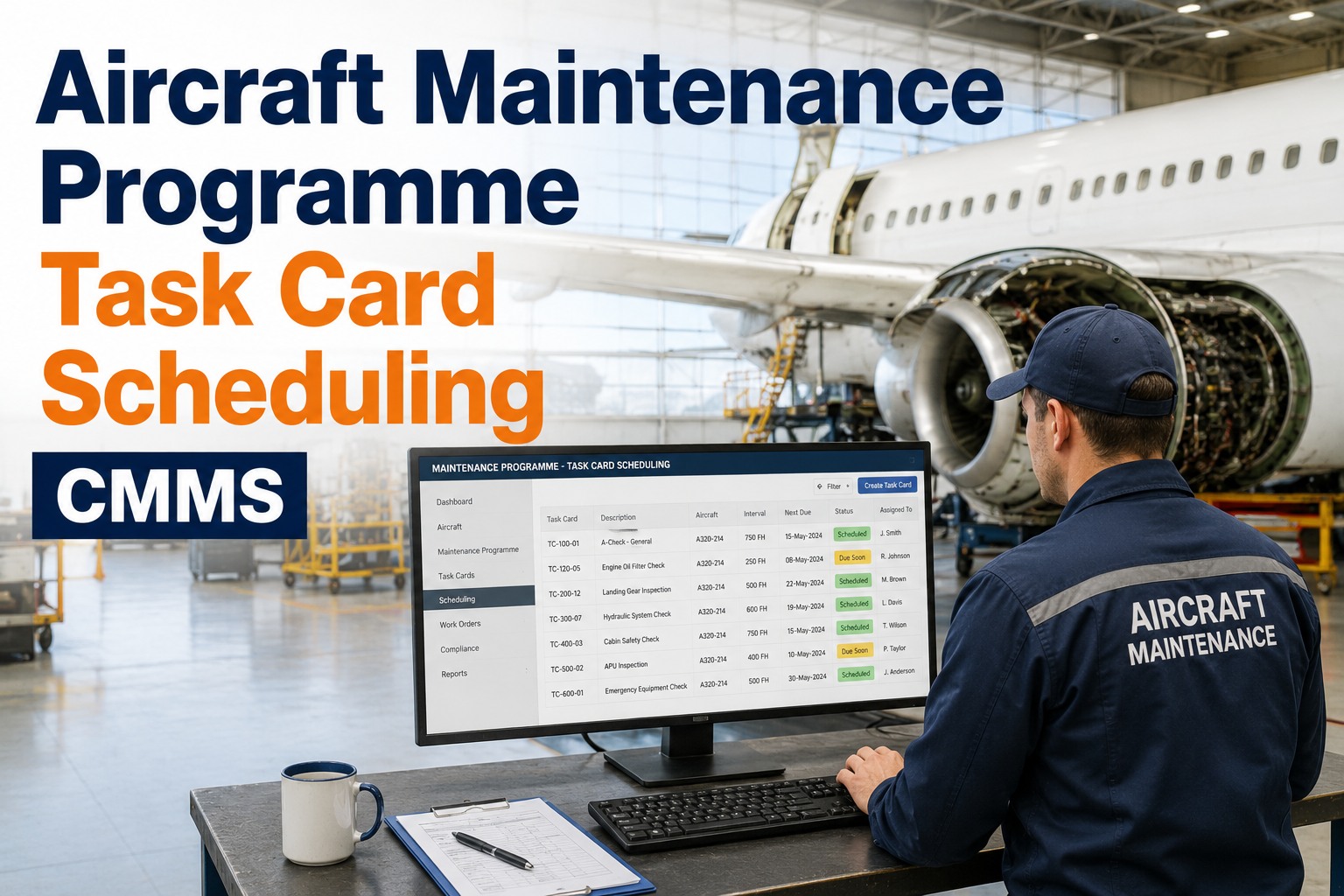
An aircraft maintenance programme (AMP) task card scheduling CMMS transforms how aviation maintenance teams generate, track, and execute interval-based scheduled tasks across every tail in their fleet. When AMP task cards are structured correctly inside a modern CMMS, maintenance planners eliminate spreadsheet chaos, ensure 100% regulatory traceability, and automatically trigger work orders at the exact flight-hour or cycle threshold. This CMMS AMP tracking guide explains how to align programme task card automation with real hangar execution, reduce aircraft ground time, and keep every aircraft airworthy — and you can Start Free Trial to see the workflow live on your fleet today.
Is Your AMP Task Card Scheduling Still Chasing Spreadsheets While Aircraft Sit AOG?
A single missed interval can ground a multi-million-dollar aircraft for days. Modern CMMS-based programme task scheduling replaces manual tracking with automatic, effectivity-driven work order creation — so no task card slips through the cracks.
with Automated CMMS Scheduling
What Is Aircraft Maintenance Programme Task Card Scheduling in a CMMS?
An aircraft maintenance programme defines every recurring inspection, lubrication, and structural check an airframe needs. In a CMMS, each programme task becomes a digital task card linked to a specific tail, interval trigger, and revision history — eliminating the disconnect between the approved programme and hangar execution.
Task Source Traceability
Every task card traces back to its MRBR, MPD, or custom programme reference. When auditors ask for proof, planners pull the full revision chain in seconds — not days.
Effectivity by Tail
Each aircraft carries unique effectivity rules. A CMMS applies the correct task card set per tail — engine variant, cabin configuration, and SB incorporation status — automatically.
Interval-Based Auto-Generation
Flight hours, cycles, and calendar days trigger work orders without manual data entry. OxMaint pushes task cards into the planning queue before the threshold window closes.
How to Structure AMP Task Cards for Automatic Work Order Creation
A 50-aircraft fleet flying 2,800 hours per tail annually generates over 12,000 interval-triggered task cards per year. Structuring those cards correctly in the CMMS is what separates a proactive planning department from a reactive one.
Import the Approved Maintenance Programme
Load MPD line items, MRBR tasks, and operator-specific programme tasks into OxMaint. Each task captures interval type (FH, FC, CAL), threshold, repeat interval, and applicable effectivity codes.
Map Effectivity to Each Tail
Assign aircraft serial numbers to effectivity groups. The CMMS resolves which task cards apply to which tail — so a Configuration-A aircraft never receives a Configuration-B inspection card.
Set Escalation and De-Escalation Rules
Define tolerance bands (typically 10% FH or 500 FH, per programme limits). OxMaint escalates overdue cards to maintenance control and de-escalates when utilisation drops — keeping you compliant without unnecessary AOG events.
Enable Automatic Work Order Generation
When a task card crosses its pre-trigger window — say, 80% of interval — OxMaint auto-creates a work order, assigns it to the next scheduled check, and reserves required spare parts and labour hours.
Manage Revisions Without Re-Keying
When the OEM issues an MPD revision, import the delta. OxMaint updates affected task cards, preserves historical compliance records, and flags any task whose interval or threshold changed for planner review.
CMMS vs. Spreadsheets: The Real Cost of Manual AMP Tracking
A regional operator managing 22 aircraft on shared spreadsheets spends an average of 120 labour-hours per month reconciling intervals against actual utilisation. One missed 4C-check card can cost $180K in expedited grounding and charter substitutions.
| Capability | Spreadsheet / Manual | OxMaint CMMS |
|---|---|---|
| Interval tracking method | Manual FH/FC entry, weekly reconciliation | Live integration with ACARS, flight logs, manual updates |
| Task card generation | Planner creates WO by hand, high error risk | Auto-generated at 80% interval threshold |
| Effectivity management | Filtered columns, prone to copy-paste errors | Rule-based per-tail assignment, zero manual matching |
| Revision control | Email chains, file v1-v9, no audit trail | Versioned programme imports with delta flagging |
| Escalation alerts | Conditional formatting, easily missed | Automated escalation to maintenance control at 95% interval |
| Audit readiness | 2–5 days to compile compliance evidence | One-click compliance report per tail, per task |
| Annual planning cost (22 a/c) | $145K labour + $180K AOG risk exposure | $36K labour, AOG risk cut by 70% |
How OxMaint Solves Aircraft AMP Task Card Scheduling
OxMaint turns a static PDF maintenance programme into a live, self-executing scheduling engine. These are the four capabilities that deliver measurable ROI for maintenance and reliability teams.
Predictive Interval Triggering
OxMaint's AI analyses historical utilisation patterns to predict when each task card will hit threshold — pre-positioning parts and labour 14–21 days before the work order drops.
One-Click Audit Compliance
Every task card carries its full DNA — source reference, revision level, sign-offs, and compliance evidence. Generate a regulator-ready report per tail in under 60 seconds.
Revision Delta Management
When the OEM revises the MPD, OxMaint ingests the delta, flags every affected task card, and routes the changes to your reliability team for review — no re-keying, no orphaned tasks.
Fleet-Wide Forecasting Analytics
Visualise every upcoming task card across the fleet on a 12-month rolling timeline. Optimise check packing to bundle cards into scheduled inputs rather than reactive line visits.
Worked Example: A 35-Aircraft Narrow-Body Fleet
Consider a low-cost carrier operating 35 A320-family aircraft at 3,100 FH per tail annually. Their approved programme contains roughly 850 unique task cards per aircraft type, with intervals ranging from 600 FH (line checks) to 12 years (structural).
Spreadsheet-Based Programme Tracking
- 4 full-time planners manually reconciling FH/FC against 29,750 active task cards
- Average 6 task cards per month discovered overdue during weekly review
- 2 aircraft grounded per quarter for expedited checks — $220K charter cost
- Regulatory audit required 5 days of planner time to compile evidence
CMMS-Driven Automated Scheduling
- 2 planners managing the same 29,750 cards — system handles reconciliation
- Overdue task cards dropped to 0.3 per month (pre-trigger alerts caught 99.7%)
- Expedited grounding eliminated — 100% of checks packed into scheduled inputs
- Audit evidence generated in 90 minutes via one-click compliance report
What Maintenance Planners Say About OxMaint
"We moved from colour-coded spreadsheets to OxMaint's AMP task card scheduling in six weeks. The first month alone, the system flagged 11 task cards our manual process had missed — three of them were 1C inspections. That paid for the platform for the entire year."
See OxMaint Schedule Your Fleet's Task Cards Live
Book a 30-minute demo and we'll load your maintenance programme, map effectivity to your tails, and show you automatic work order generation in real time.
Aircraft Maintenance Programme Task Card Scheduling FAQs
What is an AMP task card in aviation CMMS?
An AMP task card is a digital record of a single scheduled maintenance task — inspection, lubrication, replacement, or test — extracted from the approved aircraft maintenance programme. In a CMMS like OxMaint, each task card carries its interval trigger (FH, FC, or calendar), effectivity rules, revision reference, and compliance status, enabling automatic work order creation when the threshold approaches.
How does a CMMS automate task card scheduling for aircraft?
A CMMS ingests the approved maintenance programme, maps each task card to applicable tails via effectivity codes, and monitors utilisation data (flight hours, cycles, calendar days). When a task card reaches its pre-trigger threshold — typically 80% of interval — the system auto-generates a work order, assigns it to the next scheduled input, and reserves parts and labour. You can see this live by booking a demo .
Can OxMaint handle escalation and de-escalation of maintenance programme tasks?
Yes. OxMaint lets you define tolerance bands per task card — for example, 10% FH escalation or 500 FH buffer. When utilisation is high and a card approaches its limit, the system escalates it to maintenance control with priority alerts. When utilisation drops, de-escalation rules prevent unnecessary early pulls, keeping checks inside the optimal window.
How does OxMaint manage MPD and maintenance programme revisions?
When the OEM issues an MPD revision, you import the delta file into OxMaint. The system identifies every affected task card, flags interval or threshold changes, routes them to your reliability team for review, and preserves the full historical compliance chain. No re-keying, no orphaned tasks, and no loss of audit traceability.
How long does it take to migrate from spreadsheets to OxMaint for AMP tracking?
Most operators with 20–40 aircraft complete the migration in 4–8 weeks. OxMaint's onboarding team imports your approved programme, configures effectivity per tail, and validates interval triggers against historical compliance data. Start your migration with a free trial at — no credit card required.
Stop Tracking Task Cards by Hand. Start Scheduling Them by Intelligence.
Join the maintenance teams using OxMaint to automate AMP task card scheduling, eliminate overdue cards, and cut ground time by up to 50%.
Free 14-day trial · No credit card