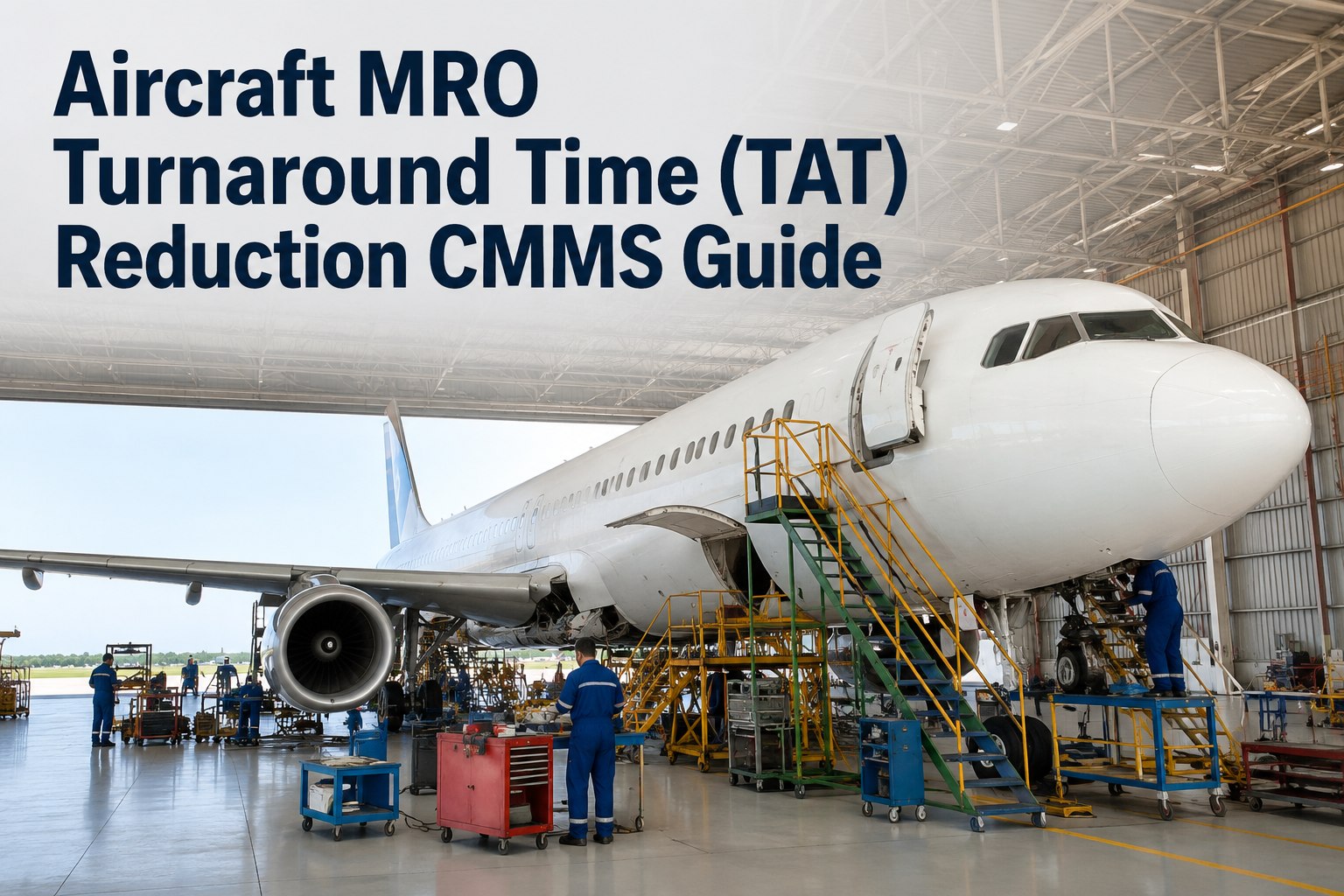
For aviation MRO providers, turnaround time is the single metric that airlines use to decide whether to send their next aircraft to your hangar or a competitor's. Every day shaved off a C-check or base maintenance event translates directly into revenue-generating flying hours for the customer, which is why top-performing facilities consistently beat industry-average TAT by 20 to 30 percent. Achieving that gap requires more than extra manpower; it demands parallel workflow design, disciplined kitting, streamlined authorization chains, and tight control over non-routine findings. A modern CMMS provides the real-time visibility and finding-to-disposition tracking needed to prevent scope creep from quietly extending your committed delivery date. Start Free Trial today to see how data-driven TAT management transforms your production floor.
Is your hangar leaving revenue on the ramp while competitors close checks days faster?
Industry-average TAT drift costs a typical mid-size MRO facility between $4M and $7M annually in lost slot utilization and re-work penalties. The gap between average and top-quartile performance is not labor hours — it is workflow architecture, finding-to-disposition velocity, and CMMS-driven visibility that prevents silent scope expansion.
Why every saved day is worth thousands to your customer
A narrowbody aircraft generates roughly $8,000 to $12,000 in daily revenue per flying day; a widebody can exceed $25,000. When your hangar holds an aircraft three extra days, the operator loses real cash — and remembers it at the next contract renewal.
A 737 C-check scheduled for 18 days that finishes in 14 does not just save four days of hangar rent — it returns roughly $40,000 in flying revenue to the operator and locks in the next annual contract.
Five parallel-workflow levers that compress TAT
Sequential maintenance is the default failure mode of under-resourced planning teams. Top MROs break the critical path into parallel streams, each tracked to a milestone in the CMMS.
Parallel task packaging
−2 to −4 daysPackage structural, systems, interior, and avionics tasks into concurrent work orders rather than sequential phases. A CMMS with dependency mapping prevents two crews from claiming the same zone, cutting idle time on the critical path by 15–25%.
Pre-loaded kitting and staging
−1 to −3 daysKit every routine card — parts, consumables, tools, and drawings — 72 hours before aircraft induction. Facilities that kit to 85%+ of routine task cards reduce parts-chase delays by an average of 2.3 days per C-check.
Finding-to-disposition fast-tracking
−24 to −48hRoute every non-routine finding through a mobile CMMS form that auto-notifies the DER, QA, and customer rep. Compressing the raise-review-approve cycle from days to hours is the single highest-impact TAT lever for non-routine-heavy events.
Authorization chain streamlining
−6 to −12hReplace paper routing slips with digital sign-offs that enforce role-based approval rules inside the CMMS. Eliminate the typical 6–12 hours lost per event chasing inspectors across three shifts and distant offices.
Scope-expansion control
−2 to −5 daysTag every additional task with a customer-impact flag and a live TAT-impact calculation. When scope growth threatens the committed delivery date, the CMMS forces a re-plan conversation instead of a silent slip.
Where 40% of TAT quietly disappears
Non-routine findings are not the enemy — unmanaged non-routines are. Without a closed-loop finding-to-disposition workflow, each discovery becomes a micro-delay that compounds across hundreds of task cards.
Disposition latency — the gap between a finding being raised and a repair scheme being approved — is the only variable a CMMS can compress by more than 70% without adding headcount.
Worked example: 12-year 737-800 C-check
A regional MRO facility inducts a 737-800 on a planned 21-day C-check. By day 6, inspectors have raised 312 non-routine findings — 18% above the historical baseline for that fleet age. Without CMMS tracking, the average finding sits 41 hours before disposition. With digital finding-to-disposition routing, that latency drops to 9 hours. The net effect: 3.1 days recovered on a 21-day event, a 14.7% TAT reduction delivered entirely through workflow visibility.
What a TAT-aware CMMS shows that spreadsheets cannot
A spreadsheet tells you the aircraft is late. A CMMS tells you why, where, and which supervisor to call — in real time, before the slip happens.
| TAT Control Dimension | Spreadsheet / Paper Tracking | CMMS with TAT Visibility |
|---|---|---|
| Finding-to-disposition cycle time | Unknown until end-of-event audit; typically 36–52h | Live dashboard, alert at 8h, average 9–14h |
| Scope expansion tracking | Manual addendum sheets, often lost | Auto-tagged with TAT-impact delta and customer notification |
| Kitting readiness at induction | "Walk and look" verification | Kit completion % tracked to task card, alerts at 72h pre-induction |
| Critical-path dependency mapping | Static Gantt chart, rarely updated | Dynamic re-critical-path on every task close-out |
| Authorization latency | Paper routing slips, shift handoffs | Role-based digital sign-off with timestamp audit trail |
| Forecasted vs. committed delivery | Updated weekly, often stale | Hourly reforecast based on actual close-out velocity |
A 90-day path from CMMS rollout to measurable TAT reduction
MROs that deploy a TAT-focused CMMS in structured 30-day phases see the first measurable delivery-date improvements by day 75, with full 20–30% TAT gains realized within two induction cycles.
Configure task-card data and zone logic
Import the last 24 months of routine and non-routine task cards. Map zones, skills, and authorization roles. Stand up the finding-to-disposition workflow with mobile capture for inspectors. Baseline your current average TAT by check type.
Deploy kitting gates and authorization routing
Enforce 72-hour pre-induction kitting completion. Activate role-based digital sign-offs. Enable scope-expansion alerts that flag any finding adding more than 4 hours to the critical path. Train production planners on the live reforecast view.
Tune critical-path parallelization and measure TAT delta
Run the first full induction under CMMS-tracked parallel workflows. Compare forecasted vs. actual close-out velocity. Identify residual disposition bottlenecks and re-route. Most facilities record their first 8–12% TAT reduction in this phase.
Ready to reclaim 2–4 revenue days per aircraft?
Deploy a CMMS built for aviation MRO TAT reduction. Configure finding-to-disposition workflows, kitting gates, and live delivery-forecasting in under 30 days.
Aircraft MRO TAT reduction, answered
What is a realistic TAT reduction target in the first year of CMMS deployment?
Most MRO facilities achieve an 8–15% reduction in the first 90 days by closing disposition-latency gaps, with cumulative gains of 20–30% within 12 months as kitting gates and parallel-workflow logic mature. The largest single jump typically comes from compressing finding-to-disposition cycle time, which alone can recover 2–3 days on a heavy C-check.
How does a CMMS prevent scope expansion from extending the committed delivery date?
Every non-routine finding is tagged with a TAT-impact estimate and routed to a re-plan workflow once cumulative additions exceed a configurable threshold — typically 4% of planned TAT. The system forces a customer-facing conversation about scope, cost, and schedule rather than allowing silent slippage. You can see this in action by scheduling a Book a Demo session.
Can a CMMS reduce TAT without adding inspectors or mechanics?
Yes. The majority of TAT waste is latency — time spent waiting for dispositions, parts, or authorizations — not labor shortage. A CMMS eliminates waiting time by routing work in parallel and surfacing bottlenecks in real time. Facilities routinely recover 10–18% TAT with the same headcount, simply by removing idle intervals from the critical path.
What check types benefit most from CMMS-driven TAT reduction?
Heavy C-checks, 12-year inspections, and major modifications benefit most because they carry the highest non-routine density — often 300+ findings per event — and the longest disposition chains. Line maintenance also benefits, but the absolute day-count savings are smaller. A typical 18-day C-check can compress to 14–15 days with disciplined CMMS workflows.
How long does it take to deploy a TAT-focused CMMS in an active MRO facility?
A structured rollout follows a 90-day path: 30 days for data import and workflow configuration, 30 days for kitting gates and authorization routing activation, and 30 days for live optimization. The first measurable TAT improvement usually appears by day 75. You can begin configuration immediately with a Start Free Trial account.
Start compressing your TAT today
Join the MROs beating industry-average turnaround time by 20–30% with CMMS-driven workflow visibility.
Free 14-day trial · No credit card