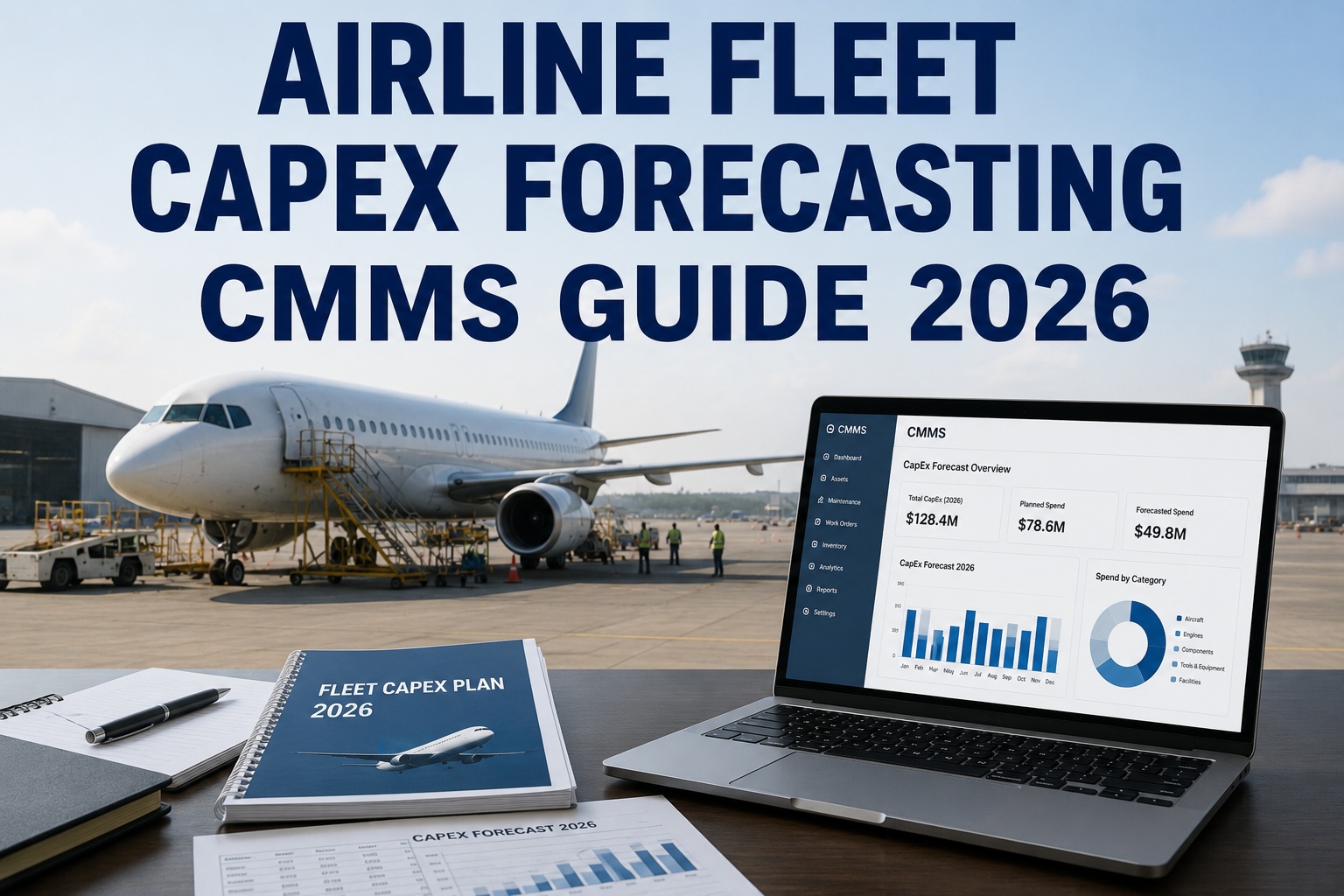
Aircraft maintenance due forecast planning is the disciplined practice of projecting when each tail, engine, APU, and component will cross its next inspection threshold — by flight hours, cycles, calendar days, or condition-monitoring limits — and sequencing those tasks so that line and base maintenance stay ahead of every due date. A CMMS built for maintenance due forecasting turns that spreadsheet scramble into weeks-ahead workload visibility, letting fleet planners allocate technicians, hangar slots, rotables, and spares before bottlenecks develop. For reliability teams managing mixed-fleet operations, the difference between a planned C-check and a last-minute AOG event often comes down to forecast accuracy and escalation logic. This guide breaks down how to build a rolling maintenance forecast inside a CMMS, with task-escalation rules, deferred-defect aging, and resource-allocation strategies that keep aircraft flying. Ready to see it on your fleet? Start Free Trial and generate your first forecast in minutes.
Aircraft Maintenance Forecasting Guide
Are you planning MRO visits weeks ahead — or scrambling at every AOG?
A CMMS-driven aircraft maintenance due forecast gives planners weeks-ahead workload visibility, projects hours and cycles with precision, and allocates resources before bottlenecks ground a single tail.
Forecast Inputs
What goes into an aircraft maintenance due forecast?
A reliable fleet forecast CMMS blends four data streams into a single rolling horizon — every due date your reliability team needs to see in one place.
Hours & Cycles Projections
Forecast remaining flight hours and cycles against MPD thresholds. A CMMS pulls utilisation data nightly and recalculates every task due within your rolling 30/60/90-day window.
Calendar-Based Tasks
Calendar due items — 12-month inspections, 36-month structural checks, RVSM recertification — are projected forward automatically, so no recurring task falls off the radar.
Deferred Defect Aging
Every deferred defect (DD) is aged daily against its MEL/CDL repair interval. The CMMS flags DDs approaching their hard limit 7, 14, and 30 days out — before they become grounding events.
Task Escalation Logic
When a threshold is crossed — say, a boroscope inspection escalating from 500 to 250 cycles remaining — the forecast automatically re-prioritises the work order and notifies planning.
Forecasting Logic
How a CMMS calculates maintenance due dates
Forecasting isn't a guess — it's a structured calculation. Here's the formula your aircraft due forecast CMMS should run for every task on every tail.
Example: An engine boroscope due at 6,000 cycles, currently at 5,720, flying ~28 cycles/day → (280 ÷ 28) = 10 days remaining. The CMMS plots this task into your 14-day hangar window with a 4-day buffer.
Buffer limits are configurable per task category: line checks at 3 days, hangar visits at 14 days, structural inspections at 30 days. Crossing any limit auto-escalates the work order and re-sequences the forecast.
Rolling Forecast Build
How to build a rolling maintenance forecast step by step
A 60-day rolling forecast is the gold standard for fleet planners — far enough to mobilise resources, near enough to be actionable. Follow these five steps.
Ingest utilisation data nightly
Connect the CMMS to ACARS, flight ops, or manual daily utilisation feeds. Every flight hour and cycle updates remaining-life calculations across all tasks for that tail overnight.
Project all due items onto a 60-day horizon
The CMMS plots hours-based, cycles-based, and calendar-based tasks on a unified timeline. Deferred defects are layered in with their MEL repair deadlines so nothing hides.
Apply escalation logic and buffer alerts
Tasks inside buffer windows are flagged red. The system auto-escalates priority, notifies the planning team, and pushes the work order into the ready-to-schedule queue.
Match resources to forecasted workload
Check technician availability, hangar slot capacity, and rotable/spare stock against the forecast. Identify gaps early — a 2-week lead on a parts shortage is the difference between planned and AOG.
Roll the window forward daily
Each day the horizon advances. Completed tasks drop off; new tasks enter from the right. The forecast is never stale — it's a living plan that always reflects current fleet status.
Before vs After CMMS
Spreadsheet forecasting vs CMMS-driven maintenance planning
Most fleet planners know the pain of maintaining forecasts in spreadsheets. Here's what changes when you move to a purpose-built CMMS due forecast engine.
| Planning Capability | Spreadsheet Forecast | CMMS Due Forecast |
|---|---|---|
| Utilisation data refresh | Manual entry, often 24–48h stale | Automated nightly sync, always current |
| Escalation alerts | Conditional formatting, easily missed | Auto-escalation with push notifications |
| Deferred defect tracking | Separate tab, manually aged | Daily auto-aging with MEL deadline alerts |
| Resource matching | Cross-referencing tabs by hand | Integrated slot, crew, and parts visibility |
| Forecast accuracy | 70–80% typical | 98%+ with real-time recalculation |
| Audit readiness | Hours of manual compilation | Full traceable history, exportable on demand |
Worked Example
A 25-aircraft regional fleet: from spreadsheet scramble to 14-day forecast clarity
A regional operator managing 25 turboprops was running its maintenance due forecast in a sprawling Excel workbook updated by two planners. Utilisation data was entered manually every 48 hours, escalation triggers were colour-coded cells, and deferred defects lived on a separate tab that nobody checked on weekends.
The result: 3–4 AOG events per quarter from tasks that crossed thresholds between updates, $180K in average quarterly AOG-related costs, and planners spending 60% of their week on data entry instead of resource optimisation.
After deploying OxMaint's CMMS forecast engine, the fleet achieved nightly automated recalculation, real-time deferred-defect aging, and a rolling 14-day forecast visible to planning, hangar, and supply-chain teams simultaneously. Within two quarters, AOG events dropped to under 1 per quarter and planner time on data entry fell by 70%.
How OxMaint Helps
How OxMaint powers your aircraft maintenance due forecast
OxMaint's AI-powered CMMS engine transforms maintenance forecasting from a reactive scramble into a proactive, data-driven plan. Here's what it delivers.
Automated Due-Date Projection
OxMaint ingests utilisation data nightly and recalculates every hours, cycles, and calendar task across your fleet — delivering a 30/60/90-day rolling forecast that's never stale.
Deferred Defect Aging Engine
Every deferred defect is aged daily against its MEL/CDL repair interval. OxMaint fires alerts at 30, 14, and 7 days from the hard deadline so no DD becomes a grounding event.
Integrated Resource & Parts Forecasting
OxMaint cross-references forecasted tasks against hangar slots, technician availability, and rotable inventory — surfacing parts shortages 14 days before they ground a tail.
See It On Your Fleet
Stop reacting to due dates. Start forecasting them.
Book a 30-minute demo and watch OxMaint build a rolling maintenance forecast for your fleet in real time — hours, cycles, calendar tasks, and deferred defects, all in one dashboard.
Frequently Asked Questions
Aircraft maintenance due forecast planning: your questions answered
What is an aircraft maintenance due forecast?
An aircraft maintenance due forecast is a forward-looking projection of when each maintenance task — driven by flight hours, cycles, calendar intervals, or condition limits — will become due across a fleet. A CMMS calculates these dates automatically by comparing current usage against thresholds and projecting forward at the fleet's utilisation rate, giving planners weeks of visibility to secure slots, parts, and labour.
How does a CMMS improve maintenance forecasting for aviation fleets?
A CMMS improves forecasting by automating utilisation data ingestion, recalculating due dates nightly, and applying escalation logic when tasks enter buffer windows. Instead of planners manually updating spreadsheets, the system continuously projects every task, ages deferred defects, and flags resource gaps — cutting unplanned AOG events by 35–50% and freeing planners to focus on optimisation rather than data entry.
How far ahead should a fleet maintenance forecast look?
Most aviation maintenance teams operate a rolling 30/60/90-day forecast, with the 14-day window being the most actionable for resource allocation. The 30-day horizon is needed to order parts and schedule hangar slots; the 60–90-day view helps with long-lead rotable procurement and workforce planning. OxMaint supports all three horizons simultaneously — you can Start Free Trial and configure your forecast windows in minutes.
Can OxMaint track deferred defects alongside scheduled maintenance due dates?
Yes. OxMaint ages every deferred defect daily against its MEL or CDL repair interval and layers it onto the same forecast timeline as scheduled tasks. Alerts fire at 30, 14, and 7 days before the hard deadline, ensuring no deferred item reaches its expiration date unnoticed and becomes a grounding event.
How long does it take to implement a CMMS for maintenance forecasting?
A focused implementation for maintenance due forecasting typically takes 2–4 weeks: one week to import asset registers and task thresholds, one week to connect utilisation data feeds, and one to two weeks for user training and forecast-window configuration. OxMaint's onboarding team handles data migration and integration, so your planners can be generating rolling forecasts within a month. To see the timeline mapped to your operation, Book a Demo with our team.
Get Started Today
Your fleet's next AOG shouldn't be a surprise.
Deploy OxMaint's AI-powered CMMS and turn maintenance due forecasting into your competitive advantage — weeks-ahead visibility, automated escalation, and zero expired defects.
Free 14-day trial · No credit card