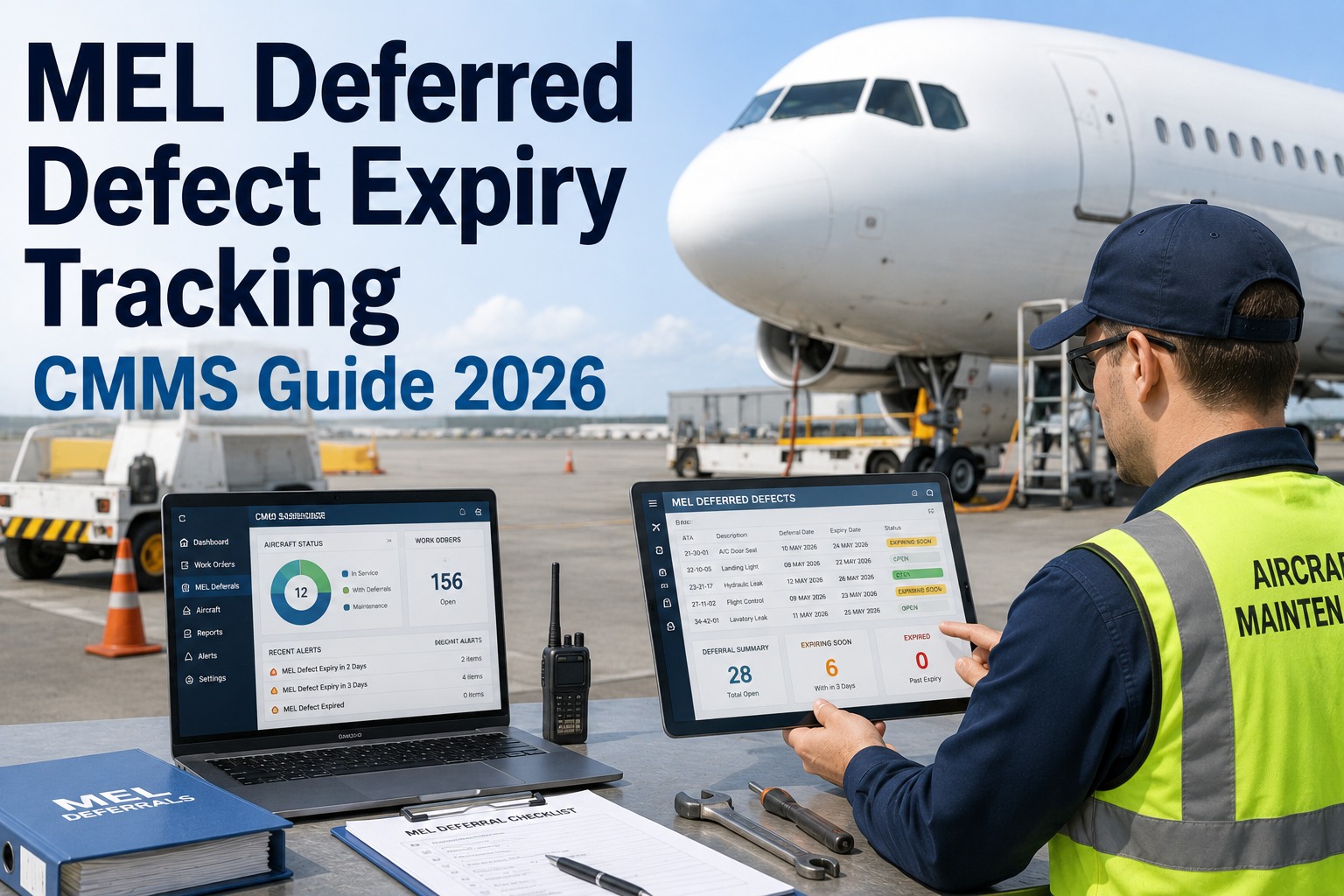
Deferred MEL items are a controlled dispatch tool, not a parking lot for problems — and every minute a deferral timer ticks down, an AOG event edges closer. Operators that let MEL and CDL items expire routinely lose 8–14 hours of schedule recovery per event and invite enforcement action that a $0 spreadsheet quietly fails to prevent. This 2026 guide walks through MEL category timers, extension approvals, expiry alerts and dispatch-check integration inside a CMMS, so no aircraft ever leaves the gate with a stale deferral. Ready to retire the whiteboard? Start Free Trial and see the live expiry tracker today.
Is a deferred MEL item about to expire on one of your tail numbers tonight?
A Category A item can expire in as little as one flight cycle. Category C items give you 10 days — but only if you actually track them. Without automated expiry alerts in your CMMS, a quiet deferral becomes a grounded aircraft, a missed slot, and a phone call from the regulator.
Most MEL failures aren't mechanical — they're administrative
Roughly 6 in 10 MEL-related groundings trace back to paperwork that expired before anyone noticed, not to a part that failed in service. The deferral was logged correctly; the clock just ran out.
MEL category timers run on cycles, not just calendar days
Each MEL category carries its own countdown logic. A CMMS that only counts calendar days will silently misfire on Category B and D items — both of which are tied to flight cycles or operating hours.
| Category | Repair Interval | Timer Type | Extension Approval |
|---|---|---|---|
| A | 1 flight cycle | Per-departure | Director of Maintenance + documented justification |
| B | 3 consecutive calendar days | Calendar | DOM sign-off; one-time only |
| C | 10 consecutive calendar days | Calendar | DOM + certificate-holding office |
| D | 120 consecutive days | Calendar / cycle hybrid | Regulatory concurrence often required |
Build a four-tier expiry alert that no one can ignore
A mature CMMS doesn't fire one alarm at zero-hour. It escalates across four thresholds so planners, line maintenance, and the DOM each get the right signal at the right moment.
Planner heads-up
A soft notification lands in the maintenance planner's queue — no action required, but parts availability and slot capacity get reviewed while there's still runway.
Line maintenance alert
Assigned technicians receive a flagged work card with the deferral reference, MEL page number, and a one-tap link to request an extension or schedule the rectification.
DOM escalation
If the item is still open, the Director of Maintenance gets a priority push notification. Extension paperwork is pre-populated and ready for digital signature.
Dispatch lock
The dispatch release system blocks release of the aircraft until the item is either rectified, extended with valid approval, or removed from the MEL. No overrides without DOM PIN.
Close the loop between the MEL logbook and the dispatch release
Expiry tracking only saves you if it's wired into the actual dispatch decision. A standalone spreadsheet that nobody checks at the gate is theatre, not compliance.
- MEL items tracked on a shared whiteboard or Excel file
- Expiry dates calculated manually; prone to off-by-one errors
- No link between the deferred item and the aircraft's dispatch status
- Discoveries happen at the gate — after passengers are boarded
- Average 11.3 hours lost per expired-deferral event
- Every deferral auto-creates a tracked item with a live countdown
- Timers computed from actual flight cycles and calendar data
- Dispatch release blocked automatically when an item reaches T-0
- Planners see expiry risk 72 hours out, while options still exist
- Average 0.4 hours lost — usually just the rectification itself
Stop discovering expired deferrals at the gate
Deploy a CMMS that watches every MEL category timer, fires four-tier expiry alerts, and locks dispatch before an illegal departure ever leaves the stand.
Operators running automated MEL expiry tracking see measurable wins
The shift from manual tracking to a CMMS-driven expiry workflow produces consistent, auditable improvements across safety metrics and operational reliability.
We went from two or three lapsed-MEL surprises a month to zero in our last six-month audit window. The 72-hour alert alone paid for the platform — it gave our planners time to actually do something about the item instead of reacting to a grounded aircraft.
MEL deferred defect expiry tracking, answered
What happens if an aircraft dispatches with an expired MEL item?
The flight is technically non-compliant from the moment the deferral lapses. Consequences range from an immediate return-to-ramp and self-disclosure filing to enforcement action, depending on how the item is discovered and whether the operator can show good-faith tracking. Insurance and lease agreements may also be voided for that sector. A CMMS with dispatch integration prevents this by blocking release before pushback — Start Free Trial to see the lock in action.
Can a CMMS track MEL items that are counted in flight cycles, not days?
Yes. A properly configured CMMS pulls live cycle data from the ACARS or flight ops feed and decrements the remaining allowable cycles on each leg. Category A and certain Category D items are cycle-bound, so a calendar-only tracker will misreport the expiry window. The system should display both the calendar and cycle countdown side by side on the deferral record.
Who needs to approve a MEL deferral extension, and how long does it take?
Approval authority depends on the category and your operations manual, but typically requires the Director of Maintenance at minimum. Category D extensions often need concurrence from the certificate-holding office or the regulator. With a CMMS that pre-populates the extension paperwork and routes it for digital signature, the cycle drops from an average of 6 hours to under 2 hours.
How does expiry tracking integrate with CDL items?
CDL (Configuration Deviation List) items follow a similar deferral logic but are often open-ended until the next scheduled maintenance check. The CMMS should flag CDL items separately from MEL deferrals, track them against the next check interval, and surface them during the dispatch release review so crews are aware of any missing or deferred exterior panels.
What's the ROI of switching from a spreadsheet to a CMMS for MEL tracking?
For a 40-aircraft fleet, a single avoided AOG event typically covers the annual CMMS subscription. Operators report 94% fewer expired-deferral groundings and roughly $1.2M in recovered schedule reliability per year. Most teams reach payback within the first 60–90 days. Book a Demo and we'll model your specific fleet numbers.
Every deferred defect has a clock. Start watching all of them.
Deploy MEL and CDL expiry tracking with four-tier alerts, dispatch integration, and full audit traceability — built for operators who can't afford a surprise grounding.
Free 14-day trial · No credit card