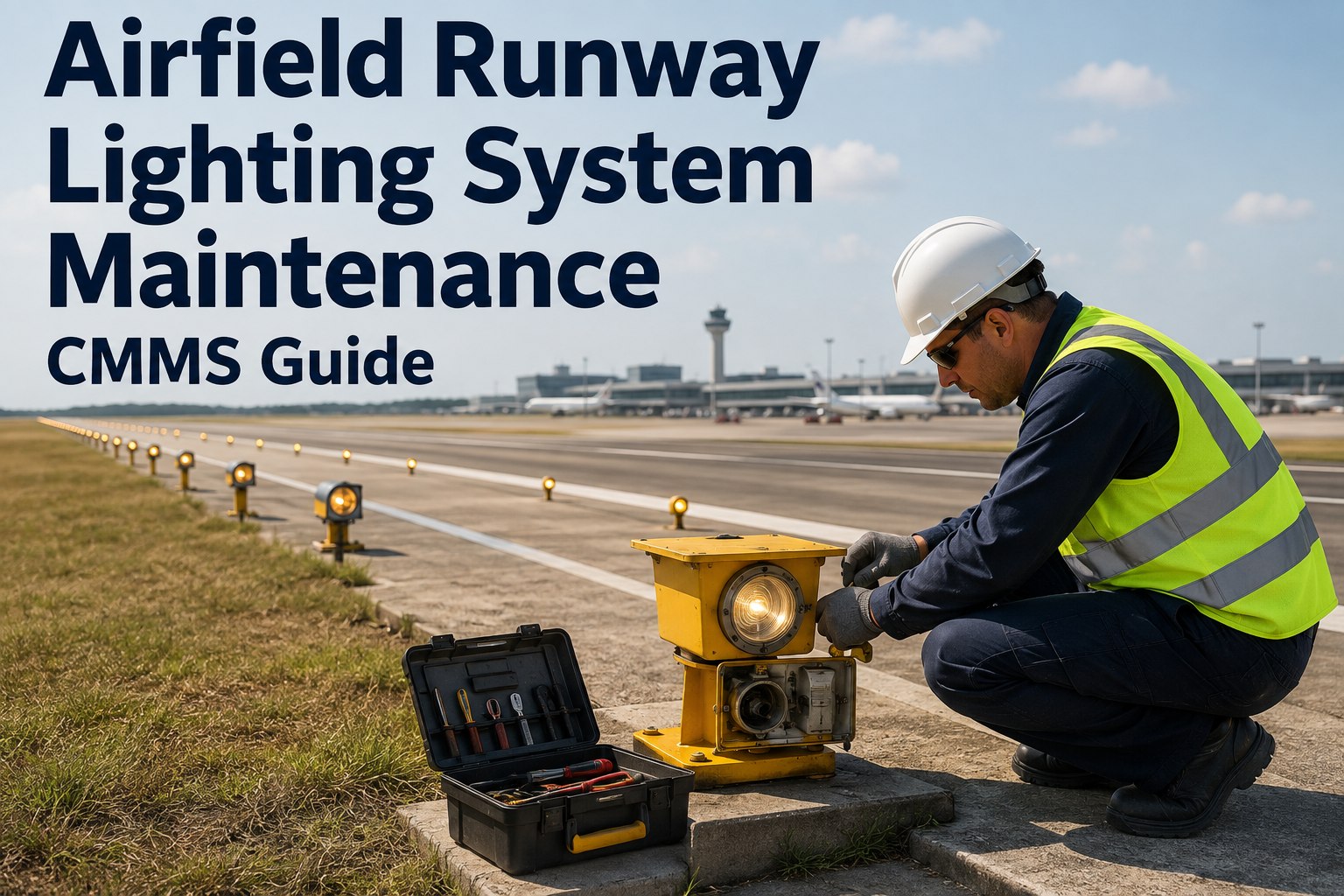
Your airfield went LED to stop relamping every 1,000 hours but now drivers fail early, a warranty claim just bounced for missing records, and no one can say which circuit goes dark next. What's missing isn't a better fixture; it's a system that turns every lighting check into a tracked action. OXMAINT AI is AI-powered maintenance management software (CMMS) that runs the full loop — inspection or fault report to flagged defect, ranked work order, and scheduled preventive or predictive maintenance — with every fixture's serial, dates and failure history in one place. Book a demo to see the workflow on your circuits.
Every Lighting Check Becomes a Ranked Work Order — Not a Sticky Note
- 1Inspection / fault report
- 2Defect flagged
- 3Ranked work order
- 4Preventive / predictive PM
The Failure Nobody Budgets For: It's the Driver, Not the Chip
The conversion business case is built on the LED chip's lifespan. But the component that actually fails first is the driver — the electronics that convert and regulate current. Industry field data and manufacturer white papers agree the split is lopsided, and it changes how you plan spares, warranties and labor.
Where Airfield LED Failures Actually Come From
The Warranty Proration Clock Is Ticking on Every Fixture
A five-year warranty is common on LED drivers, and many fixture warranties prorate after year five — meaning the manufacturer pays less the longer you wait to claim. If you can't prove the install date and failure date, you argue from a weak position. This timeline shows why fixture-level dates matter.
A Typical 10-Year LED Warranty — Full Cover to Prorated
-
Yr 1–5100% replacementNon-prorated on many programs. A failed driver is replaced in full — if you can produce proof of purchase and install date.
-
Yr 6~50% coveredProration begins. On one published schedule the buyer pays 50% of a replacement driver in year six — and more each year after.
-
Yr 7–960–80% you payThe unexpired-period math tilts against you fast. Prorated credit ≈ price × unexpired months ÷ total warranty months.
-
Yr 10+90% you pay / expiredNear the end, the credit is thin and the window closes. A claim filed after expiry is denied outright — timing is everything.
Why Legitimate Claims Get Denied
- 1
No proof of purchase. Missing invoices are one of the most common reasons a claim is denied — the manufacturer can't even establish eligibility.
- 2
No maintenance records. Several warranties require installation and maintenance logs; if records don't show proper upkeep, the burden falls on you and the claim can be refused.
- 3
No serial / fixture identity. Without model and serial linkage, a claim can't be tied to the specific failed unit or its production batch.
- 4
Missed the window. Some programs require reporting within days of a defect and filing before expiry — a late claim is denied on timing alone.
Want Every Driver Failure Captured as a Defensible Record?
The Five Data Streams That Protect Your Conversion ROI
A maintenance program run on the right software earns its ROI through operational continuity, not just fewer lamp changes. These are the records OXMAINT AI keeps for every fixture so a claim stays defensible and a shelf stays stocked. Book a demo to see them applied to your airfield.
| Data stream | What it captures | What it protects |
|---|---|---|
| Install & purchase record | Date, invoice, fixture model per circuit | Warranty eligibility and proration position |
| Driver failure telemetry | Which fixture failed, when, and how | Early-failure claims and defect-pattern proof |
| Serial / fixture identity | Serial, batch, storage location | Claim linkage to the specific failed unit |
| Spare-part inventory | Driver and fixture stock, reorder triggers | No stockout during phased conversion |
| Photometric & inspection log | Test results vs FAA thresholds | Compliance and life-extension decisions |
Phased Conversion Without Stockouts: The Spare-Part Problem
FAA guidance treats a runway or taxiway circuit as all-LED or all-incandescent — mixing on one circuit is not allowed. That means you convert circuit by circuit and, for a while, carry two spare inventories at once. Tracking them separately in your maintenance software is the difference between a smooth rollout and a grounded circuit — and it's exactly what OXMAINT AI is built to do.
- 1
Rank by ROISequence circuits by maintenance cost, energy use and failure risk — convert where savings justify the spend first.
- 2
Convert whole circuitReplace the full circuit at once to stay FAA-compliant — no mixed technology on a single loop.
- 3
Split the sparesTrack LED and incandescent stock separately with reorder triggers so neither runs dry mid-rollout.
- 4
Forecast the next 30/60/90Use failure history to predict which drivers replace next, enabling just-in-time procurement.
Life-Cycle Cost: Where the Conversion Actually Pays
The savings are real, but they land in different buckets — energy, labor and longevity — and only show up fully with a long-term power system and disciplined tracking. That tracking is where maintenance software matters: OXMAINT AI holds the failure, cost and photometric history the panel below depends on. The figures are framed honestly, using reported airport numbers as reference points.
Figures are reported reference points from cited installations, not a projection for your airfield. Actual ROI depends on your circuits, power system and maintenance discipline. Sources: Detroit Metro (Airport Improvement); Atlantis Press airfield study; Aviation Renewables.
How OXMAINT AI Runs the Airfield Lighting Workflow
OXMAINT AI is maintenance management software that connects inspection, failure capture, warranty tracking and spare planning into one loop — so a driver failure becomes a ranked work order, a dated warranty record and a reorder trigger in the same motion. Start a free trial to run the software on your circuits.
-
1
Capture
Log each fixture's install date, serial, failure event and photometric test in one record per unit. -
2
Prioritize
Turn failures and degradation into ranked work orders before performance drops below FAA thresholds. -
3
Defend
Keep the dated, serialized trail a warranty claim needs — and flag fixtures nearing proration cutoffs. -
4
Forecast
Predict 30/60/90-day replacements and split LED vs incandescent spares so no circuit goes dark.