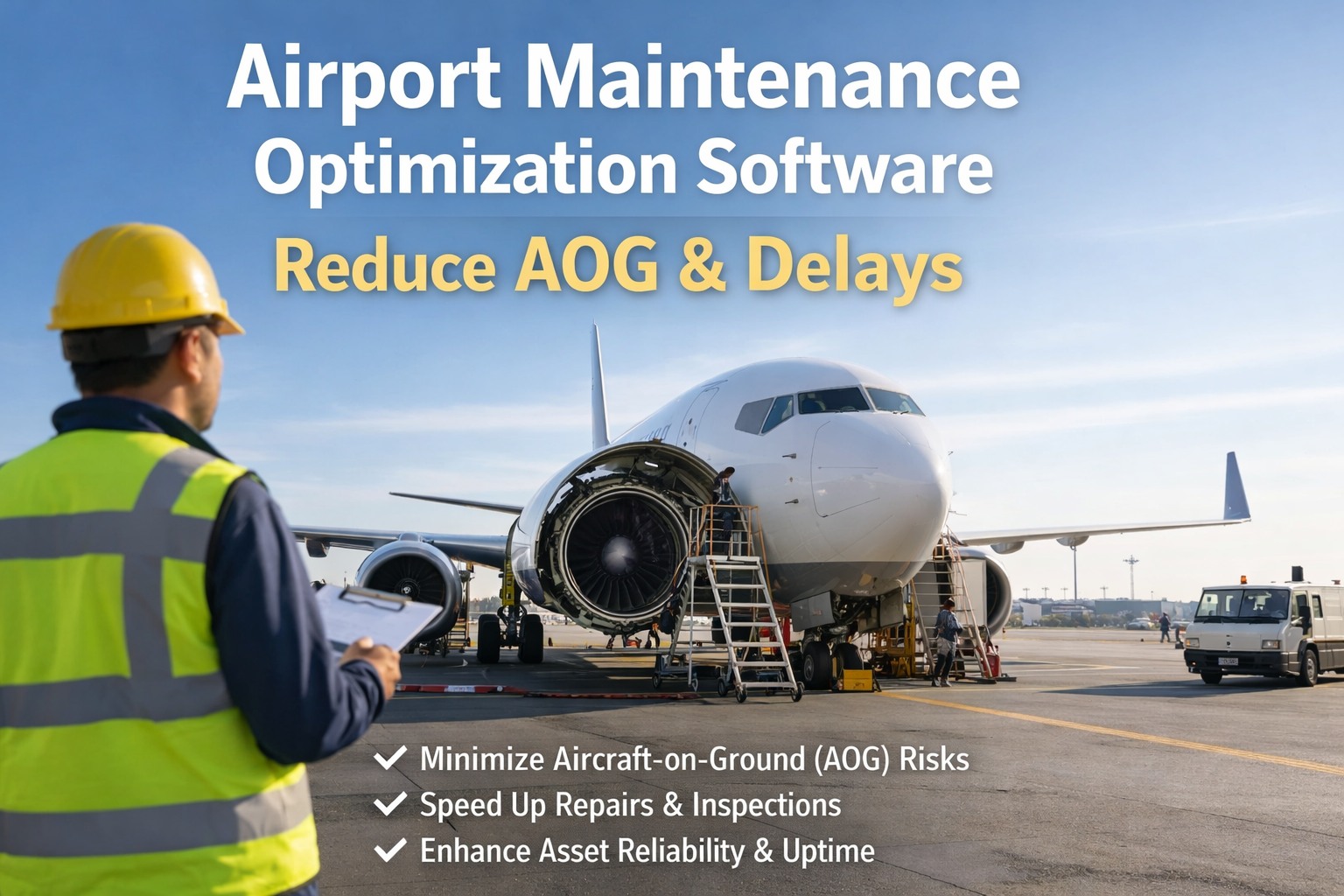
Airport Maintenance Optimization Software to Reduce AOG & Delays
By Lewis Abbott on January 30, 2026
Every minute an aircraft sits grounded costs airlines between $10,000 and $150,000. When ground support equipment fails, baggage systems stall, or passenger boarding bridges malfunction, the ripple effects cascade across terminals, delay schedules, and frustrate thousands of passengers. The airports leading in on-time performance have discovered that smarter maintenance isn't just about fixing things faster—it's about preventing failures before they ever happen. Start optimizing your maintenance and turn your ground operations into a competitive advantage.
AIRPORT OPERATIONS INTELLIGENCE
Cut AOG Impact & Airport Delays with Smarter Maintenance
Transform airport maintenance from a cost center into an operational performance engine with predictive insights and reliability-driven planning.
Aircraft on Ground events don't happen in isolation—they're symptoms of deeper operational gaps in maintenance planning, spare parts availability, and equipment reliability. When ground support equipment fails or infrastructure breaks down, the financial impact compounds by the minute.
AOG FINANCIAL IMPACTWhat Every Minute of Delay Costs
$100-$166
Per Minute
Direct ground delay costs for airlines (FAA & EASA estimates)
$10K-$150K
Per Hour
Aircraft on Ground costs depending on aircraft type and route
$1.2M+
Per Day
Extended AOG events with cascading schedule disruptions
$30B+
Industry Annual
Total cost of irregular operations including AOG events
Sources: Boeing, FAA, IATA, Airlines for America
How Maintenance Failures Lead to Operational Disruptions
14
AOG Events/Aircraft/Year
Average AOG incidents per aircraft annually in the US, with each event triggering cascading delays across the network
40%
Ground Damage from GSE
GSE operations account for 40% of total global aircraft ground damage according to IATA studies
12%
Flights Affected
Equipment breakdowns and operational delays affect more than 12% of flights annually
4×
Emergency Repair Cost
Unplanned emergency repairs cost up to 4× more than properly scheduled preventive maintenance
How Predictive Maintenance Transforms Airport Operations
REACTIVE APPROACH
Equipment fails without warning
Emergency repairs at 4× cost
Spare parts scramble delays fixes
Cascading flight delays
Passenger frustration & compensation
5,600Annual Maintenance Cancellations (Before)
AI-CMMS
PREDICTIVE APPROACH
30-90 day failure prediction
Scheduled maintenance during off-peak
Parts ready before needed
Optimized turnaround times
Reliable operations & satisfied passengers
55Annual Maintenance Cancellations (After)
Delta Airlines case study: 100× reduction in maintenance-related cancellations using predictive maintenance
Our platform connects maintenance execution with operational performance, helping airports prevent failures that cause delays and AOG scenarios.
01
Predictive Failure Analysis
AI-powered analytics identify degradation patterns and predict equipment failures 30-90 days in advance, turning unscheduled events into planned maintenance windows.
92-98% prediction accuracy
02
Spare Parts Forecasting
Intelligent inventory optimization ensures critical parts are available before failures occur, eliminating repair delays from parts unavailability.
Reduce parts-related AOG by 40%
03
Operations Integration
Real-time data sync between maintenance systems and flight operations enables coordinated response and impact-based maintenance prioritization.
Break down operational silos
04
Asset Health Monitoring
Continuous visibility into equipment condition across GSE, baggage systems, boarding bridges, and terminal infrastructure with automated alerts.
25,000+ data points/minute
05
Impact-Based Scheduling
Maintenance tasks automatically prioritized based on operational impact, ensuring critical systems receive attention before they affect flights.
Reduce high-impact failures 50%
06
Performance Analytics
Comprehensive reporting on equipment reliability, maintenance efficiency, and operational KPIs to drive continuous improvement.
Real-time dashboards
PROVEN RESULTSWhat Airports Achieve
30-50%
Reduction in High-Impact Equipment Failures
25%
Faster Response to Critical Maintenance Events
28%
Improved Operational Uptime
40%
Lower Emergency Maintenance Spending
$70M+
Annual savings achieved by large hub airports through optimized turnaround operations and reduced departure delays
See Your Airport's Delay Reduction Potential
Get a customized analysis based on your current operations and equipment portfolio
Lighting failures can close runways and divert flights
Terminal Power & HVAC
Electrical distribution, backup generators, air handling units, chillers, building automation
Terminal system failures disrupt passenger flow and operations
Industry Evidence for Predictive Maintenance Impact
Deloitte Report 2022
Predictive maintenance can reduce maintenance costs by up to 30% and AOG events by over 50% when properly implemented
Delta Airlines
APEX predictive maintenance program reduced maintenance-related cancellations from 5,600 to just 55 annually—a 100× improvement
Collins Aerospace / Japan Airlines
Ascentia predictive analytics platform reduced unscheduled maintenance costs by up to 20% through operational intelligence
ARINC Study
Airlines implementing proactive maintenance programs reduced AOG events by up to 30% compared to reactive approaches
Assaia 2025 Report
AI-driven turnaround management cut median departure delays by 25% across 450,000 analyzed turnarounds
Airport BHS Research
IoT-enabled predictive maintenance reduced baggage handling system downtime by 18-33% at major international airports
Frequently Asked Questions
Poor maintenance planning and unexpected equipment failures can delay aircraft servicing, ground operations, and support systems, increasing both the risk and duration of AOG events. When ground support equipment like pushback tractors, baggage loaders, or fueling systems fail unexpectedly, aircraft cannot complete turnaround operations on schedule. Additionally, maintenance-related delays in passenger boarding bridges, terminal systems, and airfield infrastructure compound the problem. Predictive maintenance helps airports identify these risks early and address them before they impact flight operations.
AOG reduction software helps airports and aviation operators identify maintenance risks early, improve repair response times, and prevent failures that disrupt aircraft operations. These platforms use AI and machine learning to analyze equipment data, predict potential failures 30-90 days in advance, and automatically prioritize maintenance based on operational impact. Key features include real-time asset health monitoring, spare parts forecasting, integration with flight operations systems, and performance analytics. The goal is to transform maintenance from a reactive cost center into a proactive operational advantage.
Yes, the evidence is compelling. By improving asset reliability and reducing unexpected breakdowns, maintenance optimization directly lowers operational disruptions that cause delays. Industry data shows that predictive maintenance can reduce high-impact equipment failures by 30-50%, cut unscheduled maintenance events by up to 30%, and improve overall operational uptime by 28%. Real-world examples include Delta Airlines reducing maintenance-related cancellations by 100× and major hub airports achieving $70+ million in annual savings through optimized turnaround operations. Every minute saved in turnaround time represents approximately $100 in direct cost savings.
Several categories of airport assets have outsized impact on operational reliability. Ground Support Equipment (GSE) is critical—IATA reports that GSE operations account for 40% of total global aircraft ground damage. Baggage Handling Systems directly affect turnaround times, with major hubs processing 5,000+ bags per hour. Passenger Boarding Bridges impact gate utilization and passenger flow. Fueling infrastructure delays directly extend aircraft ground time. Airfield lighting failures can close runways entirely. And terminal power/HVAC systems affect passenger experience and operational continuity. A comprehensive maintenance optimization platform should cover all these asset categories with predictive capabilities.
Most airports see measurable improvements within 3-6 months of implementation. Initial benefits typically include better visibility into asset health, reduced emergency repair incidents, and improved maintenance scheduling efficiency. Within 6-12 months, airports typically achieve significant reductions in unplanned downtime and measurable improvements in on-time performance. The platform's predictive capabilities become more accurate over time as it learns from your specific equipment patterns. ROI is typically achieved within 12-18 months through reduced emergency maintenance costs, fewer AOG-related expenses, and improved operational efficiency.
Yes, our platform is designed for seamless integration with existing airport infrastructure. It connects via REST APIs to flight information display systems (FIDS), airport operational databases (AODB), existing CMMS platforms, ERP systems, and IoT sensor networks. The hybrid approach enhances decision-making without requiring costly system replacements. Cloud and on-premise deployment options accommodate different security requirements and IT architectures. Most airports complete full integration within 8-12 weeks, with minimal disruption to ongoing operations.
Transform Your Airport Maintenance Strategy
Join the leading airports using predictive maintenance to reduce AOG impact, cut delays, and improve operational performance.