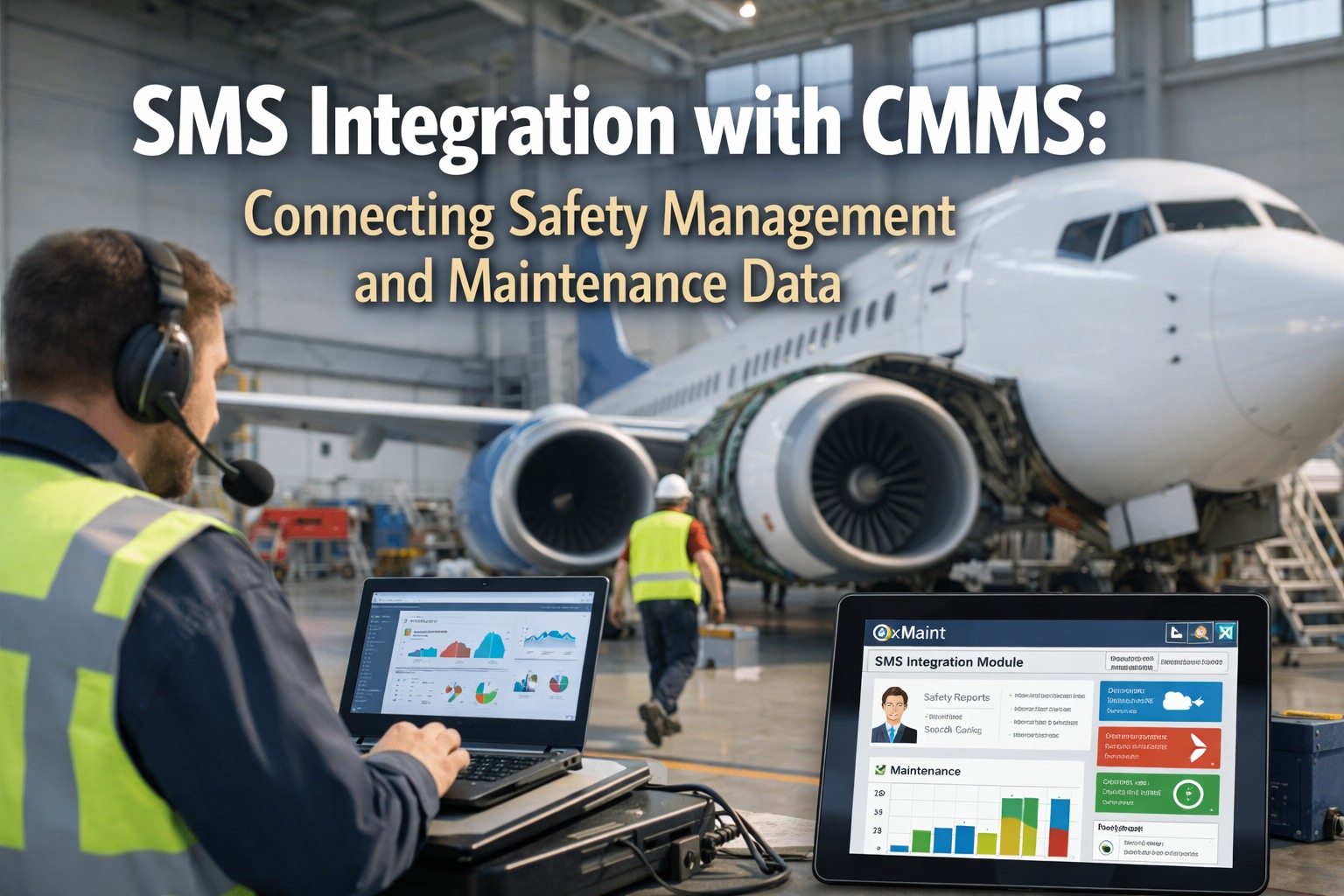
Your maintenance team closes 200 work orders a month. Your safety team files 15 hazard reports a quarter. Neither team sees the other's data. When a hydraulic pump fails for the third time in six months, the CMMS logs it as a recurring breakdown. The SMS never flags it as a systemic safety risk. That gap between maintenance execution and safety intelligence is where incidents hide. Integrating your Safety Management System with your CMMS eliminates that blind spot by turning every maintenance data point into a safety signal and every hazard report into a maintenance action. Schedule a demo to see how OXmaint bridges the SMS-CMMS divide.
The Regulatory Pressure Is Real and Growing
Aviation safety management is no longer optional. The FAA's expansion of 14 CFR Part 5 now mandates SMS for all Part 135 operators, Part 91.147 air tour operators, and certain Part 21 certificate holders, with full compliance required by May 2027. In Europe, EASA already requires all Part-145 approved maintenance organizations to have an SMS in place as of December 2024. The organizations that integrate SMS with their maintenance systems now will meet compliance deadlines with less stress and more operational value.
FAA
14 CFR Part 5 Expansion
Part 135 operators and Part 91.147 air tour providers must submit a Declaration of Compliance by May 28, 2027
~2,550 newly affected organizations
EASA
Part-145 SMS Mandate
All EASA Part-145 approved maintenance organizations must have a functioning SMS integrated into their management system
Effective since December 2024
ICAO
Annex 19 Standards
All ICAO member states required to ensure aviation service providers implement SMS aligned with the four-pillar framework
193 member states globally
May 2027 is closer than you think. OXmaint's integrated SMS module connects safety management directly to your maintenance workflows so compliance becomes a byproduct of your daily operations, not a separate project.
Start Free
The Problem: Two Systems That Should Talk but Don't
In most aviation organizations, the SMS and the CMMS operate as independent systems with separate databases, separate teams, and separate reporting chains. This separation creates dangerous information gaps that directly undermine both safety performance and maintenance effectiveness.
The Data Disconnect
Safety Management System
Hazard Reports
Risk Assessments
Incident Investigations
Safety Audits
Corrective Actions
Data Silo
✕
No data flows between systems
CMMS / Maintenance System
Work Orders
PM Schedules
Asset History
Failure Records
Parts Inventory
01
Repeated Failures Go Unescalated
A component fails three times in a year. The CMMS treats each as an isolated work order. Without SMS visibility, nobody recognizes the pattern as a systemic hazard requiring root cause analysis and risk mitigation.
02
Safety Actions Skip Maintenance
A hazard report identifies corrosion risk on a specific equipment type. The safety team documents the finding, but no preventive maintenance task is automatically created in the CMMS. The corrective action lives in a report nobody in maintenance reads.
03
Audit Preparation Becomes a Scramble
When regulators ask for evidence that safety findings led to maintenance actions, your team spends days manually cross-referencing two separate systems to reconstruct a paper trail that should exist automatically.
04
Risk Decisions Lack Maintenance Context
Safety risk assessments are made without current asset condition data. A risk panel rates a hazard as "low" because they don't know the related equipment has degraded significantly since its last inspection three months ago.
How Integrated SMS-CMMS Changes the Game
When safety data and maintenance data live in the same platform, every maintenance event becomes a safety data point and every safety finding triggers a maintenance response. This bidirectional flow is what transforms both functions from reactive record-keeping into proactive risk management.
OXmaint Integrated SMS-CMMS Data Flow
Safety Inputs
Hazard Reports
Risk Assessments
Incident Data
Audit Findings
Employee Reports
OXmaint Integration Engine
Correlates, prioritizes, and routes data bidirectionally between safety and maintenance functions
Maintenance Outputs
Auto Work Orders
PM Adjustments
Asset Condition Data
Failure Patterns
Compliance Records
The Four Pillars of SMS Powered by Maintenance Data
ICAO Annex 19 defines four pillars that every SMS must address. When your CMMS feeds directly into each pillar, compliance stops being a documentation exercise and becomes an operational advantage.
Without Integration
Safety policy exists as a document. Maintenance teams sign it annually. Nobody references it during daily operations.
With OXmaint
Safety objectives are embedded into maintenance KPIs. Every work order tracks compliance with safety targets. Policy becomes measurable.
Without Integration
Risk assessments rely on memory and meeting discussions. Hazard identification depends on voluntary reporting with no equipment data context.
With OXmaint
Failure patterns from the CMMS automatically populate hazard registers. Risk matrices incorporate real-time asset condition scores and maintenance history.
Without Integration
Safety performance monitoring is limited to lagging indicators like incident counts. No connection to leading maintenance metrics.
With OXmaint
Leading indicators from maintenance data, such as overdue PMs, repeat failures, and degradation trends, feed directly into safety performance dashboards.
Without Integration
Safety training is generic. Lessons learned from incidents are shared in quarterly meetings that most technicians miss.
With OXmaint
Safety alerts and lessons learned are attached directly to relevant work orders. Technicians see hazard context before they pick up a wrench.
Built for Part 5 Compliance
OXmaint maps directly to ICAO Annex 19 and FAA Part 5 requirements. Safety policy, risk management, assurance, and promotion are built into the same platform your maintenance team uses every day.
Inside the OXmaint SMS Dashboard
OXmaint's SMS module gives safety managers a real-time command center that draws directly from live maintenance data, creating a single source of truth for both safety performance and maintenance health.
Safety Performance
Current period metrics
Open Hazard Reports7
Risk Assessments Due3
Corrective Actions Open12
Safety Score94.2%
Maintenance-Safety Link
Cross-system health
Safety-Triggered WOs18
Repeat Failures Flagged4
Overdue PMs (Risk-Rated)6
Avg. Response Time2.4h
Compliance Tracker
Regulatory readiness
Part 5 Requirements Met38 / 42
Audit Trail Complete100%
Last Internal AuditFeb 10
Next Review DueMar 15
Safety Overview
Hazard Register
Risk Matrix
Corrective Actions
Compliance
Date
Event
Risk Level
Action Taken
2026-02-21
Hydraulic pump repeat failure (3rd occurrence)
High
Root cause investigation initiated, PM interval adjusted
2026-02-18
HVAC filter pressure anomaly in Terminal B
Medium
Preventive work order generated, inspection completed
2026-02-14
Escalator vibration exceeding threshold
Medium
Bearing replacement scheduled during overnight window
2026-02-10
Electrical panel overtemperature alert
High
Emergency work order issued, load redistributed within 90 min
What Integration Looks Like in Practice
Theory is one thing. Here is how SMS-CMMS integration changes actual scenarios your teams face every week.
Recurring Equipment Failure Pattern
Disconnected Systems
Each failure generates a standalone work order. Technician fixes the symptom. CMMS shows three separate repairs. SMS has no record of the pattern. Nobody connects the dots until the equipment causes a safety incident during operations.
OXmaint Integrated
Second occurrence triggers automatic pattern detection. System flags the asset in the hazard register with full failure history. Risk assessment is auto-populated with maintenance data. Corrective action plan created before the third failure happens.
Post-Incident Regulatory Audit
Disconnected Systems
Auditor asks for evidence linking safety findings to maintenance actions. Your safety manager spends three days cross-referencing spreadsheets, emails, and CMMS records. Some links cannot be reconstructed. Finding: inadequate safety assurance documentation.
OXmaint Integrated
Auditor requests the same evidence. One click generates a complete audit trail showing every hazard report, the risk assessment it triggered, the work orders it created, and the completion records. Full traceability in seconds.
New Hazard Identified by Technician
Disconnected Systems
Technician notices unusual wear pattern during routine PM. Mentions it to a supervisor verbally. Supervisor says they will report it. The observation never makes it into the SMS. The hazard remains untracked and unmitigated.
OXmaint Integrated
Technician tags the observation directly within the work order completion screen. It auto-routes to the SMS hazard register. Safety team receives an alert with asset history and photos. Risk assessment initiated the same day.
The Measurable Impact
Organizations that connect safety management to maintenance data see measurable improvements across compliance readiness, incident prevention, and operational efficiency.
56%
Increase in hazard reporting rates when employees can submit observations directly through maintenance workflows
50%
Reduction in audit preparation time with automated compliance documentation and traceability records
30-40%
Reduction in safety incidents when systematic maintenance data feeds proactive risk identification
20-30h
Monthly time saved by safety managers when SMS data is consolidated in an integrated database
Frequently Asked Questions
What exactly does SMS-CMMS integration mean?
It means your safety management system and your computerized maintenance management system share a common data layer. When a maintenance event has safety implications, the SMS is automatically informed. When a safety finding requires maintenance action, a work order is automatically generated. No manual data transfer, no email chains, no information lost between systems. OXmaint achieves this by building both functions into a single platform rather than trying to bolt together separate tools.
Do we need a separate SMS software alongside OXmaint?
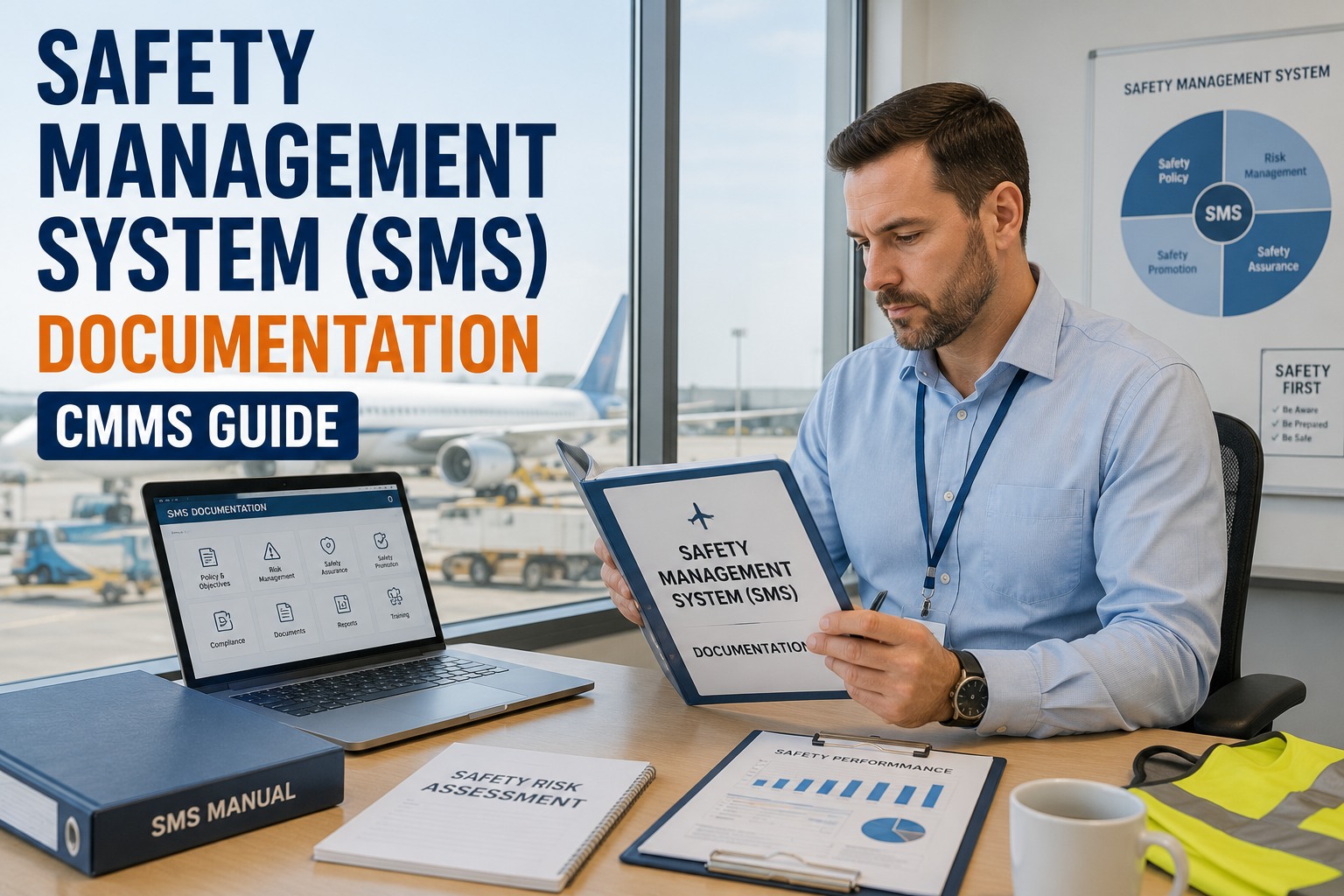
No. OXmaint's SMS module is built into the platform. It covers all four ICAO pillars: safety policy management, safety risk management with hazard registers and risk matrices, safety assurance through continuous monitoring and internal audits, and safety promotion through integrated training tracking and communication tools. Everything feeds from the same maintenance database your technicians already use.
Book a demo to see the full SMS module.
How does this help with FAA Part 5 compliance?
Part 5 requires organizations to establish processes for hazard identification, risk assessment, safety assurance monitoring, and confidential employee reporting. OXmaint maps each Part 5 requirement to a specific feature in the platform. The compliance tracker shows you exactly which requirements are met, which are in progress, and what evidence exists. When it comes time to submit your Declaration of Compliance, the documentation is already complete.
Start your free trial to explore the Part 5 mapping.
Can technicians submit hazard reports through the same mobile app they use for work orders?
Yes. Technicians can flag safety observations, submit hazard reports, and attach photos directly from the work order completion screen on the OXmaint mobile app. Reports route automatically to the SMS hazard register with full asset context. This eliminates the friction that kills voluntary reporting programs by meeting technicians where they already work.
How long does it take to implement the SMS module?
If you are already using OXmaint for maintenance management, activating the SMS module takes days, not months. The module uses your existing asset registry, work order history, and team structure. Configuration involves setting up your hazard categories, risk criteria, and reporting workflows. For organizations new to OXmaint, the combined CMMS and SMS implementation typically takes 4 to 8 weeks.
Schedule a consultation to plan your implementation.
Connect Safety and Maintenance in One Platform
Stop managing safety in spreadsheets and maintenance in a separate system. OXmaint integrates SMS and CMMS into a single platform built for aviation compliance, proactive risk management, and operational excellence.