Shift changeovers take less than 5% of total operating time in a 24/7 airport but contribute to 40% of all operational incidents — and the FAA's Human Factors "Dirty Dozen" places poor communication at #1 on the list of maintenance error precursors. Every airport post-incident review traces back through the handover log at some point, and whether that log is defensible or fictional determines whether the finding is "process failure, corrected" or "systemic gap, fine and audit action." Airports still running on paper logbooks, WhatsApp groups, and verbal pass-downs are losing critical asset intelligence every eight hours: a sensor "acting funny" noted verbally becomes a bearing failure twelve hours later, an active LOTO not formally transferred becomes an energy release hazard, a maintenance WO left in a technician's personal notes becomes a duplicated diagnosis costing an estimated $840K annually across a mid-size operation. This guide covers airport maintenance ops communication the way compliance-mature airports actually run it — the shift-handover discipline, the 5-tier escalation matrix, the role-to-role communication map, and how OxMaint CMMS replaces fragmented comms with one structured record. Start free or book a demo to see digital handover in action.
Aviation · Ops Communication · Digital Handover · CMMS 2026
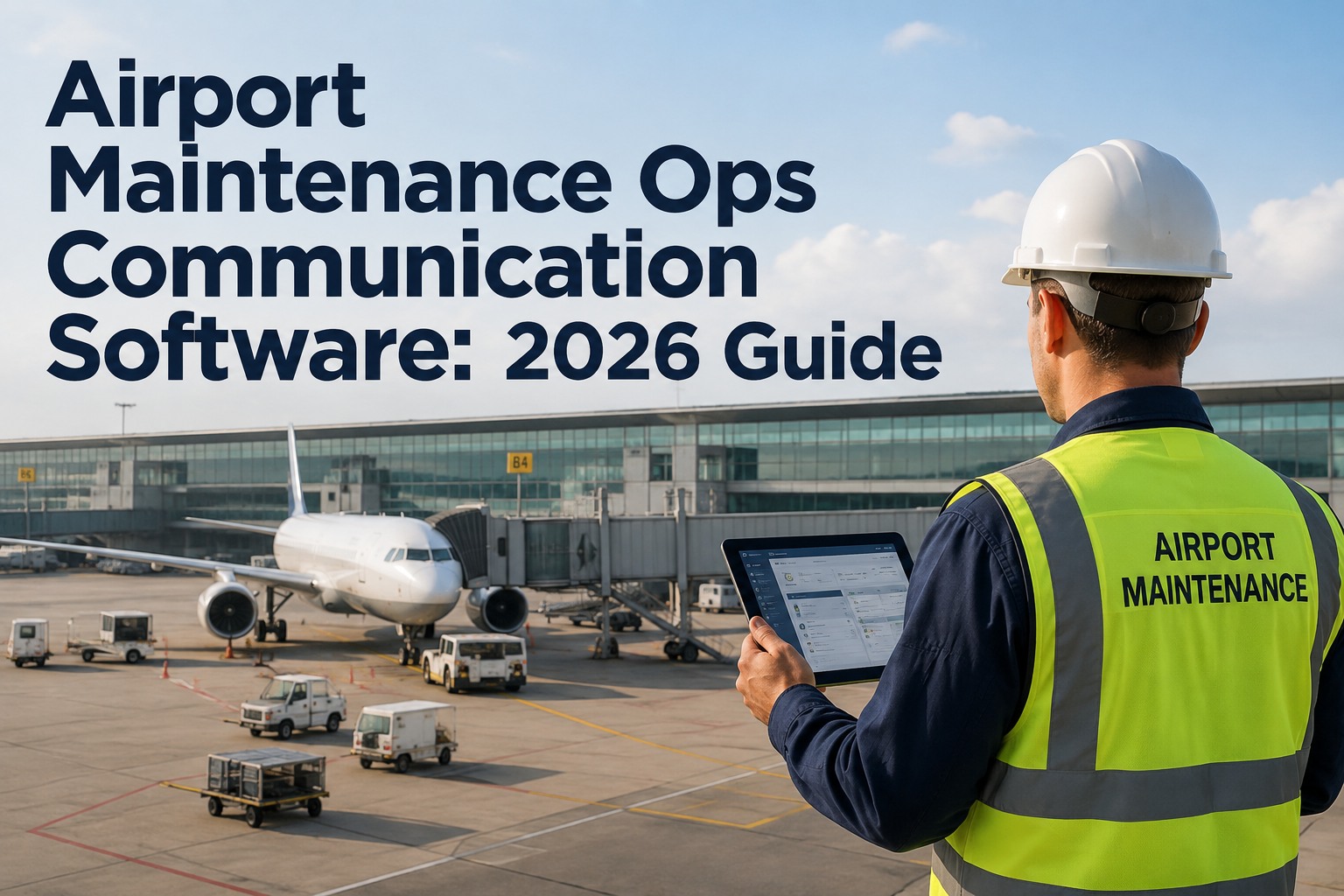
Airport Maintenance Ops Communication Software: 2026 Guide
Close the maintenance-ops-crew loop with the best 2026 airport CMMS software. Top platforms delivering structured communication across every airport shift and role — from ramp technician through operations control to plant manager.
<5% → 40%
Shift changes = 5% of ops time but 40% of all incidents (Yokogawa)
#1
Poor communication ranks first on FAA Human Factors Dirty Dozen
$840K/yr
Estimated cost of duplicated diagnoses at a mid-size facility
Every 8 hrs
Critical asset intelligence loss window on paper-based handovers
The Handover Gap — What Actually Walks Out the Door Every 8 Hours
Every shift, information gets lost. Not because technicians are careless — because paper logs, WhatsApp groups, and verbal pass-downs cannot carry structured context across a shift boundary. Below is the anatomy of the handover gap that turns minor observations into major incidents. Sign up free and OxMaint's aviation library ships with a pre-configured 4-category digital handover template — every shift ends with structured entries for safety events, open work orders, abnormal conditions, and active LOTO/permits, and no incoming supervisor can start a shift without electronically acknowledging the transfer.
HOW A MINOR OBSERVATION BECOMES A MAJOR INCIDENT
MINUTE 10
Observation
Tech notices bearing sound "off" on BHS motor. Mentions it to crew lead verbally.
→
HOUR 8
Shift End
Verbal note forgotten in end-of-shift rush. Paper log entry vague or absent. WhatsApp mentioned to two people.
→
HOUR 8-16
Handover Gap
Incoming crew has no context. Bearing continues to degrade unnoticed. No trend logging, no follow-up WO.
→
HOUR 22
Failure
Bearing seizes mid-operation. BHS goes down mid-peak. Post-incident review can't reconstruct what was known when.
The gap isn't the observation — it's the transfer. Digital handover captures the sound-off entry the moment it's noticed, ties it to the asset, dispatches a follow-up inspection WO, and forces the next shift to acknowledge before starting.
The 4 Mandatory Handover Categories — What Every Shift Must Transfer
Structured handover is four categories, always in the same order, always documented in the same digital record. Skip any one and you've recreated the gap. Below is the discipline that turns handover from a ritual into a control. Book a 30-minute demo and an OxMaint aviation specialist will walk the 4-category structure against your existing shift handover practice — you'll leave the call with a specific list of gaps in your current process before you open a trial workspace.
CATEGORY 1
Safety Events & Near-Misses
What TransfersIncidents, hazard observations, near-misses with location + personnel
Auto-TriggerSafety-team notification + follow-up investigation WO
Consequence If MissedRegulatory citation + repeat incident risk
CATEGORY 2
Open Work Orders
What TransfersExplicit status, assigned tech, expected completion window
Auto-TriggerWO ownership transfer or reassignment to incoming shift
Consequence If MissedDuplicated diagnosis, forgotten repairs, SLA breaches
CATEGORY 3
Abnormal Conditions (No WO Yet)
What Transfers"Something off" observations — noise, temp, vibration, behavior
Auto-TriggerWatch-list entry + monitoring on incoming shift
Consequence If MissedLate failures — the bearing-seizure scenario above
CATEGORY 4
Active LOTO, Permits & Isolations
What TransfersEvery active isolation with lock holder, permit ID, expected release
Auto-TriggerDual signoff required from outgoing + incoming supervisor
Consequence If MissedEnergy release incident, OSHA 1910.147 fatality risk
The 5-Tier Escalation Matrix — Getting Info to the Right Person, Fast Enough
Not every abnormal condition needs to wake the airport director. Not every routine observation waits for shift end. The escalation matrix below routes every event to the right level within the right time window — the discipline that separates working communication programs from noisy ones. Sign up free and OxMaint's escalation matrix is fully configurable per airport — priority levels, routing rules, and time thresholds all tuned to your organization structure, so alerts hit the right person without spamming everyone.
P0
CRITICAL — Immediate
Total facility shutdown, severe safety incident, environmental breach, active LOTO failure. Phone + CMMS alert 24/7 to airport ops director + safety lead.
RESPONSE: Immediate · 24/7
P1
HIGH — Escalate by shift end
Primary system down (BHS, jet bridge, chiller), critical utility failure, repair >4hrs. Escalate if unresolvable by shift end.
RESPONSE: < 8 hours
P2
URGENT — Escalate within 1 hour
Imminent failure risk, missing critical spares, safety bypass needed. Escalate to maintenance manager within 1 hour of diagnosis.
RESPONSE: < 1 hour
P3
MODERATE — Address during shift overlap
Abnormal condition, minor bottleneck, cross-department coordination needed. Handle at shift overlap briefing.
RESPONSE: This shift
P4
ROUTINE — Log for monitoring
Minor anomalies, routine PM findings, minor leaks. Document in digital shift log for incoming tech to monitor.
RESPONSE: Next shift
Every Post-Incident Review Eventually Traces Back Through the Handover Log.
And whether that log is defensible or fictional decides whether the review closes "process working, corrective action complete" or "systemic communication gap, fine and audit action open." OxMaint captures every shift's events, open faults, and outstanding work in one structured record — so no incident review ever has to ask what the previous shift saw.
The Role Communication Matrix — Who Talks to Whom, About What
Airport MRO communication isn't just handover — it's the ongoing cross-role loop between technicians, crew leads, operations control, maintenance managers, and safety leadership. Each role has a different information need, different escalation window, and different action authority. Below is the working matrix. Book a scoping call and an OxMaint aviation engineer will map this matrix against your specific airport org structure — you'll leave with a role-to-role communication design before you commit to a trial workspace.
FIELD TECHNICIAN
Real-time WO context, procedure access, ability to log observations instantly
Mobile CMMS + voice/photo capture on device
CREW LEAD / FOREMAN
Live view of crew workload, open WOs, P0-P2 escalations from field
Crew dashboard + auto-escalation alerts
OPERATIONS CONTROL
Impact of maintenance on ops (gate availability, BHS zones, jet bridge status)
Live asset status feed + ops-impact tagging
MAINTENANCE MANAGER
Shift compliance, PM completion, backlog trend, resource allocation
Manager dashboard + daily briefing digest
SAFETY LEAD
Safety events, near-misses, LOTO status, permit compliance
Safety event feed + auto-notification on P0/P1
PLANT MANAGER / DIRECTOR
Systemic patterns, cost trends, KPIs, board-ready reporting
Executive dashboard + weekly/monthly rollup
Paper Logbook + WhatsApp vs. OxMaint Digital Handover Loop
Most airports run some version of "paper logbook + WhatsApp group + verbal pass-down + occasional email." That combination is the reason 40% of incidents happen around shift changes. Here's what changes when the communication loop is structured inside OxMaint. Start free — no credit card, unlimited users so every technician, crew lead, ops controller, and manager has an account from day one, and the aviation library ships pre-configured with the 4-category handover template and 5-tier escalation matrix.
Airports that put every technician, crew lead, and manager on the same structured comms loop stop losing critical intelligence at every shift boundary. Start your free forever workspace to run your first digital handover this week, or book a demo to see live shift-to-shift transfer on a similar airport operation before you commit.
"
We had a P1 handover failure two years ago — an outgoing crew flagged a jet-bridge sensor issue on WhatsApp, the incoming lead didn't scroll far enough to see it, and the next 06:00 boarding got delayed because the bridge would not extend to spec. Nobody was blamed because nobody could prove who saw what. That was the trigger to move off the WhatsApp-plus-paper program. Six months into OxMaint, every shift ends with mandatory 4-category entries and every incoming supervisor has to e-sign before their access opens. Repeat-fault rate on BHS and jet bridges is down 41%, our last Part 139 self-inspection audit closed with zero findings on records, and my ops director stopped asking "did anyone catch that on the last shift" because now she can just check.
Head of Airport Facilities · 42-Gate International Airport · Southeast Asia
Frequently Asked Questions
Why are shift changes so incident-prone in airport operations?
Yokogawa research found shift changes account for less than 5% of total operating time but contribute to 40% of all plant incidents. In aviation specifically, the FAA's Human Factors "Dirty Dozen" ranks poor communication — especially cross-shift — as the #1 precursor to maintenance errors. The reason is context loss: verbal handovers, paper logs, and WhatsApp groups cannot reliably carry structured operational context across a shift boundary, so information walks out the door every 8 hours.
What are the 4 mandatory handover categories in a compliant airport program?
(1) Safety events and near-misses with location and personnel involved; (2) open work orders with status, assigned tech, and completion window; (3) abnormal conditions with no WO yet — the "something off" observations that predict failures; (4) active LOTO, permits, and isolations with dual signoff. Missing any single category recreates the gap the program is trying to close.
Sign up free to load the 4-category template.
Does OxMaint support Part 139 and EASA audit evidence?
Yes. Every shift handover, escalation event, work order, and LOTO transfer is captured with technician e-signature, timestamp, and full context — exportable as an audit-ready package for FAA Part 139 self-inspection programs, EASA Part-ADR aerodrome maintenance obligations, and internal reliability governance. The reconstruction that used to take weeks after an incident becomes a one-click export.
How does the 5-tier escalation matrix work in practice?
P0 (critical, immediate 24/7 alert to ops director + safety lead), P1 (high, escalate by shift end), P2 (urgent, escalate within 1 hour), P3 (moderate, address at shift overlap), P4 (routine, log for monitoring). OxMaint routes events automatically based on category, asset criticality, and configured escalation rules — no manual triage, no missed escalations, no WhatsApp group where everyone sees but nobody owns.
Can OxMaint integrate with our existing SAP, Maximo, or airport ops systems?
Yes. OxMaint overlays SAP PM and IBM Maximo — they remain source-of-truth for asset master and finance data while OxMaint runs the mobile-first shift communication and handover layer. Airport ops systems (AODB, resource management, BHS controllers) integrate via API. No rip-and-replace, no CAPEX request.
Book a demo to see the overlay live.
Do we need to give every technician a device?
Technicians access OxMaint via any mobile device — company-issued or BYOD. The free forever plan supports unlimited users, so every technician, crew lead, ops controller, and manager can have an account with no per-seat licensing. Most airports use a mix of shared shop tablets, ruggedized phones for airside work, and personal devices for supervisors.
Is a credit card or CAPEX approval needed to start?
No. OxMaint's free forever plan requires no credit card, no CAPEX request, and no consulting engagement — you can
sign up in under 2 minutes and run your first digital shift handover the same day. Airport asset templates ship pre-built for terminal, airside, BHS, and airfield infrastructure.
Every Shift Should Build On the Last, Not Restart the Same Problem.
OxMaint eliminates handover gaps, cuts repeat faults, and gives operations leadership defensible answers on what every shift saw, escalated, and closed — with structured digital records that stand up in every audit and post-incident review. Start free — no credit card, unlimited users, forever. Or book a demo for an airport-specific communication workflow walkthrough.