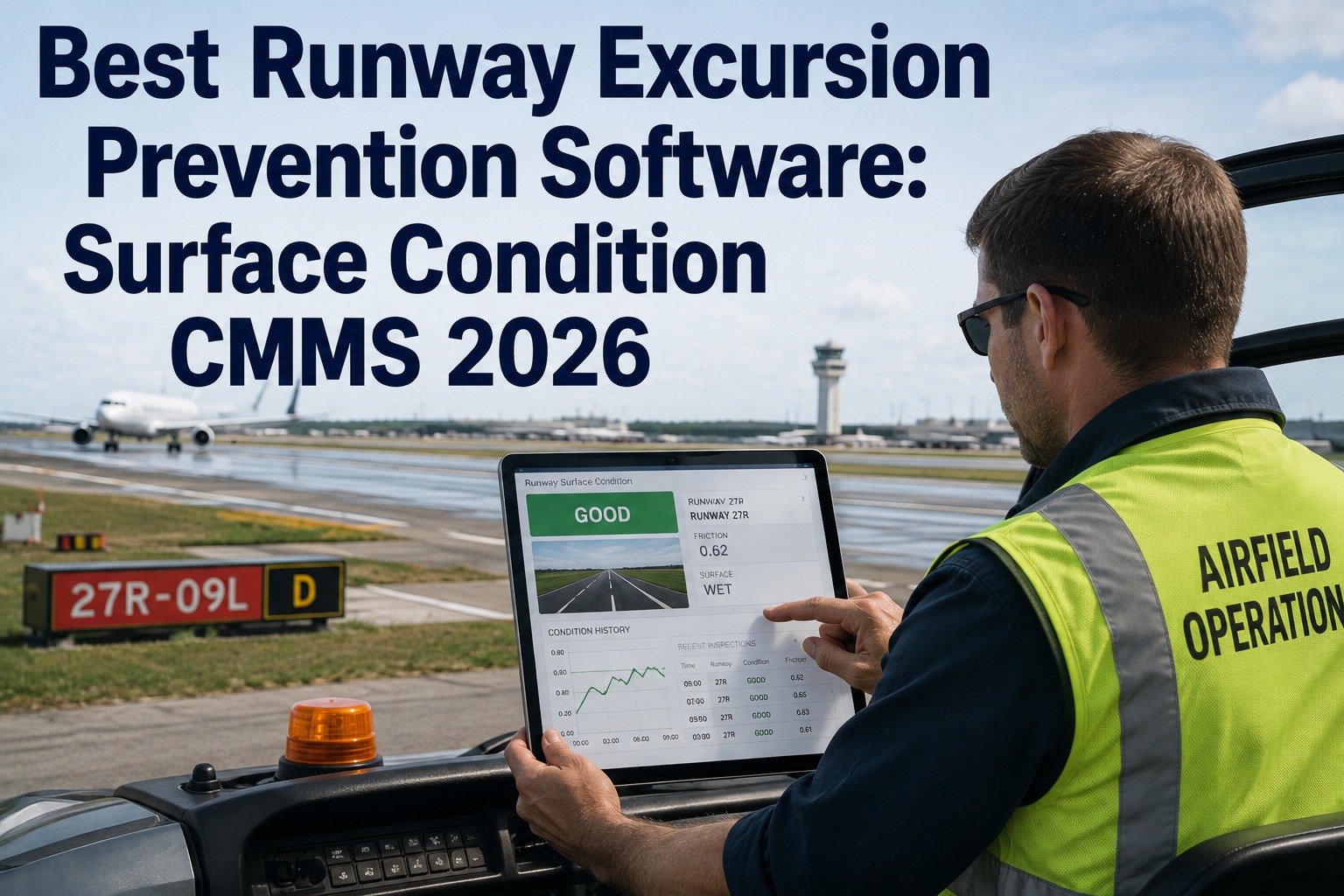
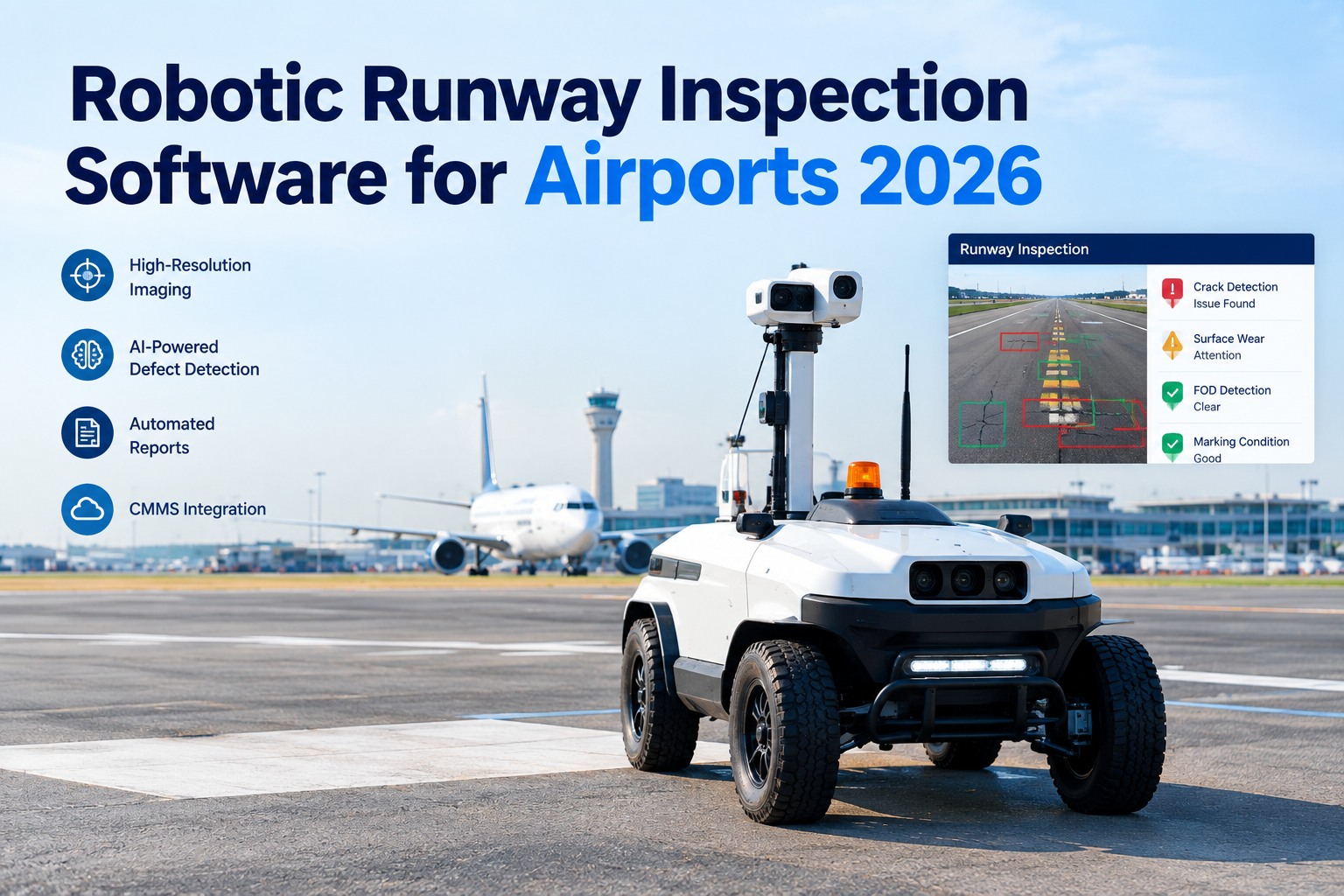
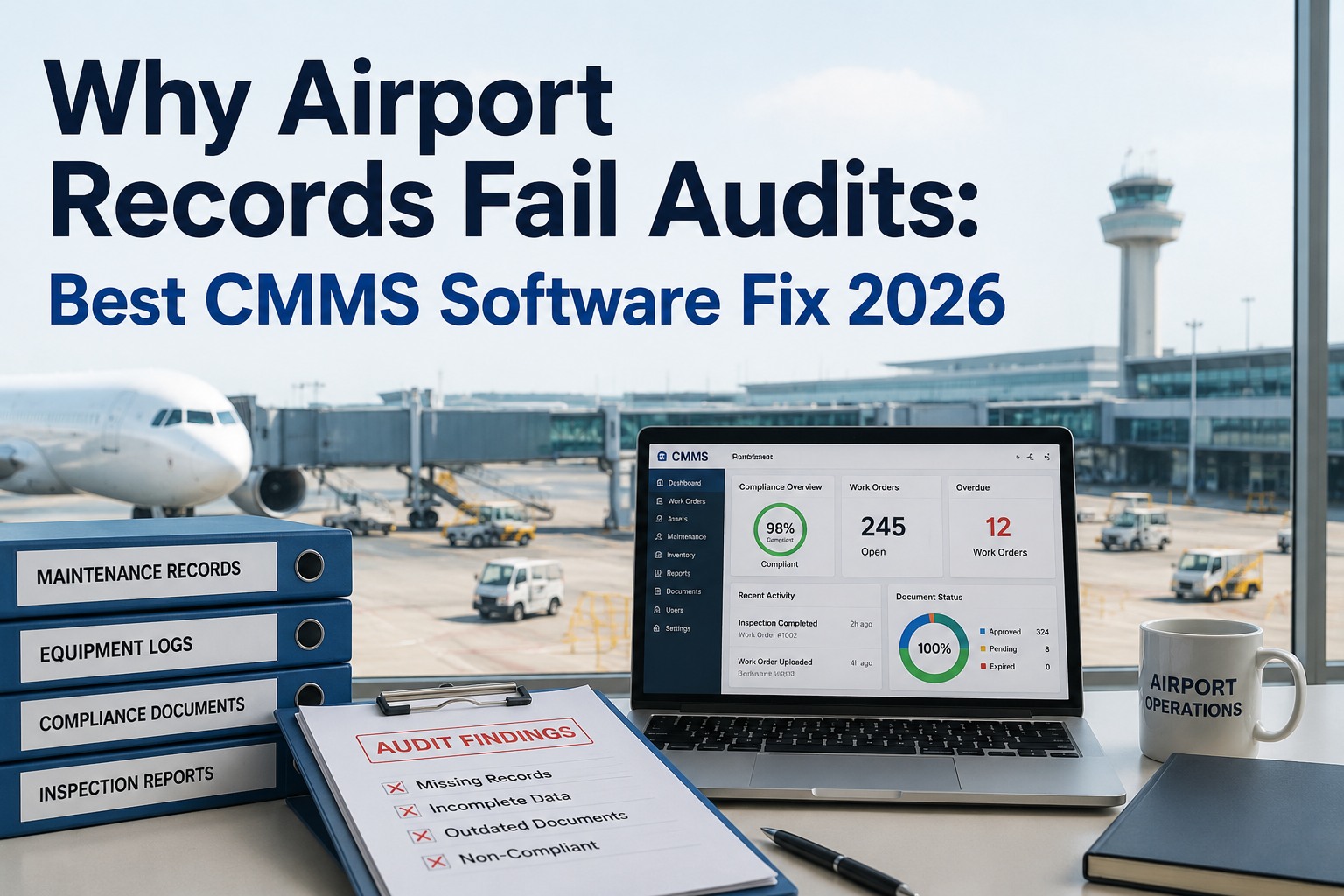
Runway excursions account for nearly a quarter of all runway safety accidents worldwide, according to IATA — and every single one of them traces back to a chain of decisions made on the ground before the wheels ever touched the pavement. The airport ops team assessed a runway third. The tower relayed a code. The dispatcher pulled a landing distance. The flight crew computed a stopping margin. When any link in that chain runs on paper, delay, or subjective judgement, the margin erodes silently — until the day it doesn't. Since November 2021, ICAO's Global Reporting Format has replaced the old Mu-value world with a harmonized methodology that connects observable runway surface conditions to aircraft braking performance through a shared Runway Condition Assessment Matrix. The best 2026 airport CMMS platforms operationalize that chain: assessment on mobile, RWYCC assignment by runway third, RCR generation, dissemination to tower and AIS, and immutable evidence of every decision. This playbook covers what to look for. Book a free demo to see the RCAM workflow against your airfield layout.
~25%
Share of all runway safety accidents attributable to runway excursions (IATA)
The Regulatory Baseline · Since November 2021
ICAO's Global Reporting Format (GRF) is the harmonized methodology for assessing and reporting runway surface conditions worldwide. Aerodrome operators use the Runway Condition Assessment Matrix (RCAM) to assign a Runway Condition Code (RWYCC 6–0) per runway third, then transmit the outcome as a Runway Condition Report to air traffic services and AIS for pilot dissemination.
The RCAM Code Scale · What the Software Must Encode
The Runway Condition Assessment Matrix defines seven Runway Condition Codes, from 6 (dry) down to 0 (wet ice or water on compacted snow). Every airport surface condition CMMS must encode this scale natively — not as free text, not as a translated legacy value, but as the exact ICAO/FAA codes pilots and dispatchers use in performance calculations. The colour and category structure below is what a modern platform surfaces on the assessment screen.
6
Dry
No visible contaminant · Full braking performance
5
Wet · Light Snow · Slush ≤3mm
Frost · slush ≤3mm depth · dry snow ≤3mm · wet snow ≤3mm
4
Compacted Snow · Cold Temp
Compacted snow at outside air temperature at or below −15°C
3
Wet Snow · Dry Snow >3mm
Wet snow >3mm · dry snow >3mm · compacted snow at >−15°C
2
Slush >3mm · Standing Water >3mm
Slush over 3mm depth · standing water over 3mm depth
1
Ice
Ice surface at any temperature — significant braking degradation
0
Wet Ice · Water on Compacted Snow
Braking action nil — landings and takeoffs may not be permitted
Runway Thirds · Why the Assessment Is Split, Not Averaged
An RCAM code is not a single value for the whole runway. It is three separate assessments — touchdown third, midpoint third, rollout third — because contamination is rarely uniform and stopping performance depends most heavily on the sections where braking work actually happens. The best software enforces this data model: three fields, three photos, three timestamps, three coded values, transmitted together as one RCR.
Touchdown Third
First contact · initial deceleration
Code A
Assess for water pooling, ice patches on approach lights zone, rubber deposit build-up
Midpoint Third
Sustained braking · steering
Code B
Assess for standing water in wheel tracks, contaminant depth variation, transverse slope drainage
Rollout Third
Final stopping · turn-off
Code C
Assess exit taxiway conditions, end-of-runway drainage, RSA/OFA surface integrity
Transmitted as one Runway Condition Report:
RWY 27L · 5 / 5 / 4 · Wet / Wet / Compacted Snow
The 9-Capability Framework · Runway Excursion Prevention Software
Airport ops leadership scoping runway surface condition software should score every candidate platform against nine specific capabilities. These aren't feature-checklist items — they are the operational functions that determine whether the RCAM chain from field assessment to pilot briefing is defensible, fast, and consistent across every shift and every season.
C01
Native RWYCC 6–0 Encoding
Codes are first-class fields in the data model — not free text, not translated legacy Mu values. Every entry validates against the ICAO scale.
C02
Per-Third Assessment Enforced
Assessment form requires all three thirds — touchdown / mid / rollout — with contaminant type, depth, and coverage per third. No partial submissions.
C03
Mobile Capture on the Airfield
Runway assessor logs on phone or tablet at the surface — photo per third, GPS-stamped, offline-tolerant for dead-zone areas of the airfield.
C04
RCR Auto-Generation
Runway Condition Report generated in seconds from the assessment — SNOWTAM-format ready, no re-typing to a separate system for tower dissemination.
C05
Tower / ATC / AIS Distribution
RCR pushes automatically to the duty officer, tower, and AIS interfaces — no phone-tag, no fax, no delay between field decision and pilot briefing.
C06
Pilot Braking-Action Ingest
Special Air Reports of braking action from landing crews feed back into the platform — if reported condition differs from assessed, the duty officer sees it immediately.
C07
Reassessment Trigger Rules
Weather change, downgraded pilot report, elapsed time — the platform prompts a fresh assessment automatically rather than relying on shift memory.
C08
Immutable RCR History
Every RCR version stored append-only with timestamp, assessor, weather snapshot, and photos. Post-incident timeline reconstruction is defensible.
C09
Part 139 / Annex 14 Audit Export
Filter by runway, date, season, condition code — export a defensible, signed, timestamped record for FAA Part 139 or ICAO Annex 14 audits in seconds.
Score Your Current Runway Assessment Workflow
30-minute walkthrough — bring your current runway assessment process, we'll walk it through the 9-capability framework and show what airport-grade software actually does end-to-end.
The Full RCAM Chain · Field Assessment to Pilot Briefing
The excursion-prevention value of good software isn't in any single feature — it's in what happens across the chain from an assessor kneeling on the pavement to a pilot reading an ATIS broadcast. The chain has six phases, and the software either compresses the time between them or introduces delay. Delay is what kills runway safety.
1
Trigger & Dispatch
Weather change, elapsed time, pilot report, or scheduled inspection triggers an assessment. Platform dispatches the runway assessor to the surface with the assessment form pre-loaded.
2
Field Assessment · Per Third
Assessor evaluates each third — contaminant type, depth, coverage percentage. Photos per third. GPS timestamps. Weather conditions auto-captured from the airfield METAR feed.
3
RWYCC Assignment
Platform maps observed conditions to the RCAM matrix and proposes a code per third. Assessor confirms or downgrades per procedure. Three codes captured together.
4
RCR Generation & Dissemination
Runway Condition Report auto-generates in SNOWTAM format. Pushes to tower duty officer, ATC, AIS in the same second. Pilots begin receiving updated info via ATIS.
5
Pilot Braking-Action Feedback
Special Air Reports from landing crews ingest into the platform. If reported braking differs from assessed condition, duty officer is alerted immediately for reassessment.
6
Immutable Record & Retention
Every RCR archived append-only with full evidence chain — assessor identity, timestamps, photos, weather, pilot feedback. Discovery-grade for post-incident review.
Contaminant Encoding · What the Assessment Form Must Capture
The RCAM code alone doesn't tell tower or crew what's actually on the pavement. The Runway Condition Report also carries contaminant type, depth, and percentage coverage per third — because a code of 3 due to dry snow behaves very differently on the aircraft from a code of 3 due to wet snow. The assessment form has to enforce all of it.
Contaminant Type
Depth Field
Coverage %
Notes on Impact
Water / Standing water
mm — 1/8 inch threshold
Per third
>3mm triggers RWYCC 2; hydroplaning risk elevated
Slush
mm — depth measured
Per third
≤3mm code 5; >3mm code 2 — rapid weather-driven change
Dry snow
mm — depth measured
Per third
≤3mm code 5; >3mm code 3 — subject to drift and re-accumulation
Wet snow
mm — depth measured
Per third
≤3mm code 5; >3mm code 3 — highest weight per mm depth
Compacted snow
Temp field required
Per third
Code 4 at ≤−15°C; code 3 warmer — temp-sensitive
Ice
Presence flag
Per third
Code 1 — significant braking degradation
Wet ice / water on compacted snow
Presence flag
Per third
Code 0 — landings/takeoffs may not be permitted
Frost
Presence flag
Per third
Code 5 — often overlooked at borderline temperatures
Adjacent Airside Safety Programs the Same Platform Should Handle
Runway surface condition is one node in a broader airside safety program. The best 2026 platforms handle the adjacent workflows on the same data model — because when an FAA Part 139 inspector arrives, they want to see the whole picture: FOD, wildlife, RSA/OFA integrity, rubber deposit control, and lighting inspection all traceable in one system.
FOD Program
Foreign object debris walks, discovery logs, root-cause tracking, corrective work orders per FOD zone
Wildlife Management
Bird and mammal strike reports, hazard patrols, deterrent activity logs, seasonal risk trending
RSA / OFA Integrity
Runway Safety Area and Object Free Area inspections, obstruction logging, corrective closure evidence
Rubber Deposit Control
Touchdown-zone friction monitoring, rubber removal scheduling, post-removal verification photos
Airfield Lighting
Circuit inspections, individual fixture outage tracking, NOTAM generation, replacement WO chain
Pavement Condition
PCI surveys, distress logging by station, crack sealing and joint repair work orders, long-trend charts
Expert Perspective · Where Runway Excursion Prevention Actually Wins
The airports that have measurably reduced runway excursion exposure share three habits. First, they moved the RCAM assessment off paper and onto mobile — because paper introduces a 20-to-40-minute delay between the observation and the pilot's ATIS briefing, and weather changes faster than that. Second, they enforced the three-thirds discipline in software — no averaged codes, no "the runway is 5" shortcuts, three real assessments transmitted together. And third, they closed the loop with pilot braking-action reports — if a landing crew reports braking worse than the assessment predicted, that report has to flow back to the duty officer in seconds, not appear in a monthly safety review three weeks later. The RCAM system itself is well designed; what fails is the operational chain around it. Software fixes the chain. The airports that treat runway condition as a live, mobile, per-third, closed-loop workflow are the ones whose landing distance calculations pilots can actually trust — and that trust is what makes the difference between a routine landing and an excursion.
Mobile Assessment
The gap between observation and ATIS broadcast shrinks from 30 minutes to under 3. Weather changes faster than paper can propagate.
Per-Third Discipline
Three real codes, not an average. The touchdown third and rollout third often disagree; the middle third is where braking actually happens.
Closed Braking-Action Loop
Pilot reports feed back into the platform in seconds. Assessment gets validated or reassessed while the next arrival is still on approach.
How OxMaint Runs the Runway Surface Condition Program
OxMaint delivers the RCAM chain as an integrated CMMS workflow — not a bolt-on module. Assessments live alongside the airside asset records, work orders auto-fire on findings, and the audit trail satisfies both FAA Part 139 and ICAO Annex 14 review without a records-scramble.
Assess
Mobile RCAM Assessment
Runway assessor logs three thirds on mobile — contaminant, depth, coverage, photo, GPS — offline-tolerant for airside dead zones
Code
Native RWYCC 6–0 Encoding
First-class ICAO code fields per third — no free text, no legacy translations. Codes validate against RCAM at entry time
Report
RCR Auto-Generation
Runway Condition Report generated in SNOWTAM-ready format the moment assessment is submitted — no re-typing anywhere
Distribute
Tower & AIS Push
RCR pushes to duty officer, tower interface, and AIS in the same operation — pilots receive updated ATIS in minutes not hours
Loop
Pilot Braking-Action Ingest
Special Air Reports feed back into the platform · alerts duty officer if pilot report differs from assessed condition
Retain
Append-Only Audit Trail
Every RCR immutable with full evidence chain · Part 139 / Annex 14 audit export in seconds by any filter
Close the RCAM Chain · Field to Pilot in Minutes
Stop losing time between the observation and the ATIS broadcast. See how OxMaint runs mobile RCAM assessment, RCR generation, tower push, and pilot braking-action loop on a single CMMS platform. Free forever plan available to trial the full workflow.
Frequently Asked Questions
What is the Global Reporting Format (GRF) and when did it come into effect?
The Global Reporting Format is ICAO's harmonized methodology for assessing and reporting runway surface conditions worldwide. It became globally applicable in November 2021 (delayed one year from the original 2020 date due to COVID-19). GRF replaces earlier methods like Mu-value friction reporting with a standardized process where aerodrome operators use the Runway Condition Assessment Matrix (RCAM) to assign a Runway Condition Code (RWYCC) per runway third, then transmit the outcome as a Runway Condition Report to air traffic services and AIS for pilot dissemination.
What do the Runway Condition Codes 6–0 actually mean?
RWYCC 6 is a dry runway with full braking performance. Code 5 is wet or light snow/slush ≤3mm. Code 4 is compacted snow at outside air temperature ≤−15°C. Code 3 is wet snow or dry snow >3mm depth. Code 2 is slush or standing water >3mm. Code 1 is ice. Code 0 is wet ice or water on top of compacted snow — braking action nil, and landings or takeoffs may not be permitted. Codes are issued per runway third, so a wet runway with compacted snow in the rollout would report as 5/5/4. ATIS normally broadcasts the RCC only when it drops to 5 or lower.
Sign up free to see the RCAM codes in the workflow.
Why does the RCAM assessment split the runway into thirds instead of giving one value?
Contamination is rarely uniform along a runway, and aircraft stopping performance depends on where in the roll the braking work happens. The touchdown third governs initial deceleration, the midpoint governs sustained braking, and the rollout governs final stopping and turn-off. Averaging the three loses critical information — a runway coded 5/5/4 behaves very differently from a runway coded 4/5/5, even though the average is identical. The GRF methodology enforces three separate codes for exactly this reason, and any surface condition CMMS worth deploying enforces the same discipline in the assessment form.
How is a pilot's braking-action report different from an RCAM assessment?
The RCAM assessment is done by the aerodrome operator from the surface — it maps observable contaminants to expected braking performance. A pilot braking-action report is done from the cockpit after a landing — it reflects actual experienced braking against expectation. When the two disagree, the reported condition takes precedence and triggers reassessment. The best 2026 platforms ingest Special Air Reports of braking action automatically and alert the duty officer within seconds so the assessment can be updated before the next arrival on approach.
Book a free demo to see the closed-loop feedback.
Is runway condition assessment software required by FAA Part 139?
FAA Part 139 requires certificated airports to have procedures for the safe and prompt reporting of pavement conditions, and RCAM adoption is required for all Part 139 airports. The regulation doesn't mandate a specific software platform, but it does require the documentation, personnel training, and NOTAM procedures — including wet-runway reporting for visible dampness or water ≤1/8 inch depth per FAA AC 150/5200-30D. In practice, meeting the documentation and dissemination timeliness expectations at scale is impractical on paper, which is why the shift to mobile-first CMMS platforms is now the operational standard rather than the exception.
Does OxMaint handle the broader airside safety program beyond runway surface condition?
Yes — OxMaint runs runway surface assessment alongside adjacent airside safety programs on the same CMMS data model: FOD walks and root-cause tracking, wildlife management and strike reports, RSA/OFA integrity inspections, rubber deposit control and touchdown-zone friction, airfield lighting inspection and NOTAM generation, and pavement condition surveys. Every program produces the same evidence chain — mobile capture, photo evidence, GPS timestamps, corrective work orders, immutable audit trail — so a Part 139 inspector sees the whole airside picture in one system. The free forever plan is available to trial the full workflow.
Sign up free to start with runway assessment.